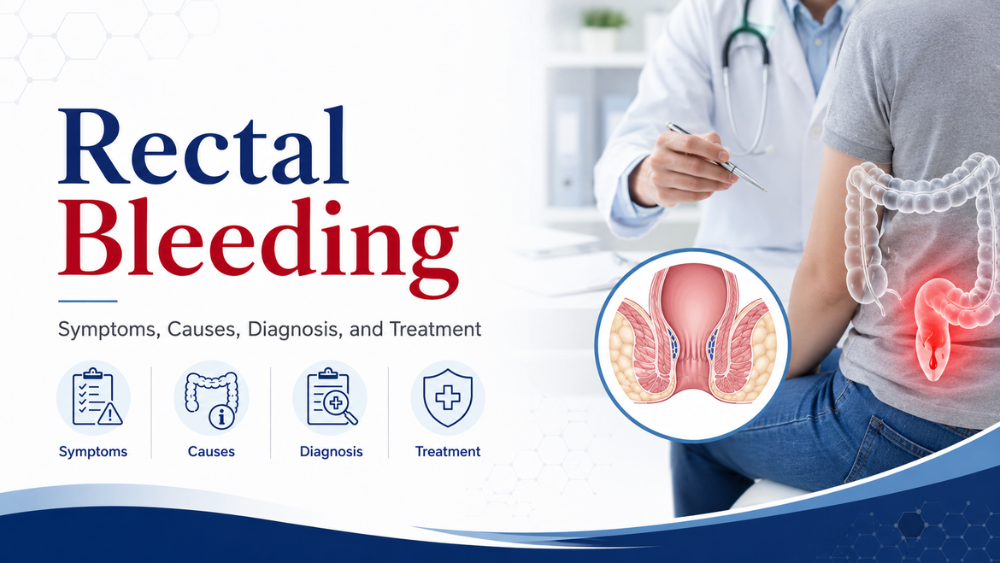
Rectal bleeding is any blood that appears during or after a bowel movement. It is very common, usually caused by piles or a small tear called an anal fissure, and most cases are safely treatable — but some need urgent evaluation to rule out polyps, inflammation, or colorectal cancer.
Quick Answer
Introduction
Seeing blood when you pass stool is frightening. Most patients who come to my clinic assume the worst — cancer. In reality, the vast majority of cases are caused by two simple, treatable conditions: piles and anal fissures. But a small number of patients do have something more serious, and knowing the difference can save your life. This guide will walk you through what rectal bleeding means, what causes it, when it is safe to watch and wait, and when you should see a surgeon right away.
What Is Rectal Bleeding?
Rectal bleeding is any blood that comes from the lower part of your digestive tract — the rectum or anus. You may notice it as bright red drops in the toilet bowl, streaks on toilet paper, blood mixed into your stool, or in rare cases as dark, tarry stool that looks almost black.
In medical terms, bleeding from this region is called hematochezia when the blood is bright red, and melena when it is black and tarry. The colour matters. Bright red usually means the source is close to the anus (piles, fissure, polyp, or rectal tumour). Black, tarry stool usually means the source is far higher up — the stomach or small intestine — and this is a medical emergency.
Common Symptoms Associated with Rectal Bleeding
Bleeding is a symptom in itself, but it rarely comes alone. The other symptoms that appear with it help identify the cause.
Mild, Usually Benign Patterns
- A few drops of bright red blood at the end of a bowel movement
- Streaks of red on toilet paper when wiping
- Mild anal itching or irritation
- A small, soft lump near the anus that comes and goes
- Sharp pain with a visible tear during stool (fissure)
Concerning Patterns That Need Prompt Evaluation
- Dark red or maroon blood mixed into the stool
- Black, sticky, foul-smelling stool (melena)
- Blood with mucus or pus
- A persistent lump at the anus that does not reduce
- Recurrent bleeding over several weeks
- Bleeding with tiredness, breathlessness, or pale skin
Common Causes of Rectal Bleeding
Here are the conditions I see most often at Sterling Hospital, grouped as benign causes and serious causes.
| Cause | Typical Pattern | Pain? |
|---|---|---|
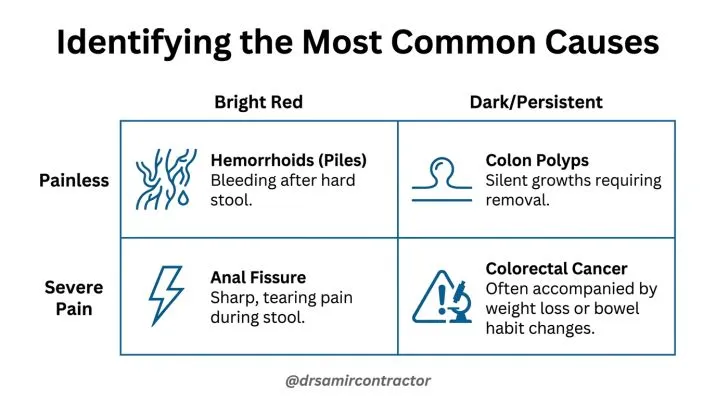
| Hemorrhoids (piles) | Bright red blood, drips after hard stool | Usually painless |
| Anal fissure | Streaks of bright red blood with sharp pain | Severe — "passing glass" |
| Colon polyps | Painless, sometimes dark red, may be mixed with stool | No pain |
| Colorectal cancer | Persistent bleeding with change in bowel habit or weight loss | Usually painless early |
| Diverticular disease | Sudden, large amount of red or maroon blood | Painless unless inflamed |
| Proctitis / colitis | Blood mixed with mucus, urgency, loose stools | Cramping often present |
| Upper GI bleeding | Black, tarry stool; sometimes vomiting blood | May have stomach pain |
1. Hemorrhoids (Piles)
Piles are swollen blood vessels inside or around the anus. They are by far the most common cause of bright red rectal bleeding. The classic pattern is painless bleeding at the end of a bowel movement. Piles often flare during pregnancy, after prolonged sitting, or in patients with chronic constipation.
2. Anal Fissure
A fissure is a small tear in the skin of the anal canal. Patients typically describe a sharp, tearing pain during stool followed by a burning sensation that lasts for hours. Fissures are strongly linked to constipation, hard stools, and chronic straining.
3. Colon Polyps
Polyps are small growths on the inner lining of the colon or rectum. Most are harmless, but some can turn into cancer over years. Polyps usually cause painless bleeding that may be mixed into the stool rather than on top of it. Painless bleeding in adults over 45 must always be investigated with a colonoscopy.
4. Colorectal Cancer
Cancer of the colon or rectum is the most serious cause of rectal bleeding. It tends to cause persistent bleeding, often with weight loss, a change in bowel habit, pencil-thin stools, or a feeling of incomplete evacuation. In my own practice I now see patients in their 40s and even 30s with it — so age is no longer reliable reassurance.
5. Diverticular Disease
Diverticula are small pouches that form in the wall of the colon, usually in people over 50. They can bleed suddenly and painlessly, often producing a large amount of dark red or maroon blood. Most stop bleeding on their own, but the episode needs medical review.
6. Inflammation (Proctitis and Colitis)
Inflammation of the rectum or colon — from infection, inflammatory bowel disease, or radiation — can cause bleeding mixed with mucus, along with cramping, urgency, and frequent loose stools.
7. Upper GI Bleeding
If you pass black, sticky, strong-smelling stool (melena), the bleeding is coming from higher up — usually a peptic ulcer, inflamed stomach lining, or varices in the food pipe. This is a medical emergency and needs urgent endoscopy.
Red Flags: When Should You Worry?
Seek urgent evaluation if rectal bleeding is accompanied by any of the following:
- Large amount of blood or clots in the toilet
- Black, tarry stool (melena)
- Vomiting blood or coffee-ground-like material
- Unexplained weight loss
- A change in bowel habits lasting more than 3 weeks
- Pencil-thin stools or a persistent feeling of incomplete evacuation
- Severe abdominal pain with bleeding
- Dizziness, weakness, or shortness of breath
- Family history of colorectal cancer or polyps
- Age above 45 with new-onset bleeding
Who Is at Higher Risk?
Some patients are more likely to develop bleeding or to have a serious cause behind it.
- Age: Over 45 — screening for colon polyps and cancer becomes important
- Diet: Low-fibre, refined-carb-heavy Indian diets dominated by maida and polished rice
- Fluid intake: Chronic dehydration, common in Gujarat summers
- Lifestyle: Prolonged sitting — drivers, office workers, IT professionals
- Constipation: Long-standing straining habits
- Pregnancy and postpartum: Piles and fissures are common
- Family history: Colorectal cancer or polyps in a first-degree relative
- Comorbidities: Obesity, diabetes, inflammatory bowel disease
- Medications: Blood thinners such as aspirin, clopidogrel, or warfarin
How Doctors Evaluate Rectal Bleeding
When a patient comes to my clinic with bleeding, my goal in the first visit is to answer three questions: Where is the blood coming from? Is it a benign cause like piles or fissure? Does the patient need a colonoscopy to rule out something more serious?
Clinical History
I ask about the colour, pattern, and frequency of bleeding. Pain or no pain? Constipation? Weight loss? Any family history of cancer or polyps? The answers narrow the diagnosis before examination.
Physical Examination
Examination of the perianal region and a gentle digital rectal examination identify most fissures and external piles. A proctoscope — a short, lighted tube — lets me see internal piles and the lower rectum directly. The examination is quick, respectful, and tells me a great deal.
Tests That May Be Needed
Not every patient needs every test. Investigations depend on age, symptoms, examination findings, and red flags. The tests I commonly order include:
- Proctoscopy / sigmoidoscopy — an office procedure that examines the lower rectum and anal canal
- Colonoscopy — a day-care procedure done under sedation that examines the entire large intestine. Gold-standard test for unexplained bleeding in adults over 45 or at any age with red flags.
- Upper GI endoscopy — if black stool, vomiting blood, or upper abdominal pain suggest a stomach or duodenal source
- Blood tests — hemoglobin, iron studies to check for chronic blood loss and anaemia
- Stool tests — occasionally used to detect hidden bleeding or infection
- Imaging — CT colonography or MRI pelvis in selected cases
Treatment Options for Rectal Bleeding
Treatment depends entirely on the underlying cause. That is why diagnosis must come first — self-medicating for piles when the real problem is a polyp or an early cancer can delay life-saving treatment.
Non-Surgical Management
- High-fibre diet with adequate water intake
- Stool softeners and isabgol (psyllium husk)
- Warm sitz baths for fissures and external piles
- Topical ointments for pain and healing
- Dietary modification and lifestyle correction
Laparoscopic and Minimally Invasive Procedures
- Laser hemorrhoidoplasty — a modern day-care procedure for Grade 2–3 piles, with minimal pain and same-day discharge
- Stapler procedure (MIPH) — for larger, prolapsing piles
- Rubber band ligation — office-based option for small internal piles
- Lateral internal sphincterotomy (LIS) — the definitive cure for chronic anal fissure
- Colonoscopic polypectomy — polyps are snared off during colonoscopy itself, preventing future cancer
- Laparoscopic colorectal resection — for colorectal cancer and selected non-malignant conditions, offering smaller incisions and faster recovery
When Surgery Is Needed
Surgery is recommended only when it is clearly indicated — never as a first option when conservative care can work. The typical indications are:
- Large or prolapsing piles that fail medical treatment
- Recurrent bleeding from piles despite diet and fibre
- Chronic anal fissure that has not healed after 6 to 8 weeks of conservative care
- Polyps discovered on colonoscopy that require removal
- Colorectal cancer
- Complications such as strangulated piles, perianal abscess, or torrential bleeding
What Happens If Rectal Bleeding Is Ignored?
Ignoring rectal bleeding rarely ends well, even when the cause is benign. Here is what can happen over time if different conditions go untreated.
- Piles: Chronic bleeding leads to iron-deficiency anaemia, fatigue, and breathlessness. Larger piles can thrombose — causing sudden, severe anal pain.
- Anal fissure: Acute fissures turn chronic and develop a sentinel tag. Pain worsens and often stops patients from eating normally because they fear the next stool.
- Polyps: Left in place over 5 to 10 years, certain adenomatous polyps can turn cancerous.
- Colorectal cancer: Early cancer is highly curable; advanced cancer is not. Every month of delay reduces the chance of cure.
- Inflammatory bowel disease: Untreated inflammation leads to scarring, strictures, and increased cancer risk.
- Upper GI bleeding: A bleeding ulcer can cause dangerous drops in blood pressure and require emergency intervention.
Good News About Most Bleeding
If you are under 45, otherwise healthy, and the bleeding is mild, painless, and clearly linked to constipation, it is most likely piles or a fissure. These are very treatable — often without surgery. But "most likely" is not "certainly," and a proper examination is the only way to be sure.
Recovery and What Patients Can Expect
Recovery depends on the treatment chosen. For most day-care procedures at Sterling Hospital, here is a realistic timeline.
First Week After Laser Piles or LIS Surgery
Diet After Surgery — Indian Context
When to Call the Doctor After Surgery
- Heavy bleeding that soaks a pad
- Fever above 38°C
- Inability to pass urine
- Severe pain not controlled by prescribed medication
Worried about rectal bleeding? One consultation can replace weeks of uncertainty.
India Relevance & Vadodara Care
Rectal bleeding is extremely common in Indian adults, and three local factors drive it.
Diet: Urban Indian diets are heavy in maida rotis, polished rice, and fried snacks — low in fibre. This leads to constipation, hard stools, and straining, all of which cause piles and fissures.
Dehydration: In Gujarat, summer temperatures above 40°C mean many patients are chronically dehydrated, which worsens constipation.
Delayed care: Cultural discomfort with anal symptoms means most Indian patients wait months before consulting a surgeon. Ayurvedic creams and over-the-counter ointments are often tried for years before a proper diagnosis is sought.
Younger colorectal cancer: Colorectal cancer is rising in India and now affects patients in their 30s and 40s more often than in Western populations. This means age-based reassurance is less reliable.
Postpartum piles: Very common in Indian women and often ignored. Early treatment prevents long-term problems.
Frequently Asked Questions
તમારી ભાષામાં સવાલો · Questions in Gujarati / Hinglish
Haa, evaluation karavu joiye. Majority cases piles ke fissure na chhe — jene easily treat kari shakay. Pan kharab cases — jeva ke polyp ke cancer — pan ha j symptom thi start thai. Ek consultation ma clarity ave.
Symptoms thi 100% farq karvo mushkel chhe. Piles ma typically painless bright red lohi ave chhe. Cancer ma persistent bleeding, weight loss, ke bowel habit ma change hoy. Exam ane colonoscopy thi j sachu answer male.
Bleeding stop thai gayu ema cause kharif thai gayo evu nathi — underlying piles, fissure, polyp ke inflammation present chhe. Recurrence = evaluation jaruri chhe.
Nai. Colonoscopy light sedation hetu thai chhe — patient sui jay chhe ane 30 minute pachi jagay chhe, ni pain ni memory thi. Sauthi difficult part prep (dava pive ni) chhe, pan e pan manageable chhe.
Jaruri nahi. Early piles ke acute fissure diet ane medicine thi heal thai jay chhe. Operation tyare j karvu jai jyare larger piles, chronic fissure, polyps, ke cancer hoy.
Haa, Grade 1-2 piles ma fibre, paani, sitz bath, ane ointment thi relief male chhe. Pan prolapsing ke recurrent bleeding hoy to surgery j permanent solution chhe.