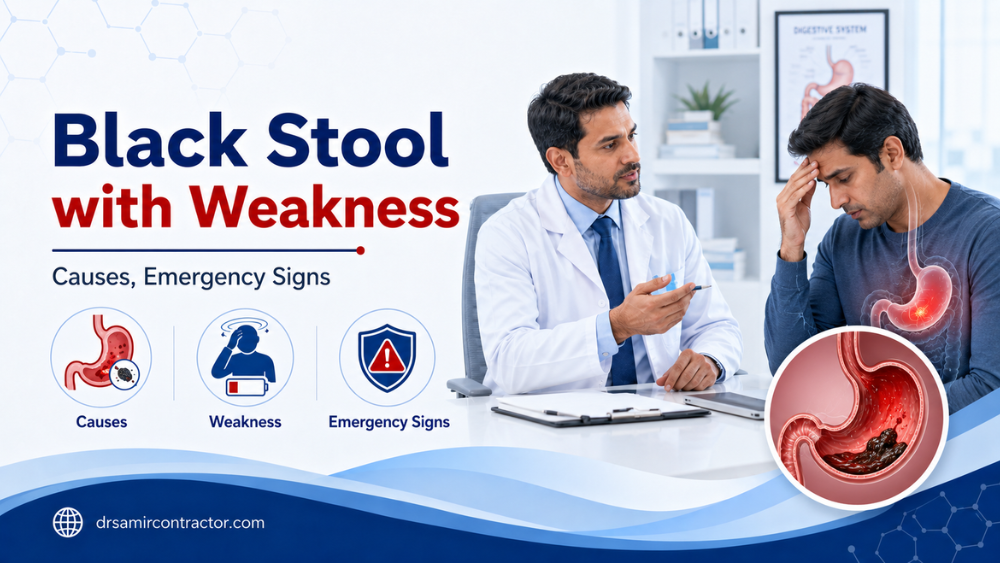
Black stool on its own can be harmless — iron tablets or dark foods are common causes. But when black stool appears together with weakness, dizziness, or fatigue, the picture changes completely. This combination points to active bleeding from the stomach or upper gut with enough blood loss to affect your body. It should be treated as a same-day emergency.
Quick Answer
You passed a black, sticky stool — and now you feel weak, lightheaded, or drained of energy. These two symptoms appearing together are not a coincidence. They are your body telling you that blood is leaving your circulation through a wound somewhere in your upper digestive tract, and that enough has been lost to matter.
This page explains why the combination is more significant than either symptom alone, what causes it, how to separate a true emergency from a benign iron-tablet scenario, and what happens when you reach hospital. It is designed for patients and families who need clear answers right now.
For a broader guide to black stool including all non-urgent causes, see our black stool (melena) page. For visible red blood, see blood in stool. This page focuses on the specific danger of the black stool + weakness cluster.
What This Combination Means
Black tarry stool — called melena — forms when blood from the oesophagus, stomach, or duodenum is broken down by stomach acid and intestinal bacteria as it passes through the gut. The digestion process converts red haemoglobin into a dark compound called acid haematin, which gives melena its characteristic black, sticky, foul-smelling appearance.
Weakness, dizziness, or fatigue that accompanies melena means one critical thing: enough blood has been lost from circulation to reduce your body's ability to deliver oxygen to tissues. This can happen acutely (a large bleed over hours) or gradually (a slow bleed over days to weeks that drops your haemoglobin steadily). Either way, your body is signalling that the blood loss is no longer trivial.
Why the Combination Is More Serious Than Either Symptom Alone
- Black stool alone could be iron tablets, bismuth, or dark food. No emergency if stool is firm and there are no other symptoms.
- Weakness alone has dozens of causes — poor sleep, viral illness, low sugar, thyroid problems, stress. Most are not urgent.
- Black stool + weakness together narrows the diagnosis sharply. In clinical practice, this combination is treated as active upper GI bleeding with haemodynamic significance until proven otherwise.
Common Causes of Black Stool with Weakness
Any condition that produces upper GI bleeding can cause this symptom pair. The weakness appears when blood loss crosses a threshold — typically more than 500 ml acutely or a haemoglobin drop below 8–9 g/dL over time.
| Cause | How It Bleeds | Who Is at Risk |
|---|---|---|
| Peptic ulcer (stomach or duodenal) | Ulcer erodes into an artery in the stomach or duodenal wall | NSAID users, H. pylori infected, smokers, alcohol drinkers |
| Erosive gastritis | Multiple shallow erosions bleed slowly but persistently | Painkiller overuse, alcohol, critical illness |
| Oesophageal or gastric varices | Dilated veins in patients with liver disease burst under pressure | Alcoholic liver disease, cirrhosis from any cause |
| Mallory-Weiss tear | A longitudinal tear at the gastro-oesophageal junction from forceful vomiting | Binge drinkers, patients with severe retching |
| Gastric or oesophageal cancer | Tumour surface ulcerates and bleeds, often slowly over weeks | Older adults, smokers, family history, chronic reflux |
| Dieulafoy lesion | A tiny, hard-to-see artery in the stomach wall bleeds intermittently | No typical risk profile; often diagnosed only at endoscopy |
| Blood-thinner related bleeding | Anticoagulants (warfarin, heparin) or antiplatelets (aspirin, clopidogrel) amplify a small bleed into a significant one | Cardiac patients, post-stent patients, those on long-term anticoagulation |
In India, peptic ulcer driven by NSAID overuse or H. pylori infection accounts for the largest share of cases presenting with black stool and weakness. Variceal bleeding from alcoholic liver disease is the second most common pattern in hospital emergency departments.
The Anaemia Connection: Why You Feel Weak
Weakness during GI bleeding is driven by anaemia — a fall in the number of red blood cells carrying oxygen through your body. When you bleed into the gut, the lost blood is not visible like a wound on the skin. The only external sign is black stool. Internally, however, your haemoglobin is falling.
Stages of Blood Loss and Symptoms
- Mild loss (up to 15% blood volume): You may feel slightly tired or notice your heart beating faster than usual. Blood pressure is still normal.
- Moderate loss (15–30%): Weakness becomes obvious. You feel dizzy when standing up (postural hypotension). Skin looks pale. Heart rate rises above 100.
- Severe loss (30–40%): Confusion, extreme weakness, cold sweaty skin, rapid shallow breathing. Blood pressure drops even while lying down.
- Life-threatening loss (>40%): Loss of consciousness, organ failure if not treated within minutes to hours.
A slow bleed is deceptive. The body compensates by constricting blood vessels and increasing heart rate. A patient can lose a third of their blood volume over several days and still walk into the clinic under their own power — only to collapse when compensation fails. This is why we do not use "how weak do you feel" as the only guide to severity. Blood tests and vital signs are essential.
Red Flags — Go to Hospital NOW
Go to the nearest emergency department immediately if black stool is accompanied by:
- Black tarry stool plus dizziness, lightheadedness, or fainting
- Vomiting blood or dark coffee-ground material
- Rapid heartbeat (pulse above 100) or feeling your heart pounding
- Cold, clammy, or sweaty skin
- Confusion or unusual drowsiness
- Passing out or nearly passing out when standing
- Black stool with weakness in a patient already on blood thinners (warfarin, aspirin, clopidogrel)
- Black stool with weakness in someone who drinks alcohol heavily or has known liver disease
- Breathlessness at rest or with minimal effort
- Repeated episodes of black stool over several days with worsening fatigue
Action: Do not drive yourself. Call 108 or have someone take you to the nearest emergency department. Do not eat or drink — you may need an urgent endoscopy.
When It Is Probably Not an Emergency (The Iron Tablet Scenario)
There is one common situation where black stool with mild tiredness is not a GI bleed:
- You are currently taking oral iron supplements (prescribed for known iron-deficiency anaemia)
- The stool is dark but firm — not tarry, not sticky, not shiny, and no unusual smell
- The weakness is improving day by day (because the iron is correcting your anaemia)
- There is no dizziness, no vomiting, no abdominal pain
Even in this scenario, if the tiredness worsens or new symptoms appear, stop the iron for 48 hours and see whether the stool returns to normal brown. If it stays black, get a blood test and evaluation. When in doubt, get checked — an unnecessary visit is always better than a missed bleed.
How Black Stool with Weakness Is Diagnosed
When a patient arrives in emergency with this combination, a structured workup begins immediately. Diagnosis and treatment often run in parallel because time matters.
Step 1: Rapid Clinical Assessment
- Vital signs — blood pressure (lying and standing), pulse, oxygen saturation
- Physical examination — pallor, abdominal tenderness, signs of liver disease
- History — medications (especially NSAIDs, aspirin, blood thinners), alcohol use, previous ulcer or liver disease, duration and frequency of black stool, severity of weakness
Step 2: Blood Tests
- Complete blood count (CBC): Haemoglobin level is the most critical number. Below 7 g/dL usually requires transfusion.
- Blood group and crossmatch: So blood is ready for immediate transfusion if needed.
- Kidney and liver function: To assess overall organ status and detect liver disease.
- Coagulation studies (PT/INR): Especially if the patient is on blood thinners or has liver disease.
- Stool occult blood test: Confirms that the dark colour is indeed due to blood, not food or medication.
Step 3: Upper GI Endoscopy
This is the definitive investigation. A thin, flexible camera is passed through the mouth into the oesophagus, stomach, and duodenum. In most cases it identifies the bleeding source within minutes. Importantly, the endoscopist can treat the bleed during the same procedure — using clips, thermal energy, injection therapy, or band ligation for varices.
Current guidelines recommend endoscopy within 24 hours of presentation for all patients with upper GI bleeding, and within 12 hours for those who are haemodynamically unstable (exactly the black stool + weakness group).
Treatment: Stabilise, Scope, Treat the Cause
Treatment follows a clear three-step sequence. In emergency settings, the first two steps often happen simultaneously.
1. Stabilise the Patient
- Large-bore IV access and rapid fluid resuscitation
- Blood transfusion if haemoglobin is below 7–8 g/dL or there are signs of shock
- Intravenous proton-pump inhibitor (PPI) infusion — high-dose to suppress acid and promote clot stability
- Correction of coagulopathy (reverse blood thinners if needed, with cardiology input)
- Monitoring in a high-dependency or ICU setting for severe cases
2. Endoscopy — Find and Stop the Bleed
- Peptic ulcer: Adrenaline injection around the ulcer base, thermal coagulation, or haemostatic clip placement
- Varices: Endoscopic band ligation (rubber bands placed around the dilated vein)
- Mallory-Weiss tear: Clip placement or observation if bleeding has stopped
- Erosive gastritis: Argon plasma coagulation for diffuse oozing areas
- Cancer: Temporary haemostasis followed by staging and surgical planning
3. Treat the Underlying Cause
- H. pylori eradication: 14-day course of two antibiotics plus a PPI. Confirmation testing after 4 weeks.
- NSAID cessation: Stop all painkillers. Switch to alternatives that do not damage the stomach.
- Long-term acid suppression: 4–8 weeks of PPI therapy to allow ulcer healing.
- Liver disease management: Beta-blockers for variceal prophylaxis, alcohol cessation support, hepatology referral.
- Surgical intervention: Rarely needed — reserved for uncontrolled bleeding, perforation, or confirmed cancer requiring resection. Laparoscopic approaches are preferred where possible.
What Happens If Black Stool with Weakness Is Ignored?
This is not a symptom pair that resolves on its own. Ignoring it carries real and escalating risks.
- Worsening anaemia. Each day of continued bleeding drops the haemoglobin further. A patient who felt mildly weak on Monday may be unable to stand by Friday.
- Haemodynamic collapse. A slow bleed can suddenly accelerate. An ulcer that was oozing can erode into a major artery and produce massive haemorrhage within minutes.
- Organ damage. The brain, heart, and kidneys are the first organs to suffer from low oxygen delivery. In older adults, even moderate blood loss can trigger a heart attack, stroke, or acute kidney injury.
- Missed cancer. Stomach cancer or oesophageal cancer may present initially with nothing more than black stool and fatigue. A 6-month delay in diagnosis can mean the difference between a curable and an incurable stage.
- Perforation. A bleeding ulcer can perforate through the stomach or duodenal wall, spilling contents into the abdomen. This is peritonitis — a surgical emergency with significant mortality.
- Rebleeding. An untreated bleeding source will bleed again. Each rebleed carries a higher risk of complications than the one before. Endoscopic treatment after the first episode reduces rebleed rates by 70–80%.
The single most effective action you can take is to reach a hospital within 12–24 hours of noticing black stool with weakness. A 20-minute endoscopy can identify the problem, stop the bleed, and set you on the path to full recovery.
India Relevance & Vadodara Care
Several factors make this symptom combination particularly dangerous for Indian patients.
- Widespread over-the-counter painkiller use. Diclofenac, ibuprofen, and combination tablets containing NSAIDs are available without prescription across India. Many patients take them daily for chronic joint pain, back pain, or headaches — without knowing the stomach damage they cause.
- Very high H. pylori rates. Community prevalence of H. pylori infection in India ranges from 60% to 80%. This is the single largest driver of peptic ulcer disease in the country, and most carriers are undiagnosed.
- Delayed presentation. Patients often attribute weakness to "low BP," poor diet, or stress. Black stool is managed with home remedies — jeera water, ajwain, antacid powders. By the time they reach hospital, haemoglobin may be 4–5 g/dL (less than a third of normal).
- Baseline anaemia, especially in women. Many Indian women already have haemoglobin levels of 9–10 g/dL from dietary iron deficiency. When upper GI bleeding is superimposed, they reach dangerous levels much faster.
- Alcohol-related liver disease. Rising alcohol consumption in Gujarat and across India is increasing the burden of variceal bleeding, which can be sudden and massive.
If you have black stool and feel weak — even mildly — do not wait. Go to a hospital with endoscopy facilities the same day. Do not rely on antacid syrups, home remedies, or "waiting to see if it improves." Early endoscopy is available, affordable, and saves lives.
Black Stool with Weakness? Act Today.
This combination should not wait. Dr Samir Contractor and the Sterling Hospital team provide same-day emergency endoscopy, on-site blood bank, and ICU-level care for upper GI bleeding.
Frequently Asked Questions
Related Pages on This Site
Medical Disclaimer: This page is intended for general health education and does not replace a face-to-face consultation with a qualified doctor. Every patient's situation is unique. If you are experiencing black stool with weakness, dizziness, or any symptoms described above, seek immediate medical attention at your nearest hospital. Do not make treatment decisions based solely on online content. Dr Samir Contractor and Sterling Hospital Vadodara are not responsible for outcomes arising from actions taken without an in-person clinical evaluation.