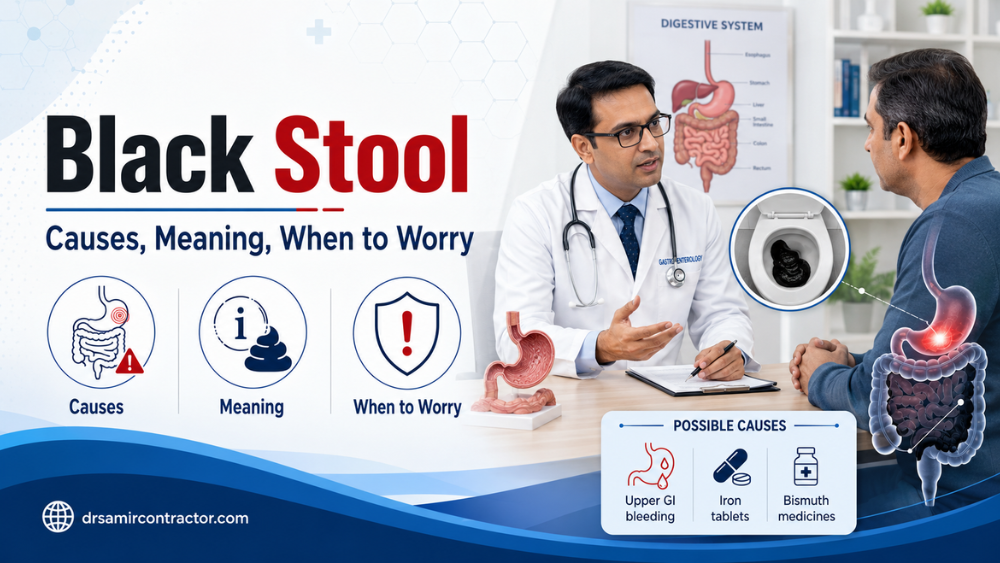
Black stool can be harmless (iron tablets, certain foods) — or the single most reliable sign of bleeding from the stomach or duodenum. This guide shows you how to tell the difference and what to do in the next 24 hours.
Quick Answer
Introduction
Most people only notice the colour of their stool for one reason — it has changed. A sudden black bowel movement is one of the most common reasons patients ask for an urgent appointment. The question is always the same: is this dangerous?
The honest answer is: sometimes yes, sometimes no. A sensible first step is to look at the stool itself rather than panic. Certain features reliably separate harmless causes from true medical emergencies. This page walks through that distinction, then explains what actually happens inside your gut when stool turns black, and finally the tests and treatments used in Vadodara.
This page is the companion to our blood in stool guide, which covers bright red and mixed bleeding, and our rectal bleeding guide for general triage. Black stool specifically points upward in the digestive tract — and that changes everything about the workup.
Why Stool Turns Black
The natural brown colour of stool comes from bile pigments that have been acted on by gut bacteria. Any process that changes this chemistry can alter the final colour. There are three main reasons stool appears black.
1. Digestion of Blood (Melena)
When blood leaves a vessel in the stomach, duodenum, or esophagus, it spends several hours travelling through roughly 25 feet of intestine. Stomach acid and digestive enzymes chemically modify the haemoglobin, producing a black pigment called acid haematin. By the time the blood reaches the rectum, the stool is black, sticky, and has a distinctive smell that experienced clinicians recognise immediately.
2. Iron and Bismuth
Oral iron tablets — prescribed for anaemia, pregnancy, or after bariatric surgery — turn stool from dark green to black. Bismuth salts, found in some antacid products, do the same. Both reactions are pure chemistry. The stool is usually firm, not tarry, and does not have the intense smell of digested blood.
3. Foods and Colours
Blueberries, black grapes, black liquorice, beetroot (in large quantities), dark leafy vegetables, and activated charcoal tablets can all darken stool transiently. The effect is harmless and resolves within a day or two of stopping the food.
Is It Iron — or Is It Bleeding? A Quick Comparison
✓ Usually Harmless (Iron / Food)
- Dark brown to matte black
- Normal firm or soft consistency
- No unusual smell — normal stool odour
- Does not stick to the pan
- You feel well; no weakness
- Started after a new iron tablet or specific food
- Clears within 1–2 days of stopping it
⚠ Likely Melena (See Doctor Today)
- Jet black, shiny, tarry
- Sticky — clings to the toilet pan
- Strong distinctive foul smell
- Accompanied by weakness or dizziness
- Pallor, rapid heartbeat, cold hands
- Vomiting blood or coffee-ground material
- History of ulcer, NSAIDs, or alcohol use
Causes of Melena (True Upper GI Bleeding)
When the workup confirms that the black stool is truly melena, the question becomes: where in the upper digestive tract is the bleeding coming from? The list below covers almost every case we see in practice.
| Cause | Typical patient | Other clues |
|---|---|---|
| Peptic ulcer (stomach or duodenum) | Middle-aged, NSAID user, H. pylori-positive, smoker | Burning epigastric pain, worse with empty stomach |
| Erosive gastritis | Heavy alcohol, chronic NSAIDs, severe stress | Nausea, upper abdominal discomfort |
| Esophagitis / reflux ulcers | Long-standing GERD, obese adults | Heartburn, chest burn, regurgitation |
| Mallory-Weiss tear | After repeated forceful vomiting | Vomiting first, then blood; often after alcohol |
| Esophageal varices | Cirrhosis, chronic liver disease | Large-volume bleeding, sometimes sudden collapse |
| Upper GI cancer (stomach / esophagus) | Older adults, weight loss, loss of appetite | Early satiety, anaemia, difficulty swallowing |
| Dieulafoy lesion / vascular malformation | Any age | Sudden painless brisk melena; can be elusive |
| Post-surgical or post-procedural | After endoscopic polypectomy, bariatric surgery, biopsy | Usually within 1–2 weeks of procedure |
Peptic Ulcer Disease — the Number-One Cause
In Indian adults presenting with melena, peptic ulcer accounts for the largest share of cases. Two forces drive it: Helicobacter pylori infection (which weakens the stomach lining) and chronic use of NSAIDs such as diclofenac, ibuprofen, and aspirin. Add regular alcohol or heavy smoking, and the risk multiplies. Many patients have had vague burning pain for months and dismissed it as "gas" or "acidity" before bleeding brings them in.
Erosive Gastritis
Inflammation of the stomach lining, often patchy, caused by NSAIDs, alcohol binges, severe physical stress (major surgery, burns, ICU admission), or rarely, autoimmune disease. Bleeding is usually less dramatic than ulcer bleeding but may present as melena with anaemia.
Esophagitis and Esophageal Ulcers
Long-standing acid reflux can erode the lining of the lower esophagus and occasionally cause chronic low-grade bleeding that shows up as iron-deficiency anaemia and dark stool. Untreated reflux is extremely common in Gujarat and deserves structured care — see our GERD page.
Bleeding Esophageal Varices
In patients with cirrhosis, increased pressure in the portal vein causes dilated veins to develop in the lower esophagus. If one bursts, the bleeding is large-volume and can be life-threatening. It usually presents as vomiting bright red blood followed by melena. Treatment is emergency endoscopy with band ligation.
Mallory-Weiss Tear
A common pattern in Vadodara: a patient has a heavy night of drinking or a viral illness with repeated vomiting, then notices blood streaks in the vomit followed by a black stool a day later. The forceful retching has torn the junction between the esophagus and stomach. Most heal on their own, but some need endoscopic treatment.
Upper GI Cancer
An important but less common cause. Stomach and esophageal cancers can bleed slowly and silently for months, producing anaemia and occasional dark stool, before more obvious symptoms appear. Weight loss, early fullness, and difficulty swallowing are warning signs.
Red Flag Signs — Go to Hospital Today
- Tarry, sticky, foul-smelling stool
- Vomiting blood — fresh red or coffee-ground material
- Weakness, dizziness, or fainting
- Pale skin, cold hands, rapid heartbeat
- Known history of ulcer, liver disease, or varices
- Recent use of NSAIDs, aspirin, or blood thinners
- Unexplained weight loss with dark stool
- Difficulty swallowing with dark stool
If any of the above apply, this is not a wait-and-watch situation. Go to a hospital emergency the same day.
Likely Harmless Scenarios
- Started iron tablets 1–3 days ago, no other symptoms
- Ate a large portion of blueberries, beetroot, or spinach
- Taking bismuth-containing antacids
- Dark stool but firm, no smell change, feel well
Even in these cases, if dark stool continues after stopping the suspect food or tablet for 48 hours, get a stool occult-blood test done.
How Doctors Confirm the Cause
The workup is focused, because melena is — by default — considered serious until proven otherwise. In Vadodara, we complete the key tests in under 6 hours for stable patients, and much faster for unstable ones.
Clinical Assessment
A careful history covers medicines (especially NSAIDs, aspirin, blood thinners, and steroids), alcohol, previous ulcer, liver disease, weight loss, and pain patterns. Examination measures pulse, blood pressure (including a lying-and-standing check), pallor, and signs of chronic liver disease.
Blood Tests
Haemoglobin measures the severity of blood loss, though it can be falsely reassuring in the first few hours. Kidney function, coagulation profile, liver function, and a blood group with cross-match are obtained early.
Upper GI Endoscopy
The single most important test. A thin flexible scope is passed through the mouth to examine the esophagus, stomach, and first part of the small intestine. It finds the source in 90% of cases and can treat it at the same time — banding a varix, injecting an ulcer, or clipping a tear. It is done under short sedation and usually takes 15–25 minutes.
Stool Occult Blood
When the picture is ambiguous — dark stool without other clues — a stool occult-blood or immunochemical test can confirm whether real blood is present, distinguishing iron and food effects from melena.
Other Tests
If endoscopy does not find the source, further imaging such as CT-angiography, tagged red-cell scan, or capsule endoscopy is used to hunt for small-bowel bleeding. Colonoscopy is done when the pattern turns out to be lower GI rather than upper.
Treatment Options
Treatment follows a simple sequence: stabilise first, find the cause, treat the cause, prevent recurrence.
Immediate Stabilisation
- Intravenous fluids to maintain blood pressure
- Blood transfusion if haemoglobin is below 7–8 g/dL or the patient is unstable
- Proton-pump inhibitors (PPIs) given intravenously — they reduce acid and promote clot stability
- Correction of any coagulation abnormality
- Admission to a ward or high-dependency unit based on severity
Endoscopic Treatment
- Ulcers: adrenaline injection, thermal coagulation, or haemostatic clips
- Varices: band ligation or sclerotherapy
- Mallory-Weiss tears: clip placement or simple observation
- Dieulafoy lesions: clip or injection therapy
Medical Therapy
- H. pylori eradication — a 14-day combination of antibiotics plus PPI cures the underlying infection in most ulcer patients.
- Long-term PPIs for erosive disease and reflux.
- NSAID cessation or modification — switching to safer pain relief where possible.
- Treatment of underlying liver disease and beta-blocker prophylaxis for varices.
Surgery
Surgery is reserved for patients in whom endoscopy cannot control the bleeding, who have a perforation, or who have a bleeding cancer requiring resection. Most of these procedures are now done by laparoscopy with small incisions, shorter stays, and faster recovery.
What Happens If Black Stool Is Ignored?
Unlike bright red bleeding — which is uncomfortable to look at but often minor — ignored melena tends to have serious consequences.
- Progressive anaemia. A slow ulcer can drop the haemoglobin from 14 to 7 g/dL over weeks. Patients become breathless climbing one flight of stairs.
- Recurrent acute bleeds. An untreated ulcer will bleed again. Each recurrence is statistically more dangerous than the one before.
- Perforation. An ulcer that bleeds can also perforate, leading to peritonitis — a true surgical emergency with high mortality if delayed.
- Missed upper GI cancer. Stomach cancer diagnosed after only anaemia and vague symptoms for 6 months has a much poorer prognosis than early disease.
- Complications in older patients. In adults over 70, even moderate blood loss can precipitate a heart attack, stroke, or renal failure.
A single 25-minute endoscopy done within 24 hours of a melena episode changes outcomes more than almost any other investigation in gastroenterology.
Why This Matters in India
Three patterns make black stool a particularly important symptom for Indian patients, especially in Gujarat.
- Rampant self-medication with painkillers. NSAIDs are sold over the counter without prescription. Tablets like diclofenac and ibuprofen are used daily for back pain, joint pain, and headaches. The stomach lining pays the price.
- High H. pylori prevalence. Studies show H. pylori infection rates above 60–70% in parts of India, much higher than in Western countries. This is a major driver of ulcer disease.
- Late presentation. Patients often take home remedies (jeera water, ajwain, aloo-jeera, antacid sherbets) for weeks before seeking medical care. While these soothe symptoms, they do not heal an ulcer or stop bleeding.
A simple rule for the Indian context: if you have had even one episode of black tarry stool, get an upper GI endoscopy within 48 hours — even if you feel fine now. Early detection is inexpensive, day-care, and often life-saving.
Frequently Asked Questions
ગુજરાતી માં પૂછાતા પ્રશ્નો (Gujarati / Hinglish FAQs)
Ha ane na — bey ni vache farak chhe. Iron ni goli ke blueberry thi kalu hoy to problem nathi. Pan chipaku, chamakdar, dhurgandh valu kalu stool hoy to ae melena chhe — aaj ne aaj hospital javu padshe.
Bilkul link chhe. Diclofenac, Ibuprofen, Aspirin — aa badha NSAIDs pet ni lining ne nukshan kare chhe. Ulcer thay, lohi pade, ane 6-8 kalak ma stool kalu thay. Painkillers band karo ane endoscopy karavo.
Ayurvedic dava lakshan shanta kari sake chhe, pan H. pylori no bacteria nashkarvo hoy to antibiotic j kaam ave chhe. Test karavo, pachi treatment nakki thay. Jeera-ajwain pani shanti apshe, pan bleeding band nahi kare.
Sedation ma thay chhe. Tamne kai yaad nathi rahetu. Bas ek chhota camera gale thi jaay, 15-20 minute ma thai jaay. Halka-fulka nashto sa'nje thi band karvo — evu ek j rule.
Turant hospital. 108 call karo ke koi vahan ma emergency ma pahonchao. Aa ek medical emergency chhe — lohi ni ulti pachi kalu stool pan ave, pan te evadhu rahevu na joiye. Pehli gadhi mahiti endoscopy ni j hoy.
Darubandi + ulti + lohi = Mallory-Weiss tear na chances vadhu chhe. Liver ma problem hoy to varices pan ho sake chhe. Bann kissa ma endoscopy thi confirm thay chhe. Ghar ma wait na karo.