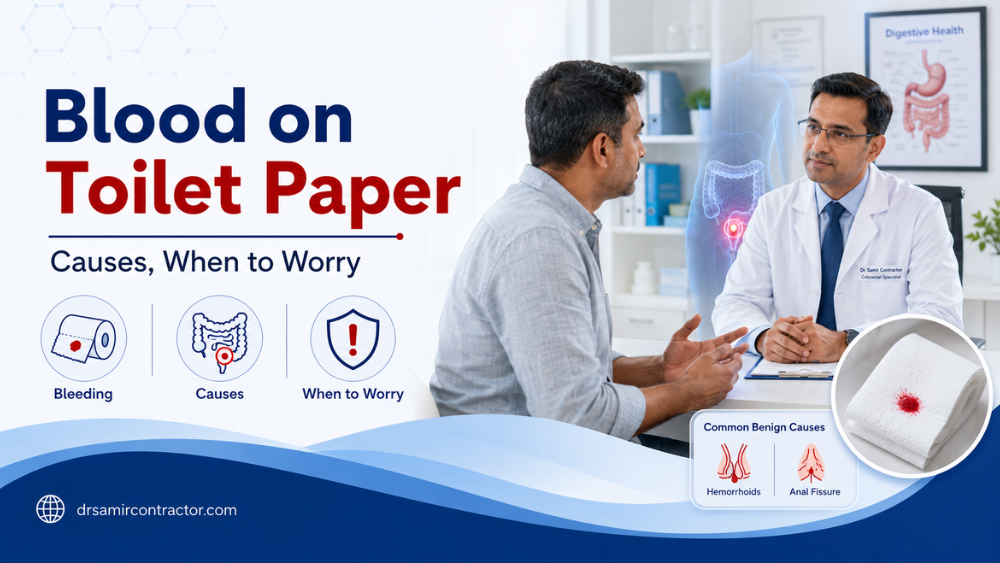
In simple terms: Noticing blood on toilet paper when you wipe is common and usually caused by piles (hemorrhoids) or a small tear near the anus. Most cases settle on their own — but if the bleeding keeps coming back or gets heavier, you should see a specialist to be safe.
Quick Answers — Blood on Toilet Paper
What Does Blood on Toilet Paper Actually Mean?
While this is the mildest presentation, it still deserves attention. Think of it as an early signal from your body. Addressing the cause now can prevent progression to heavier bleeding — the kind where you see drops in the toilet bowl or blood mixed into the stool.
In clinical terms, this is a low-grade form of hematochezia — fresh blood originating from the lower gastrointestinal tract, most often from the last few centimetres of the anal canal. Because the source is so close to the surface, the blood is bright red and minimal in volume.
While this is the mildest presentation, it still deserves attention. Think of it as an early signal from your body. Addressing the cause now can prevent progression to heavier bleeding — the kind where you see drops in the toilet bowl or blood mixed into the stool.
Common Causes of Blood on Toilet Paper
In my practice at Sterling Hospital, Vadodara, the vast majority of patients who come in reporting blood on tissue paper have one of these conditions:
1. Hemorrhoids (Piles)
Swollen blood vessels inside or around the anus are the single most common cause. Internal hemorrhoids are painless and often produce a small streak of blood during wiping. This is the classic "blood on paper but no pain" scenario. Read more about hemorrhoids — symptoms and grades.
2. Anal Fissure
A small tear in the lining of the anus, usually caused by passing a hard stool. A fissure typically produces blood on the paper along with a sharp, stinging pain during or after passing stool. Learn more about anal fissures.
3. Constipation and Straining
Hard stools that require excessive pushing can scratch the delicate anal lining. The blood is minimal — just enough to show on the tissue. Increasing dietary fibre and water intake usually resolves this within days.
4. Minor Perianal Skin Tears
Vigorous or rough wiping, especially with dry toilet paper, can cause tiny abrasions on the perianal skin. These heal quickly but can produce a faint pink or red mark on the tissue.
5. Rectal Polyps
Small growths on the inner lining of the rectum can sometimes cause trace bleeding noticed only during wiping. Polyps are usually benign but should be evaluated, especially in patients over 40.
6. Proctitis or Inflammatory Conditions
Inflammation of the rectal lining — from infections, inflammatory bowel disease, or radiation therapy — can present as blood on the paper, sometimes with mucus.
7. Less Common Causes
Rectal prolapse, solitary rectal ulcer syndrome, and (rarely) early-stage colorectal conditions can occasionally first appear as trace blood on toilet paper. These are uncommon but worth mentioning for completeness.
Red Flags — See a Doctor Soon
- Blood on toilet paper for more than 1 week without improvement
- Amount of blood increasing over days — progressing from a streak to drops
- Blood that is dark red, maroon, or black
- Bleeding accompanied by persistent abdominal pain
- Unintentional weight loss or appetite change
- Mucus, pus, or unusual discharge along with blood
- A family history of colorectal cancer or polyps
- Age over 40 with new-onset blood on paper
- Associated change in bowel habit (new diarrhoea, narrower stool)
Signs It's Likely Not Serious
- Blood is bright red and only on the paper — not in the bowl or stool
- It happens after a hard stool or straining episode
- There is no pain, or only a brief sting that settles quickly
- The episode is isolated or occurs only occasionally
- You are under 40 with no family history of bowel disease
- Symptoms improve within 3–5 days with fibre, water, and sitz baths
How Is Blood on Toilet Paper Diagnosed?
When you visit a specialist for this symptom, the evaluation is straightforward and not something to dread:
- Detailed history: Your doctor will ask about the colour, amount, frequency, associated pain, dietary habits, and family background.
- External examination: A visual inspection of the perianal area to check for external piles, fissures, skin tags, or other visible causes.
- Digital rectal examination (DRE): A brief, gloved-finger examination to feel for internal hemorrhoids, masses, or tenderness. This takes seconds and causes minimal discomfort.
- Proctoscopy: A short, slender instrument is used to look inside the anal canal. It provides a clear view of internal hemorrhoids and low-lying fissures.
- Colonoscopy (if indicated): Recommended for patients over 40, those with red flags, or when the cause isn't clear from the initial examination. A flexible camera examines the entire colon. Learn more about colonoscopy.
In the majority of patients with only blood on toilet paper, the diagnosis is confirmed within the first visit itself — no lengthy investigations needed.
Treatment Options
Treatment depends entirely on the underlying cause. Here is the typical approach:
Conservative / Home Treatment (Mild Cases)
- Fibre supplementation: Isabgol (psyllium husk) — 1–2 teaspoons in water at night — softens stool and reduces straining
- Hydration: Aim for 2.5–3 litres of water daily
- Sitz baths: Sit in warm water for 10–15 minutes, 2–3 times a day, to soothe the anal area
- Gentle wiping: Use soft, moist tissue or water instead of rough dry paper
- Avoid prolonged sitting on the toilet — limit to 5 minutes
Medical Treatment
- Topical creams and ointments: For hemorrhoids (containing lignocaine or steroids) or fissures (GTN / diltiazem ointment)
- Stool softeners: Lactulose or polyethylene glycol for persistent constipation
- Antibiotics or anti-inflammatories: If proctitis or infection is the cause
Surgical Treatment (When Needed)
Surgery is considered only when conservative measures fail or the condition is advanced:
- Hemorrhoid surgery: Minimally invasive options include stapled hemorrhoidopexy and laser treatment. Open hemorrhoidectomy for advanced grades. See hemorrhoid surgery options.
- Fissure surgery: Lateral internal sphincterotomy — a small procedure with excellent results. See fissure surgery details.
- Polypectomy: Polyps found during colonoscopy can be removed during the same sitting.
What Happens If Blood on Toilet Paper Is Ignored?
Because this symptom is so mild, many people dismiss it — sometimes for months or even years. Here is what can happen when it goes unchecked:
- Hemorrhoids can progress: Grade I piles (bleeding only) can advance to Grade III or IV, where they prolapse and may require surgery.
- Fissures can become chronic: An acute fissure that heals in weeks can become a chronic fissure with a sentinel tag, requiring surgical correction.
- Anaemia from slow blood loss: Even small, repeated bleeding can reduce haemoglobin over time — leading to fatigue, weakness, and breathlessness.
- Underlying conditions go undetected: In rare cases, blood on paper can be the earliest sign of a polyp or growth that is best treated early.
- Anxiety and avoidance: Many patients develop toilet anxiety, avoid eating properly, or skip meals to reduce bowel movements — all of which worsen the problem.
The key message: Blood on toilet paper is usually not dangerous — but ignoring it repeatedly removes your opportunity to fix a simple problem before it becomes a complex one.
Why This Matters in India
Anorectal problems are remarkably common in India, yet most patients wait far too long before seeking help. Several factors contribute:
- Dietary patterns: High intake of refined flour (maida), low-fibre diets, excessive spicy food, and inadequate water intake — particularly common in Gujarat — increase constipation and straining.
- Stigma and embarrassment: Discussing bleeding "from down there" remains taboo in many families. Many patients, especially women, suffer in silence for years before consulting a doctor.
- Reliance on home remedies: Applying coconut oil, ghee-based preparations, or unverified ayurvedic formulations may provide temporary comfort but can mask a progressing condition.
- Sedentary work habits: Prolonged sitting — whether at office desks, during long commutes, or while using mobile phones on the toilet — significantly increases pressure on the anal cushions.
- Late presentation: Many Indian patients present to a surgeon only when piles have reached Grade III–IV or a fissure has become chronic. Early-stage bleeding on toilet paper is exactly the right time to intervene.
If you are reading this page, you are already taking the right step. A 10-minute consultation can provide clarity and save you from months of unnecessary worry.
Ready to get answers? Book your consultation with Dr. Samir Contractor today.
Frequently Asked Questions — Blood on Toilet Paper
? Gujarati & Hinglish FAQs — Blood on Toilet Paper
A: ગભરાવાની જરૂર નથી. મોટાભાગે આ પાઇલ્સ કે ફિશર ના કારણે હોય છે. પણ જો 3-4 દિવસ ચાલુ રહે, તો ડૉક્ટરને બતાવો.
A: Zyaadatar cases mein yeh piles ya chhoti si fissure ki wajah se hota hai — serious nahi. Lekin agar baar baar ho raha hai ya amount badh raha hai, toh doctor ko dikhao.
A: પેપર પર લોહી હળવું (mild) છે — બહારની સપાટી પરથી આવે છે. ટોઇલેટ બાઉલમાં ટીપાં પડે તો થોડું વધારે bleeding છે. બંને ચેક કરાવવા જોઈએ, પણ બાઉલમાં લોહી હોય તો જલ્દી બતાવો.
A: Isabgol raat ko paani mein lelo, din mein 3 litre paani piyo, aur warm paani mein 10-15 minute baitho (sitz bath). 3-5 din mein theek nahi ho toh doctor ke paas jao.
A: ખૂબ જ ભાગ્યે જ. 40 વર્ષથી ઓછી ઉંમરમાં આ લગભગ ક્યારેય કેન્સર નથી હોતું. પરંતુ 40+ ઉંમર હોય અને family history હોય, તો colonoscopy ચોક્કસ કરાવો.
A: Dr Samir Contractor, Sterling Hospital, Vadodara. Appointment 1-2 din mein mil jaati hai. Pehli visit mein hi diagnosis ho jaata hai. WhatsApp pe bhi contact kar sakte ho — 9824593464.