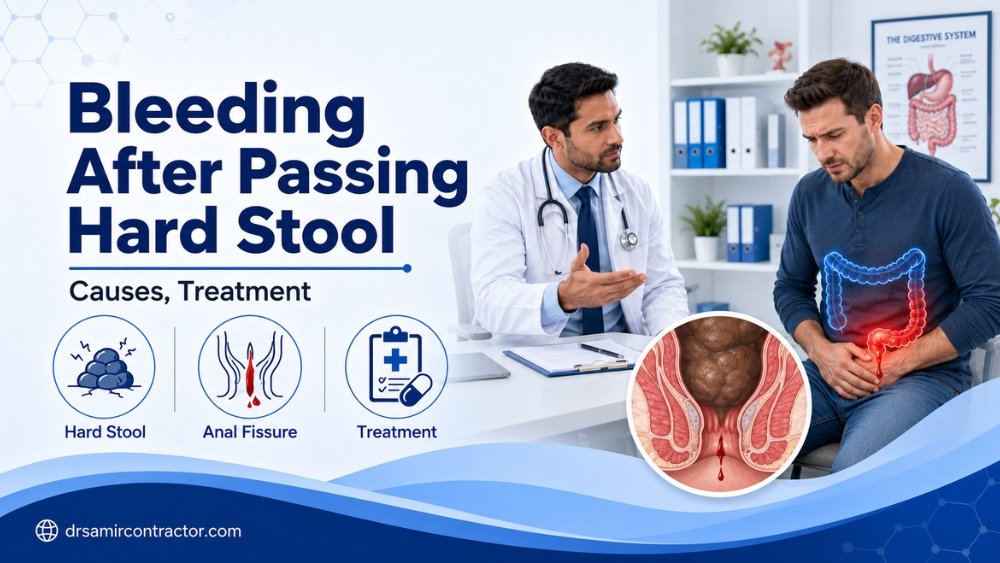
You struggled to pass a hard, dry stool - and then noticed blood. This is one of the most common reasons patients search for anorectal symptoms online. In almost every case, the hard stool itself is the direct cause of the bleeding. It physically tears the anal lining or damages swollen blood vessels on its way out. The good news: the fix is usually straightforward - soften the stool with fibre and water, and the bleeding stops.
Quick Answer
The moment you see blood after a painful bowel movement, your mind races to the worst possibilities. But step back and think about what just happened mechanically: a dry, compacted mass forced its way through a narrow canal lined with thin, blood-rich tissue. That physical trauma - not disease - is almost always the explanation.
This page focuses specifically on the acute hard-stool event - you passed one hard stool and it bled. If you are dealing with a longer pattern of constipation and bleeding over weeks, our guide on blood in stool with constipation covers that broader picture. If you want to understand all possible colours and causes of blood in stool, start with our blood in stool guide.
How a Hard Stool Causes Bleeding: The Mechanical Trauma
What Happens Inside the Anal Canal
The anal canal is approximately 3-4 cm long. It is lined by a thin layer of tissue called the anoderm, which has a rich blood supply but almost no protective mucus coating. Just beneath this lining sit three vascular cushions - spongy pads filled with blood vessels - that help with continence.
When stool is soft, it passes through this canal with minimal friction. But when stool is hard, dry, and compacted, two forms of damage occur simultaneously:
- Direct tearing (Anal Fissure): The hard stool mass is wider and rougher than the canal can stretch comfortably. It cracks the anoderm like dry ground splitting under pressure. This linear tear - an anal fissure - exposes the raw tissue beneath, which bleeds bright red and hurts sharply.
- Vascular engorgement (Hemorrhoids): To push the hard mass out, you strain. Straining raises abdominal pressure, which forces blood into the anal vascular cushions. They swell, the overlying tissue thins, and the surface breaks - releasing painless bright red blood that drips or splashes into the bowl.
The critical point: In both cases the hard stool is the trigger. Remove the hard stool from the equation - by softening it permanently - and the tissue heals itself. This is why fibre and water are the first-line treatment, not medicines or surgery.
What Causes the Hard Stool in the First Place?
Before treating the bleeding, it helps to understand why the stool was hard. Common reasons include:
- Low fibre intake: A diet heavy in maida (refined flour), white rice without dal or sabzi, packaged snacks, and biscuits produces compact, dry stool.
- Not drinking enough water: The colon absorbs water from stool as it passes through. If you are dehydrated, the colon absorbs more, leaving the stool hard and pellet-like.
- Ignoring the urge: When you suppress the urge to go - because you are at work, travelling, or uncomfortable using a public toilet - the stool sits longer in the colon, loses more water, and hardens.
- Medications: Iron tablets, calcium supplements, certain painkillers (tramadol, codeine), and some antacids cause constipation as a side effect.
- Sedentary routine: Physical inactivity slows intestinal transit, giving the colon extra time to dry out the stool.
- Excessive tea or coffee: Moderate amounts are fine, but 5-6 cups per day act as diuretics, pulling water from the body and contributing to harder stool.
Causes of Bleeding After Hard Stool
The hard stool is the trigger, but different structures get damaged. The table below outlines the possibilities from most common to least common.
| Cause | How hard stool triggers it | Bleeding pattern | Key clue |
|---|---|---|---|
| Anal fissure (most common) | Hard stool physically tears the anal lining | Bright red streaks on stool surface or toilet paper | Sharp, cutting pain during and after stool that lasts minutes to hours |
| Hemorrhoids (piles) | Straining engorges anal vascular cushions; hard stool abrades their surface | Painless bright red drips or splash in the bowl | Soft lump at anus, itching; develops with repeated straining episodes |
| Mucosal abrasion | Hard stool scrapes the rectal mucosa without creating a full fissure | Small amount of blood mixed with mucus on stool | Mild discomfort, resolves quickly without treatment |
| Rectal prolapse (partial) | Severe straining pushes rectal tissue outward, which then bleeds | Blood with mucus, tissue visible at anus after straining | Feeling of something "coming out" during bowel movement |
| Solitary rectal ulcer (SRUS) | Chronic straining causes ulceration of the rectal wall | Blood and mucus, often with incomplete evacuation | Persistent straining pattern over months |
| Pre-existing polyp | Hard stool passing over a polyp can traumatise its surface | Dark red or occult blood | Often found incidentally on colonoscopy; age over 40 |
Fissure vs Piles: Quick Distinction
Patients often ask whether the bleeding came from a fissure or from piles. A practical guide:
- Fissure: Pain is the dominant feature. Sharp pain starts during stool passage and continues for 30 minutes to several hours afterward. The bleeding is usually small volume - streaks on paper or stool surface. Often triggered by a single hard stool episode.
- Piles: Bleeding is the dominant feature, with minimal or no pain. Blood drips into the bowl or is seen when wiping. A soft lump may be felt at the anus. Develops gradually over weeks of repeated straining.
- Both together: Very common. A patient with existing grade 1-2 piles passes a hard stool that also produces a small fissure. The result is bleeding with pain. A clinical exam clarifies the picture in minutes.
Red Flags - See a Doctor Promptly
- Bleeding continues even after stools have become soft for two weeks
- Blood is dark red, maroon, or black rather than bright red
- Blood is mixed inside the stool, not just on the surface
- Mucus or pus accompanies the blood
- Unintended weight loss - more than 3 kg in a month
- Persistent change in stool calibre - thin, ribbon-like stools
- Heavy bleeding that fills the bowl or makes you feel dizzy
- Anaemia found on a blood test (low haemoglobin)
- Family history of colorectal polyps or cancer
- You are over 40 with new-onset bleeding, even if bright red
Signs That Point to a Simple Cause
- Bright red blood only on toilet paper or stool surface
- Bleeding started immediately after struggling with a hard stool
- Small volume - a few streaks or drops, not a flow
- Bleeding stops once stool becomes soft in the following days
- No weight loss, no appetite change, no anaemia
- Age under 35 with no family history of colon cancer
Even when all signs are reassuring, a single evaluation by a surgeon confirms the diagnosis and gives you confidence that nothing has been missed.
How Is It Diagnosed?
If you visit a surgeon for bleeding after hard stool, the evaluation is quick and straightforward:
- History: The surgeon asks about stool consistency, frequency, pain pattern, blood colour, diet, water intake, medications, and family history. This alone narrows the possibilities significantly.
- External examination: A visual inspection of the anal area often reveals a fissure at the posterior midline, an external pile, or a skin tag from a healed old fissure.
- Digital rectal exam: A gentle finger examination checks for internal masses, sphincter tone, and tenderness. In acute fissure with severe spasm, this may be deferred.
- Proctoscopy: A short, thin scope passed into the lower rectum in the clinic. Takes under two minutes. Shows internal piles, low rectal lesions, or confirms the fissure position.
- Blood tests: A complete blood count checks haemoglobin levels. If constipation is chronic and unexplained, thyroid function may be tested.
- Colonoscopy: Reserved for patients over 40, those with persistent bleeding despite soft stools, those with red flags, or those with a family history. It examines the entire colon and can remove polyps in the same sitting.
In a young patient with a clear fissure following a hard stool episode, proctoscopy alone is sufficient. No further tests are needed unless the situation changes.
Treatment: Soften the Stool, Heal the Wound
Because the hard stool caused the bleeding, the treatment centres on making sure the next stool - and every stool after that - is soft. The wound heals on its own once the repeated trauma stops.
Step 1: Indian Dietary Fibre Plan
The goal is 25-30 grams of fibre per day from everyday Indian foods. You do not need imported supplements or specialty health foods. Here is a practical daily plan:
| Meal | What to eat | What to reduce |
|---|---|---|
| Breakfast | Whole wheat paratha with curd, or vegetable poha, or oats chilla. Add one banana or a bowl of papaya. | White bread (maida), cream biscuits, instant noodles |
| Lunch | 2 whole wheat roti + 1 bowl dal (moong, masoor, or chana) + 1 bowl green sabzi (bhindi, palak, lauki, turai) + raw salad (cucumber, carrot, radish, beetroot) | Polished white rice alone without dal or sabzi, fried farsan |
| Evening snack | Sprouts chaat, roasted chana, or a seasonal fruit (guava, pear, apple with skin, orange) | Samosa, kachori, vada pav, packaged chips |
| Dinner | 2 roti + lighter sabzi (lauki, tinda, parval) + small bowl dal or kadhi. A handful of salad on the side. | Heavy paneer gravy, excessive ghee, maida-based naan or rumali roti |
| Before bed | 1 teaspoon sat isabgol (psyllium husk) stirred into a full glass of warm water or milk | Late-night tea or coffee (dehydrates stool overnight) |
Water is not optional. Fibre works by absorbing water to form a soft gel. Without enough fluid - at least 8-10 glasses per day - extra fibre can actually bulk up the stool without softening it, making things worse. Drink water throughout the day, not just with meals. Keep a bottle at your desk and sip regularly.
Step 2: Sat Isabgol (Psyllium Husk)
Sat isabgol is the single most effective natural stool softener available in India. It is inexpensive (a few rupees per dose), available at every medical store, and safe for daily long-term use. Take 1-2 teaspoons in a full glass of water or warm milk at bedtime. It forms a gel overnight, and most patients pass a soft stool the next morning. Continue daily for at least 4-6 weeks while the fissure or damaged tissue heals completely.
Step 3: Sitz Bath and Topical Care
A warm sitz bath - sitting in a tub or basin of warm water for 10 minutes, twice daily - relaxes the anal sphincter, improves blood flow to the area, and speeds healing of fissures. For fissures, a surgeon may prescribe a topical ointment containing diltiazem or glyceryl trinitrate to reduce spasm. For piles, topical creams reduce swelling and itching while dietary changes take effect.
Step 4: When Surgery Becomes Necessary
Surgery is considered only when dietary and medical measures have been tried for 6-8 weeks and the problem persists:
- Chronic anal fissure: A small day-care procedure called lateral internal sphincterotomy releases the tight muscle causing the fissure to persist. Recovery is about a week. More details on our fissure surgery page.
- Grade 3-4 hemorrhoids: If piles have progressed beyond what diet can manage, laser hemorrhoidoplasty or stapler hemorrhoidopexy provides lasting relief with minimal pain. Both are day-care procedures. See our hemorrhoid surgery page.
- Polyps found on colonoscopy: Polyps are removed during the colonoscopy itself - a procedure called polypectomy. This prevents future cancer risk.
What Happens If You Ignore It?
Many patients dismiss hard-stool bleeding as a one-time event and take no action. If the underlying hard stool problem is not corrected, the consequences compound:
- A fresh fissure becomes chronic: A new tear that could heal in 10-14 days with soft stool instead deepens into a chronic fissure with scarring, a sentinel tag, and spasm. Chronic fissures rarely heal without surgery.
- Piles progress in grade: Grade 1 internal piles that would respond to fibre alone advance to grade 3-4 prolapsing piles that bleed frequently and require a procedure.
- Iron-deficiency anaemia develops: Small daily blood loss adds up. Over weeks and months, haemoglobin falls - causing fatigue, breathlessness, hair loss, and poor concentration. Patients often attribute these to "stress" and never connect them to the bleeding.
- A polyp goes undetected: If bleeding is assumed to be "just from hard stool" without a proper check, a polyp growing silently in the colon can be missed for years. Most colorectal cancers begin as polyps.
- Fear-avoidance cycle begins: Pain from a fissure makes you fear the next bowel movement. You start delaying, the stool hardens further, and the next passage causes more damage. This cycle can persist for months if not broken.
The cost of one clinical evaluation is trivial compared to treating a condition that has advanced because it was ignored.
Why This Is So Common in India
- Maida-heavy modern diet: Biscuits, white bread, instant noodles, samosa, kachori, pizza, burger buns - the average urban Indian diet has shifted heavily toward refined flour. Maida has almost zero fibre and produces compact, dry stool.
- Chronic low water intake: Many Indians drink 3-4 glasses of water per day instead of the recommended 8-10. Tea and coffee consumption (which act as mild diuretics) further reduces net hydration.
- Suppressing the morning urge: Rushing to work, avoiding office toilets, or uncomfortable public facilities lead to habitual stool-holding. The longer stool sits in the colon, the harder it becomes.
- Prolonged toilet sitting: Scrolling through the phone on the toilet has become a widespread habit. This gravity-dependent posture engorges the anal veins and contributes to piles over time.
- Reluctance to consult early: Embarrassment about anorectal symptoms means many patients tolerate bleeding for months before seeing a doctor - by which point a simple fissure has become chronic or piles have advanced.
- The Indian diet has the solution too: A traditional dal-roti-sabzi meal with a side salad provides more fibre than most Western diets. The problem is not the Indian food tradition - it is the departure from it. Returning to whole grains, dal, and seasonal vegetables is both culturally natural and medically effective.
Consult Dr Samir Contractor in Vadodara
If you have noticed bleeding after a hard stool - whether it happened once or has been recurring - a single consultation can identify the exact cause, rule out anything serious, and give you a clear treatment plan that often starts with simple dietary changes.
Bleeding After Hard Stool? Get It Checked Once.
A single consultation with Dr Samir Contractor at Sterling Hospital, Vadodara identifies the cause, rules out anything serious, and gives you a clear plan - most patients need nothing more than dietary changes.
Frequently Asked Questions
Patients Also Ask (Gujarati / Hinglish)
A: Pahela potho naram karvo - aaje raate ek chamchi sat isabgol pani ma lo. Kaal thi roti, dal, sabzi, ane fruit vadharo. 8-10 glass pani piyo. Garam pani ma 10 minute beso (sitz bath). Jyare potho naram thase, blood apne aap bandh thase.
A: Ek vaar bright red blood aavyu ane potho hard hato, to moat bhag ma aa fissure che. Diet fix karo - jo 2 week ma bandh thay to theek. Pan jyare fari aave, dark blood hoy, ya dard ghanu vakhate, to ek vaar check karavo.
A: Banne thay shake. Hard stool sidhi rite lining faade to fissure thay - aa ma dard thay. Straining thi veins suje to piles thay - aa ma dard ochu hoy pan blood vadhare tapke. Doctor ek check thi kahi de ke shu che.
A: Haa, bilkul safe che. Sat isabgol natural fibre che - aa laxative nathi. Dependency thati nathi. Bas sathe puri glass pani pivanu jaruri che. India ma sauthi sasti ane sauthi sari fibre supplement aa j che.
A: General surgeon athva piles specialist pase javo. Dr Samir Contractor, Sterling Hospital Vadodara - fissure, piles, ane colon ni problem ma 25 varsh no experience che. Proctoscopy clinic ma j thay che, 2 minute ma.
A: Haa, maida ma fibre lagbhag zero hoy che. Bread, biscuit, noodles, samosa - badhu maida. Aa potho hard ane sukho banave che. Etle j whole wheat roti ane dal-sabzi sauthi saru - potho naram rahe ane blood na aave.