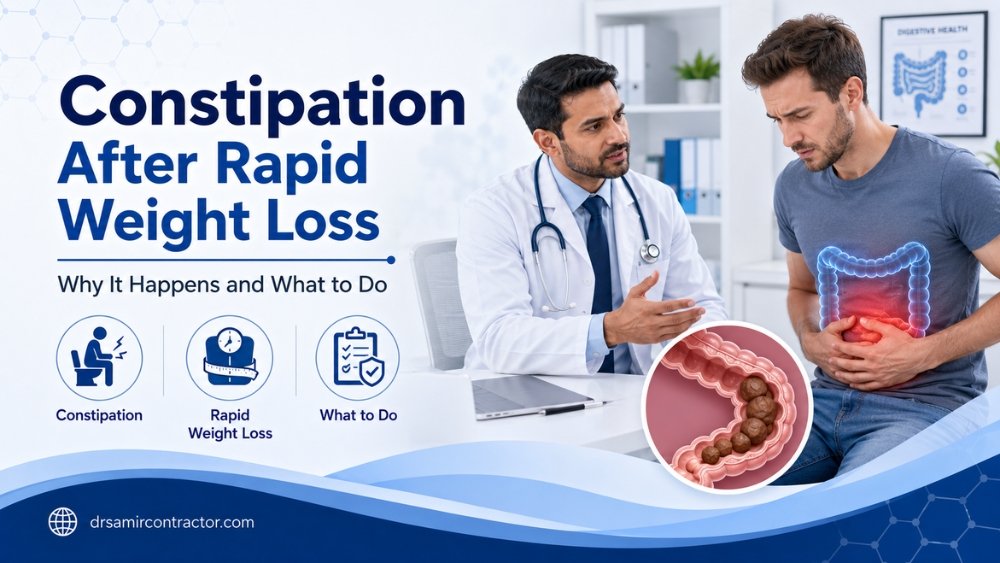
Constipation is one of the most common complaints after rapid weight loss - whether from aggressive dieting, GLP-1 receptor agonist medications (semaglutide, tirzepatide), or bariatric surgery. The core mechanisms are reduced food volume (less bulk to push through the colon), dehydration, high-protein low-fibre diets, iron supplementation, and decreased physical activity during recovery. Most cases respond well to adequate hydration, gradual fibre intake (isabgol, fruits, dalia), and structured eating. However, persistent or worsening constipation after weight loss can signal gallstones, internal hernias, or anastomotic strictures - conditions that need surgical evaluation.
Quick Answers
Understanding Constipation After Weight Loss
When patients lose weight rapidly - whether by design (crash diets, very low calorie diets) or through medical intervention (bariatric surgery, GLP-1 medications) - the digestive system undergoes significant changes. The colon, which relies on food bulk, hydration, and fibre to generate coordinated contractions, suddenly has far less material to work with. The result is predictable: infrequent bowel movements, hard stools, straining, and a sense of incomplete evacuation.
This is not a minor inconvenience. Constipation after rapid weight loss causes real distress. Patients who are motivated by their weight loss progress become frustrated when bowel difficulties interfere with daily life. Understanding the specific mechanisms - and knowing which solutions actually work - makes a significant difference.
Importantly, most post-weight-loss constipation is functional and reversible. But a small proportion of cases indicate something more serious: gallstones (which form rapidly during weight loss), anastomotic strictures after gastric bypass, or even small bowel obstruction from internal hernias. Recognising the difference is critical.
Six Mechanisms Behind Post-Weight-Loss Constipation
Constipation after weight loss is not caused by a single factor. Multiple mechanisms operate simultaneously, and their combined effect explains why this symptom is so prevalent.
1. Reduced food volume = reduced stool bulk
This is the most straightforward mechanism. After bariatric surgery, patients eat 300-500 ml per meal (compared to 1,000-1,500 ml pre-surgery). On very low calorie diets (800-1,200 kcal/day), total food intake drops by 50-70%. Less food entering the colon means less residue to form stool. Without adequate bulk, the colon cannot generate the mass-movement contractions that propel stool forward. The result is small, infrequent, hard stools.
2. Dehydration and inadequate fluid intake
Dehydration is ubiquitous during rapid weight loss. After bariatric surgery, patients struggle to drink adequate volumes because the small stomach pouch fills quickly. On calorie-restricted diets, overall fluid intake often drops alongside food intake. GLP-1 medications suppress appetite and thirst simultaneously. The colon absorbs water from stool as it passes through - when the body is even mildly dehydrated, the colon extracts more water, producing dry, hard stool that is difficult to pass.
3. High-protein, low-fibre dietary patterns
Post-bariatric and weight-loss diets emphasise protein (to preserve muscle mass during weight loss) while limiting carbohydrates. Protein-heavy foods - chicken, eggs, paneer, whey protein - contain virtually no fibre. Without adequate dietary fibre (the recommended 25-35 g/day), stool lacks the water-holding capacity and bulk needed for normal transit. This is compounded by avoiding traditional Indian staples rich in fibre - rotis made from whole wheat, dals, sabzis, and rice - that many patients cut out during aggressive dieting.
4. Iron and calcium supplementation
After bariatric surgery, iron and calcium supplements are essential to prevent deficiency. However, both are well-known causes of constipation. Ferrous sulfate in particular produces hard, dark stools and slows gut transit. Calcium carbonate has a similar constipating effect. Post-bariatric patients taking both supplements simultaneously - as most protocols require - face a double constipating burden that must be actively managed.
5. GLP-1 receptor agonist effects on gut motility
Semaglutide (Ozempic, Wegovy), liraglutide (Saxenda), and tirzepatide (Mounjaro) work partly by slowing gastric emptying and intestinal transit. This delayed motility is central to how these drugs reduce appetite and food intake - but it also means stool spends more time in the colon, where more water is absorbed. The result is constipation in 20-30% of patients, sometimes severe enough to require dose reduction or discontinuation.
6. Reduced physical activity during recovery
After bariatric surgery, patients are advised to limit strenuous activity for 4-6 weeks. During aggressive dieting, fatigue and low energy often reduce exercise levels. Physical activity stimulates colonic motility - the gastrocolic reflex (increased colonic activity after eating and moving) is well-established. When patients are sedentary, colonic transit slows and constipation worsens.
Constipation by Weight Loss Method
The severity and pattern of constipation differs depending on how weight was lost. Understanding these differences helps target management.
| Weight Loss Method | Constipation Risk | Primary Mechanisms | Typical Duration |
|---|---|---|---|
| Crash dieting / VLCD | Moderate (30-40%) | Reduced bulk, low fibre, dehydration | Duration of diet + 2-4 weeks |
| Keto / high-protein diet | High (40-50%) | Very low fibre, dehydration (ketosis), reduced bulk | Duration of diet |
| GLP-1 medications | Moderate-High (20-30%) | Slowed gut motility, reduced food intake, dehydration | Duration of medication (may persist) |
| Sleeve gastrectomy | High (40-50%) | Drastically reduced intake, iron/calcium supplements, dehydration, recovery inactivity | 2-4 months (improves with dietary progression) |
| Gastric bypass (RYGB) | High (35-45%) | Reduced intake, supplements, altered anatomy, possible stricture | 2-4 months (longer if stricture present) |
Indian Dietary Solutions for Post-Weight-Loss Constipation
Generic advice to "eat more fibre and drink water" is not enough. Patients need specific, practical recommendations that fit Indian dietary patterns and are compatible with their weight loss goals.
Fibre-rich foods that fit a weight loss diet
- Isabgol (psyllium husk): 1-2 teaspoons in 250 ml warm water before bedtime. The single most effective, calorie-free fibre supplement. Forms a gel that adds bulk and softens stool. Must be taken with adequate water.
- Papaya: 1 cup (150 g) at breakfast. Contains papain enzyme and fibre - natural stool softener. Low in calories (approx. 60 kcal per cup).
- Guava (with seeds): 1 medium guava provides 12% of daily fibre. The seeds add roughage. Excellent between-meal snack compatible with weight loss.
- Dalia (broken wheat porridge): 1 bowl (cooked from 40 g dry) provides good fibre with moderate calories. Can replace refined cereal for breakfast.
- Flaxseeds (alsi): 1 tablespoon ground, added to curd or smoothie. Provides both soluble and insoluble fibre plus omega-3.
- Palak (spinach) and methi (fenugreek): Cooked leafy greens provide fibre, magnesium (natural laxative effect), and negligible calories.
- Moong dal (split green gram): Higher fibre than other dals, easy to digest post-surgery, and protein-rich. Good combination food.
Hydration strategy
- Target: 2-2.5 litres per day (water, buttermilk, coconut water, clear soups)
- After bariatric surgery: sip frequently (60-90 ml every 15-20 minutes), do not gulp large volumes
- Avoid drinking during meals - wait 30 minutes before and after eating
- Morning warm water with lemon - stimulates the gastrocolic reflex
- Buttermilk (chaas) after lunch - provides fluid, probiotics, and aids digestion
Structuring meals for bowel regularity
- Eat at consistent times - regularity trains the bowel to expect food and triggers motility
- Include a source of fibre at every meal, even if the portion is small
- Do not skip meals - even on low-calorie diets, 4-5 small meals maintain gut stimulation
- Morning is the best time for bowel activity - eat breakfast within 30 minutes of waking
Safe, Effective Daily Routine for Post-Weight-Loss Constipation
- Morning: 1 glass warm water with lemon on waking → breakfast with papaya or dalia within 30 minutes
- Mid-morning: 1 guava or a handful of soaked prunes
- Lunch: include cooked vegetables (palak, lauki, bhindi) + moong dal + small roti or rice
- Afternoon: chaas (buttermilk) - 200 ml
- Evening: flaxseed in curd or a small fruit
- Bedtime: 1-2 tsp isabgol in 250 ml warm water
- Throughout day: sip water to reach 2-2.5L total
- Walk 20-30 minutes after dinner - stimulates colonic motility
Medical Management When Diet Is Not Enough
If 2-3 weeks of dietary modification and hydration do not produce regular, comfortable bowel movements, medical management may be needed. This should be guided by a physician - self-medicating with stimulant laxatives long-term is not recommended.
| Agent | How It Works | Suitability After Weight Loss |
|---|---|---|
| Isabgol (psyllium) | Bulk-forming - absorbs water, increases stool volume | First line. Safe long-term. Must take with adequate water. |
| Lactulose | Osmotic - draws water into colon | Safe after surgery. 15-30 ml at bedtime. May cause bloating initially. |
| PEG (polyethylene glycol) | Osmotic - retains water in stool | Effective and well-tolerated. No significant calorie content. |
| Bisacodyl | Stimulant - triggers colonic contractions | Short-term rescue only (1-2 days). Not for regular use. |
| Liquid paraffin | Lubricant - coats stool for easier passage | Occasional use acceptable. Avoid after gastric bypass (aspiration risk with reflux). |
| Prucalopride | Prokinetic - stimulates colonic motility via serotonin receptors | Specialist use. For refractory cases not responding to above agents. |
Iron supplement tip: If iron supplements are causing significant constipation, ask your surgeon about switching from ferrous sulfate to ferrous bisglycinate - it is better absorbed and causes fewer GI side effects. Taking iron with vitamin C (amla, orange juice) improves absorption and may allow lower doses.
Constipation After Bariatric Surgery? Not Getting Better?
Dr Samir Contractor provides structured post-bariatric dietary guidance and evaluation for persistent bowel symptoms at Sterling Hospital, Vadodara.
Book a ConsultationRed Flags: When Post-Weight-Loss Constipation Signals Something Serious
Most constipation after weight loss is benign and responds to dietary measures. However, certain patterns demand urgent surgical evaluation because they may indicate a complication of the weight loss itself.
- Complete inability to pass stool AND gas for 48+ hours - may indicate small bowel obstruction, especially after gastric bypass (internal hernia or adhesions)
- Severe, colicky abdominal pain with vomiting - bowel obstruction until proven otherwise
- Progressively worsening constipation with abdominal distension - possible large bowel obstruction or stricture
- Right upper abdomen pain with constipation - gallstones are extremely common after rapid weight loss (up to 30% within 6 months); can cause biliary colic or even acute cholecystitis
- Blood in stool or black/tarry stools - anastomotic ulcer (after gastric bypass), fissure from straining, or other pathology
- Persistent vomiting after bariatric surgery with inability to eat - anastomotic stricture (especially 4-8 weeks post-gastric bypass)
- Constipation not responding to 4+ weeks of adequate fibre, fluids, and laxatives - needs investigation to exclude mechanical cause
Gallstones after rapid weight loss
This deserves special mention. When the body metabolises fat rapidly, the liver secretes excess cholesterol into bile. This cholesterol-saturated bile forms gallstones - a well-documented complication of rapid weight loss. Up to 30% of patients who lose more than 1.5 kg per week develop gallstones within 6 months. Gallstones can cause right upper abdomen pain, nausea, and - if a stone blocks the common bile duct - jaundice and pancreatitis. Constipation combined with right upper abdomen pain after rapid weight loss should always prompt an abdominal ultrasound.
Internal hernias and bowel obstruction
After Roux-en-Y gastric bypass, internal hernias can develop at the mesenteric defects created during surgery. These hernias can trap a loop of small bowel, causing obstruction that presents as severe pain, vomiting, and absolute constipation (no stool or gas). This is a surgical emergency. Any patient who has had gastric bypass and develops sudden severe abdominal pain with inability to pass stool must be evaluated with an urgent CT scan.
Anastomotic stricture
The gastrojejunal anastomosis (connection between stomach pouch and small bowel) after gastric bypass can narrow due to scarring. This typically presents 4-12 weeks after surgery with progressive difficulty eating, vomiting, and - because almost no food passes through - severe constipation. Diagnosed by upper GI endoscopy and treated with endoscopic balloon dilatation.
When to Investigate - and What Tests Are Needed
If constipation persists despite 4 weeks of dietary optimisation, adequate hydration, and appropriate laxative use, further investigation is warranted.
- Blood tests: Thyroid function (TSH) - hypothyroidism causes constipation and weight changes; blood glucose/HbA1c - diabetes affects gut motility; calcium - hypercalcaemia causes constipation; full blood count - anaemia from occult bleeding
- Abdominal ultrasound: First-line imaging to check for gallstones - essential after rapid weight loss
- Abdominal X-ray: Shows faecal loading, bowel dilatation, or signs of obstruction
- CT abdomen: If obstruction or internal hernia suspected - especially after bariatric surgery
- Upper GI endoscopy: If anastomotic stricture suspected after gastric bypass (difficulty swallowing + vomiting + constipation)
- Colonoscopy: If blood in stool, age above 45 with new symptoms, or constipation not responding to treatment - to exclude polyps, cancer, or stricture
Post-Bariatric Surgery Constipation: A Specific Guide
Constipation after bariatric surgery deserves focused attention because the causes are specific and the management must account for the altered anatomy.
Week 1-2 Post-Surgery
- Liquid diet only - minimal residue
- Bowel movements may be absent for 3-5 days
- This is normal and expected
- Focus on sipping fluids (60-90 ml every 15 min)
- Pain medications (opioids) worsen constipation
- Lactulose 15 ml at night if no movement by day 4
Week 3-6 Post-Surgery
- Soft/pureed diet - some fibre returning
- Introduce isabgol (1 tsp in water) at bedtime
- Begin gentle walking (20 min/day)
- Iron supplements begin - expect harder stools
- Target 1.5-2L fluid daily
- Expect improvement as diet progresses
Month 2-4 Post-Surgery
- Regular diet with small portions
- Isabgol 1-2 tsp daily + papaya at breakfast
- Target 2-2.5L fluid
- Exercise increasing - aids motility
- Most patients have regular movements by month 3
- Persistent symptoms need evaluation
The Role of Physical Activity
Exercise is a powerful stimulant of colonic motility. The gastrocolic reflex - increased colonic contractions triggered by food entering the stomach - is amplified by physical activity. Even moderate walking (20-30 minutes daily) significantly improves bowel regularity.
After bariatric surgery, patients should begin walking within 24 hours of surgery (hospital corridors) and build up to 30 minutes of brisk walking daily by week 3-4. Resistance training can be added at 6-8 weeks post-surgery. The combination of improved core muscle strength and regular cardio activity addresses constipation more effectively than any single laxative.
For patients losing weight through dieting or GLP-1 medications, maintaining a daily 30-minute walk - ideally after dinner - directly improves evening and morning bowel function. Yoga asanas that involve abdominal compression (Pawanmuktasana, Malasana squat) are particularly helpful and commonly practised across India.
Constipation After Weight Loss - The Indian Context
Why This Problem Is Growing in India
India has seen explosive growth in both bariatric surgery (India is now the third-largest bariatric surgery market globally) and GLP-1 medication use. An estimated 2-3 lakh bariatric procedures are performed annually in India, and GLP-1 prescriptions have multiplied tenfold since 2022. The result is a rapidly increasing population of patients experiencing post-weight-loss GI symptoms - constipation being the most common.
Indian dietary culture actually offers excellent solutions. Traditional foods like isabgol, papaya, guava, dalia, ajwain water, and fermented buttermilk (chaas) have been used for digestive health for generations. The challenge is that patients on aggressive weight loss programmes often abandon these traditional foods in favour of imported protein powders and restrictive Western-style diets. Reintroducing Indian dietary staples - in appropriate portions - is often the most effective treatment.
Vadodara - Bariatric Surgery and Post-Operative Care
Vadodara has become a significant centre for bariatric surgery in Gujarat, with multiple hospitals offering laparoscopic sleeve gastrectomy and gastric bypass. Dr Samir Contractor at Sterling Hospital provides comprehensive bariatric care including pre-operative assessment, laparoscopic surgery, and - critically - structured post-operative follow-up that addresses bowel function, nutrition, and long-term metabolic health. Patients from Vadodara, Ahmedabad, Surat, and across Gujarat seek specialised post-bariatric evaluation when GI symptoms like persistent constipation do not resolve with standard measures.
Desi Patient Questions (Gujarati)
Surgery pachhi pehla 5-7 divas ma aa normal chhe - liquid diet par chho ane painkillers gut slow kare chhe. Pan jya sudhi gas pan na aave ane pet fool-vu lage, to turant surgeon ne phone karo. Lactulose 15 ml raat-re lo - doctor ni salah mujab. Week 4 pachhi isabgol 1 tsp warm paani ma start karo.
Crash dieting ma fibre ane paani banne ochi thai jaay chhe - etla constipation thay. Isabgol 1-2 tsp roj raat-re, papaya savaar-na, guava afternoon ma, ane 2-2.5 litre paani roj - aa basic steps follow karo. Weight loss chalu raakhjo - pan fibre skip na karo.
Dawai chhodi na do - constipation manage thai shake chhe. Isabgol roj lo, paani 2.5 litre peevo, palak/methi sabzi khao, ane walk roj 30 minute karo. Joo bahu severe hoi to doctor pase jao - dose adjust kari shake chhe. Pan dawai potani marz-thi stop na karo.
Iron (ferrous sulfate) constipation nu common kaaran chhe surgery pachhi. Doctor ne poochho - ferrous bisglycinate par switch kari shake chhe (ochi side effects). Vitamin C sathe lo (amla, orange) - absorption vadhhe ane ochi dose chalti thay. Isabgol ane lactulose saath ma lo.
Haa - rapid weight loss pachhi 30% sudhi patients ne 6 mahina ma gallstones bane chhe. Right upper pet ma dukhavvo + constipation = abdominal ultrasound zaruri chhe. Gallstones confirm thay ane symptoms aave to laparoscopic cholecystectomy (gallbladder removal) karavi padhe. Dr Samir Contractor, Sterling Hospital, Vadodara ma consult karo.
Gastric bypass pachhi 4-12 weeks ma anastomotic stricture thay shake chhe - connection tight thai jaay chhe scarring thi. Progressive difficulty eating + vomiting + constipation (khavanu nathi javtu etla stool pan nathi bantu) - aa classic presentation chhe. Upper GI endoscopy karavi padhe - endoscopic balloon dilatation thi treat thay chhe. Turant surgeon ne batavo.