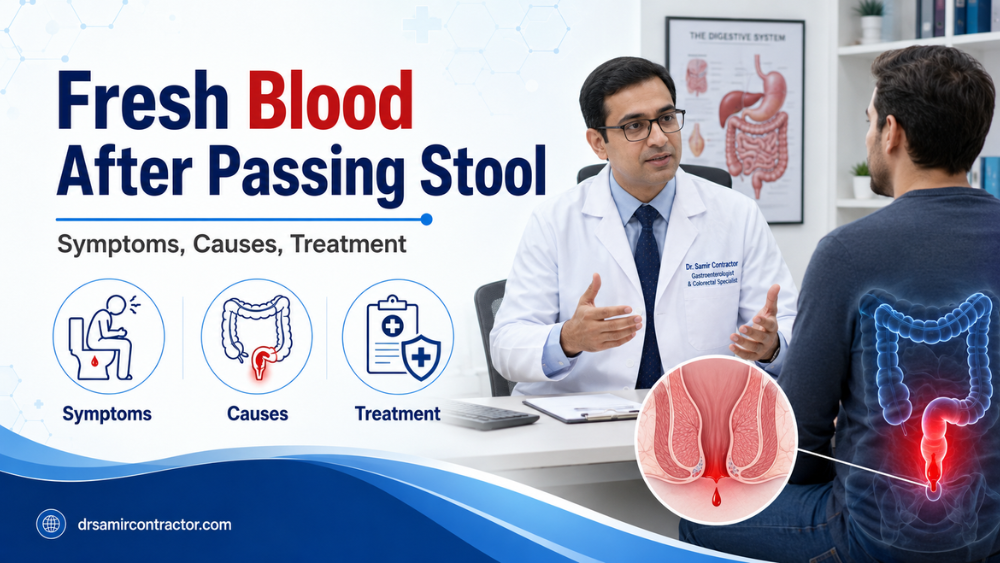
In simple terms: Seeing bright red blood after you pass stool is alarming, but in the vast majority of cases the cause is piles (hemorrhoids) or an anal fissure — both of which are common and treatable.
This page explains the likely causes, the warning signs that need urgent attention, and the steps you should take next.
Quick Answers
What Does Fresh Blood After Passing Stool Actually Mean?
When you notice bright red blood — on the toilet paper, dripping into the bowl, or coating the surface of your stool — it is called hematochezia in medical terms. The bright colour tells your doctor something important: the bleeding source is likely in or very near the anus or lower rectum.
This is different from darker blood mixed inside the stool (which can point to a source higher up in the colon) or black, tarry stools (which suggest bleeding in the stomach or upper intestine). Understanding this distinction is the first step toward feeling less afraid and more informed.
Fresh blood after a bowel movement is one of the most common complaints seen in surgical clinics across India. In my practice in Vadodara, I see at least 5-8 patients every day who describe this exact symptom. The good news: the overwhelming majority walk out reassured after a simple examination.
Common Causes of Fresh Blood After Passing Stool
1. Piles (Hemorrhoids) — The Most Common Cause
Hemorrhoids are swollen blood vessels in the anal canal. When they are inside the canal (internal hemorrhoids), they tend to bleed painlessly — you see bright red blood on the paper or in the bowl, but you do not feel much discomfort. External hemorrhoids can cause pain along with bleeding.
In India, piles are extremely common due to dietary patterns (low fibre), prolonged squatting, and a tendency to delay medical consultation out of embarrassment. Many patients try home remedies for months before seeking help.
2. Anal Fissure — The Painful One
A fissure is a small tear in the lining of the anus, usually caused by passing a hard, dry stool. It produces a sharp, cutting pain during the bowel movement followed by bright red blood on the paper. The pain can linger for minutes to hours afterward.
Fissures are especially common in patients who eat less fibre, drink insufficient water, or have chronic constipation — a pattern frequently seen in individuals who rely heavily on maida-based foods and consume fewer green vegetables.
3. Rectal or Colonic Polyps
Polyps are small growths on the inner lining of the colon or rectum. Most are harmless, but some can bleed, and a small percentage may become cancerous over time. This is one reason why persistent bleeding — even if it looks like a simple piles case — should be investigated if it does not settle with initial treatment.
4. Proctitis or Rectal Inflammation
Inflammation of the rectal lining can cause bleeding, mucus discharge, and a feeling of urgency. Causes include infections, inflammatory bowel disease (ulcerative colitis, Crohn's disease), or radiation therapy.
5. Diverticular Bleeding
Diverticula are small pouches that form in the colon wall, more common after age 50. They can occasionally bleed, sometimes heavily, though the bleeding often stops on its own.
6. Other Less Common Causes
- Rectal prolapse — protrusion of rectal tissue through the anus
- Solitary rectal ulcer — related to chronic straining
- Colorectal cancer — rare in younger patients but always considered in persistent cases
- Anal warts or skin tags — can bleed with friction
- Blood-thinning medications — aspirin, warfarin, or other anticoagulants can make minor bleeding heavier
Red Flags — See a Doctor Urgently If You Notice
- Heavy bleeding that fills the toilet bowl or does not stop
- Dark red, maroon, or black blood in or around the stool
- Blood mixed inside the stool (not just on the surface)
- Dizziness, lightheadedness, or fainting after bleeding
- Unintentional weight loss alongside bleeding
- A change in bowel habit lasting more than 3 weeks (new constipation or diarrhea)
- A family history of colon cancer or polyps
- Fever or abdominal pain with the bleeding
- Age over 45 with new-onset rectal bleeding
Likely Benign — Signs That Suggest a Low-Risk Cause
- Small amount of bright red blood only on toilet paper or dripping after stool
- Bleeding that occurs during or right after a hard bowel movement
- Bleeding that stops on its own within a few minutes
- No other symptoms like pain, weight loss, or appetite change
- Known history of piles or fissure
- Improvement when you add fibre and water to your diet
Remember: "Likely benign" does not mean "ignore it forever." Even low-risk bleeding deserves a professional evaluation if it persists beyond a week or two.
How Is the Cause Diagnosed?
A proper diagnosis usually requires only a short clinic visit. Here is what to expect:
- Detailed history: Your surgeon will ask about the colour, quantity, timing (during or after stool), pain, and duration. Be honest and specific — this conversation narrows down the likely cause before any examination.
- Visual inspection: A gentle external examination of the anal area can reveal external piles, fissures, skin tags, or prolapse.
- Digital rectal examination (DRE): A brief, gloved-finger examination. It takes under 30 seconds and provides vital information about internal piles, masses, or tenderness.
- Proctoscopy: A small, short instrument is inserted to directly view the anal canal and lower rectum. This is done in the clinic without anaesthesia and takes about a minute.
- Colonoscopy (when indicated): A flexible camera examination of the entire colon. Recommended for patients over 45, those with persistent or recurrent bleeding, or when polyps or deeper causes are suspected. It is performed under mild sedation and typically takes 20-30 minutes.
Treatment Options
Conservative (Non-Surgical) Management
The first line of treatment for piles and fissures — and often the only treatment needed — involves lifestyle and dietary changes:
- Increase dietary fibre: Include more vegetables, whole dal, fruits (guava, papaya, banana), whole-wheat roti, oats, and leafy sabzi. Aim for 25-30 grams of fibre daily.
- Stay hydrated: Drink 2.5-3 litres of water daily, especially in Gujarat's hot months.
- Avoid straining: Do not sit on the toilet for extended periods. Avoid using your phone on the toilet (a habit more common than patients admit).
- Warm sitz baths: Sitting in warm water for 10-15 minutes, 2-3 times a day, reduces pain and promotes healing of fissures.
- Topical ointments: Prescribed creams containing lignocaine and diltiazem or nitroglycerin for fissures; steroid-based creams for inflamed piles.
- Stool softeners: Isabgol (psyllium husk) or lactulose help soften stool and reduce trauma to the anal lining.
Minimally Invasive Procedures
- Rubber band ligation: A small rubber band is placed around the base of an internal hemorrhoid, cutting off blood supply. It falls off in a few days. Done in the clinic, no anaesthesia needed.
- Sclerotherapy: An injection is given into the hemorrhoid to shrink it. Suitable for Grade I-II piles.
- Infrared coagulation: Heat is used to shrink small hemorrhoids.
Surgical Options (When Conservative Treatment Fails)
- Laser hemorrhoidoplasty: A modern, minimally invasive approach using laser energy to shrink hemorrhoidal tissue. Less pain and faster recovery than traditional surgery.
- Stapled hemorrhoidopexy (MIPH): A stapler device repositions and reduces blood flow to the hemorrhoids. Suitable for circumferential (all-around) piles.
- Open or closed hemorrhoidectomy: Traditional surgical removal, reserved for large Grade IV hemorrhoids or complicated cases.
- Lateral internal sphincterotomy (LIS): A small, controlled cut in the internal sphincter muscle to relieve spasm and allow a chronic fissure to heal. Highly effective with low recurrence.
- Polypectomy during colonoscopy: If polyps are found, they are removed during the same procedure using a snare or cautery.
What Happens If You Ignore Fresh Blood After Passing Stool?
Consequences of Delaying Treatment
- Chronic anaemia: Even small daily blood losses add up over weeks and months. Many patients in India present with haemoglobin levels below 8 g/dL because they tolerated bleeding for too long.
- Progression of piles: Grade I-II piles that could have been treated conservatively may progress to Grade III-IV, eventually requiring surgery.
- Chronic fissure formation: An acute fissure can heal in 2-3 weeks with proper care. Left untreated, it becomes chronic (with a sentinel skin tag and exposed muscle fibres), almost always requiring surgery.
- Missed polyps: A polyp that bleeds is one that could be detected and removed early. If ignored, certain polyps may undergo malignant transformation over years.
- Unnecessary anxiety: Perhaps the most immediate cost — weeks or months of worry, internet searching, and sleepless nights, when a 10-minute clinic visit could provide clarity.
Why This Matters in India
Anorectal bleeding is one of the most under-reported symptoms in India. Cultural embarrassment around discussing anything related to the anus means patients delay consultation by an average of 6-18 months.
- Dietary factors: The traditional Gujarati thali is rich in flavour but often low in roughage. Excessive maida (refined flour) in snacks like khaman, fafda, and gathiya, combined with insufficient water intake, contributes to hard stools and straining.
- Self-medication: Many patients try ayurvedic churans, home remedies, or over-the-counter piles creams for months before seeing a surgeon. While some of these offer temporary relief, they do not address the root cause.
- Stigma and silence: Patients — especially women — often avoid mentioning rectal bleeding even to family members. This delay is particularly harmful when the cause is something other than piles.
- Anaemia burden: India already has one of the highest rates of anaemia in the world. Chronic rectal bleeding in someone who is already iron-deficient can tip the balance into severe anaemia requiring transfusion.
- Rising colorectal cancer incidence: While still less common than in Western countries, colorectal cancer rates in urban India are increasing. Early detection through timely investigation of bleeding symptoms is critical.
Ready to get answers?
Frequently Asked Questions
Gujarati & Hinglish FAQs
A: Aa common chhe pan normal nathi. Mostly piles ke fissure hoy chhe, pan doctor ne batavvu jaruri chhe.
A: Ha, jova jevo chhe. Thoduk blood pan fissure ke early piles no sign hoi sake chhe. Ek checkup karavi lo.
A: Tikhu sidhu bleeding nathi kartu, pan agar piles ke fissure hoy to ae vadhaare irritate thay chhe. Diet ma thodu balance rakhvo saaru.
A: Samjo ke surgeon divas ma 10-15 aava patients jue chhe. Tamara mate aa navu chhe pan amara mate routine chhe. Sharam thi delay karsho to problem vadhse.
A: Grade I-II piles ma haa — diet, dawaa, ane lifestyle changes thi ghanu saaru thay chhe. Advanced piles ma minimally invasive procedure jaruri thay chhe.
A: Ha, blood sathe pet ma dukhavo hoy to jaldi doctor ne mado. Aa colitis, polyp, ke bija kaaran hoi sake chhe — checkup jaruri chhe.