Colorectal cancer is one of the most preventable cancers — if caught early. This page lists the warning signs every adult should know, explains who should be screened and when, and covers the screening and treatment pathway available in Vadodara.
Quick Answer
Introduction
Colorectal cancer is the third most common cancer worldwide and the second leading cause of cancer death. In India, it is less common than in Western countries — but incidence is rising fast, especially in urban areas and in adults younger than 50. The tragedy is that most cases begin as harmless polyps that can be removed painlessly during a colonoscopy, years before cancer develops.
This page is not designed to scare you. It is designed to make sure you know the signs, understand the screening timeline, and act early if anything does not feel right. If you arrived from our blood in stool, rectal bleeding, or change in bowel habits page, this is the next step in your evaluation pathway.
Warning Signs of Colorectal Cancer
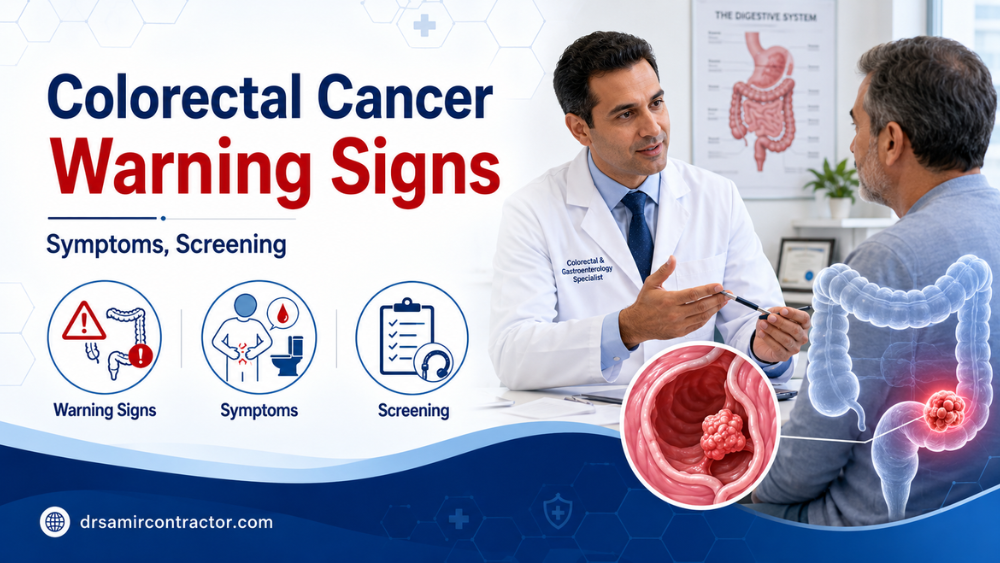
Early colorectal cancer often has no symptoms at all. That is precisely why screening is important. When symptoms do appear, they usually include one or more of the following.
Warning Signs — Get Evaluated
- Change in bowel habit lasting more than 3 weeks — new constipation, new diarrhoea, or alternating between the two
- Blood mixed into the stool (not just on the surface)
- Dark red or maroon-coloured stool
- Pencil-thin or ribbon-like stool
- Unexplained weight loss — losing weight without trying
- Iron-deficiency anaemia — fatigue, pallor, breathlessness, low haemoglobin found on routine blood work
- Persistent abdominal discomfort — cramps, gas, or bloating that does not resolve
- Feeling of incomplete evacuation — urgency, tenesmus, or a sense that the bowel is never fully empty
- Mucus in stool — unexplained jelly-like discharge
- Fatigue that is out of proportion to daily activity
Any one of these in a person over 40 — or any two at any age — warrants a clinical evaluation and usually a colonoscopy.
How Symptoms Differ by Location
| Location | Common symptoms | Why |
|---|---|---|
| Right colon (ascending) | Anaemia, fatigue, vague right abdominal discomfort, weight loss | The colon is wide here; tumours grow large before causing obstruction. Chronic hidden bleeding causes anaemia. |
| Left colon (descending, sigmoid) | Change in bowel habit, constipation, crampy pain, blood in stool | The colon is narrower; even small tumours can alter stool calibre and pattern. |
| Rectum | Rectal bleeding, tenesmus, mucus, incomplete evacuation, pencil stool | Close to the anus; bleeding is noticed early and the tumour can be felt on examination. |
Risk Factors
Non-Modifiable
- Age over 45. Risk increases with each decade; most cases are diagnosed between 50 and 75.
- Family history. A first-degree relative (parent, sibling, child) with colon cancer or advanced polyps roughly doubles your risk.
- Hereditary syndromes. Lynch syndrome and familial adenomatous polyposis (FAP) carry very high lifetime risk and require early, frequent screening.
- Personal history of polyps or inflammatory bowel disease.
Modifiable
- Low-fibre, high-processed-meat diet. Daily consumption of processed meats (sausages, salami, cured meats) is classified as a Group 1 carcinogen for colorectal cancer.
- Obesity. Excess visceral fat increases inflammatory markers linked to polyp formation.
- Physical inactivity. Regular exercise reduces colorectal cancer risk by 20–30%.
- Smoking. Increases both the risk of developing polyps and the risk of those polyps becoming malignant.
- Heavy alcohol. More than 2 drinks per day raises risk significantly.
Screening: The Single Most Powerful Prevention Tool
Colorectal cancer is unique among cancers because it has a long, identifiable precancerous stage — the polyp. Removing a polyp during colonoscopy prevents cancer from ever forming. No other cancer can be prevented so directly by a screening test.
Who Should Be Screened
| Risk level | Start age | Recommended test | Frequency |
|---|---|---|---|
| Average risk (no symptoms, no family history) | 45 | Colonoscopy | Every 10 years if normal |
| First-degree relative with CRC | 40 or 10 years before relative's age of diagnosis | Colonoscopy | Every 5 years |
| Lynch syndrome / FAP confirmed | 20–25 (as per genetics team) | Colonoscopy | Every 1–2 years |
| Personal history of adenomatous polyps | After polypectomy | Colonoscopy | 3–5 years depending on polyp type |
Stool-Based Tests
Faecal immunochemical test (FIT) and faecal occult blood test (FOBT) are simple, non-invasive screens that detect hidden blood in stool. They are useful as population-level tools, but a positive result must always be followed by a colonoscopy. A negative result does not guarantee the absence of polyps.
The Polyp-to-Cancer Journey
Nearly all colorectal cancers begin as a polyp — a small growth on the inner lining of the colon. Not all polyps become cancer, but the ones that do follow a predictable sequence over 5 to 15 years. Finding and removing them during this window is the entire basis of screening.
- Hyperplastic polyps: small, flat, common in the rectum. Almost no cancer risk.
- Adenomatous polyps (adenomas): the main precancerous type. Risk increases with size (>1 cm), villous architecture, and high-grade dysplasia.
- Sessile serrated lesions: flat, often subtle, usually in the right colon. Increasingly recognised as a cancer precursor.
For more on polyps, see our colorectal polyps page.
Staging and Survival
| Stage | What it means | 5-year survival (approx) |
|---|---|---|
| Stage I | Cancer confined to the inner layers of the colon wall | Above 90% |
| Stage II | Cancer has grown through the wall but not reached lymph nodes | 70–85% |
| Stage III | Cancer has spread to nearby lymph nodes | 50–70% |
| Stage IV | Cancer has spread to distant organs (liver, lungs) | 10–15% |
The message is simple: the gap between Stage I (90%+ survival) and Stage IV (10–15%) is determined almost entirely by when the cancer is found.
Treatment Overview
Surgery
Surgical removal of the affected segment of the colon or rectum, along with its lymph-node drainage area, is the primary treatment for Stage I–III disease. In Vadodara, laparoscopic colorectal resection is the standard — smaller incisions, less pain, and faster recovery than open surgery.
Chemotherapy
Recommended for most Stage III cancers and selected Stage II cancers with high-risk features. Modern regimens are given as outpatient infusions over 3–6 months.
Radiation
Used primarily for rectal cancer, either before surgery (to shrink the tumour) or after surgery (to reduce recurrence).
Endoscopic Treatment
Very early cancers confined to a polyp can sometimes be cured by endoscopic polypectomy alone, without any surgery.
What Happens If Warning Signs Are Ignored?
- Stage migration. A cancer that could have been Stage I at the time symptoms began may become Stage III or IV within 6–12 months of ignoring symptoms.
- Emergency presentation. Approximately 15–20% of colorectal cancers in India present as emergencies — obstruction, perforation, or massive bleeding — when elective treatment would have been simpler and safer.
- More aggressive treatment. Late-stage disease often requires more extensive surgery, stoma creation, and prolonged chemotherapy that could have been avoided.
- Missed polyp window. A polyp found at 50 could have been removed painlessly. The same polyp as a cancer at 58 requires a major operation.
Why This Matters in India
- Younger age at diagnosis. Indian data shows a significant proportion of colorectal cancers diagnosed between 40 and 55 — a decade younger than global averages. Waiting until 50 for screening misses a critical window.
- Piles misdiagnosis. The single biggest delay factor. Patients bleed for months, self-treat with pile creams, and present only when weight loss or obstruction forces them to hospital. A one-time proctoscopy or colonoscopy at the first bleed would have caught the tumour early.
- Low screening awareness. Unlike breast cancer or cervical cancer, colon-cancer screening is not yet part of mainstream health-check packages in India. Patients and doctors need to ask for it proactively.
- Diet trends. The shift toward processed foods, refined flour, sugary drinks, and reduced physical activity in urban Gujarat mirrors the dietary pattern linked to rising colorectal cancer rates worldwide.
The bottom line for Indian adults: if you are 45 or older, have a family history, or have had even a single episode of bleeding — a one-time colonoscopy is the single most valuable investment in your long-term gut health.
Over 45? Family History? Concerned Symptoms?
A screening colonoscopy takes 30 minutes under mild sedation and can prevent colorectal cancer before it starts. Same-week slots available.
Frequently Asked Questions
ગુજરાતી માં પૂછાતા પ્રશ્નો (Gujarati / Hinglish FAQs)
Bowel habit badlay (3 ahwaliya thi vadhu chale), stool ma lohi mix thay, vajan ghate bina karan, khamoshi thi haemoglobin ghati jay. Koi pan ek sign 40 upar hoy to colonoscopy karavo.
Na — piles ane cancer ek sathe hoy sake chhe. Piles nu lohi bright red hoy, cancer nu dark ane mixed hoy — pan confirm thi colonoscopy thi j thay.
45 thi — ane family ma cancer hoy to 40 thi ke 10 varsh aghau thi. Normal report hoy to 10 varsh pachi farithi karavi.
Colonoscopy vakhte j kaadhi nakhvama aave chhe — painless chhe. Biopsy thay, report upar agle colonoscopy 3 ke 5 varsh pachi nakki thay. Polyp kaadhi nakhiye to cancer thay j nahi.
Mota bhagnu — nahi. Bag mainly low rectal cancer ma ke emergency ma j lage chhe. Ane mota bhagnu temporary hoy — 3-6 months pachi hatavi devay chhe.
Maida, processed food, sugary drinks, ane ochhi physical activity — aa badha urban Gujarat ma vadhya chhe. Fibre ochhu thay, colonoscopy koi karavtu nathi, ane late diagnosis thay chhe.