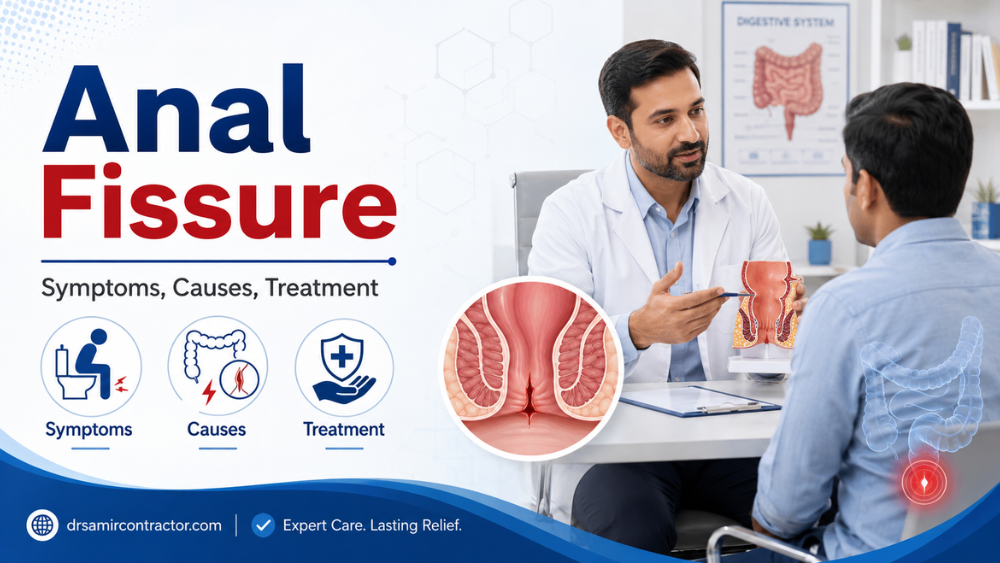
An anal fissure is a small tear in the lining of the anal canal that causes sharp, cutting pain during stool and often minor bleeding. Most acute fissures heal with simple measures. Chronic fissures may need a brief day-care procedure.
Quick Answer
Introduction
An anal fissure is the most common cause of severe pain during a bowel movement. It is also one of the most over-treated and under-treated conditions at the same time many patients use painkillers and creams for months without a diagnosis, while others are rushed into surgery when simple medical treatment would have worked.
Understanding the difference between acute and chronic fissure is the key to getting the right treatment at the right time. This page explains that distinction, covers every treatment option from sitz baths to sphincterotomy, and answers the questions patients in Vadodara ask most often.
What Causes an Anal Fissure?
The anal canal is lined by a thin, sensitive layer of tissue called the anoderm. It has a rich nerve supply which is why fissures hurt so much — and a limited blood supply, which is why they can struggle to heal.
The Vicious Cycle
The sequence is almost always the same. A hard stool tears the anoderm. The tear causes pain. The pain makes the internal sphincter muscle go into spasm. The spasm reduces blood flow to the tear and tightens the anal opening. The next bowel movement re-tears the wound. The cycle repeats, and the fissure becomes chronic.
Common Triggers
- Hard, dry stool from low fibre and low water intake — the number one cause.
- Straining on the toilet: pushing forces the stool against an already tight canal.
- Explosive diarrhoea: forceful liquid stools can tear the lining too.
- Childbirth: vaginal delivery can cause a posterior or anterior fissure.
- Post-surgical constipation: opioid painkillers and reduced mobility after any surgery.
- Chronic straining in the gym: heavy squats and deadlifts without pelvic-floor awareness.
Atypical fissures: A fissure that is off the midline (lateral), multiple, or not healing despite correct treatment may indicate an underlying condition — Crohn's disease, tuberculosis, HIV, or very rarely, a cancer. These need biopsy and specialist evaluation.
Symptoms
- Sharp, cutting pain during stool. Patients describe it as "passing glass" or "a blade inside." The pain can be so severe that people dread bowel movements and begin holding stool — which makes constipation worse.
- Burning or throbbing after stool. A dull ache or throb that lasts 30 minutes to several hours after the bowel movement has ended.
- Bright red blood on the stool or toilet paper. Usually a small amount — streaks rather than drops. Much less bleeding than piles typically produce.
- Visible crack. Many patients can feel or see a small tear at the anal opening.
- Sentinel skin tag. In chronic fissures, a small flap of skin forms at the outer end of the tear. Patients often mistake it for a pile.
- Fear of the toilet. This is real and under-acknowledged. Patients skip meals, reduce fluid intake, or use excess laxatives to avoid the pain — all of which worsen the problem.
Acute vs Chronic Fissure
| Feature | Acute fissure | Chronic fissure |
|---|---|---|
| Duration | Less than 6–8 weeks | More than 6–8 weeks |
| Appearance | Fresh paper-cut, clean edges | Deep, fibrous base, rolled edges |
| Sentinel tag | Absent | Usually present |
| Sphincter spasm | Mild to moderate | Severe, sustained |
| Response to medical Rx | Good (>80% heal) | Partial (50–60% heal with ointment) |
| Surgery needed? | Rarely | Often (if ointment fails) |
⚠ See a Doctor If
- Pain has not improved after 4 weeks of fibre, water, and sitz baths
- A sentinel tag or lump is visible
- Fissure is off to the side rather than front or back
- Fever, pus, or swelling develops — this suggests abscess formation
- You have a history of inflammatory bowel disease
- Pain is so severe you are avoiding meals or holding stool
✓ Manageable at Home (First 4 Weeks)
- Recent onset, clearly triggered by a hard stool
- Pain improving day by day with fibre and sitz baths
- No lump, no pus, no fever
Treatment Options
Step 1 — Conservative Care (All Fissures Start Here)
- High-fibre diet: whole wheat roti, chhilka daal, guava, papaya, leafy vegetables. Target 25–30 g/day.
- Water: 2.5–3 L daily.
- Stool softeners: ispaghula husk (Sat Isabgol) or lactulose to keep stool soft and easy to pass.
- Sitz baths: sit in 10 cm of warm water for 10–15 minutes, 2–3 times daily and after every bowel movement. This relaxes the sphincter and improves blood flow.
- Topical ointment: GTN 0.2% or diltiazem 2% applied inside the canal twice daily for 6–8 weeks. These are smooth-muscle relaxants — they reduce sphincter spasm and promote healing.
- Avoid straining: do not push. If stool does not come within 5 minutes, get up and try later.
Step 2 — Minor Procedures (If Medical Treatment Fails)
Lateral internal sphincterotomy (LIS) is the gold-standard operation for chronic fissure. A small, controlled cut is made in the lower part of the internal sphincter muscle. This permanently breaks the spasm cycle, restores blood flow, and allows the fissure to heal. The procedure takes 10–15 minutes under spinal or short general anaesthesia, and the patient goes home the same day.
Fissurectomy — the fissure, sentinel tag, and any fibrotic tissue are excised, and a small flap of healthy tissue may be advanced to cover the wound. This is preferred when sphincter tone is already low (e.g., post-childbirth, elderly) and a sphincterotomy could risk incontinence.
Botox Injection
An injection of botulinum toxin into the internal sphincter produces temporary relaxation (3–4 months), giving the fissure time to heal. It avoids a permanent cut but has a higher recurrence rate (30–40%) than LIS. It is useful in patients who are not fit for surgery or who have very high anxiety about a procedure.
What Happens If a Fissure Is Ignored?
- Chronic pain cycle. Months or years of severe pain with every bowel movement, affecting sleep, work, and quality of life.
- Stool-holding behaviour. Patients eat less, drink less, and use excessive laxatives — worsening the constipation that caused the fissure.
- Secondary complications. A chronic fissure can develop a perianal abscess or even an anal fistula — more complex conditions requiring more involved surgery.
- Unnecessary suffering. A 10-minute sphincterotomy has a cure rate above 95%. Delaying it for months of pain serves no purpose.
Why This Matters in India
- Maida dominance: Indian snacking culture — puri, paratha, bread, farsan — provides almost no fibre. This creates exactly the hard-stool environment that causes fissures.
- Stigma around anal symptoms: Many patients, especially women, endure months of pain rather than undergo a rectal examination. A female-friendly clinic setting and a reassuring consultation break this barrier quickly.
- Fear of surgery: "Bawasir ka operation" has a fearful reputation in Indian culture. Modern LIS is nothing like the older open procedures — it is day-care, minimal pain, and the relief is felt from day one.
- Over-reliance on home remedies: Ghee, coconut oil, and castor oil are used widely. While soothing, they do not break the sphincter-spasm cycle and should not delay medical treatment beyond 4 weeks.
Frequently Asked Questions
ગુજરાતી માં પૂછાતા પ્રશ્નો (Gujarati / Hinglish FAQs)
Mota bhagnu — ha. Stool vakhte sharp pain ane pachi 30 minute thi 2 kalak sudhi burn thay, ae fissure nu classic sign chhe. Ek vaar doctor ne batavso to turant khabar padi jaay.
10-15 minute. Spinal anaesthesia ma thay chhe. Daycare chhe — savare aavo, saanjhe ghar jao. Pain fissure karta operation pachi OCHHI hoy chhe — relief turant malse.
Ghee thodi rahat apshe, pan sphincter no spasm nahi todse. GTN ke diltiazem ointment — aa evidence-based davao chhe. Ghee saath chalu rakhso to vando nathi, pan akelu kafi nathi.
Ha — agle j divase thi. Stool soft rakhvu padse (fibre + pani). Sitz bath karvu padshe toilet pachi. Pain bahu ochhi hoy chhe — fissure karta gani ochhi.
Ha — banne constipation thi thay chhe, etale ek sathe dekhava common chhe. Doctor banne ni tapas ek sathe kari le chhe ane treatment alag alag nakki thay.
Fibre vadharo — papaya, keri (season ma), daal, sabzi. Pani pivadavo. Toilet par force na karo. Sitz bath garma pani thi. Mota bhagnu 2-3 ahwaliya ma matay chhe. Na matay to pediatric surgeon ne batavo.
Sharp Pain During Stool?
Most fissures are diagnosed in a single gentle examination. If it is acute, we start medical treatment the same day. If chronic, a brief day-care procedure cures it.