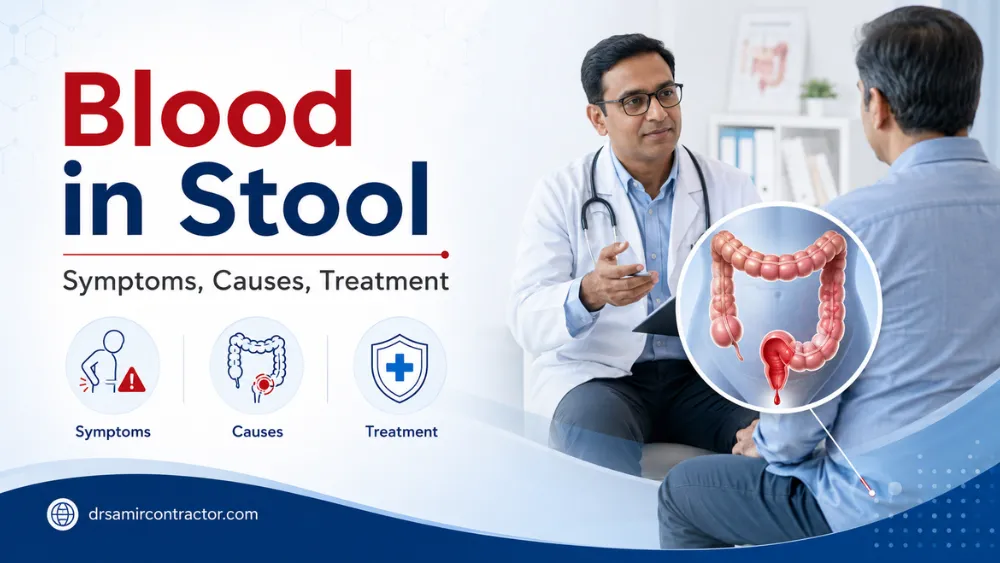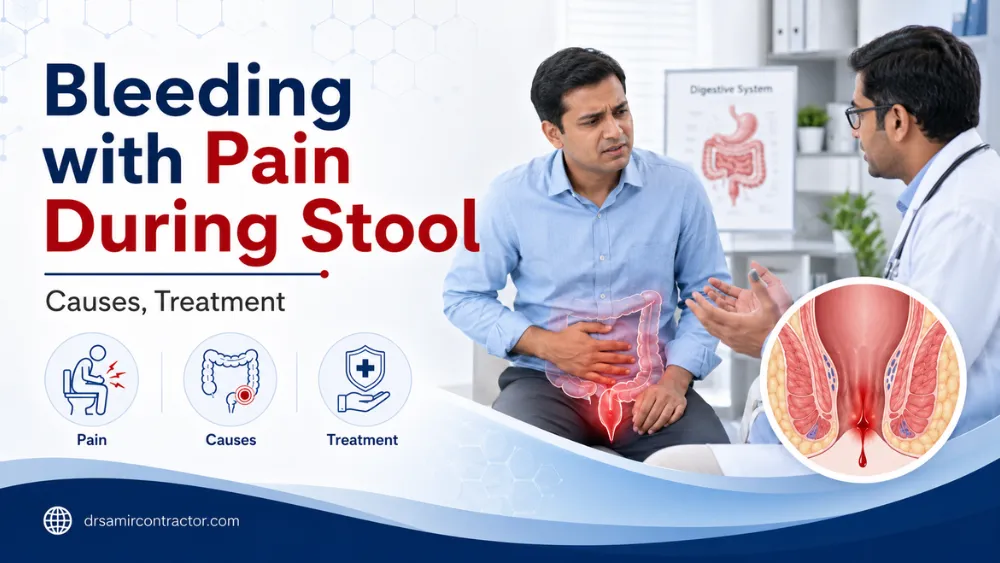
In Simple Terms: You notice blood — on the tissue, in the toilet, or on the stool — but there is zero pain. Your first thought: "It's probably just piles, it'll go away." Most of the time, internal hemorrhoids are indeed the cause. But here's the problem — colorectal polyps and early-stage colorectal cancer can bleed exactly the same way, painlessly. The only way to know the difference is a proper clinical examination, often with a colonoscopy.
Quick Answers
What Does Painless Rectal Bleeding Actually Mean?
Painless rectal bleeding refers to any blood that originates from the rectum or lower colon and appears without accompanying discomfort, burning, or soreness. You might notice it as:
- Bright red streaks on toilet paper after wiping
- Blood dripping into the toilet bowl during or after a bowel movement
- A red tinge or coating on the stool surface
- Blood stains on undergarments (less common)
The key feature is the absence of pain. And that absence is precisely what makes it deceptive. Pain draws attention, creates urgency, and motivates people to seek help quickly. Without pain, bleeding gets rationalized, minimized, and postponed — sometimes for months or years.
Causes of Painless Rectal Bleeding: Not Everything Is Piles
Understanding the range of possible causes is the first step toward taking this symptom seriously.
1. Internal Hemorrhoids (Most Common)
Internal hemorrhoids sit above the dentate line inside the anal canal, in an area with visceral nerve supply — meaning they do not produce sharp pain. They are the single most frequent cause of painless bright red rectal bleeding in adults. The blood is typically noticed on wiping or dripping into the bowl. While internal hemorrhoids are not dangerous, they need clinical confirmation because you cannot diagnose them by symptoms alone.
2. Colorectal Polyps
Polyps are abnormal tissue growths on the inner lining of the colon or rectum. Most polyps produce no symptoms at all. When they do bleed, the bleeding is painless and often intermittent. Certain types of polyps — particularly adenomatous polyps — carry a real risk of progressing to colorectal cancer over time. Detecting and removing polyps early through colonoscopy is the single most effective way to prevent colon cancer.
3. Colorectal Cancer (Early Stage)
Early colorectal cancer frequently bleeds without any pain. In fact, painless bleeding may be the only early warning sign. By the time pain develops, cancer has often advanced significantly. This is the primary reason why dismissing painless bleeding as "just piles" is dangerous — it can delay a cancer diagnosis by months or even years.
4. Diverticular Bleeding
Diverticula are small pouches that form in the colon wall, especially in older adults. Occasionally, a blood vessel adjacent to a diverticulum ruptures, causing sudden, painless, and sometimes heavy rectal bleeding. Diverticular bleeds often stop on their own but can recur.
5. Angiodysplasia
These are fragile, abnormal blood vessels in the colon wall that can bleed slowly and painlessly. More common in older adults, angiodysplasia is typically diagnosed during colonoscopy.
6. Rectal Ulcers (Solitary Rectal Ulcer Syndrome)
An uncommon condition where an ulcer forms on the rectal wall, sometimes causing painless bleeding with mucus discharge. It is linked to straining and pelvic floor dysfunction.
| Cause | Typical Blood Colour | Pain? | Who's at Risk? |
|---|---|---|---|
| Internal Hemorrhoids | Bright red | Usually painless | Adults of any age; constipation, straining |
| Colorectal Polyps | Bright red to dark red | Painless | Age >40; family history |
| Colorectal Cancer | Variable; dark red or mixed | Often painless early | Age >45; family history; polyp history |
| Diverticular Bleeding | Maroon to bright red | Painless (usually) | Older adults >60 |
| Angiodysplasia | Dark red | Painless | Elderly; kidney disease |
| Solitary Rectal Ulcer | Bright red with mucus | Mild or painless | Young adults; chronic strainers |
Why Painless Does Not Mean Harmless
This is the single most important message on this page. The human tendency is straightforward: no pain means no urgency. But in colorectal medicine, the opposite is often true.
- Internal hemorrhoids bleed painlessly — and they are benign.
- Colorectal polyps bleed painlessly — and they are precancerous.
- Early colorectal cancer bleeds painlessly — and it is life-threatening if missed.
All three conditions can produce identical-looking blood. You cannot distinguish between them based on the appearance of the blood, the amount, or the timing. Only a clinical examination — and in many cases, a colonoscopy — can tell you the actual source.
In my practice, I have seen patients who self-treated "piles" for years with over-the-counter creams, only to discover at their first colonoscopy that they had advanced polyps or, in some cases, cancer that had already spread. These outcomes are preventable with timely evaluation.
Red Flags — Seek Urgent Evaluation
- Painless bleeding in anyone over age 40 (first-time occurrence)
- Bleeding accompanied by unexplained weight loss
- Change in bowel habits lasting more than 3 weeks (new constipation, diarrhoea, or narrowing of stool)
- Family history of colorectal cancer or polyps
- Dark red, maroon, or black-coloured blood/stool
- Feeling of incomplete evacuation that is new and persistent
- Bleeding that recurs after initial treatment for hemorrhoids
- Anaemia (fatigue, pallor, breathlessness) with rectal bleeding
Reassuring Signs (But Still Get Checked)
- Small amount of bright red blood only on wiping, in a young adult (<35)
- Bleeding clearly linked to hard stools or straining
- No family history of colorectal cancer
- No weight loss, no bowel habit changes, no anaemia
- Bleeding resolves completely with dietary fibre and hydration
Even with all reassuring features, a single clinical examination can provide definitive clarity. Getting checked is always worthwhile.
How Is Painless Rectal Bleeding Diagnosed?
Diagnosis follows a structured approach — the goal is not just to confirm the obvious (e.g., hemorrhoids) but to exclude the dangerous (e.g., polyps, cancer).
Step 1: Detailed Clinical History
Your doctor will ask about the colour, quantity, frequency, and pattern of bleeding, along with bowel habits, diet, family history, and any associated symptoms. This conversation alone helps stratify risk.
Step 2: Digital Rectal Examination (DRE)
A brief, non-painful physical examination of the anal canal and lower rectum. It can detect low-lying rectal masses, internal hemorrhoids, and rectal wall abnormalities.
Step 3: Proctoscopy / Anoscopy
An in-office examination using a short, lighted tube to directly visualize the anal canal and lower rectum. This is excellent for confirming internal hemorrhoids and identifying low rectal pathology.
Step 4: Colonoscopy (When Indicated)
The gold standard for evaluating the entire colon. A flexible camera is inserted through the rectum to examine the colon lining. Polyps can be identified and removed during the same procedure. Colonoscopy is recommended when:
- The patient is over 40 years old
- There is a family history of colorectal cancer
- Bleeding is persistent or recurrent
- There are associated red-flag symptoms
- Initial examination does not fully explain the bleeding
Step 5: Blood Tests
Complete blood count to check for anaemia, along with inflammatory markers if infection or inflammatory bowel disease is suspected.
Treatment: Based on the Cause, Not the Assumption
Treatment depends entirely on the confirmed diagnosis. Self-treating before knowing the cause is the single biggest mistake patients make with painless bleeding.
For Internal Hemorrhoids
- Grade I–II: Dietary modification (high fibre, adequate water), topical medications, and rubber band ligation (office-based, quick, effective)
- Grade III–IV: Minimally invasive procedures such as laser hemorrhoidoplasty, stapled hemorrhoidopexy, or surgical hemorrhoidectomy depending on severity
For Colorectal Polyps
- Polypectomy during colonoscopy — the polyp is removed and sent for histopathological examination
- Surveillance colonoscopy at intervals determined by polyp type, size, and number
For Colorectal Cancer
- Staging workup (CT, MRI) followed by surgical resection, with or without chemotherapy and radiation depending on stage
- Early-stage cancers detected through timely evaluation have excellent cure rates
For Diverticular and Angiodysplastic Bleeding
- Most episodes resolve spontaneously
- Colonoscopic intervention (cauterization, clipping) for recurrent bleeds
- Surgery is rarely needed
What Happens If Painless Rectal Bleeding Is Ignored?
The Cost of Delay
- Hemorrhoids progress: Grade I piles that could be treated conservatively may advance to Grade III–IV requiring surgery
- Polyps grow and transform: A small adenomatous polyp removable in minutes during colonoscopy can grow into an invasive cancer over 5–10 years
- Cancer advances silently: Stage I colorectal cancer has a 90%+ five-year survival rate. Stage IV drops below 15%. The difference between these outcomes is often just timing of diagnosis
- Chronic blood loss causes anaemia: Ongoing slow bleeding leads to iron deficiency, fatigue, weakness, reduced quality of life, and cardiovascular strain
- False reassurance from intermittent bleeding: Bleeding that stops and starts creates a dangerous cycle of relief and delay. "It stopped, so it must be fine" — until it isn't
Why This Matters in India
Colorectal cancer incidence in India is rising steadily, particularly in urban populations. According to ICMR registry data, colorectal cancer is now among the top five cancers in Indian metros. Yet, screening rates remain extremely low compared to Western nations.
Cultural hesitation around anorectal symptoms means many Indian patients endure months or years of painless bleeding before consulting a specialist. Self-medication with Ayurvedic preparations, homeopathic remedies, or over-the-counter ointments is common — none of which can diagnose the underlying cause.
The average delay from first symptom to specialist consultation in India often exceeds 6–12 months. For something as simple as a colonoscopy to rule out serious disease, this delay is unnecessary and potentially dangerous. Awareness is the first step: painless bleeding deserves a professional opinion, not a home remedy.
Don't Wait for Pain to Take Action
Painless rectal bleeding deserves a proper evaluation. Book a consultation or reach out on WhatsApp today.
Frequently Asked Questions: Painless Rectal Bleeding
Common Questions in Gujarati & Hinglish
હા, દુખાવો ન હોવો એનો અર્થ એ નથી કે સમસ્યા નાની છે. આંતરિક મસા (piles), પોલિપ્સ, અને કોલોરેક્ટલ કેન્સર — ત્રણેય વગર દુખાવે લોહી આપી શકે છે. ડૉક્ટરની તપાસ જરૂરી છે.
Sabse pehle specialist doctor se milein. Self-medication se cause pata nahi chalta. Doctor examination aur zaroorat padne par colonoscopy se exact reason bata sakte hain. Der mat kijiye.
ઘરે બેઠા ફરક ખબર ન પડે. બંનેમાં લોહીનો રંગ અને પ્રમાણ સરખું લાગી શકે. ફક્ત ડૉક્ટરની તપાસ અને colonoscopy થી ખરો ફરક ખબર પડે છે.
Fibre badhaana aur paani peena helpful hai symptoms ke liye, lekin yeh sirf temporary relief hai. Bina diagnosis ke ghar pe treatment karna risky hai — polyps aur cancer miss ho sakte hain. Pehle check-up karwayein, phir treatment shuru karein.
ના. આજકાલ colonoscopy sedation (બેભાન કરવાની દવા) હેઠળ થાય છે. મોટાભાગના દર્દીઓને કોઈ દુખાવો નથી થતો. 20-30 મિનિટમાં પ્રક્રિયા પૂરી થાય છે અને તે જ દિવસે ઘરે જઈ શકાય છે.
Dr Samir Contractor, Sterling Hospital Vadodara mein senior colorectal surgeon hain. 25+ saal ka experience aur 8,000+ successful surgeries ke saath, woh painless rectal bleeding ke complete evaluation aur treatment provide karte hain. Aap unse WhatsApp par bhi contact kar sakte hain.