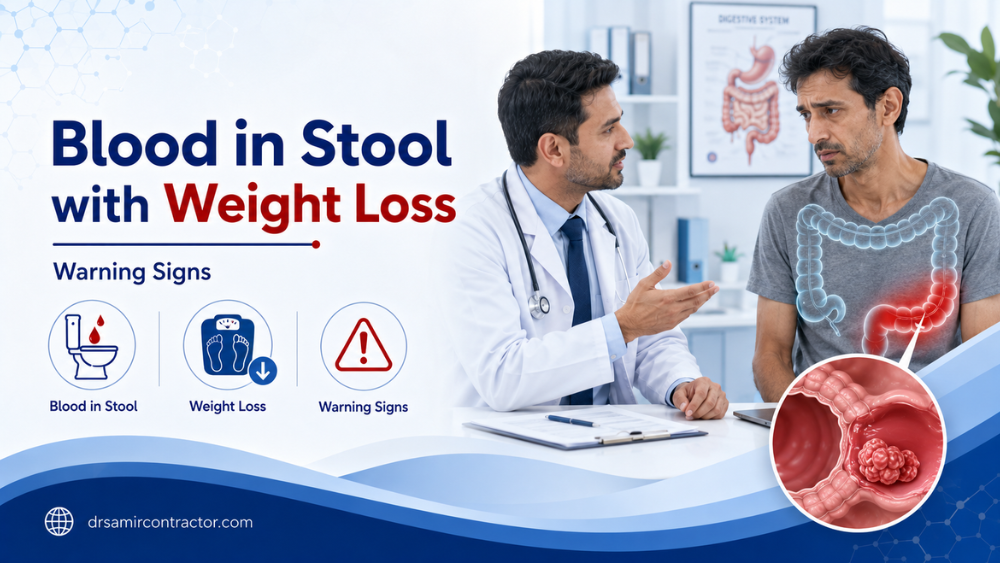
When blood in stool appears alongside unexplained weight loss, the body is sending a clear alarm. This symptom pair is the single strongest clinical indicator that something serious — often colorectal cancer — may be present. The purpose of this page is not to frighten you, but to give you the information you need to act quickly and get a colonoscopy without delay.
Quick Answer
Why Blood in Stool + Weight Loss Together Is a Red Flag
Blood in the stool is common. Weight loss happens for many reasons. But when both occur in the same person at the same time — and the weight loss has no obvious explanation — the clinical significance multiplies. This is not a situation where you watch and wait. This is a situation where you book a colonoscopy.
This page is different from our broader guide on colorectal cancer warning signs, which covers the full spectrum of the disease. Here we focus specifically on the symptom-cluster entry point: the patient who has noticed bleeding and weight loss together and wants to understand what it means.
Why Blood in Stool + Weight Loss Together Is a Red Flag
Each symptom alone has a long list of possible causes, many of them benign. But the combination narrows the differential diagnosis sharply. Here is why surgeons treat this pair with urgency:
- The bleeding points to a lesion inside the gut. Whether it is a tumour, a large polyp, or an ulcerated mass, something is eroding through the intestinal lining and exposing blood vessels.
- The weight loss points to a systemic process. Cancers consume energy. They trigger inflammatory cytokines that suppress appetite and accelerate muscle breakdown. The body is literally being consumed from within.
- Together, they suggest a tumour that is both locally destructive and metabolically active. This is the hallmark of a colorectal malignancy that has grown large enough to bleed and advanced enough to affect body composition.
Clinical reality: In published studies, the combination of rectal bleeding with unexplained weight loss has a positive predictive value for colorectal cancer that is significantly higher than either symptom in isolation. Guidelines from both NICE (UK) and ICMR (India) recommend urgent referral for colonoscopy when these two symptoms coexist.
The Cancer Connection: How Colorectal Tumours Cause Both Symptoms
A colorectal tumour produces bleeding and weight loss through distinct but overlapping mechanisms:
- Bleeding: As the tumour grows into the lumen (inner space) of the colon or rectum, its surface ulcerates. Blood vessels on the tumour surface break open with the passage of stool. Right-sided (ascending colon) tumours often cause dark or occult blood; left-sided and rectal tumours more commonly produce visible red blood.
- Chronic blood loss leads to iron-deficiency anaemia. The patient becomes tired, pale, and breathless — and these symptoms may overshadow the bleeding itself.
- Weight loss occurs through cancer cachexia. The tumour releases cytokines (TNF-alpha, IL-6, IL-1) that suppress appetite, increase basal metabolic rate, and break down skeletal muscle. The patient loses weight even without trying.
- Obstruction reduces food intake. As the tumour narrows the bowel lumen, patients eat less because they feel full quickly, bloated, or nauseated. This adds to the weight loss.
Beyond Cancer: Other Conditions That Cause Both Symptoms
While colorectal cancer is the most dangerous explanation, it is not the only one. A surgeon evaluating you will also consider:
| Condition | How it causes bleeding | How it causes weight loss | Key distinguishing feature |
|---|---|---|---|
| Inflammatory bowel disease (Crohn's, ulcerative colitis) | Chronic ulceration of the intestinal lining | Malabsorption, chronic inflammation, reduced appetite | Younger patients, relapsing-remitting pattern, mucus and diarrhoea prominent |
| Intestinal tuberculosis | Ulcerative lesions in the ileocaecal region | Chronic infection drives fever, night sweats, appetite loss | Common in India; may mimic Crohn's disease on imaging; TB contact history |
| Chronic amoebic or parasitic infections | Mucosal invasion causes bloody diarrhoea | Chronic nutrient loss, poor absorption | Travel history, contaminated water exposure, stool microscopy positive |
| Large colorectal polyps | Polyp surface bleeds, especially villous adenomas | Very large polyps can cause protein-losing enteropathy | Usually less weight loss than cancer; colonoscopy distinguishes easily |
| Coeliac disease with concurrent GI lesion | Co-existing ulcer or lesion may bleed | Severe malabsorption of nutrients | Chronic diarrhoea, iron deficiency, positive tTG antibody |
| HIV-associated GI disease | Opportunistic infections cause mucosal bleeding | HIV wasting syndrome | Known HIV status, multiple infections, low CD4 count |
The critical point: Regardless of the eventual diagnosis, every single condition in this table requires investigation that begins with a colonoscopy. The treatment path is different for each, but the diagnostic starting point is the same.
The Anaemia Bridge: How Chronic Blood Loss Connects Bleeding to Weight Loss
Many patients with this symptom pair have a third finding they may not be aware of: iron-deficiency anaemia. Understanding how anaemia fits into the picture is important.
- Slow, persistent bleeding — even if you do not see it in the stool — drains your iron reserves over weeks and months.
- Iron-deficiency anaemia causes fatigue, weakness, breathlessness, and poor appetite. These symptoms overlap with those of cancer cachexia, making it harder to identify the root cause without testing.
- Anaemia itself can contribute to weight loss through reduced appetite and activity. A patient who feels exhausted eats less and moves less, losing muscle mass.
- A low haemoglobin in someone with rectal bleeding is a red flag on its own. When combined with weight loss, the three-symptom cluster (bleeding + weight loss + anaemia) is among the strongest indicators for urgent colonoscopy.
The Three-Symptom Cluster
If you have blood in stool + unexplained weight loss + fatigue or pallor, ask your doctor to check your haemoglobin and serum ferritin immediately. Iron-deficiency anaemia in a middle-aged or older adult — without an obvious dietary cause — is considered a colorectal cancer marker until proven otherwise.
Red Flags: When to Seek Urgent Evaluation
See a surgeon or gastroenterologist within days — not weeks — if you have blood in stool along with any of the following:
- Unintentional weight loss of more than 3-4 kg
- Progressive fatigue, pallor, or breathlessness (suggesting anaemia)
- A change in bowel habits lasting more than 3 weeks — new constipation, diarrhoea, or alternating pattern
- Narrowing of stool calibre ("pencil-thin" stools)
- A feeling that the bowel does not empty completely (tenesmus)
- A palpable lump in the abdomen
- Family history of colorectal cancer or polyps
- Age over 40 with new-onset rectal bleeding — even without weight loss
- Dark or black stools (indicating higher GI source of bleeding)
- Persistent abdominal pain or bloating that does not resolve
If you recognise two or more items from this list, a colonoscopy is not optional — it is necessary.
Diagnosis: The Colonoscopy-First Approach
When a patient presents with blood in stool and weight loss, the evaluation follows a structured path. There are no shortcuts.
Step 1: Blood Tests
- Complete blood count (CBC): Checks haemoglobin level and MCV. A low haemoglobin with low MCV strongly suggests iron-deficiency anaemia from chronic blood loss.
- Iron studies: Serum ferritin, serum iron, and TIBC confirm iron deficiency.
- CEA (carcinoembryonic antigen): A tumour marker. Not used for screening, but useful as a baseline if cancer is found — it helps monitor treatment response later.
- Liver function tests and albumin: Low albumin may indicate advanced disease or chronic inflammation.
Step 2: Colonoscopy with Biopsy
This is the definitive test. A flexible scope examines the entire colon and rectum. Any suspicious lesion — mass, ulcer, polyp, narrowing — is biopsied during the same procedure. The biopsy result tells us whether the lesion is cancerous, precancerous, inflammatory, or infectious.
A colonoscopy takes 20-30 minutes, is done under sedation, and is safe. The information it provides is irreplaceable. No blood test, no CT scan, and no stool test can substitute for direct visualisation with biopsy.
Step 3: Staging (If Cancer Is Confirmed)
- CT scan of the abdomen and chest: Checks for spread to lymph nodes, liver, or lungs.
- MRI pelvis: For rectal cancers, to assess depth of invasion and involvement of surrounding structures.
- PET-CT: In select cases where distant spread is suspected.
Staging determines the treatment plan — whether surgery alone is sufficient, or whether chemotherapy and/or radiation need to be added before or after surgery.
Treatment Overview
The treatment depends entirely on the diagnosis. A brief overview:
| Diagnosis | Primary treatment | Prognosis when caught early |
|---|---|---|
| Colorectal cancer (Stage I-II) | Laparoscopic surgical resection; adjuvant chemotherapy if indicated | 5-year survival exceeds 80% in Stage I-II |
| Colorectal cancer (Stage III) | Surgery + chemotherapy (FOLFOX or CAPOX regimen) | 5-year survival approximately 50-70% |
| Large polyps / advanced adenomas | Endoscopic removal (polypectomy); surgical resection if too large | Excellent — removal prevents progression to cancer |
| Inflammatory bowel disease | Immunosuppressive therapy; surgery for complications | Good with long-term medical management |
| Intestinal tuberculosis | Anti-tubercular therapy (ATT) for 6-9 months | Excellent with complete treatment |
The key message: Early-stage colorectal cancer is highly curable with surgery alone. The survival rates drop substantially with each advancing stage. This is precisely why the combination of blood in stool with weight loss must be investigated without delay — catching the disease at Stage I instead of Stage III can be the difference between a straightforward operation and months of chemotherapy.
What Happens If This Combination Is Ignored?
This section exists because in clinical practice, patients frequently delay seeking help. The reasons are understandable — embarrassment, fear of the diagnosis, or being told it is "just piles." But the consequences of delay are measurable and severe:
- A Stage I cancer (confined to the bowel wall) may progress to Stage III or IV within 12-18 months. The tumour grows through the bowel wall, reaches lymph nodes, and eventually spreads to the liver or lungs.
- Anaemia worsens progressively. Patients become dependent on blood transfusions. Severe anaemia increases surgical risk when treatment finally begins.
- Weight loss accelerates. Cancer cachexia is difficult to reverse once established. Malnourished patients tolerate surgery and chemotherapy poorly.
- Bowel obstruction may occur. A growing tumour can block the colon completely, requiring emergency surgery — which carries higher complication rates than planned procedures.
- The treatment becomes more aggressive. What could have been a single laparoscopic operation now requires radiation, chemotherapy, and possibly a temporary or permanent stoma (colostomy bag).
A direct statement: If you have blood in your stool and you are losing weight without explanation, every week of delay reduces your chances of a good outcome. The colonoscopy itself is simple. The fear of the result should never outweigh the cost of late diagnosis.
India Relevance: Why This Problem Is Especially Critical Here
Late diagnosis is the norm, not the exception. In India, more than 60% of colorectal cancers are diagnosed at Stage III or IV. This is not because the disease behaves differently — it is because patients present late and symptoms are misattributed.
- The "piles assumption": Rectal bleeding in India is overwhelmingly attributed to piles — by patients and, unfortunately, by some practitioners. When a patient also reports weight loss, this should immediately override the piles assumption. But in many primary care settings, a colonoscopy is not ordered, and the cancer grows unchecked.
- Young-onset colorectal cancer is rising in India. Nearly 1 in 5 Indian colorectal cancer patients is under 40. Western screening guidelines that begin at age 45 may not apply to the Indian population. Any young patient with bleeding and weight loss needs investigation regardless of age.
- Intestinal TB mimics cancer. India has the world's highest TB burden, and intestinal TB can present with bleeding, weight loss, and a mass on CT scan. This makes biopsy even more critical — the treatment for TB and cancer are completely different, and misdiagnosis in either direction is harmful.
- Lack of screening infrastructure. India does not have a national colorectal cancer screening programme. Symptom-driven diagnosis is the primary pathway to detection. This makes it even more important that high-risk symptom combinations like blood in stool with weight loss trigger immediate investigation.
- Dietary transition and urbanisation are increasing colorectal cancer incidence in Indian metros. The shift away from traditional high-fibre diets toward processed food, combined with sedentary lifestyles, is contributing to rising case numbers.
The message for Indian patients: Do not accept a diagnosis of "piles" if you are also losing weight. Insist on a colonoscopy. The test is available at most district-level hospitals and is covered under several government health schemes.
Blood in Stool + Weight Loss? Get a Colonoscopy.
This symptom combination requires investigation — not reassurance. Book a consultation with Dr Samir Contractor for a structured evaluation and same-week colonoscopy at Sterling Hospital, Vadodara.
Frequently Asked Questions
Gujarati & Hinglish FAQs
Haa, aa combination cancer ni sabauthi strong nishani chhe. Colonoscopy karavi zaruri chhe — koi pan umar ma.
Piles thi vazan nathi ghattu. Banne sathe hoy to colonoscopy karavine kharai karano janvo zaruri chhe.
Dr Samir Contractor, Sterling Hospital, Vadodara ma colonoscopy ane biopsy ni facility chhe. WhatsApp karo: 9824593464
Ye combination serious hai. Piles ka ilaj se aage sochiye — colonoscopy zaroor karao. Jaldi pata chale to cancer bhi completely curable hai.
Haan. India me 20% se zyada colon cancer ke cases 40 saal se kam umar me hote hain. Sirf umar dekh ke symptoms ignore mat karo.
Nahi. Sedation me hota hai — 20-30 minute lagta hai. Tayyari (pet saaf karna) sabse mushkil part hai, procedure aaram se ho jata hai.
Related Reading
Medical Disclaimer: This content is for educational purposes and does not replace a face-to-face consultation with a qualified surgeon. Every patient's situation is unique — diagnosis and treatment must be individualised. If you are experiencing blood in stool with weight loss, please consult a doctor promptly. Dr Samir Contractor and Sterling Hospital are not responsible for clinical decisions made solely based on this article. In an emergency, visit your nearest hospital immediately.