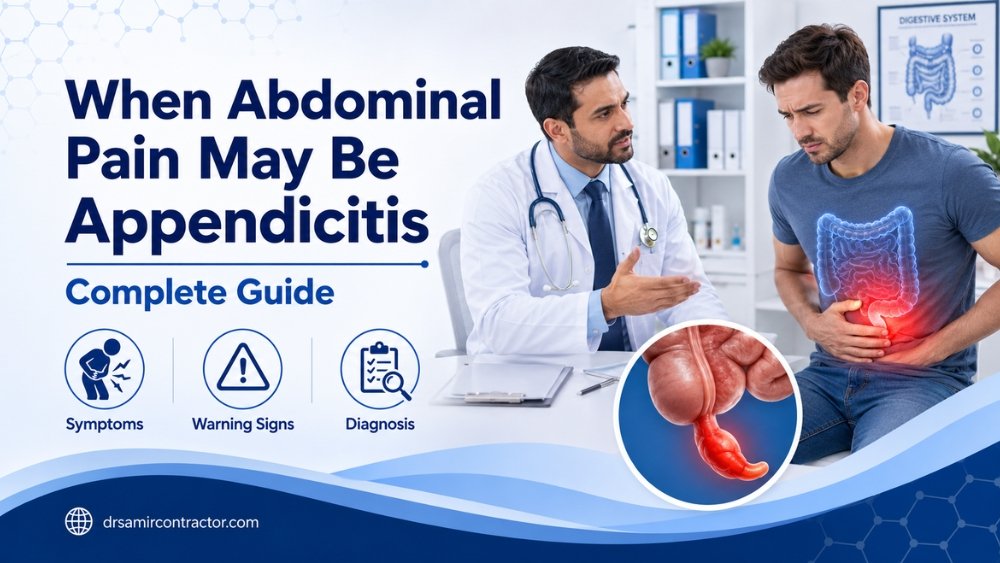
Appendicitis is the most common abdominal surgical emergency. Recognising it before perforation occurs - using the combination of classic symptoms, clinical scoring, and CT imaging - gives patients the best outcomes. This page provides a practical guide to identifying when abdominal pain may be appendicitis and what to do about it.
Quick Answers
Appendicitis is the most common cause of emergency abdominal surgery worldwide and in India. It affects all ages but peaks in adolescents and young adults. The challenge is that appendicitis can present in many ways - the "classic" presentation occurs in only 70% of cases. This guide covers all patterns.
The Alvarado Score - Clinical Tool for Appendicitis Probability
The Alvarado score assigns points to clinical features and blood test results to estimate appendicitis probability. Use this as a guide - never a substitute for clinical evaluation and investigation.
| Feature | Score |
|---|---|
| Migration of pain from periumbilical to right lower abdomen | +1 |
| Anorexia (loss of appetite) | +1 |
| Nausea and vomiting | +1 |
| Tenderness in the right lower abdomen | +2 |
| Rebound tenderness (pain on lifting examining hand) | +1 |
| Elevated temperature (>37.3°C) | +1 |
| Elevated white blood cell count (WBC >10,000) | +2 |
| Shift to left on WBC differential (neutrophilia) | +1 |
| Total: | 10 points |
| Score | Probability | Recommended Action |
|---|---|---|
| 1–4 | Low | Discharge with observation; return if symptoms worsen |
| 5–6 | Indeterminate | CT scan; hospital observation |
| 7–8 | High | CT scan; surgical evaluation; likely appendectomy |
| 9–10 | Very High | Emergency appendectomy without delay; CT optional |
Patient Self-Checklist - "Does My Pain Sound Like Appendicitis?"
Tick each feature you have. More ticks = higher likelihood of appendicitis:
- (+1) Pain started around my navel and has now moved to the right lower abdomen
- (+1) I have lost my appetite - I don't feel like eating at all
- (+1) I feel nauseous or have vomited once or twice
- (+2) The right lower abdomen is tender when I press on it
- (+1) I have a low-grade fever (above 37.5°C)
- (+1) The pain has been getting progressively worse over the last several hours
- (+1) I walk hunched or avoid sudden movement because it makes the pain worse
If you ticked 4 or more boxes - go to hospital for surgical evaluation now.
Atypical Presentations - When Appendicitis Doesn't Follow the Classic Pattern
- Retrocaecal appendicitis (30%) - appendix points backward; pain is more in the right flank, not classic right lower; may be confused with renal colic
- Pelvic appendicitis (15%) - appendix hangs into the pelvis; pain is more suprapubic (lower central/right lower); may cause urinary symptoms or diarrhoea
- Appendicitis in pregnancy - the appendix is displaced upward by the growing uterus; pain may be in the right flank or right upper abdomen rather than right lower; diagnosis is more challenging
- Appendicitis in children - anorexia and nausea may be more prominent than pain localisation; children progress to perforation faster (24–36 hours); always take abdominal pain seriously in children
- Appendicitis in the elderly - may present atypically; fever and pain may be less dramatic; higher rate of perforation at presentation due to blunted inflammatory response
When It Is No Longer "Just Appendicitis" - Signs of Perforation
Perforation may have occurred if appendicitis symptoms are followed by:
- Brief apparent improvement of pain - the appendix has ruptured and pressure released
- Pain then spreading to entire abdomen - peritonitis developing
- Abdomen becoming rigid or board-like
- Significantly worsening fever (>39°C) and rapidly rising WBC
- Patient appearing more systemically unwell, not better
Once the appendix has perforated and generalised peritonitis develops, the operation is more complex, hospital stay is longer, and recovery is slower. This is entirely preventable by seeking care when the classic symptoms first appear.
Investigations and Treatment
CT scan - definitive investigation
Sensitivity >95% for appendicitis. Identifies: inflamed appendix (>6mm with periappendiceal fat stranding), perforation, appendicular mass/abscess. Performed when Alvarado score is 5–8 or clinical diagnosis is uncertain. Time to CT should not delay surgery when clinical diagnosis is very high.
Laparoscopic appendectomy
3 small incisions, 30–60 minutes, next-day discharge for non-perforated disease. Recovery in 1–2 weeks. Excellent safety profile. The only curative treatment for appendicitis.
Frequently Asked Questions
Appendicitis in India
- Appendicitis is extremely common in India - affecting predominantly young adults and children, often in the 10–30 age group
- Delayed presentation is a major problem - many patients take pain killers for 24–48 hours at home before presenting, by which time perforation has often occurred
- Negative appendectomy rate (operating and finding a normal appendix) has reduced dramatically with CT availability - but CT must not delay surgery when clinical diagnosis is very strong
- Access to laparoscopic appendectomy has expanded across India's tier-2 and tier-3 cities - outcomes at experienced centres are excellent
Desi Patient Questions
Ha - immediately. 5+ features = appendicitis highly likely. CT scan confirm karshe. Jyaré confirmed thay to laparoscopic surgery same day. Do not wait - every hour delay vadhare chhe perforation risk. Hospital javo ABHI.
Laparoscopic appendectomy pachhi: next day discharge most cases ma. 1 week light activity. 2 weeks full recovery. School/office: 1-2 weeks. Physical work: 2-4 weeks. Very quick recovery compared to open surgery. Mini-scars jo nearly invisible thay chhe.
Seek Care in Vadodara
When your pain pattern suggests appendicitis - Dr Samir Contractor at Sterling Hospital, Vadodara provides same-day CT evaluation and laparoscopic appendectomy. Do not wait for the pain to get worse.
Think It Might Be Appendicitis? Don't Wait.
CT scan + same-day laparoscopic appendectomy if confirmed. Emergency evaluation available 24 hours at Sterling Hospital.