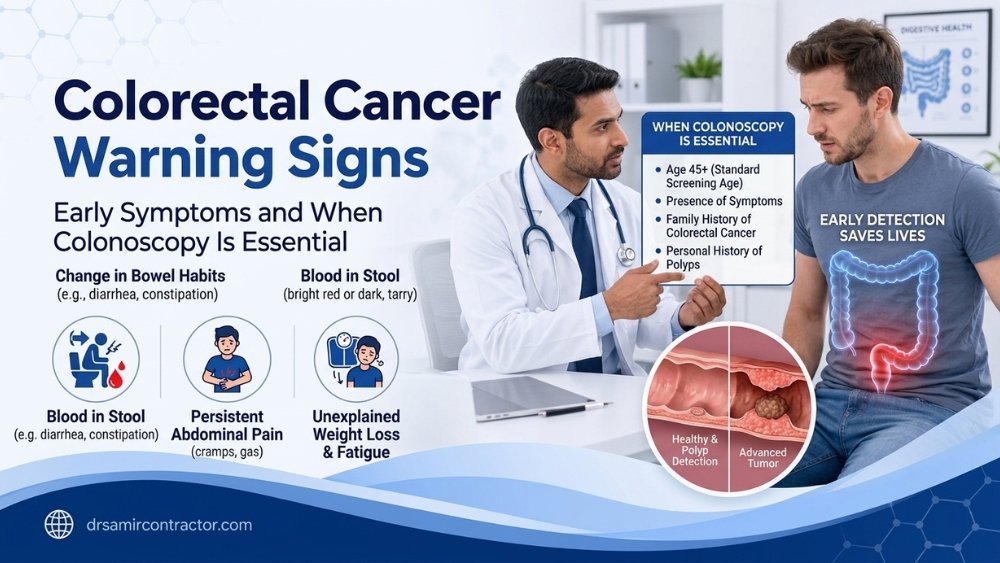
Colorectal cancer is one of the most common and most preventable GI cancers in India. It typically grows slowly from polyps over 10-15 years, providing a window for early detection. Early-stage colorectal cancer is highly curable. Advanced-stage disease has poor prognosis. Recognising the warning signs and acting on them with colonoscopy is the most important preventive action an Indian patient above 45 can take.
✦ Quick Answers
These Symptoms Above Age 45 - Colonoscopy Without Delay
- Blood in stool - bright red OR dark red OR mixed into stool
- New constipation or change in bowel habit that is persisting
- Pencil-thin or ribbon-like stools that are different from usual
- Unintended weight loss alongside bowel symptoms
- Abdominal pain or cramping not explained by other causes
- Feeling that the bowel never fully empties (tenesmus)
- Unexplained iron deficiency anaemia
- Mucus in stool without other clear cause
Warning Signs by Stage
Early-stage colorectal cancer (Stage I-II)
Often asymptomatic - or minimal symptoms that are dismissed as haemorrhoids. Blood in stool may be the only sign. Change in bowel habit or vague abdominal discomfort. Weight loss is usually absent. Colonoscopy at this stage allows curative surgery.
Locally advanced (Stage III)
Symptoms become more prominent - constipation or change in bowel habit is more persistent, blood in stool is more consistent, weight loss may begin. Abdominal pain. Colonoscopy with biopsy confirms diagnosis; staging CT determines extent.
Metastatic (Stage IV)
Symptoms of advanced disease - significant weight loss, fatigue, liver pain (right upper abdomen, may cause jaundice if liver metastases obstruct bile), lung symptoms (cough, breathlessness). Outcome is significantly poorer. This is the stage most Indian patients present at due to delayed colonoscopy.
Risk Factors for Colorectal Cancer
| Risk Factor | Increased Risk |
|---|---|
| Age ≥45 | Risk increases progressively with age; most cases above 50 |
| Family history | First-degree relative with colorectal cancer: 2-3× increased risk |
| Personal history of polyps | Adenomatous polyps significantly increase risk |
| Inflammatory bowel disease | Longstanding colitis: 5-8× increased risk; requires surveillance |
| Low-fibre, high red meat diet | Particularly processed meat (sausages, salami) |
| Obesity | Central obesity associated with increased risk |
| Physical inactivity | Sedentary lifestyle increases colonic transit time |
| Smoking | Significant independent risk factor |
| Alcohol | Dose-dependent increase in risk |
| Hereditary syndromes | FAP (familial adenomatous polyposis) and Lynch syndrome: very high lifetime risk |
The Most Important Message
Diagnosis and Staging
- Colonoscopy + biopsy: Definitive diagnosis; identifies cancer type, location, degree of differentiation
- CT scan of chest, abdomen, pelvis: Staging - identifies lymph node involvement, liver metastases, lung metastases
- MRI rectum: For rectal cancer - determines relationship to mesorectal fascia (critical for surgical planning and neoadjuvant therapy decision)
- PET-CT: For staging in selected cases - identifies distant metastases
- CEA (carcinoembryonic antigen): Tumour marker - useful for monitoring treatment response and detecting recurrence, not for diagnosis
Treatment Overview
- Stage I-II colon cancer: Laparoscopic right or left hemicolectomy / sigmoid colectomy - curative intent; no chemotherapy needed for most stage I and many stage II cases
- Stage III colon cancer: Surgery + adjuvant chemotherapy (CAPOX or FOLFOX) - reduces recurrence risk by 30%
- Rectal cancer: Pre-operative chemoradiotherapy (neoadjuvant) followed by surgery for locally advanced rectal cancer; preserving the sphincter where possible (anterior resection); abdominoperineal resection for low tumours involving the sphincter
- Stage IV: Systemic chemotherapy (FOLFOX, FOLFIRI + targeted therapy); resection of limited liver metastases in selected patients
- Total mesorectal excision (TME): The surgical technique standard for rectal cancer - precise excision of the mesorectal envelope reduces local recurrence to <5%< /li>
?? Colorectal Cancer in India
India-specific context
- Colorectal cancer incidence is rising in India - estimated 40,000-50,000 new cases annually, with urban populations showing particularly rapid increases
- The average stage at diagnosis in India is III-IV - compared to I-II in countries with organised screening programmes. This explains the much lower survival rates
- The main barrier to early diagnosis is the cultural assumption that rectal bleeding is "just piles" - delaying colonoscopy by months or years
- India has no national colorectal cancer screening programme - but opportunistic colonoscopy starting at age 45 for average-risk and age 40 (or 10 years before youngest affected relative) for high-risk patients is the recommended standard
- Laparoscopic colorectal surgery is increasingly available in major centres including Vadodara - with outcomes comparable to open surgery and significantly faster recovery
Desi Patient Questions
Ha - absolutely. Blood in stool + change in bowel habit = colorectal cancer warning signs. Colonoscopy ASAP. Majority cases ma benign cause milshe - pun cancer exclude karvu mandatory chhe. Early stage ma cancer = surgery se cure possible chhe. Delay = worse stage = worse outcome. Please do not wait.
Ha - family history = higher risk. Colonoscopy at age 40 ya 10 years before youngest affected relative. Doctor pase jao ane family history discuss karo. Colonoscopy thi polyps early identify ane remove thay - cancer prevention most effective approach chhe.
Frequently Asked Questions
Related Pages
Colorectal Cancer Warning Signs? Get Colonoscopy in Vadodara Now
Don't dismiss warning signs as "just piles." Dr Samir Contractor at Sterling Hospital, Vadodara provides urgent colonoscopy, diagnosis, and surgical management.
Medical Disclaimer: For patient education only. Warning signs require urgent medical evaluation.