Hemorrhoids - commonly called piles - are enlarged, engorged blood vessels in and around the anal canal. They are among the most common conditions in India and are usually caused by chronic straining and constipation. Most hemorrhoids are very treatable without surgery. Grade-based management - from dietary change to rubber band ligation to surgical hemorrhoidectomy - provides excellent results.
✦ Quick Answers
Hemorrhoids are present in everyone - they are normal vascular structures in the anal canal (the anal cushions at 3, 7, and 11 o'clock positions) that help with continence. They become symptomatic (clinical hemorrhoidal disease) when they enlarge, engorge, and prolapse. Chronic straining from constipation, a low-fibre diet, sedentary lifestyle, pregnancy, and portal hypertension are the main drivers.
In India, "piles" is one of the most common reasons patients see a general surgeon - and one of the most under-discussed conditions due to embarrassment. Early treatment prevents progression to larger, more symptomatic hemorrhoids requiring more invasive procedures.
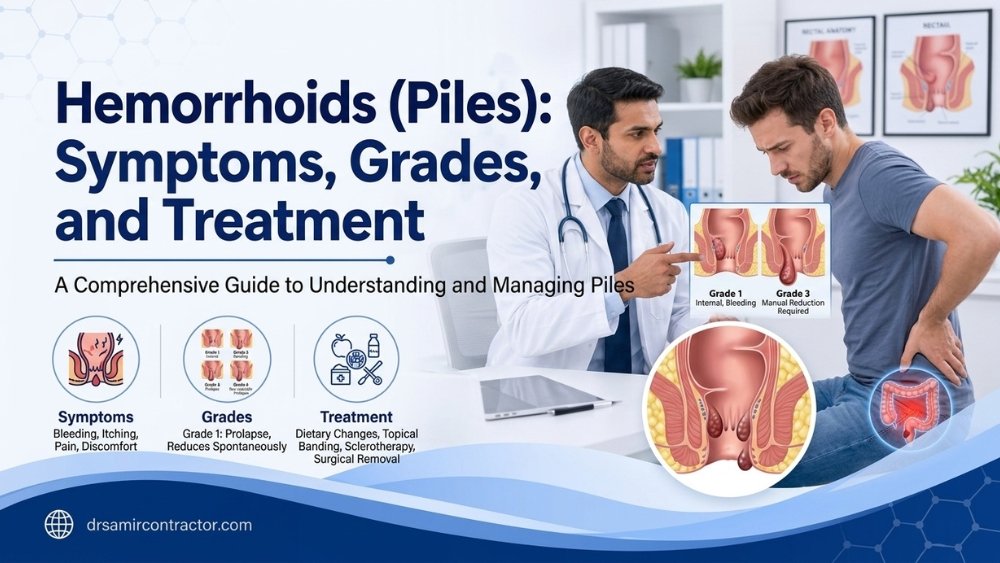
Grading System - Internal Hemorrhoids
| Grade | Description | Symptoms | Treatment |
|---|---|---|---|
| Grade I | Enlarged but do not prolapse - remain inside anal canal | Bright red bleeding only - no prolapse, no pain | Dietary change, fibre, sclerotherapy |
| Grade II | Prolapse on straining but reduce spontaneously | Bleeding, mucus, occasional feeling of something coming out that goes back on its own | Dietary change + rubber band ligation |
| Grade III | Prolapse on straining; require manual reduction | Bleeding, mucus, prolapse needing pushing back, discomfort, incomplete evacuation sensation | Rubber band ligation or hemorrhoidectomy |
| Grade IV | Irreducibly prolapsed - cannot be pushed back | Constant prolapse, mucus, pain, bleeding, thrombosis possible | Surgical hemorrhoidectomy |
External hemorrhoids
Located below the dentate line; covered by squamous epithelium; typically cause pain, swelling, and thrombosis. Thrombosed external hemorrhoid: sudden onset severe anal pain with a visible, tender bluish-purple lump at the anus. Treated by excision within 72 hours of onset for immediate relief.
Symptoms
- Bright red rectal bleeding - the most common symptom; blood on toilet paper, coating stool surface, or dripping into bowl. Does not cause dark blood or melaena.
- Prolapse - tissue coming out during or after straining; may reduce spontaneously (grade II) or require manual reduction (grade III) or remain prolapsed (grade IV)
- Mucus discharge - the prolapsed mucosa secretes mucus; causes soiling and anal itching (pruritus ani)
- Anal discomfort - heaviness or dragging sensation; worsened by prolonged sitting
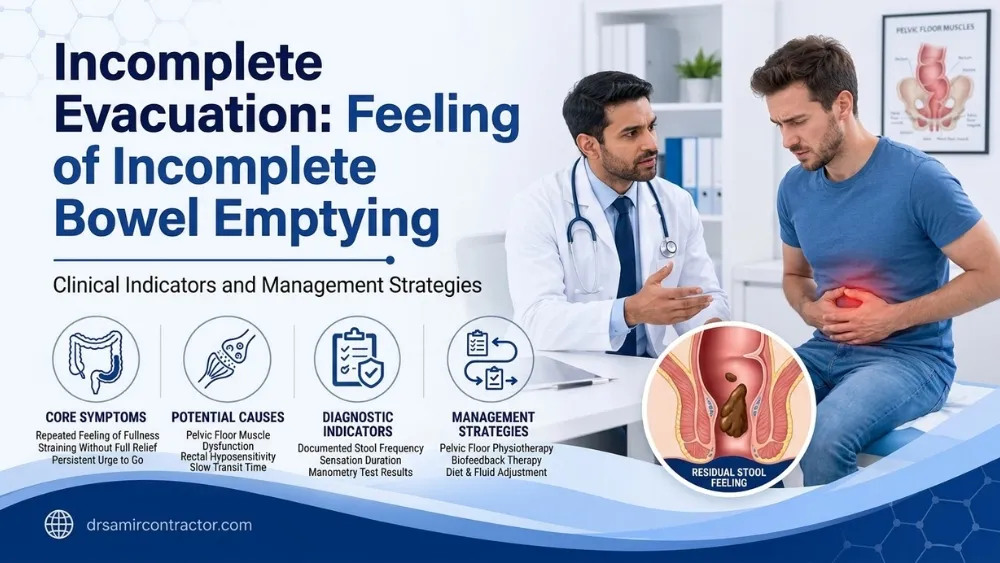
- Incomplete evacuation sensation - from the prolapsed tissue at the anal outlet
- Thrombosis - sudden severe pain from clot formation in an external hemorrhoid
Red Flags - When Hemorrhoid Bleeding Needs More Investigation
Colonoscopy needed even when hemorrhoids are confirmed if:
- Patient is above 45 years of age
- Weight loss accompanies bleeding
- Blood is mixed into stool (not just on surface)
- Change in bowel habit - new constipation or diarrhoea
- Family history of colorectal cancer
- Anaemia on blood tests
Treatment
Dietary Foundation - Always First for All Grades
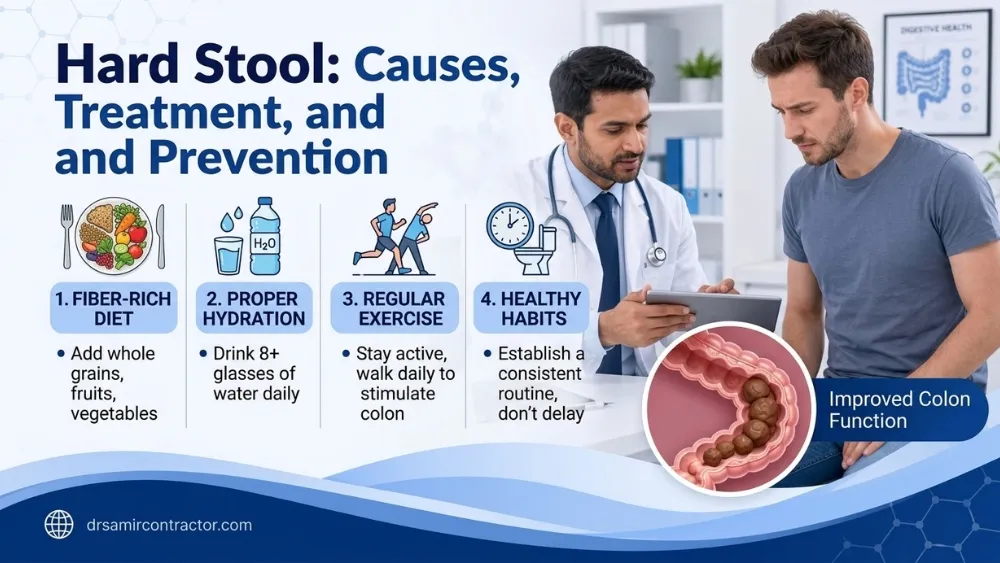
- High-fibre diet (25-35g/day) and 2-3L water - reduces straining; the primary cause of hemorrhoid progression
- Avoid spending more than 5 minutes on the toilet - no phone or book reading during defecation
- Footstool during defecation - reduces straining effort
- Regular physical activity
- Sitz baths (warm water) after bowel movements - reduces discomfort and swelling
Outpatient procedures (Grade I-III)
- Rubber band ligation (RBL): The most widely used office procedure for grade II-III hemorrhoids. A small rubber band is placed at the base of the internal hemorrhoid, cutting off its blood supply. The hemorrhoid shrinks and falls off within 1-2 weeks. Highly effective (80-90% success for grade II-III). Minimal pain. No anaesthesia. Repeat for multiple hemorrhoids at separate sessions 4-6 weeks apart.
- Sclerotherapy: Injection of a sclerosant agent into grade I-II hemorrhoids. Simple office procedure. Good for grade I bleeding hemorrhoids.
- Infrared coagulation: Heat applied to hemorrhoid base - similar indications and results to sclerotherapy.
Surgical hemorrhoidectomy (Grade III-IV, failed conservative or procedural)
- Conventional hemorrhoidectomy (Milligan-Morgan or Ferguson): Surgical excision of hemorrhoidal tissue under general or spinal anaesthesia. 1-3 day hospital stay. 2-3 week recovery. Very effective (90%+); more painful than other procedures in the short term.
- Stapled hemorrhoidopexy (PPH - Procedure for Prolapse and Hemorrhoids): A circular stapler removes a ring of mucosa above the hemorrhoids, lifting them back into normal position and cutting off their blood supply. Less pain than conventional hemorrhoidectomy. Shorter recovery. Not suitable for all cases; higher recurrence rate for grade IV.
- HAL-RAR (Hemorrhoidal Artery Ligation and Recto-Anal Repair): Doppler-guided ligation of feeding arteries; plication of prolapsed tissue. Minimal pain, outpatient in some centres.
Hemorrhoids in India
India-specific context
- Hemorrhoidal disease is one of the most common conditions seen by colorectal and general surgeons in India - affecting millions of patients across all age groups
- Cultural hesitancy and embarrassment lead to very delayed presentation - many patients have grade III-IV disease that could have been treated with simple banding if presented earlier
- The transition from traditional squat toilets (natural squatting position) to Western sitting toilets increases anorectal pressure and straining - contributing to hemorrhoid development
- Low-fibre Indian diets (refined rice, maida) and sedentary office work are major drivers of chronic straining
- Rubber band ligation - an excellent outpatient procedure - is widely available at colorectal surgical centres in Vadodara
Desi Patient Questions
Grade I-II: dietary change + rubber band ligation (outpatient, no anaesthesia, 20-minute procedure, highly effective). Grade III: banding ya surgery. Grade IV: surgery necessary. Most patients Grade I-II ma non-surgical treatment thi thik thay chhe. Doctor examination thi grade confirm thay chhe ane appropriate treatment guide kare chhe.
Age 45+ hoy, ya weight loss hoy, ya stool ma blood mixed hoy - ha, colonoscopy zaruri chhe. Younger patients ma typically examination + treatment first. But hemorrhoids confirmed hova thi cancer automatically exclude nahi thatu - both can coexist. Doctor nu guidance follow karo.
Frequently Asked Questions
Related Pages
Hemorrhoids (Piles)? Get Properly Graded and Treated in Vadodara
From rubber band ligation to hemorrhoidectomy - Dr Samir Contractor at Sterling Hospital, Vadodara provides comprehensive hemorrhoid management.
Medical Disclaimer: For patient education only. Not a replacement for medical consultation.