Rectal prolapse occurs when the full-thickness rectal wall protrudes through the anus. It is most common in elderly women and in patients with chronic straining and constipation. It causes a red, moist tissue mass at the anus, mucus discharge, and often faecal incontinence. Treatment is surgical - laparoscopic mesh rectopexy provides excellent long-term results with minimal recovery time.
✦ Quick Answers
Rectal prolapse is a condition that significantly affects quality of life but is often under-diagnosed because patients are embarrassed to report a "lump coming out" and because many doctors in India do not perform a thorough anorectal examination. The condition is very treatable with surgery, with good functional outcomes in appropriately selected patients.
Types of Rectal Prolapse
Full-Thickness (Complete) Rectal Prolapse
- All layers of rectal wall protrude
- Characteristic concentric rings visible on examination
- Initially reduces spontaneously; later requires manual reduction; eventually irreducible
- Associated with faecal incontinence and constipation
- Requires surgical repair
? Mucosal Prolapse
- Only mucosal layer prolapses
- Radial folds visible (unlike concentric in full prolapse)
- Often confused with prolapsed hemorrhoids
- Less severe - may respond to conservative treatment or local procedures
- Does not cause true faecal incontinence
Internal rectal prolapse (intussusception)
The rectal wall folds internally but does not protrude through the anus. Causes incomplete evacuation, straining, and ODS symptoms. Diagnosed by defecography or proctoscopy. Managed with biofeedback and sometimes STARR or rectopexy.
Symptoms
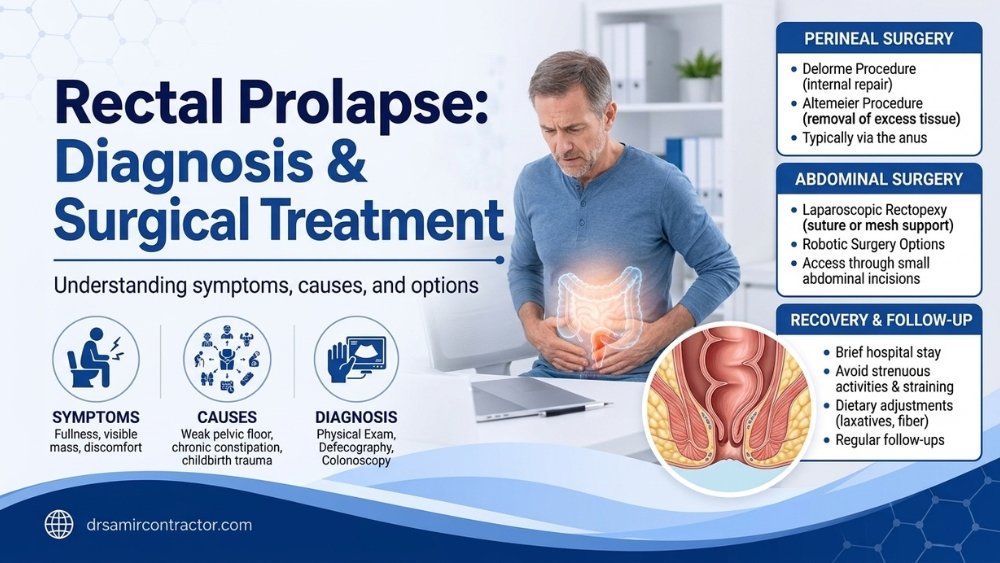
- Red, moist tissue protruding from the anus during defecation or straining - initially reduces spontaneously, later needs manual reduction
- Mucus discharge - the prolapsed mucosa secretes excess mucus; causes soiling and pruritus
- Faecal incontinence - chronic prolapse stretches the sphincters; may cause inability to control flatus and faeces
- Sensation of incomplete evacuation
- Constipation and obstructed defecation - particularly with internal prolapse
- Bleeding - from mucosal trauma on the prolapsed segment
Causes and Risk Factors
- Pelvic floor weakness - multifactorial; previous vaginal delivery, age-related weakness, connective tissue disorders
- Chronic straining and constipation - repeatedly pushing the rectum downward
- Neurological conditions - spinal cord injury, cauda equina lesions, multiple sclerosis
- Previous anorectal surgery - disruption of the anatomical supports
- Chronic diarrhoea - repeated liquid stool passage weakens pelvic floor
- Elderly age - progressive atrophy of pelvic floor support structures
When to Seek Urgent Care
Seek emergency care if rectal prolapse is:
- Irreducible - prolapse cannot be pushed back in; strangulation risk
- Strangulated - prolapsed segment has its blood supply cut off; becomes oedematous, dark, and painful
- Gangrenous - dark, necrotic tissue; needs emergency surgery
Treatment
Conservative management (limited role)
For mucosal prolapse or internal prolapse - biofeedback, pelvic floor physiotherapy, dietary changes. For full-thickness prolapse, conservative management is temporary at best - it prevents progression but does not cure.
Surgical repair - definitive treatment
Laparoscopic ventral mesh rectopexy (LVMR) - preferred approach in younger and fit patients:
- The rectum is mobilised from the front (anterior approach), preserving autonomic nerves
- A synthetic mesh is sutured to the anterior rectal wall and fixed to the sacral promontory
- Addresses full-thickness prolapse, internal prolapse, rectocele, and enterocele simultaneously
- Performed laparoscopically - 2-3 small incisions
- Hospital stay 2-3 days; recovery 2-3 weeks
- Recurrence rate <5% at 5 years in experienced centres
- Low incontinence risk; may improve defecation function
Perineal procedures (Delorme or Altemeier) - for elderly or high surgical risk patients:
- Performed from below (perineal approach); no abdominal incision
- Delorme: plication of rectal muscle after mucosal stripping
- Altemeier (perineal rectosigmoidectomy): resection of prolapsed bowel segment
- Lower physiological stress - suitable for very elderly or medically compromised
- Higher recurrence rate than abdominal procedures (15-30% at 5 years)
Desi Patient Questions
Possible chhe - full thickness rectal prolapse ya mucosal prolapse. Doctor examination thi distinguish karshe. Jyaré concentric rings visible hoy = full prolapse = surgical repair needed (laparoscopic mesh rectopexy preferred). Jyaré radial folds hoy = mucosal prolapse/hemorrhoids = different treatment. Please get examined - do not delay.
Frequently Asked Questions
Related Pages
Rectal Prolapse? Get Expert Surgical Repair in Vadodara
Laparoscopic mesh rectopexy and perineal procedures - Dr Samir Contractor at Sterling Hospital, Vadodara.
Medical Disclaimer: For patient education only. Not a replacement for medical consultation.