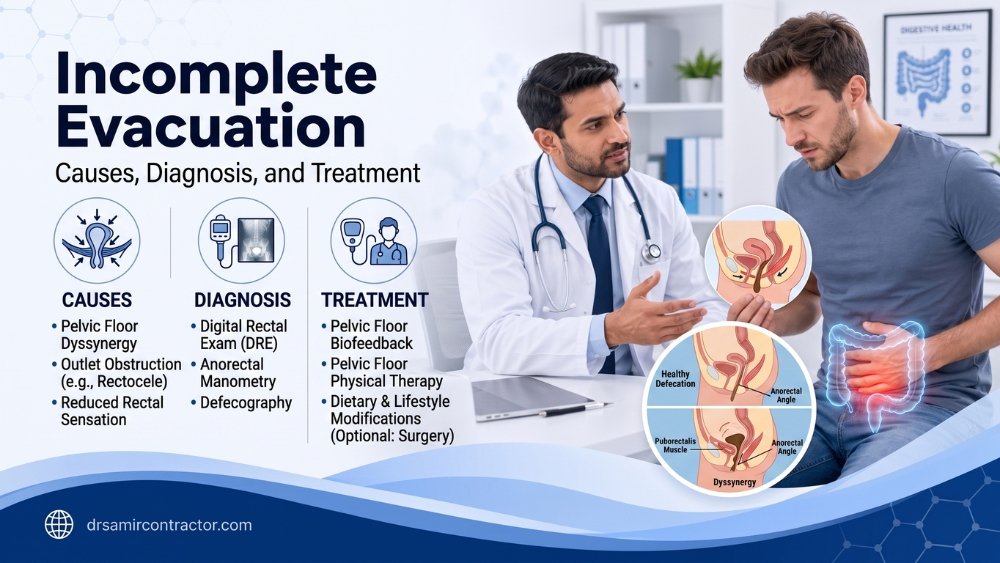
By Dr Samir Contractor, MS, FMAS, FIAGES — Senior Surgeon & Colorectal Specialist, Sterling Hospital, Race Course Road, Vadodara — 25+ years of clinical experience · 8,000+ successful surgeries — Published: 17 April 2026
Incomplete evacuation - the persistent feeling that your bowels have not fully emptied after a trip to the toilet - is one of the most frustrating digestive complaints. This page explains every major functional and structural cause behind incomplete bowel emptying, walks through the specialised tests used to reach a diagnosis (including anorectal manometry and defecography), describes when the symptom is harmless and when it needs urgent attention, and outlines the full range of treatment options from biofeedback to surgery.
✦ Quick Answers - Incomplete Evacuation at a Glance
What Is Incomplete Evacuation?
Incomplete evacuation refers to the persistent feeling of incomplete bowel movement - the sense that you have not finished even though you have been to the toilet. Patients describe it in many ways: "I feel like there is still stool inside," "I can never fully empty," or "I keep going back to the bathroom within 15 minutes."
This symptom sits at the intersection of colorectal surgery, pelvic floor medicine and gastroenterology. It is not a diagnosis by itself - it is a signal that something in the defecation process is not working correctly. The underlying cause may be functional (a muscle coordination or sensory problem) or structural (an anatomical change in the rectum or pelvic floor).
The symptom is remarkably common. Studies suggest that 20-30% of adults report incomplete bowel emptying at some point, and it is one of the defining criteria of both chronic constipation and irritable bowel syndrome. It is especially prevalent in women after vaginal childbirth, where pelvic floor injury and rectocele are frequent contributors.
Functional vs. Structural Causes - Why This Distinction Matters
The single most important question a specialist asks when evaluating incomplete evacuation is: Is this a problem of function or structure? The answer determines the entire treatment pathway.
Functional Causes (No Visible Anatomical Problem)
In functional incomplete evacuation, the anatomy of the rectum and pelvic floor looks normal on imaging. The problem lies in how the muscles and nerves coordinate the act of defecation.
Dyssynergic Defecation (Pelvic Floor Dyssynergia)
This is the most common functional cause of incomplete evacuation. Normally, when you push to have a bowel movement, the puborectalis and external anal sphincter muscles relax to open the outlet. In dyssynergia, these muscles paradoxically contract or fail to relax, creating a functional obstruction. Patients strain excessively, spend a long time on the toilet, and still feel as though stool remains inside.
Dyssynergia is diagnosed by anorectal manometry (which measures the pressure patterns during simulated defecation) and a balloon expulsion test (which checks whether the patient can push out a water-filled balloon within a normal time frame). The good news is that biofeedback therapy - a specialised form of pelvic floor retraining - successfully corrects the pattern in the majority of patients.
Slow-Transit Constipation
When the colon moves stool too slowly, the rectum may never receive a full bolus. Patients feel an incomplete urge, pass small hard fragments, and are left with a residual stool feeling. A colonic transit study (markers swallowed and tracked on X-ray) can confirm the diagnosis.
Irritable Bowel Syndrome (IBS)
IBS - particularly the constipation-predominant type (IBS-C) - frequently includes a sensation of incomplete evacuation as a core symptom. In IBS, rectal sensitivity is altered: the rectum may signal "not empty" even when it is, creating a phantom residual sensation. Addressing the broader IBS picture (diet, stress management, gut-directed therapy) often resolves this symptom.
Rectal Hyposensitivity
Some patients have a blunted ability to sense stool in the rectum. They do not feel the urge to go until the rectum is overfull, and even then, the sensation is vague and incomplete. This can result from chronic straining, nerve injury, or habitual suppression of the defecation urge. Anorectal manometry with sensory testing identifies the problem.
Structural Causes (An Anatomical Problem Is Present)
Structural causes involve a physical change in the rectum, anal canal or pelvic floor that mechanically interferes with complete emptying.
Rectocele
A rectocele is a bulge of the front wall of the rectum into the back wall of the vagina. During defecation, stool gets trapped in the pocket created by the bulge instead of moving downward and out. The hallmark symptom is the need to press on the vaginal wall or perineum (splinting) to complete the bowel movement. Rectoceles are very common in women who have had one or more vaginal deliveries, and the risk increases with age, obesity and chronic straining.
Small rectoceles (under 2 cm) are often incidental and do not need treatment. Symptomatic rectoceles - those causing significant trapping of stool - can be repaired surgically (transanal, transvaginal or perineal approach).
Rectal Intussusception (Internal Rectal Prolapse)
In rectal intussusception, the upper rectal wall telescopes downward into the lower rectum or anal canal during straining. This creates a mechanical obstruction that blocks stool from passing, producing a strong sensation of incomplete defecation. Patients often describe needing to strain repeatedly and feeling a "blockage" low in the pelvis. Defecography (either fluoroscopic or MRI-based) is the definitive test to visualise the intussusception in real time.
Large Internal Haemorrhoids
Grade III-IV internal haemorrhoids that prolapse into the anal canal can create a physical sense of fullness and obstruction. Patients feel as though something is "still there" after defecation, and they may notice mucus discharge, minor bleeding, or the need to manually reduce a prolapsing mass. Treatment ranges from rubber band ligation to surgical haemorrhoidectomy depending on grade.
Rectal Mass or Large Polyp
A growth in the rectum - whether a benign polyp or a malignancy - can occupy space and produce a constant sense of incomplete evacuation. This is one of the most important reasons to never ignore a persistent, unexplained change in evacuation sensation. Associated warning signs include rectal bleeding, pencil-thin stools, mucus, and unintended weight loss. Colorectal cancer warning signs →
Enterocele and Pelvic Organ Prolapse
An enterocele (herniation of the small bowel into the recto-vaginal space) or significant pelvic organ prolapse can compress the rectum externally, obstructing complete evacuation. This is most common in older women with a history of multiple deliveries or prior pelvic surgery.
Functional vs. Structural Causes - Comparison Table
| Feature | Functional Cause | Structural Cause |
|---|---|---|
| Anatomy on imaging | Normal | Abnormal (rectocele, intussusception, mass) |
| Key test | Anorectal manometry, balloon expulsion | Defecography, colonoscopy, MRI pelvis |
| Typical patient | Any age; learned behaviour, IBS | Women post-childbirth; older adults |
| Need for splinting (vaginal/perineal pressure) | Rare | Common (especially rectocele) |
| First-line treatment | Biofeedback, dietary fibre, behavioural therapy | Surgical repair, colonoscopic polypectomy |
| Rectal bleeding | Usually absent | May be present (mass, haemorrhoids) |
Common Causes at a Glance
| Cause | Mechanism | Key Diagnostic Clue |
|---|---|---|
| Dyssynergic defecation | Pelvic floor muscles contract instead of relaxing | Abnormal push pattern on manometry |
| Rectocele | Stool traps in anterior rectal bulge | Need to press vaginal wall to empty |
| Rectal intussusception | Rectal wall telescopes inward, blocking outlet | Visible fold on defecography |
| Large internal haemorrhoids | Prolapsing tissue creates sensation of fullness | Mucus, minor bleeding, palpable mass |
| Rectal mass / polyp | Space-occupying lesion | Bleeding, thin stools, weight loss |
| Slow-transit constipation | Colon moves stool too slowly | Delayed markers on transit study |
| IBS-C | Altered rectal sensitivity | Bloating, pain relieved by stool, Rome IV criteria |
| Rectal hyposensitivity | Blunted rectal sensation | Raised sensory thresholds on manometry |
Incomplete Evacuation and Obstructed Defecation Syndrome
When structural and functional problems combine to produce a pattern of chronic incomplete emptying, excessive straining, digital assistance and prolonged toilet time, the umbrella term obstructed defecation syndrome (ODS) is used. ODS is not a single disease but a clinical syndrome with multiple possible contributors - rectocele, intussusception, dyssynergia, enterocele - often present simultaneously.
A thorough workup for ODS typically involves anorectal manometry, defecography and sometimes a colonic transit study to separate outlet obstruction from whole-colon slow transit. Treatment is tailored to the dominant contributing factor.
When Should You Worry? Red Flags
See a Doctor Urgently If You Have:
- Rectal bleeding - bright red or dark blood mixed with stool alongside incomplete emptying
- Progressive narrowing of stools - pencil-thin stool that persists for more than 2 weeks
- Unintended weight loss (more than 5 kg over 3 months without dieting)
- New-onset symptom after age 45 without prior history of constipation or pelvic floor issues
- Constant urge to pass stool that is never relieved - especially if accompanied by blood or mucus (this overlaps with tenesmus)
- Family history of colorectal cancer combined with any of the above symptoms
- Iron-deficiency anaemia with no other obvious explanation
Reassuring Signs - Likely Manageable Conservatively
- Incomplete evacuation that improves with dietary fibre and hydration within 1-2 weeks
- Symptom that occurs only when you are stressed, travelling or have changed your diet
- No associated bleeding, weight loss, or change in stool calibre
- Long history of similar sensation (years) with no progressive worsening
- Symptom clearly linked to periods of constipation and resolves when stool softens
Even reassuring presentations benefit from a specialist consultation if symptoms persist beyond 4 weeks or significantly affect your quality of life.
Tired of Feeling Like You Haven't Finished?
A focused consultation can identify the cause and start targeted
treatment.
Dr Samir Contractor has helped thousands of patients with this exact complaint.
How Is Incomplete Evacuation Diagnosed?
Because the causes range from muscle coordination problems to rectal masses, the diagnostic workup is systematic and layered.
1. Detailed History
Your doctor will ask: How long have you had this symptom? How many times do you return to the toilet? Do you need to press on the vagina or perineum? Is there blood or mucus? Have your stools changed in calibre? Have you had children? Do you strain excessively? These questions alone narrow the differential significantly.
2. Digital Rectal Examination (DRE)
A gloved finger examination assesses resting and squeeze sphincter tone, checks for a rectocele or intussusception, palpates for a rectal mass, and evaluates the push effort - a valuable bedside screening for dyssynergia.
3. Proctoscopy
A short lighted scope visualises the anal canal and lower rectum, identifying internal haemorrhoids, low rectal polyps or mucosal abnormalities.
4. Anorectal Manometry
This is the key test for functional causes. A thin catheter with pressure sensors is placed in the anal canal. It measures resting pressure, squeeze pressure, the relaxation pattern during simulated defecation (bearing down), and rectal sensation thresholds. Dyssynergic defecation produces a characteristic pattern: paradoxical increase in anal pressure during push, or inadequate propulsive force, or both.
5. Balloon Expulsion Test
A small balloon filled with 50 ml of water is placed in the rectum. The patient is asked to expel it in private. Inability to expel within 1-3 minutes (depending on the protocol) supports a diagnosis of outlet dysfunction.
6. Defecography (Evacuation Proctography)
This is the key test for structural causes. Barium paste is introduced into the rectum, and the patient evacuates on a special commode under fluoroscopic or MRI guidance. The study captures rectocele formation, intussusception, enterocele, pelvic floor descent and the degree of emptying in real time. MRI defecography has the added advantage of showing all pelvic compartments without radiation.
7. Colonoscopy
If a rectal mass, polyp or inflammatory condition is suspected - or if the patient is over 45 with new symptoms - a full colonoscopy is indicated to inspect the entire colon and rectum. Any suspicious lesion can be biopsied or removed during the same procedure.
8. Colonic Transit Study
If slow-transit constipation is suspected as a contributing factor, the patient swallows radio-opaque markers and undergoes abdominal X-rays over several days to track how quickly the markers move through the colon.
Treatment of Incomplete Evacuation
Treatment is directed at the specific underlying cause. Many patients have overlapping factors, so a tailored, multi-pronged approach is often needed.
Conservative & Behavioural Management
- Dietary fibre optimisation - 25-30 g daily from fruits, vegetables, whole grains and a psyllium-based supplement. Fibre bulks the stool, giving the rectum a larger, more satisfying bolus to evacuate.
- Adequate hydration - 2-3 litres of water daily. Fibre without water can worsen constipation.
- Toilet posture correction - a footstool to raise the knees above hip level mimics a squatting position, straightens the anorectal angle and reduces straining.
- Timed toileting - sitting for no more than 5-10 minutes per attempt, ideally 20-30 minutes after a meal (to harness the gastrocolic reflex). Avoid prolonged straining.
- Stool softeners (lactulose, polyethylene glycol) when fibre alone is insufficient.
Biofeedback Therapy (For Dyssynergic Defecation)
Biofeedback is the gold standard for treating dyssynergic defecation. Using visual or auditory feedback from anorectal manometry sensors, a trained therapist teaches the patient to relax the pelvic floor muscles during defecation and coordinate abdominal push with anal relaxation. Studies consistently show a 70-80% improvement rate, making it one of the most effective treatments in functional gastroenterology. Sessions are typically conducted weekly over 4-6 weeks.
Pelvic Floor Physiotherapy
Particularly important for women post-childbirth. A pelvic floor physiotherapist uses manual techniques, exercises and sometimes electrostimulation to restore muscle strength, coordination and flexibility. This is often combined with biofeedback.
Surgical Management
- Rectocele repair - transanal, transvaginal or perineal approach depending on size and associated pelvic floor defects. Indicated when conservative measures fail and the rectocele causes significant stool trapping.
- Stapled transanal rectal resection (STARR) - removes redundant rectal tissue in cases of intussusception with obstructed defecation. Selected patients with combined rectocele and intussusception benefit most.
- Ventral mesh rectopexy - a laparoscopic procedure that supports the rectum with a mesh to correct intussusception and prevent further descent, while preserving nerve function and bowel motility.
- Colonoscopic polypectomy - removal of polyps found during colonoscopy. Learn more → Colon Polyps
- Colorectal surgery - resection of rectal mass or malignancy if a cancerous or pre-cancerous lesion is identified. Read more → Rectal Lesions
- Haemorrhoidectomy / stapled haemoidopexy - for large prolapsing internal haemorrhoids contributing to the incomplete evacuation sensation.
Incomplete Evacuation in Women After Childbirth
Vaginal delivery is one of the strongest risk factors for incomplete evacuation. The pelvic floor muscles, nerves and connective tissue can sustain injury during labour - especially prolonged second stage, forceps-assisted delivery or delivery of a large baby. The consequences include:
- Rectocele - the rectovaginal septum weakens, allowing the rectum to bulge forward
- Pelvic floor neuropathy - pudendal nerve stretch injury impairs muscle coordination
- Perineal descent - the pelvic floor drops lower than normal during straining
- Combined pelvic organ prolapse - cystocele (bladder), uterine prolapse and rectocele may coexist
Many women first notice incomplete bowel emptying months or even years after delivery, often dismissing it as "normal." It is not normal, and effective treatment is available. Pelvic floor physiotherapy should be considered early - ideally within the first year postpartum - for any woman experiencing persistent evacuation difficulty.
What Happens If Incomplete Evacuation Is Ignored?
- Worsening pelvic floor dysfunction: Chronic straining in the presence of dyssynergia or rectocele progressively weakens the pelvic floor, leading to perineal descent and potentially full rectal prolapse.
- Rectal mucosal injury: Repeated excessive straining can cause solitary rectal ulcer syndrome - a painful ulcerated area on the anterior rectal wall associated with intussusception.
- Haemorrhoid formation: Chronic straining increases venous pressure, promoting haemorrhoid development or worsening existing ones.
- Faecal loading and overflow: If the rectum fails to empty adequately over time, stool accumulates, leading to faecal loading, overflow soiling and, in severe cases, faecal impaction.
- Missed malignancy: A rectal tumour causing incomplete evacuation can grow and spread while the symptom is attributed to "just constipation." Timely colonoscopy is the safeguard.
- Psychological impact: Chronic incomplete evacuation significantly affects quality of life - patients report anxiety around meals, avoidance of social situations and time-consuming toilet rituals.
Key message: Identifying the cause early allows simpler, more effective treatment and prevents a cascade of complications.
Practical Steps You Can Start Today
While specialist evaluation is important for persistent symptoms, these evidence-based measures can provide initial improvement:
- Switch to a squatting-assist posture: Place a 15-20 cm footstool under your feet while sitting on the toilet. This straightens the anorectal angle and allows gravity to assist emptying.
- Limit toilet time to 5-10 minutes: If you have not finished, stand up and walk around. Return when the urge is strong again. Prolonged straining worsens pelvic floor damage.
- Use the gastrocolic reflex: The strongest urge to evacuate occurs 20-30 minutes after a meal, especially breakfast. Time your toilet visit accordingly.
- Increase fibre gradually: A sudden jump in fibre can cause bloating. Add 5 g per week until you reach 25-30 g daily. Psyllium husk (ispaghula) is a well-studied, gentle bulking agent.
- Stay hydrated: Aim for 2-3 litres of water daily. Fibre absorbs water - without adequate hydration, it can harden stool further.
- Do not ignore the urge: Habitually suppressing the defecation urge trains the rectum to hold more stool before signalling, leading to rectal hyposensitivity over time.
- Avoid excessive laxative use: Stimulant laxatives (senna, bisacodyl) should not be used daily for more than a few weeks without medical guidance. Osmotic agents (polyethylene glycol) are safer for longer use.
Incomplete Evacuation in India - Cultural and Practical Challenges
In Dr Samir Contractor's clinical practice, several India-specific patterns stand out:
- Under-recognised in women: Post-childbirth pelvic floor problems are normalised in Indian society. Women are told that difficulty emptying bowels "happens after delivery" and will improve on its own. Many suffer for years without knowing that rectocele or dyssynergia is the cause and that effective treatment exists.
- Self-medication with laxatives: Patients often use stimulant laxatives (senna, bisacodyl) for years, which addresses transit but does nothing for outlet obstruction. Laxative dependence develops, masking the real problem.
- Low awareness of biofeedback: Biofeedback therapy - the most effective treatment for dyssynergic defecation - is available in only a few centres across India. Patients travel long distances or, more commonly, are never offered it. At Sterling Hospital, Vadodara, anorectal physiology testing and biofeedback are available.
- Dietary factors: Rapid urbanisation has shifted diets toward refined carbohydrates and low-fibre processed food, particularly in younger urban Indians. This contributes to harder stools and more straining.
- Hesitation to discuss symptoms: Describing the need to digitally assist evacuation or press on the vaginal wall is embarrassing for many patients. This delays diagnosis. A specialist consultation in a private, non-judgmental setting is essential.
- Screening gaps: Colonoscopy screening for colorectal cancer is still not routine in India. A new symptom of incomplete evacuation in someone over 45 should prompt a colonoscopy to rule out rectal pathology.
Common Questions in Gujarati & Hinglish
Meaning: "Even after passing stool, I feel like my stomach hasn't cleared - why?" - This feeling is called incomplete evacuation. The most common cause is a coordination problem of the pelvic floor muscles (dyssynergia) or a structural problem like a rectocele. A specialist test called anorectal manometry can identify the exact cause.
Meaning: "I have to go to the toilet repeatedly but never feel satisfied - what should I do?" - Repeatedly returning to the toilet without relief suggests outlet obstruction, dyssynergia or a rectocele. Do not keep straining. Consult a specialist who can perform the right tests and start proper treatment.
Meaning: "After delivery, my bowel movements aren't complete - is this normal?" - This is common but not normal. Childbirth can injure the pelvic floor and cause rectocele. Pelvic floor physiotherapy and, if needed, further evaluation can help. Do not assume you have to live with it.
Meaning: "Could this be a sign of cancer?" - In most cases, no. But if you also have bleeding, weight loss, or thin stools, a colonoscopy is needed to check for polyps or a mass. The vast majority of people with this complaint have treatable, benign causes.
Meaning: "What is biofeedback therapy - and is it available in Vadodara?" - Biofeedback is a specialised training that teaches your pelvic floor muscles to relax properly during a bowel movement. It is painless and very effective. It is available at Sterling Hospital, Vadodara, under the guidance of Dr Samir Contractor.
Frequently Asked Questions About Incomplete Evacuation
Why Trust This Page?
- Written by a specialist: Dr Samir Contractor is a senior surgeon (MS, FMAS, FIAGES) with over 25 years dedicated to colorectal and anorectal surgery.
- Experience-backed: 8,000+ successful surgeries covering the full range of pelvic floor and colorectal conditions, including obstructed defecation, rectocele repair and colonoscopic procedures.
- Institutional credibility: Practising at Sterling Hospital, Race Course Road, Vadodara - a NABH-accredited multispeciality facility with anorectal physiology testing capabilities.
- Evidence-based content: Information on this page is grounded in current colorectal surgery guidelines and gastroenterology literature. It is reviewed and updated regularly.
- Patient-centred approach: Content is organised by functional vs. structural causes - matching how specialists actually evaluate the symptom - making it genuinely useful for patients before and after consultation.
Stop Living with Incomplete Evacuation - Get Answers
The right treatment starts with the right diagnosis. Whether you
need biofeedback, pelvic floor therapy or a surgical opinion, Dr Samir Contractor can
help.
Book a confidential consultation today.