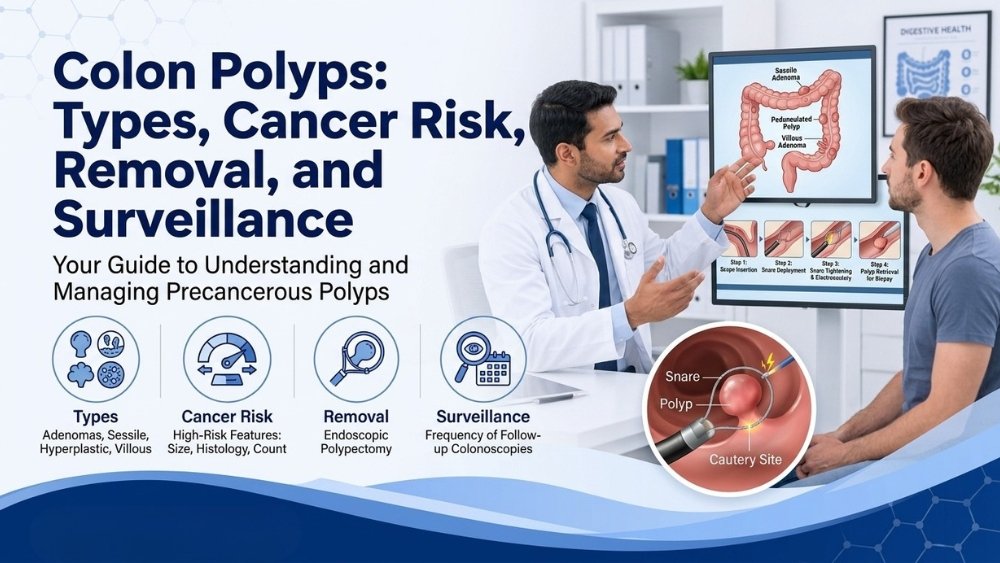
Colon polyps are small growths on the inner lining of the colon or rectum. Most cause no symptoms and are found incidentally at colonoscopy. They are clinically important because adenomatous polyps - the most common type - can progress to colorectal cancer over a period of years. Removing them at colonoscopy (polypectomy) prevents this progression and is one of the most effective cancer prevention interventions available.
✦ Quick Answers
The adenoma-carcinoma sequence is one of the most important cancer prevention opportunities in medicine: normal colonic epithelium → adenomatous polyp (adenoma) → colorectal cancer over 10-15 years. By identifying and removing adenomas at colonoscopy before they progress, colorectal cancer deaths are prevented. This is the rationale for colonoscopy screening in average-risk individuals above age 45 and earlier in high-risk patients.
Types of Colon Polyps and Cancer Risk
| Polyp Type | Cancer Risk | Features | Management |
|---|---|---|---|
| Tubular adenoma | Low-Moderate | Most common adenoma; 80% of adenomas; pedunculated or sessile; <1 cm usually low risk; ≥1 cm higher risk | Polypectomy; surveillance based on size and number |
| Tubulovillous adenoma | Moderate | Mixture of tubular and villous elements; higher cancer risk than tubular | Polypectomy; 3-year surveillance |
| Villous adenoma | High | Soft, carpet-like; mostly sessile; highest malignant potential of adenomas; often large | Complete polypectomy or EMR; close surveillance |
| Hyperplastic polyp | None | Very common; usually small (<5mm); rectosigmoid location; pale, flat | Remove at colonoscopy; no specific surveillance required unless large/proximal |
| Sessile serrated lesion | Low-Moderate | Flat or slightly elevated; pale; often right colon; look like hyperplastic but with dysplastic potential | Complete polypectomy; surveillance |
| Advanced adenoma | High | ≥10mm, OR villous features, OR high-grade dysplasia | Complete removal; 3-year surveillance colonoscopy |
Symptoms of Colon Polyps
Most colon polyps are asymptomatic - this is why colonoscopy screening is important. When symptoms occur:
- Rectal bleeding - bright red or dark red blood mixed in stool
- Change in bowel habits - new constipation, diarrhoea, or alternating pattern
- Mucus in stool - particularly with villous adenomas
- Abdominal cramping - with large polyps causing partial obstruction
- Iron deficiency anaemia - from chronic occult blood loss from large polyps
Diagnosis - Colonoscopy
Colonoscopy is the gold standard for detecting, characterising, and removing colon polyps. It allows direct visualisation of the entire colon and rectum, real-time removal of polyps (polypectomy), and histological assessment of all specimens.
Alternative investigations:
- CT colonography (virtual colonoscopy) - non-invasive; good sensitivity for polyps ≥6mm; does not allow polypectomy during the same session
- Stool DNA testing (FIT/cologuard) - non-invasive; detects blood and altered DNA from polyps; lower sensitivity than colonoscopy; positive result requires colonoscopy
Treatment - Polypectomy
All polyps found at colonoscopy are removed (polypectomy) during the same session and sent for histological examination. Techniques:
- Cold snare polypectomy: For polyps ≤9mm - snare loops around polyp base and cuts it off without electrocautery; lower complication risk
- Hot snare polypectomy: For larger pedunculated polyps - snare with electrocautery to control bleeding
- Endoscopic mucosal resection (EMR): For large flat or sessile polyps - submucosal injection lifts the lesion for safer removal
- Endoscopic submucosal dissection (ESD): For very large flat lesions - en bloc resection; specialist centres
- Surgical resection: For polyps that cannot be safely removed endoscopically, or where cancer is confirmed histologically
Surveillance After Polypectomy
Recommended Surveillance Intervals (British Society of Gastroenterology / Indian guidelines)
- No polyps / hyperplastic polyps only: Routine screening colonoscopy in 5-10 years (or as per national guidelines)
- 1-2 small (<10mm) tubular adenomas: Repeat colonoscopy in 3 years
- 3-4 small tubular adenomas: Repeat in 3 years
- Advanced adenoma (≥10mm, villous, high-grade dysplasia): Repeat in 1 year then 3 years
- 5+ adenomas: Repeat in 1 year
- Sessile serrated lesion ≥10mm: Repeat in 3 years
- Incomplete polyp removal: Repeat colonoscopy in 3 months
Colon Polyps in India
India-specific context
- Colorectal cancer incidence is rising in India - particularly in urban populations with Westernised diets (low fibre, high red meat) and sedentary lifestyles
- Colonoscopy screening is not yet part of a national population-based programme in India - but opportunistic screening colonoscopy for symptomatic patients and high-risk individuals is strongly recommended
- Many Indians present for first-time colonoscopy only when symptomatic - at which point polyps may have already progressed or malignancy has developed. Earlier screening starting at age 45 prevents this
- Colonoscopy quality - complete visualisation of the caecum, adequate bowel preparation, and polyp detection rate - varies significantly between centres. High-quality colonoscopy at experienced centres is important for effective cancer prevention
Desi Patient Questions
Polyp removed = cancer risk eliminated for that specific polyp. But new polyps develop - surveillance colonoscopy schedule follow karo (3 years ya 1 year depending on polyp type). Report ma "adenoma" hoy to doctor schedule karashe. Surveillance = cancer prevention. Appointments miss na karo.
Frequently Asked Questions
Related Pages
Colon Polyps or Colonoscopy Screening? Get Evaluated in Vadodara
High-quality colonoscopy with polypectomy and surveillance planning - Dr Samir Contractor at Sterling Hospital, Vadodara.
Medical Disclaimer: For patient education only. Not a replacement for medical consultation.