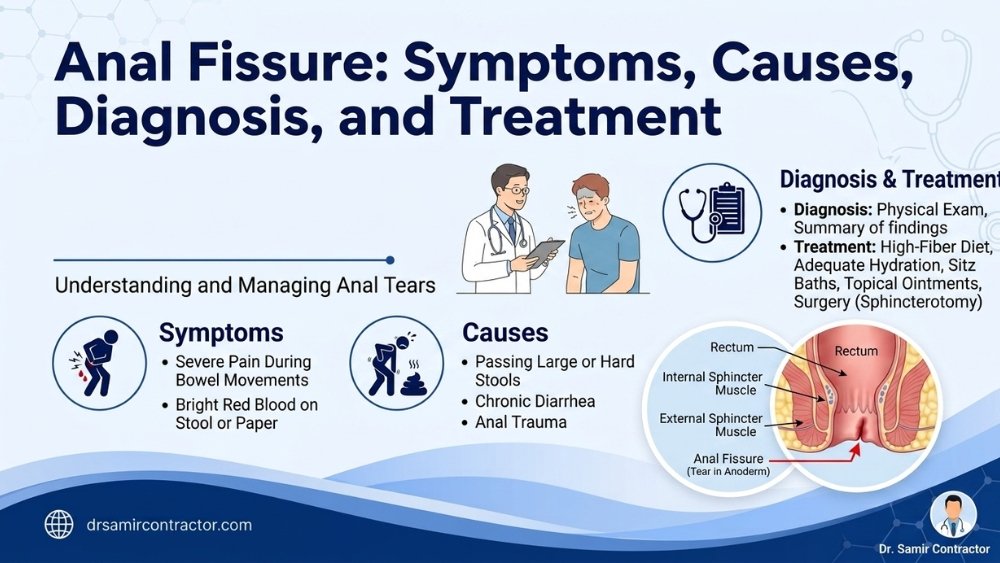
An anal fissure is a small, painful tear in the skin lining of the anal canal - the most common cause of anal pain in India. It produces sharp, burning pain during and after bowel movements, with bright red blood on toilet paper. Most fissures are caused by hard stool from constipation. With the right treatment - stool softening AND sphincter relaxation - most fissures heal completely. Surgery is needed only for chronic, non-healing fissures.
✦ Quick Answers
Anal fissure is one of the most common and most undertreated anorectal conditions in India. Patients suffer in silence for months or years, embarrassed to seek help, taking oral analgesics, or trying home remedies. Yet anal fissure is highly treatable - most acute fissures heal with simple medical treatment, and chronic fissures are cured by a quick surgical procedure with excellent outcomes and minimal risk.
Anatomy and Pathophysiology
The anal canal is approximately 4cm long and lined by sensitive squamous epithelium below the dentate line. The internal anal sphincter - the innermost layer of muscle - provides the resting tone of the anal canal. It is innervated by the sympathetic nervous system and is under involuntary control.
An anal fissure typically occurs at the posterior midline (6 o'clock position) - 90% of cases. This location is predisposed because the posterior midline has relatively poor blood supply (an anodermal watershed zone) and is the point of maximum traction during defecation. When a hard stool tears this area, the internal sphincter goes into spasm - this spasm constricts blood supply further, prevents healing, and perpetuates the pain-spasm cycle.
Symptoms of Anal Fissure
- Sharp, cutting, burning pain during bowel movements - the dominant symptom
- Pain that persists for 30-60 minutes after defecation (sphincter spasm)
- Bright red blood on toilet paper (not mixed into stool)
- Visible tear at the anal opening (posterior midline)
- Constipation secondary to fear of defecation
- A skin tag (sentinel tag) at the lower end of a chronic fissure
- Scarring and fibrotic edge (chronic fissure appearance)
Acute vs. Chronic Fissure
- Acute fissure (<8 weeks): Soft edges, pink base, no skin tag; 50-60% heal with medical treatment
- Chronic fissure (>8-12 weeks): Hard, fibrotic edges, white/exposed internal sphincter fibres visible at base, sentinel skin tag; medical treatment alone insufficient in most cases
Causes and Risk Factors
- Hard stools from constipation - the primary cause in most patients; low fibre + inadequate water
- Diarrhoea - repeated passage of liquid stool can also traumatise the anal lining
- Childbirth trauma - anterior fissures in women after difficult vaginal delivery
- Anal intercourse trauma
- Secondary fissures (Crohn's disease, tuberculosis, HIV, STIs) - atypical location (lateral), multiple fissures
- Fear-avoidance cycle - once a fissure forms, pain leads to stool suppression, harder stools, more trauma
Treatment Pathway
Treatment Steps - All Require Simultaneous Stool Softening
- 1Stool softening (always, all stages)High-fibre diet, 2-3L water, osmotic laxative. Without soft stools, no treatment heals the fissure permanently.
- 2Topical anaesthetic (immediate pain relief)Lidocaine 5% ointment applied before defecation. Does not heal - only reduces pain during passage.
- 3Topical sphincter relaxants (GTN or diltiazem)GTN 0.2% ointment or diltiazem 2% ointment, applied to anal margin twice daily for 6-8 weeks. Relaxes internal sphincter, improves blood supply, promotes healing. Side effect: GTN headache (5-20% of patients) - diltiazem avoids this.
- 4Warm sitz bathsTwice daily for 15 minutes - reduces sphincter spasm, improves circulation. Safe adjunct at all stages.
- 5Botulinum toxin injection (chronic fissure)Injection into the internal sphincter under local anaesthetic. Relaxes sphincter for 3 months, allowing healing. 70-80% success rate for chronic fissures. Outpatient procedure, minimal recovery.
- 6Lateral internal sphincterotomy (surgery)For fissures not healing after botox or in patients who prefer definitive treatment. A small controlled nick in the internal sphincter permanently relaxes it and allows healing. 90%+ success rate. Minimal risk of incontinence in experienced hands. 2-3 day recovery.
What Happens If Anal Fissure Is Untreated?
- Chronic pain causes progressive fear-avoidance - constipation worsens, fissure deepens
- Chronic fissures lose their capacity to heal - fibrotic edges with exposed sphincter fibres no longer respond to topical treatment
- Quality of life impairment - patients cannot exercise, sit comfortably, or maintain normal bowel habits
- Fecal impaction in severe cases - complete avoidance of defecation
- Untreated fissures in unusual locations (lateral, multiple) may indicate Crohn's disease or STI - which delays diagnosis of these conditions
?? Anal Fissure in India
India-specific context
- Anal fissure is extremely common in India - driven by low-fibre diet (refined flour, white rice), inadequate hydration, and culturally embedded dietary habits
- Most patients suffer for months before seeking help - embarrassment and assumption that "it will go away" are the main barriers to early treatment
- GTN ointment is the most widely available topical treatment; diltiazem ointment (less headache side effect) is available on prescription at specialist centres
- Lateral internal sphincterotomy is widely available at colorectal surgical centres in Vadodara and across India with excellent outcomes
Desi Patient Questions
Nahi necessarily. First: stool soften karo (fibre, paani) AND topical ointment (GTN ya diltiazem). Jyaré 6-8 weeks ma nahi sudhartu hoy - botox injection try karo (outpatient, 70-80% success). Jyaré pachi pan nahi thayun - lateral internal sphincterotomy surgery (day case, 90%+ success, quick recovery). Doctor ne malsho - examination thi stage decide thay chhe.
Frequently Asked Questions
Related Pages
Anal Fissure? Get Effective Treatment in Vadodara
Medical treatment, botulinum toxin, and surgical sphincterotomy - Dr Samir Contractor at Sterling Hospital, Vadodara provides the full range of anal fissure management.
Medical Disclaimer: For patient education only. Not a replacement for medical consultation.