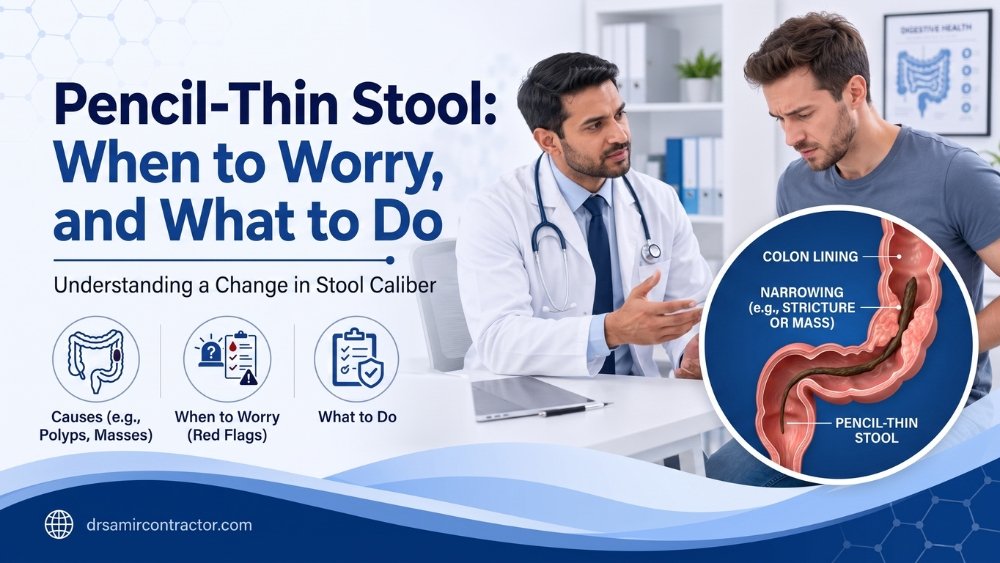
Pencil-thin or ribbon-like stools are a common source of worry. In most cases, the cause is functional - irritable bowel syndrome, temporary dietary changes, or mild constipation. However, persistent narrowing of stool that does not return to normal within a few weeks always warrants medical evaluation, because it can occasionally indicate a mass, polyp, or stricture in the sigmoid colon or rectum that is physically narrowing the passage.
✦ Quick Answers
Few things cause as much anxiety as noticing a sudden change in the shape of your stool. Searching online for "pencil-thin stool" almost always returns results about colorectal cancer within the first few links - and understandably, this creates fear. The reality is more nuanced, and it is worth understanding properly.
Stool calibre - the width or thickness of your bowel movement - is influenced by many factors: what you eat, how much fibre and water you consume, how your colon contracts, how much time stool spends in the colon, and whether there is any physical narrowing in the lower colon or rectum. A change in calibre that lasts a day or two is rarely significant. A change that persists for weeks, or that comes with other warning signs, is the type that needs proper evaluation.
This page explains why pencil-thin stools happen, which causes are common and reassuring, which need investigation, and what the evaluation process looks like. The goal is to give you accurate, balanced information - neither dismissive nor alarmist.
What Is Pencil-Thin Stool?
Pencil-thin stool describes bowel movements that are significantly narrower than your usual stool. Patients describe it in various ways: "thin like a pencil," "flat like a ribbon," "narrow and string-like," or "compressed and flat." The medical term for this is a change in stool calibre.
Normal stool diameter varies between individuals, but it generally reflects the diameter of the lower rectum and anal canal through which it passes. When something changes the way stool is formed in the colon, or physically narrows the passage through which it exits, the resulting stool becomes thinner.
It is important to distinguish between:
- Occasional thin stools - a single episode or a few days of narrower stool, often related to what you ate, how hydrated you are, or temporary changes in bowel habit. This is common and usually resolves on its own.
- Persistent thin stools - a consistent pattern where stools remain narrow over several weeks, especially if progressively worsening. This is the pattern that warrants investigation.
Common Causes of Pencil-Thin Stool
Causes fall into two broad categories: functional (where the colon and rectum are structurally normal but motility or consistency is altered) and structural (where something physically narrows the bowel lumen).
Functional Causes (Most Common)
- Irritable bowel syndrome (IBS) - altered motility and colonic spasm temporarily narrow the stool
- Low-fibre diet - produces smaller, less bulky stools that appear thin
- Dehydration - hard, compacted stool loses its normal width
- Stress and anxiety - affect gut motility, producing variable stool shapes
- Mild constipation - hard stool fragments appear thinner when passed with effort
- Dietary changes - sudden change in food type or amount alters stool bulk
- Medications - antispasmodics, opioids, iron supplements can alter stool form
Structural Causes (Less Common but Important)
- Colorectal polyps - large polyps in sigmoid colon or rectum narrow the lumen
- Colorectal cancer - tumour in the sigmoid or rectum compresses stool
- Rectal stricture - narrowing from surgery, radiation, or inflammatory bowel disease
- Obstructed defecation syndrome - functional outlet obstruction alters stool shape
- Rectal prolapse - prolapsing tissue alters the exit pathway
- Diverticular disease - chronic inflammation can cause sigmoid narrowing
- External compression - pelvic mass or enlarged uterus pressing on rectum (rare)
The critical distinction is duration and progression. Functional causes produce intermittent changes that come and go. Structural causes produce persistent or progressive narrowing that worsens over time.
How Does Colorectal Cancer Cause Thin Stool?
This is the question most patients are really asking. Understanding the mechanism helps put the symptom in context.
A tumour in the left (sigmoid) colon or rectum can grow inward toward the bowel lumen - the central passage through which stool moves. As it grows, it narrows this passage. Stool is then squeezed through a smaller opening, emerging as a thinner, ribbon-like shape. This tends to be:
- Progressive - the stool gets thinner over weeks and months, not better
- Persistent - it does not alternate with normal-calibre stools the way IBS does
- Accompanied by other features - blood in stool (often mixed with stool, not just on the surface), mucus, unexplained weight loss, worsening constipation, or a feeling of incomplete emptying
Right-sided colon cancers rarely cause thin stool because the colon is wider in that region and stool is still semi-liquid. It is the left colon and rectum - where stool is already formed and the colon is narrower - where a growing mass produces this symptom.
It is worth emphasising: most patients with pencil-thin stool do not have cancer. But the symptom is a valid reason to evaluate, especially when persistent, because early-stage polyps and tumours are highly treatable when caught by colonoscopy.
? Stool Shape Changes and What They Indicate
The Bristol Stool Form Scale is a clinical tool used to classify stool consistency. While it primarily describes consistency (from hard lumps to watery), shape and calibre are also clinically significant. The table below summarises common stool shape descriptions and their likely causes.
| Stool Description | Likely Cause | Action Needed |
|---|---|---|
| Normal, sausage-shaped, smooth | Healthy bowel function | None |
| Hard, lumpy pellets | Constipation, low fibre, dehydration | Increase fibre and water intake |
| Thin, pencil-shaped (occasional) | IBS, dietary change, stress, mild constipation | Monitor - likely resolves |
| Thin, pencil-shaped (persistent, progressive) | Polyps, sigmoid/rectal mass, stricture | Colonoscopy needed |
| Flat, ribbon-like | Hemorrhoids, obstructed defecation, rectal lesion | Anorectal examination + possible colonoscopy |
| Alternating thin and normal | IBS, variable diet | Reassurance if no red flags; review diet |
| Thin stool with blood or mucus | Rectal lesion, polyps, IBD, cancer | Urgent colonoscopy |
Red Flags - When Pencil-Thin Stool Needs Urgent Evaluation
Pencil-thin stool on its own - especially when occasional and self-resolving - rarely signals serious disease. However, when combined with the following features, prompt medical evaluation and colonoscopy are warranted.
See a doctor promptly if thin stool is accompanied by:
- Blood in stool - whether bright red, dark, or mixed with stool
- Mucus discharge with bowel movements
- Unintended weight loss (more than 3-4 kg over a few weeks)
- Progressive worsening - stools getting thinner week by week
- New-onset constipation that is not responding to dietary changes
- Persistent feeling of incomplete evacuation after passing stool
- Abdominal pain, cramping, or bloating that is worsening
- Iron-deficiency anaemia (fatigue, pallor, breathlessness)
- New onset of thin stool in a person above age 45
- Family history of colorectal cancer or polyps
The presence of even one of these alongside persistent thin stool is enough reason to arrange a colonoscopy. Early detection of polyps or an early-stage tumour fundamentally changes outcomes.
✅ When Pencil-Thin Stool Is Probably Not Serious
Not every episode of thin stool needs investigation. The following patterns are generally reassuring.
Reassuring features:
- Thin stools that occur for a day or two, then return to normal
- Associated with a clear trigger - dietary change, travel, stress, illness
- Alternating between thin and normal-shaped stools (typical of IBS)
- No blood, no mucus, no weight loss
- No family history of colorectal cancer
- Below age 45 with no other bowel symptoms
- Already known to have IBS with similar episodes in the past
- Resolves with increased fibre and water intake
If your situation matches the reassuring pattern above, it is reasonable to increase dietary fibre (25-35 grams per day), ensure adequate water intake (2-3 litres per day), and observe for 2-3 weeks. If stools normalise, no further investigation is needed. If they persist or red-flag features develop, see a doctor.
Persistent thin stool with red-flag symptoms? A colonoscopy can provide clarity and peace of mind.
How Doctors Evaluate Pencil-Thin Stool
When a patient presents with persistent change in stool calibre, the evaluation follows a structured approach.
1. Clinical history
Your doctor will ask: How long have the stools been thin? Is it every stool or intermittent? Is there blood, mucus, or pain? Have you lost weight? Any family history of bowel cancer or polyps? Any recent dietary or medication changes? History of IBS or inflammatory bowel disease?
2. Physical examination
Abdominal examination to check for masses, tenderness, or distension. A digital rectal examination (DRE) is essential - it can identify low rectal masses, strictures, hemorrhoids, or prolapse that may be causing the calibre change. Many patients are reluctant about DRE, but it provides critical information in 30 seconds.
3. Blood tests
Complete blood count (to check for anaemia), liver function, and tumour markers (CEA) if cancer is suspected. These do not diagnose the cause but guide the urgency and direction of further investigation.
4. Colonoscopy
The definitive investigation. A flexible camera examines the entire colon and rectum from inside. It can directly identify polyps, tumours, strictures, inflammation, or diverticular disease. If a polyp is found, it can often be removed during the same procedure (polypectomy). If a suspicious lesion is found, a biopsy is taken for pathological confirmation.
5. Imaging (if needed)
CT scan of the abdomen and pelvis may be ordered if a mass is found on colonoscopy (for staging) or if colonoscopy cannot be completed. CT colonography (virtual colonoscopy) is occasionally used as an alternative in patients who cannot tolerate standard colonoscopy.
Treatment Based on the Underlying Cause
Treatment depends entirely on what the evaluation reveals. There is no single treatment for "thin stool" - the underlying cause determines the approach.
| Cause | Treatment Approach |
|---|---|
| IBS | Dietary modification (fibre, low-FODMAP trial), antispasmodics, stress management, gut-directed therapy. Stool calibre improves as IBS is controlled. |
| Low-fibre diet / dehydration | Gradual increase to 25-35 g fibre/day, adequate water (2-3 L/day), regular meals. Most cases resolve within 1-2 weeks. |
| Colon polyps | Colonoscopic polypectomy - the polyp is removed during colonoscopy. Surveillance colonoscopy at intervals based on polyp type and size. |
| Colorectal cancer | Staging with CT scan, then treatment based on stage. Options include surgery (laparoscopic or open colectomy), chemotherapy, and radiation depending on location and stage. Early-stage detection has excellent outcomes. |
| Rectal stricture | Endoscopic dilatation for benign strictures. Surgical intervention for complex or malignant strictures. |
| Obstructed defecation syndrome | Biofeedback physiotherapy for pelvic floor dysfunction. Surgical repair (STARR procedure or laparoscopic ventral mesh rectopexy) for structural outlet obstruction. |
| Diverticular stricture | Medical management of acute inflammation, followed by elective sigmoid colectomy if stricture is significant or recurrent. |
The Role of Colonoscopy in Evaluating Thin Stool
Colonoscopy deserves special emphasis because it is the investigation that provides the most definitive answers for this symptom.
What colonoscopy can detect
- Colon polyps (adenomatous, sessile serrated, hyperplastic) - which can be removed during the procedure
- Colorectal cancer at any stage - with biopsy for tissue diagnosis
- Strictures - from cancer, diverticular disease, radiation, or inflammatory bowel disease
- Inflammatory bowel disease (Crohn's disease, ulcerative colitis) - with mucosal biopsy
- Diverticular disease - severity and complications
- Normal colon - which itself is a valuable finding that provides reassurance
What to expect during colonoscopy
The procedure takes 20-40 minutes and is typically performed under sedation so that you feel little or no discomfort. Bowel preparation the day before (a laxative solution to clean the colon) is the part most patients find inconvenient, but it is essential for a thorough examination. You can usually go home the same day and resume normal activities within 24 hours.
When colonoscopy finds nothing
A normal colonoscopy is a genuinely reassuring result. It means there is no polyp, no mass, no stricture, and no inflammation in the colon or rectum. If the stools are thin and the colonoscopy is normal, the cause is almost certainly functional - IBS, dietary, or motility-related - and can be managed accordingly with confidence.
? Prevention: Can You Reduce the Risk?
You cannot prevent all causes of thin stool, but you can reduce the risk of the most serious ones - particularly colon polyps and colorectal cancer.
- Dietary fibre: A fibre-rich diet (25-35 g/day from vegetables, whole grains, fruits, and legumes) supports healthy stool bulk and regularity
- Adequate hydration: 2-3 litres of water per day keeps stools soft and well-formed
- Regular physical activity: Exercise promotes healthy colonic motility and reduces colorectal cancer risk
- Limit processed and red meat: High intake of processed meat is associated with increased colorectal cancer risk
- Avoid tobacco and excess alcohol: Both are established risk factors for colorectal cancer
- Screening colonoscopy: Recommended at age 45 (or earlier with family history). Screening colonoscopy finds and removes polyps before they become cancer - the most effective form of prevention
- Act on symptoms: Do not ignore persistent changes in bowel habit, stool shape, or blood in stool. Early evaluation saves lives.
?? Pencil-Thin Stool and Colorectal Health in India
Why this matters in the Indian context
- Colorectal cancer incidence in India is rising, particularly in urban populations. Earlier screening and symptom awareness are critical.
- Indian dietary patterns - high in refined carbohydrates, low in fibre - contribute to functional bowel symptoms including IBS and constipation, which are common causes of thin stool
- There is significant reluctance in India to discuss bowel habits, stool shape, and rectal symptoms with a doctor. Many patients present late when symptoms have progressed.
- Self-medication with laxatives, antacids, and home remedies is common, delaying proper diagnosis
- Screening colonoscopy awareness remains low in India compared to Western countries. The concept that colonoscopy can prevent cancer - not just detect it - needs wider understanding.
- Younger age of onset: colorectal cancer in India often presents at a younger age than in Western populations, making symptom awareness even more important for patients in their 30s and 40s
Desi Patient Questions (Gujarati / Hinglish)
Majority cases ma answer "No" chhe. Patlu motion IBS, low fibre diet, ya constipation thi thay chhe. Pan jyo persist kare, blood hoy, weight loss hoy, ya 2-3 week pachhi pan normal na thay to colonoscopy karavi joiye - jethee polyp ke tumour hoy to early detect thay.
Colonoscopy sedation ma thay chhe - tamne injection aapva ma aave chhe jethee tamne koi takleef na lage. 20-40 minute ma procedure purru thay chhe. Preparation (ek divas pahela bowel clean karvu) thodi inconvenience chhe, pan procedure potane comfortable chhe. Dar na rakho - it can save your life.
IBS ma thin stool common chhe - motility change thi stool no shape change thay chhe. Pan IBS ma pattern intermittent hoy chhe - kabhi thin, kabhi normal. Jyo continuously worsening hoy, blood hoy, ya weight loss hoy to IBS no blame na aapvo - colonoscopy karavo to be safe.
Ha, bahu connection chhe. Oche fibre valu food - maida, white rice, processed food - stool ne nanu ane patlu banave chhe. Vegetables, salad, whole wheat roti, dals vadharo to 1-2 week ma farak padse. Pani 2-3 litre rooj piyo.
Ha, bilkul. 45 pachhi screening colonoscopy recommend thay chhe - bhalé koi symptom na hoy. Purpose chhe ke polyps - jo cancer na bane tyaa sudhee - kadhi nakhva. Family history hoy to 40 upar j screening start karvi joiye. Early detection best protection chhe.
Jyo 2-3 week thi patlu aave chhe ane fibre vadhaarya pachhi pan normal nathi thatu to ha, doctor pase javo. Blood na hoy to pan persistent calibre change evaluate karvo joiye - kaaranke kétlaak polyps ane early tumours blood nathi aapti pan stool ne patlu banavé chhe.
Frequently Asked Questions
Worried About Pencil-Thin Stools? Get Evaluated in Vadodara
Dr Samir Contractor at Sterling Hospital, Vadodara provides expert evaluation - clinical examination, colonoscopy, polypectomy, and colorectal surgery - for all causes of stool calibre change.
Related Pages
Medical Disclaimer: This page is for patient education only. It does not replace a medical consultation, particularly if symptoms are persistent, worsening, or accompanied by red-flag features. Always consult a qualified surgeon or gastroenterologist for individual evaluation.