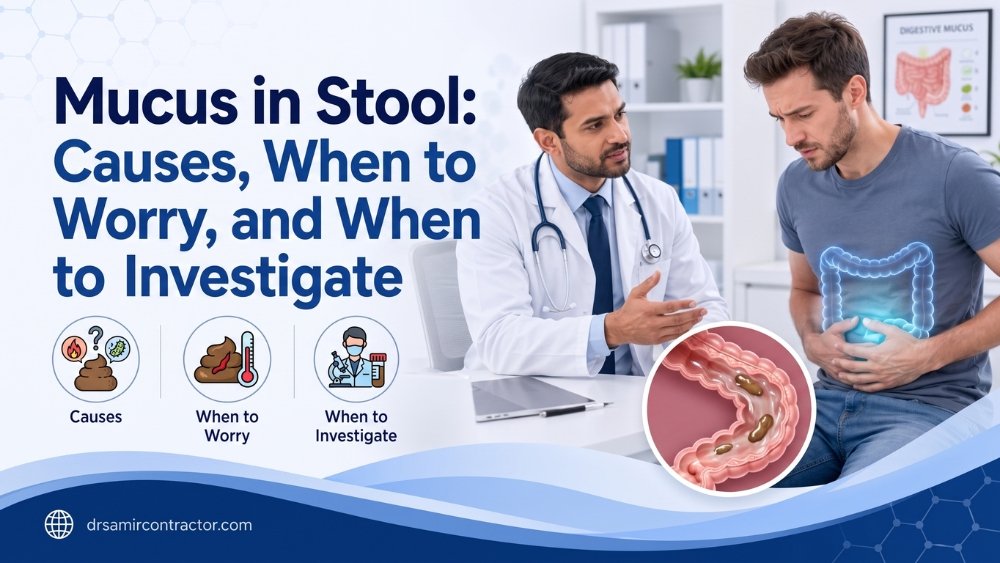
Noticing mucus in your stool can be alarming. Many patients describe it as a slimy coating on stool, a jelly-like substance in the toilet bowl, or a clear-to-white discharge after passing a motion. While small amounts of mucus are perfectly normal, large amounts or mucus mixed with blood signals a problem that needs medical evaluation.
Quick Answers
Why Does the Bowel Produce Mucus?
The inner lining of your large intestine (colon) and rectum contains specialised cells called goblet cells. These cells continuously secrete mucus - a clear, sticky, gel-like substance - which serves several important functions:
- Lubrication: Mucus coats the bowel wall and stool surface, allowing stool to pass through the colon and rectum smoothly without friction or trauma
- Protection: It forms a barrier between the bowel lining and the contents of the colon, protecting the delicate mucosal cells from bacteria, digestive enzymes, and mechanical damage
- Immune function: Mucus traps bacteria and other organisms, helping prevent them from invading the bowel wall
- Hydration balance: It helps regulate the water content of stool, contributing to normal stool consistency
Under normal circumstances, the mucus produced is invisible - it mixes into the stool and you do not notice it. The problem arises when the bowel produces too much mucus, when the mucus is not mixed with stool (appearing as a separate discharge), or when it changes colour or becomes mixed with blood.
Normal vs Abnormal Mucus in Stool
Understanding the distinction between normal mucus production and clinically significant mucus is essential. The following table provides a clear comparison.
| Feature | Normal (No concern) | Abnormal (Needs evaluation) |
|---|---|---|
| Amount | Thin film, barely visible | Visible globules, coating, or separate discharge |
| Colour | Clear to slightly whitish | Yellow, green, blood-streaked, or brown-tinged |
| Frequency | Occasional, not every stool | Present with most or all bowel movements |
| Consistency | Thin, mixed into stool | Thick, jelly-like, or passed separately from stool |
| Associated symptoms | None | Urgency, tenesmus, blood, cramping, change in bowel habit |
| Pattern | Random, self-limiting | Persistent or progressively increasing over weeks |
If your mucus fits the middle column, it is almost certainly normal goblet cell production. If any features in the right column apply, medical evaluation is appropriate.
Causes of Mucus in Stool
The causes of excess mucus in stool range from very common and benign to uncommon but clinically important. Understanding where your symptoms fall on this spectrum is the key to appropriate management.
Common / Functional Causes
- Irritable bowel syndrome (IBS)
- Dietary triggers (spicy food, dairy)
- Food intolerances
- Mild gastroenteritis (infection)
- Stress-related bowel disturbance
- Medications (antibiotics, laxatives)
Structural / Pathological Causes
- Proctitis (rectal inflammation)
- Large villous adenoma (mucus-secreting polyp)
- Rectal lesion or mass
- Colorectal cancer
- Bacterial infections (C. difficile, Shigella)
- Parasitic infections (amoebiasis)
Irritable Bowel Syndrome (IBS)
IBS is responsible for the majority of cases where patients present with mucus in stool. In IBS, the bowel is structurally normal but functionally overactive. Goblet cells produce more mucus than usual in response to the disordered bowel motility. Patients typically notice mucus alongside cramping, bloating, alternating constipation and diarrhoea, and an urgency to pass stool. The mucus is usually clear or white and is not mixed with blood. IBS is a diagnosis of exclusion - meaning it is confirmed after other causes have been ruled out.
Proctitis (inflammation of the rectum)
Proctitis causes the rectal lining to become inflamed and to produce excess mucus. Patients often describe a mucus discharge from the rectum - sometimes without stool, sometimes with urgency and tenesmus (the persistent feeling of needing to pass stool even when the rectum is empty). Proctitis can result from infections (sexually transmitted infections, bacterial infection), radiation treatment to the pelvis, or inflammatory conditions. The mucus in proctitis may be yellow or blood-tinged.
Large villous adenoma
A villous adenoma is a specific type of colon polyp that has a characteristic "finger-like" surface and can secrete large amounts of mucus. Patients may notice a jelly-like mucus discharge, sometimes so profuse that it causes electrolyte imbalance (loss of potassium) in extreme cases. This is a pre-cancerous polyp and requires removal, typically during colonoscopy (polypectomy) or, if very large, through surgical resection.
Rectal lesion or colorectal cancer
A tumour in the rectum or lower colon can produce mucus, sometimes mixed with blood. When mucus is accompanied by a persistent change in bowel habits, rectal bleeding, tenesmus, unexplained weight loss, or iron-deficiency anaemia, it raises the suspicion of a colorectal malignancy. Colonoscopy with biopsy is the definitive investigation.
Infections
Certain bacterial infections (such as Clostridium difficile, Shigella, or Salmonella) and parasitic infections (such as amoebiasis - common in India) can cause mucus in stool, often with diarrhoea, fever, and cramping. These typically have an acute onset and are diagnosed through stool testing. Amoebiasis in particular can produce a bloody mucoid stool and is an important consideration in the Indian clinical setting.
Food intolerances and dietary triggers
Lactose intolerance, gluten sensitivity, or consuming large amounts of spicy or fatty food can irritate the bowel lining and increase mucus production. The mucus is usually mild, self-limiting, and improves when the dietary trigger is identified and removed.
When Should You Worry? Red Flags
Most patients with mucus in stool do not have a serious condition. However, certain features alongside mucus demand prompt medical evaluation. Do not ignore these signs.
Seek urgent medical evaluation if mucus in stool is accompanied by:
- Blood mixed with mucus - especially dark or persistent blood
- Persistent change in bowel habits lasting more than 3 weeks
- Tenesmus - the constant urge to pass stool with little result
- Urgency that is worsening or disrupting daily life
- Unexplained weight loss
- New symptom in a person aged 45 or older
- Night-time symptoms waking you from sleep
- Iron-deficiency anaemia (low haemoglobin, fatigue)
- Family history of colorectal cancer or polyps
- Progressive increase in mucus volume over weeks to months
These features do not automatically mean cancer or a serious disease. But they indicate that the bowel needs direct visualisation through colonoscopy to identify or exclude a structural cause.
When Mucus in Stool Is Likely Not Serious
Reassuring features - mucus is likely benign when:
- It is occasional and self-limiting - appearing for a day or two, then resolving
- The amount is small and mixed into stool (thin film or streak)
- There is no blood, no weight loss, and no change in bowel habit
- It occurs after a dietary trigger and settles when the trigger is removed
- You are young (under 40), with no family history of colorectal disease
- Stool consistency, frequency, and colour are otherwise normal
- There is no urgency, tenesmus, or incomplete evacuation
In these situations, the mucus is almost always from normal goblet cell activity or a minor, self-correcting irritation. Monitoring for a few weeks is reasonable, and no urgent investigation is needed. However, if mucus becomes persistent or any red-flag features develop, reassessment is important.
How Doctors Evaluate Mucus in Stool
When you consult a doctor for mucus in stool, the evaluation typically follows a structured approach:
Step 1 - Clinical history
Your doctor will ask about the duration, amount, colour, and consistency of the mucus. They will also ask about associated symptoms: blood, urgency, tenesmus, abdominal pain, bloating, weight loss, and changes in stool frequency or form. Dietary habits, recent travel, antibiotic use, and family history of bowel disease are all relevant.
Step 2 - Physical examination
An abdominal examination to check for tenderness, distension, or masses. A digital rectal examination (DRE) is an important part of the assessment - it allows the doctor to feel for a rectal mass, assess the mucosa, and check for blood or mucus on the examining finger.
Step 3 - Basic investigations
Blood tests (complete blood count, inflammatory markers, iron studies) and stool tests (for infection, parasites, and occult blood) are typically ordered as a first-line screen. These help identify infections, anaemia, and inflammation.
Step 4 - Colonoscopy (when indicated)
Colonoscopy is the definitive investigation. A flexible camera examines the entire colon and rectum, identifying polyps, proctitis, tumours, or other structural causes. Biopsies can be taken during the procedure. Colonoscopy is indicated when red-flag features are present, when the cause is unclear, when symptoms are persistent, or when the patient is above 45 with new symptoms.
What the Character of Mucus Can Tell You
The appearance of mucus provides clinical clues - though it is not diagnostic on its own, it helps guide the evaluation.
| Mucus Appearance | Possible Significance |
|---|---|
| Clear or white, small amount | Normal goblet cell production; no action needed unless persistent |
| White, jelly-like, larger amounts | IBS, food intolerance, or early proctitis; monitor and investigate if persistent |
| Yellow or greenish mucus | Infection (bacterial or parasitic), proctitis; stool testing and clinical assessment needed |
| Blood-streaked mucus | Proctitis, polyp, rectal lesion, or fissure; warrants colonoscopy |
| Profuse watery mucus (without stool) | Large villous adenoma (mucus-secreting polyp); colonoscopy and polypectomy needed |
| Mucus with pus or foul smell | Infection, abscess, or inflammatory condition; urgent assessment |
| Mucus passed separately (without stool) | Rectal pathology (proctitis, rectal mass, solitary rectal ulcer); examination and colonoscopy indicated |
Treatment: Addressing the Underlying Cause
Mucus in stool is a symptom, not a disease. Treatment depends entirely on the underlying cause identified through proper evaluation.
IBS-related mucus
The mainstay of treatment is dietary management (identifying trigger foods, increasing soluble fibre, maintaining regular meal patterns), stress management, and medications when needed (antispasmodics, probiotics, low-dose antidepressants in selected patients). Once the IBS is managed, the excess mucus typically resolves.
Proctitis
Treatment depends on the cause of the rectal inflammation. Infectious proctitis is treated with appropriate antibiotics. Radiation proctitis may require topical treatments or specialised procedures. Inflammatory proctitis is managed with topical steroids or 5-ASA preparations, often under specialist care.
Colon polyps (including villous adenoma)
Polyps identified during colonoscopy are removed (polypectomy) during the same procedure whenever possible. Large villous adenomas that cannot be safely removed endoscopically may require surgical resection. After removal, follow-up surveillance colonoscopy is scheduled to monitor for recurrence.
Rectal lesion or colorectal cancer
If a mass or tumour is identified, biopsy determines the nature. Treatment involves a multidisciplinary approach - typically surgery (colorectal resection), sometimes combined with chemotherapy or radiotherapy depending on the stage and location. Early detection through timely colonoscopy significantly improves outcomes.
Infections
Bacterial infections are treated with targeted antibiotics based on culture and sensitivity. Parasitic infections such as amoebiasis are treated with metronidazole and a luminal agent. In most cases, the mucus resolves fully once the infection is cleared.
Dietary and lifestyle causes
Identifying and removing dietary triggers (dairy, excess spice, processed foods) often resolves mucus within days to weeks. Adequate hydration, regular physical activity, and a balanced fibre intake support normal bowel function and mucus production.
What Happens If Mucus in Stool Is Ignored?
In the majority of patients - especially those with IBS or dietary triggers - mucus in stool is not dangerous and will not lead to complications even if left alone. However, ignoring mucus that has red-flag features can result in:
- Delayed diagnosis of polyps - villous adenomas are pre-cancerous; early removal prevents progression to cancer
- Missed rectal lesion - a rectal mass identified early has a much better prognosis than one detected at an advanced stage
- Untreated infection - chronic infections like amoebiasis can cause ongoing bowel damage and liver complications
- Progressive proctitis - untreated inflammation can lead to stricture, ulceration, or chronic symptoms
- Unnecessary anxiety - ongoing worry about unexplained mucus can significantly affect quality of life; proper evaluation provides reassurance or a clear treatment plan
The message is straightforward: if mucus fits the "reassuring" profile, monitoring is reasonable. If it does not, early investigation is the responsible approach.
The Role of Screening Colonoscopy
Beyond investigating symptoms, colonoscopy plays an important role in screening - looking for polyps and early cancer before symptoms develop.
- Current guidelines recommend screening colonoscopy starting at age 45 for average-risk individuals
- If you have a first-degree relative (parent, sibling, child) with colorectal cancer, screening should begin 10 years before the age at which they were diagnosed, or at age 40 - whichever is earlier
- Polyps found during screening colonoscopy are removed immediately - this prevents them from ever becoming cancerous
- Regular surveillance after polyp removal reduces the long-term risk of colorectal cancer by more than 75%
If mucus in stool prompts you to see a doctor and leads to a timely colonoscopy, it may be the most valuable symptom you ever paid attention to.
Mucus in Stool - What's Relevant for Indian Patients
Why this symptom matters in the Indian context
- Amoebiasis (amoebic dysentery) is endemic in many parts of India and is a common cause of mucoid, bloody stool - stool testing for parasites is an important first step
- Spicy food, irregular meal patterns, and high-fat diets are common dietary triggers that can increase mucus production in susceptible individuals
- IBS prevalence in India is estimated at 10-15% of the urban population, making it the most common cause of mucus in stool in clinical practice
- Colorectal cancer incidence is rising in urban India, particularly among adults aged 40-60 - mucus with red-flag features should always prompt colonoscopy
- Many patients self-treat with antibiotics or Ayurvedic remedies for prolonged periods before seeking specialist evaluation - this can delay diagnosis of treatable conditions
- Awareness of screening colonoscopy remains low in India. Presenting with mucus in stool is often the trigger that leads to a first-ever colonoscopy and the detection of otherwise silent polyps
Evaluation and Treatment in Vadodara
If you are experiencing persistent mucus in stool, mucus with blood, or any red-flag features described on this page, schedule a consultation at Sterling Hospital, Vadodara. Dr Samir Contractor provides comprehensive evaluation including clinical assessment, digital rectal examination, stool investigations, and colonoscopy with polypectomy when indicated.
Early evaluation is especially important if you are over 45, have a family history of colorectal cancer, or have been self-treating without improvement. A single colonoscopy can provide a definitive answer and, if polyps are found, remove them before they become a problem.
Desi Patient Questions (Gujarati / Hinglish)
Stool ma thodi mucus normal chhe - intestine naturally produce kare chhe. Pan jyare vadhu amount ma aave, jelly jevun lage, ya blood sathe hoy to doctor ne batavo. Most common cause IBS chhe, pan polyp ya rectal problem rule out karva jaruri chhe.
Zaruri nathi ke cancer j hoy. Blood-streaked mucus hemorrhoids, fissure, ya proctitis thi pan hoy chhe. Pan blood sathe mucus aave to colonoscopy karavi jaruri chhe - especially jo umar 45 thi upar hoy ya weight loss thayo hoy.
IBS ma bowel ni motility disturbed hoy chhe - goblet cells vadhu mucus produce kare chhe. Aa clear ya white mucus hoy chhe, blood nathi hotu. Bloating, cramping, ane stool pattern change sathe aave chhe. Dietary management ane stress reduction thi improve thay chhe.
Colonoscopy painless procedure chhe - sedation sathe thay chhe. 20-30 minute lage chhe. Jyare mucus persistent hoy, blood hoy, ya red-flag features hoy tyare colonoscopy jaruri chhe. Polyp male to same time ma remove thay chhe. Dar na rakho - early detection best outcome aape chhe.
Ha, amoebiasis India ma common chhe ane bloody mucoid stool cause kare chhe. Stool test thi diagnose thay chhe ane medicine thi sara thai jay chhe. Jo mucus sathe diarrhoea ane fever hoy to stool test jarur karavo - especially monsoon season ma.
Ha - spicy food, oily food, dairy, ane irregular meals mucus vadhare chhe. Thodu halku khao, fibre vadharo, pani puro pivo, ane trigger foods identify karo. IBS-related mucus dietary changes thi ghanu improve thay chhe. Dietitian ni madad lo jo jarur hoy.
Concerned About Mucus in Your Stool? Get Evaluated in Vadodara
Dr Samir Contractor at Sterling Hospital, Vadodara provides expert assessment for mucus in stool - from clinical evaluation and stool testing to colonoscopy, polypectomy, and colorectal surgery when needed.