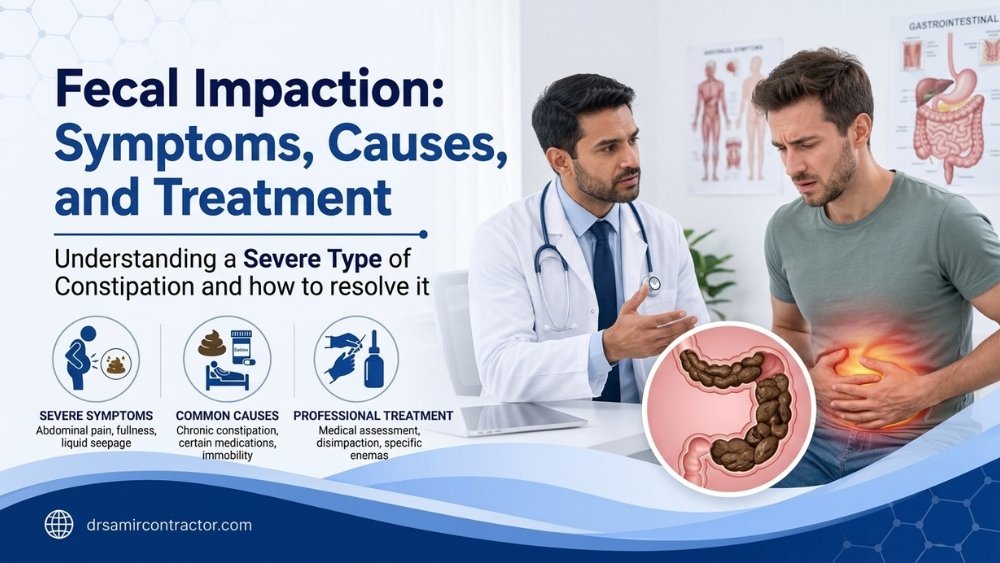
Fecal impaction is the most severe form of constipation - a large, rock-hard mass of stool that has become lodged in the rectum or colon and cannot be passed by normal effort. It requires medical intervention: enemas, manual disimpaction, or rarely surgery. It is most common in elderly, bedridden, or institutionalised patients and is entirely preventable with proper constipation management.
✦ Quick Answers
Fecal impaction represents the extreme end of the constipation spectrum. It occurs when untreated or inadequately managed constipation allows stool to accumulate in the rectum and lower colon over days to weeks. The stool becomes progressively harder as water continues to be absorbed - eventually forming a hard mass that cannot be expelled. Without medical intervention, it leads to serious complications.
Symptoms of Fecal Impaction
- Complete inability to pass stool for many days
- Severe lower abdominal cramping and discomfort
- Abdominal distension
- Paradoxical (overflow) diarrhoea - liquid stool leaks around the impacted mass; often misidentified as diarrhoea and treated with anti-diarrhoeals, which worsen the impaction
- Loss of appetite, nausea, vomiting
- Urinary retention in severe cases (mass pressing on the bladder)
- Confusion in elderly patients (from systemic toxin absorption)
- A hard palpable mass in the lower abdomen on examination
- On rectal examination: rock-hard stool in the rectum
Causes and Risk Factors
- Immobility - bedridden patients, stroke, dementia, post-surgical
- Opioid medications - the most common pharmacological cause; opioids dramatically reduce colonic motility
- Dehydration - reduced fluid intake in elderly, febrile patients
- Insufficient dietary fibre - particularly in institutionalised patients on restricted or liquid diets
- Cognitive impairment - dementia patients may not recognise or respond to defecation urge
- Spinal cord injury or neurological disease - impaired defecation reflex
- Psychiatric conditions - severe depression, eating disorders
- Inadequately treated chronic constipation
Complications
Seek emergency care if fecal impaction is associated with:
- Stercoral perforation - rare but life-threatening; the hard mass erodes through the bowel wall
- Complete bowel obstruction
- Vomiting with paradoxical diarrhoea - obstruction developing
- Urinary retention from mass pressure
- Confusion or altered consciousness in elderly
Treatment
Enemas - first-line
- Phosphate enema - softens rectal impaction; most commonly used first-line
- Mineral oil (arachis oil) retention enema - lubricates and softens impacted stool; left in for 30 minutes before evacuation
- High-dose PEG solution - large-volume oral or nasogastric lavage for high colonic impaction
Manual disimpaction
For hard rectal impaction that does not respond to enemas - a doctor or nurse digitally breaks up the impacted mass and removes it. Performed under conscious sedation or with appropriate analgesia to reduce discomfort.
Sigmoidoscopy or colonoscopy
For high colonic impaction not reachable by enema or digital disimpaction - endoscopic fragmentation and removal.
Prevention after disimpaction
Establishes a regular laxative regimen to prevent recurrence. Adequate hydration. Dietary fibre increase. Treating underlying causes (opioid management, mobility improvement where possible).
Desi Patient Questions
Nahi - aa fecal impaction nu paradoxical diarrhoea hoi shake chhe. Liquid around impacted hard stool leaks. Anti-diarrheal tablet bilkul na do - worse thay chhe. Doctor pase lavo immediately - rectal examination confirm karshe. Enema ya manual disimpaction zaruri chhe.
Frequently Asked Questions
Related Pages
Fecal Impaction? Get Medical Management in Vadodara
Dr Samir Contractor at Sterling Hospital, Vadodara provides disimpaction management and prevention planning.
Medical Disclaimer: For patient education only. Fecal impaction requires medical evaluation and management.