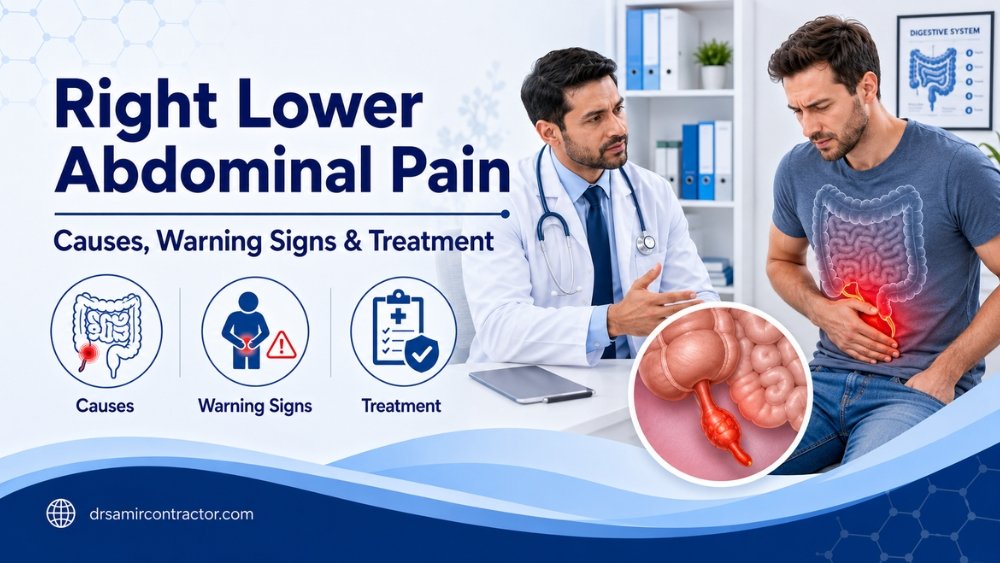
Right lower abdominal pain has many causes - but appendicitis is the most important to identify and exclude promptly. When right lower pain is progressive, accompanied by fever and loss of appetite, and worsening over hours - it is appendicitis until proven otherwise. This requires urgent surgical evaluation. Other causes include ovarian cysts, kidney stones, and mesenteric adenitis. The location of pain within the lower right quadrant guides diagnosis.
Quick Answers
Right lower abdominal pain is one of the most common reasons patients present to emergency departments and surgical clinics in India. The wide range of possible causes - from benign to life-threatening - makes accurate, systematic evaluation essential. The most important principle: do not assume right lower pain is benign without proper investigation, particularly when it is progressive and accompanied by fever.
What Lives in the Right Lower Abdomen?
- Appendix - the most important structure; its inflammation (appendicitis) is a surgical emergency
- Cecum - junction of the small and large intestine; right-sided colitis or Crohn's can affect this area
- Right ureter - kidney stones descending the ureter cause severe colicky right lower pain
- Right ovary and fallopian tube (in women) - ovarian cysts, torsion, ectopic pregnancy, PID
- Right inguinal region - inguinal hernia (especially in men)
- Mesenteric lymph nodes - mesenteric adenitis (particularly in children) from viral infections
- Terminal ileum - Crohn's disease, Meckel's diverticulum, terminal ileitis
- Psoas muscle - psoas abscess, psoas haematoma
How to Identify the Likely Cause
Appendicitis - the key pattern to recognise
- Pain starts around the navel (periumbilical) - migrates to right lower abdomen over 6–12 hours
- Becomes constant - not colicky
- Worsens progressively - each hour is worse than the last
- Accompanied by loss of appetite - nearly universal in appendicitis
- Nausea (and sometimes vomiting)
- Low-grade fever - usually 37.5–38.5°C initially
- Patient walks hunched or avoids sudden movement - peritoneal irritation
Ovarian cause (women) - similar location, different features
- Sudden onset of right lower pain - ovarian torsion twists suddenly
- Cycle relationship - pain at ovulation or during menstruation
- No progressive pattern - may be constant or colicky
- Ultrasound pelvic identifies ovarian pathology
Ureteric stone - colicky and severe
- Sudden onset of very severe, colicky flank pain radiating to right groin
- Urinary symptoms - burning, frequency, blood in urine
- No loss of appetite or fever (unless infected stone)
- Urine test and CT scan confirm
Causes of Right Lower Abdominal Pain
Common Causes (Many Benign)
- Appendicitis - most important to exclude
- Ovarian cyst - right-sided in women
- Ureteric stone - right kidney stone
- Mesenteric adenitis - viral (especially children)
- Inguinal hernia - right-sided
- Constipation-related pain - stool in ascending colon
- Muscle strain - right lower abdominal wall
- Irritable bowel syndrome - right lower pattern
Serious Causes (Urgent Evaluation)
- Appendicitis - perforated appendix = peritonitis
- Ovarian torsion - ovary twisting on its blood supply; ischaemia develops rapidly
- Ectopic pregnancy - pregnancy in fallopian tube; rupture = haemorrhage
- Crohn's disease acute flare - right lower + systemic symptoms
- Caecal volvulus - caecum twists; rare but serious
- Right colon cancer - chronic progressive pain
- Psoas abscess - rare; fever + hip pain + right lower pain
Seek emergency care if right lower pain is:
- Progressive - each hour worse than the last
- Accompanied by fever
- Associated with complete loss of appetite
- Makes you walk hunched or avoid moving suddenly
- Has been present for >6 hours and is worsening
- Accompanied by rigid abdomen - possible perforated appendix
- Severe sudden onset (ovarian torsion, ectopic)
- Associated with missed period and positive pregnancy test
Tests That May Be Needed
Investigation urgency matches clinical severity - investigations should not delay surgery when clinical diagnosis of appendicitis is very strong.
Blood tests
Full blood count (raised WBC = infection), C-reactive protein (elevated in appendicitis), blood pregnancy test (beta-hCG) in all women of reproductive age. Kidney function tests if ureteric stone is considered.
Urine test
For blood cells (ureteric stone), white cells (urinary infection or appendicitis nearby), and pregnancy (if beta-hCG not yet done from blood).
Ultrasound abdomen and pelvis
First-line imaging - identifies appendicular inflammation in some cases, ovarian pathology, kidney stones, free fluid. However, ultrasound sensitivity for appendicitis is only 70–80% - a normal ultrasound does not exclude appendicitis.
CT scan of abdomen and pelvis
The most accurate investigation for appendicitis - sensitivity >95%. Identifies appendicular inflammation, perforation, appendicular mass, and alternative diagnoses. Used when clinical diagnosis is uncertain or when complications are suspected.
Treatment
Appendicitis - Laparoscopic appendectomy
Surgery through 3 small incisions (5–10mm). Performed under general anaesthesia. Takes 30–60 minutes. Most patients go home the next day. Return to normal activity in 1–2 weeks. Highly safe in experienced hands. The only treatment that definitively cures appendicitis.
Perforated appendicitis
IV antibiotics started immediately. Laparoscopic appendectomy when the patient is stabilised. More complex surgery, longer hospital stay (3–5 days), slower recovery.
Appendicular mass / phlegmon
IV antibiotics and observation - appendectomy deferred for 6–8 weeks after the mass has resolved, when surgery is safer (interval appendectomy).
Other causes managed by diagnosis
- Ovarian torsion - emergency laparoscopic detorsion and cyst removal
- Ectopic pregnancy - emergency surgical or medical management
- Ureteric stone - pain control, hydration, lithotripsy or ureteroscopy if needed
- Mesenteric adenitis - conservative, usually self-limiting
What Happens If Appendicitis Is Ignored?
- The inflamed appendix perforates - typically within 24–72 hours of symptom onset
- Perforation releases gut bacteria into the peritoneal cavity - generalised peritonitis develops
- Peritonitis is a life-threatening infection - septic shock, multi-organ failure
- Even if perforation is walled off (appendicular mass), delayed surgery is more difficult and has higher complication rates
- Mortality from perforated appendicitis is significantly higher than from appendectomy for non-perforated disease
Frequently Asked Questions
Desi Patient Questions
Ha - 6+ hours progressive pain + loss of appetite = appendicitis highly likely. Hospital javo turant. Blood tests + CT scan confirm karshe. Appendicitis ma laparoscopic surgery safe ane fast recovery chhe. Delay = perforation risk vadhé chhe.
Nahi - pain killer masking kare chhe pain ne, cure nathi karta. Appendicitis tenu tenu progress kare chhe - perforation thay shake chhe pain temporarily better feeling pachi pan. Doctor evaluation zaruri chhe - pain killers leva ne delay nathi karvanu.
Children ma mesenteric adenitis (viral) appendicitis jashu laage chhe pun surgical nathi hota. Blood tests + ultrasound/CT distinguish karshe. But progressive pain + fever = evaluation zaruri chhe - children ma appendicitis faster perforate kare chhe adults karta.
Right Lower Abdominal Pain in India
- Appendicitis is among the most common emergency surgical conditions in India, affecting predominantly young adults and children - and it is eminently treatable with excellent outcomes when diagnosed early
- Delayed presentation is a major problem in India - patients often self-medicate with analgesics for 24–48 hours before presenting to hospital, by which time the appendix has often already perforated
- In young women presenting with right lower pain, ectopic pregnancy must be excluded as an emergency before any other evaluation proceeds - beta-hCG testing is mandatory
- Mesenteric adenitis - viral lymph node enlargement mimicking appendicitis - is extremely common in Indian children, particularly during monsoon and winter seasons
Seek Care in Vadodara
Progressive right lower abdominal pain with fever - seek evaluation at Sterling Hospital, Vadodara. Dr Samir Contractor provides emergency surgical evaluation, CT imaging, and laparoscopic appendectomy.
Think It Might Be Appendicitis? Don't Wait.
CT scan + same-day laparoscopic appendectomy if confirmed. Emergency evaluation available 24 hours at Sterling Hospital.