whatsapp  Book Appointment
FAQs About Pilonidal Cyst or Sinus People also like to read about

FAQs for Pilonidal Sinus Surgery

Laser Surgery for Anal Fissure & Pilonidal Sinus

Laser Surgery for Pilonidal Sinus

Consult Dr. Samir Contractor for Pilonidal Sinus Surgery.

Book a Consultation

FAQs About Pilonidal Cyst or Sinus

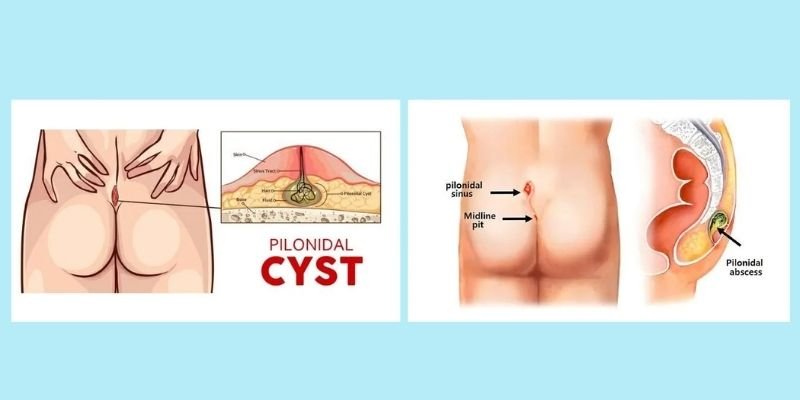
Pilonidal means a ‘nest of hairs.’ A sinus tract is a narrow tunnel (a small abnormal channel) in your body. A sinus tract typically goes between a focus of infection in deeper tissues to your skin surface. This means that the tract may discharge pus from time to time onto your skin. A pilonidal sinus is a sinus tract that commonly contains hairs. It occurs under your skin between your buttocks (the natal cleft) Rarely a pilonidal sinus occurs in other sites of your body.

Certain factors increase the risk of developing the condition and include:

  • A job involving much sitting (a sedentary occupation)
  • Being overweight or obese
  • A previous persistent irritation or injury to the affected area
  • Having a hairy, deep natal cleft
  • A family history of the condition
  • Being male
  • Practicing poor hygiene habits
  • Sitting for long periods at a time
  • Having thick, stiff body hair

Pilonidal disease is considered an acquired disease resulting from three main factors- the hair or foreign body, a force causing hair deposition into the sinus, and skin vulnerability. The exact cause is not clear. There are various theories. A similar condition can occur between the fingers of hairdressers, caused by customers’ hairs entering moist, damaged skin.

A pilonidal sinus affects the natal cleft. Symptoms vary from mild to severe, depending on the presence or absence of infection

  • Small dimples in the skin
  • Irritation or discomfort
  • Painful mass, which may be an abscess
  • Drainage from the area (clear, cloudy, or bloody fluid)
  • Red, tender area
  • Foul-smelling pus
  • Fever

  • Wide excision and healing by secondary intention: the sinus and surrounding skin are cut out, and the wound is left open to heal naturally. Healing takes several weeks with regular dressing changes. Recurrence is low with this procedure.
  • Excision and primary closure: the sinus area is removed, and the wound is stitched closed. Healing is faster, but the risk of recurrence or wound infection is higher.
  • A plastic surgery technique: recommended when the sinus recurs or is extensive, involving reconstructive surgical methods.

  • Wide excision and healing by secondary intention: This operation involves cutting out the sinus and a wide margin of skin surrounding the sinus. The wound is not closed but left to heal by natural healing processes. This usually requires several weeks of regular dressing changes until it heals fully. Recurrence is low with this procedure.
  • Excision and primary closure: This means taking out the section of skin which contains the sinus and stitching the wound. The advantage of this is that, if successful, the wound heals quite quickly. However, the risk of a recurrence or of developing a wound infection after the operation is higher than with the above procedure.
  • A plastic surgery technique: When the sinus recurs or is extensive, plastic surgery may be advised.

You need to keep the wound clean and the surrounding hairy area to be shave regularly to prevent recurrence.
Hair removal techniques : In some cases, hair removal may be the first step in treating a pilonidal sinus if an infection is not present.
Hair removal options may include:

  • Shaving
  • Waxing
  • Laser removal
  • Depilation creams
Why trust this content

Experience · Expertise · Authority · Trust

Every page on this site is written and medically reviewed by Dr Samir Contractor — a practising fellowship-trained surgeon — not by a content agency. Here is the evidence behind that claim.

E

Experience

Over 25 years of continuous surgical practice at Sterling Hospitals, Vadodara. Every claim on this page is drawn from direct clinical experience — not textbook paraphrasing.

25+ years in active surgical practice
8,000+ total procedures performed
5,000+ laparoscopic procedures
400+ bariatric procedures (sleeve & bypass)
1,500+ anorectal procedures
Senior Consultant, Sterling Hospitals since 2000
E

Expertise

Fellowship-trained at the Royal College of Surgeons of Edinburgh with subspecialty MIS training at Sir Ganga Ram Hospital, New Delhi. Board-certified in multiple countries.

MBBS — Medical College Baroda
MS (General Surgery) — Medical College Baroda
FRCS — Royal College of Surgeons, Edinburgh (UK)
FMAS — Fellow in Minimal Access Surgery
FACS — American College of Surgeons (USA)
PN1 Certified Exercise & Nutrition Coach
A

Authoritativeness

Affiliated with Sterling Hospitals — a leading multi-specialty hospital in Vadodara. Active member of recognised surgical bodies in India, the United Kingdom and the United States.

Senior Consultant, Sterling Hospitals, Vadodara
Indian Medical Association (IMA)
Indian Assoc. of GI Endo Surgeons (IAGES)
Obesity Surgery Society of India (OSSI)
Association of Surgeons of India (ASI)
General Medical Council, United Kingdom
T

Trustworthiness

Transparent pricing published on every procedure page. Surgery recommended only when clinically indicated. 4.9★ patient rating from named, verified patient reviews.

★ 4.9 average verified patient rating
Transparent package pricing on all pages
Medical disclaimer on every page
Content last reviewed: May 2026
Sterling Hospitals, Vadodara — established institution
Surgery discussed only when clinically appropriate
Qualifications
MBBS MS — General Surgery FRCS (Edinburgh, UK) FMAS FACS (USA) PN1 Certified
Memberships & Registrations
IMA IAGES ASI OSSI GMC, United Kingdom Royal College of Surgeons, Edinburgh American College of Surgeons

People also like to read about


Hemorrhoids / Piles Ebook Mockup
Free Instant Access

Hemorrhoids or Piles

Patient Information Guide

Back to top