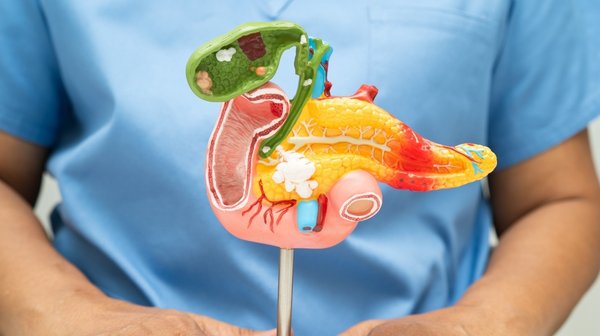
Acute cholecystitis is an infected and inflamed gallbladder — almost always caused by a gallstone obstructing the cystic duct. It is characterised by constant right upper abdominal pain, fever, and a positive Murphy's sign. It requires hospital admission, IV antibiotics, and laparoscopic cholecystectomy within 72 hours for best outcomes. It is not a condition to manage at home.
Quick Answers
Acute cholecystitis is one of the most common emergency surgical admissions in India. It occurs when a gallstone becomes permanently lodged at the cystic duct (outlet of the gallbladder), causing sustained obstruction, gallbladder distension, inflammation, and then bacterial infection of the stagnant bile. Every patient with known symptomatic gallstones who has not had surgery is at risk of this transition from biliary colic to acute cholecystitis.
Pathophysiology — How Cholecystitis Develops
The sequence:
- A gallstone obstructs the cystic duct (gallbladder outlet) — unlike biliary colic where the stone temporarily obstructs and shifts, here the stone is permanently lodged
- The gallbladder cannot empty — bile accumulates, the gallbladder distends
- Distension causes ischaemia of the gallbladder wall
- Gut bacteria (E. coli, Klebsiella, Enterococcus) colonise the stagnant bile
- The gallbladder wall becomes thickened, oedematous, and inflamed
- If untreated: empyema (pus), perforation, gangrene of the gallbladder wall
In 5–10% of cases, acute cholecystitis occurs without gallstones (acalculous cholecystitis) — in critically ill ICU patients, after major surgery, burns, or prolonged fasting. This form is particularly dangerous because there is no obvious precipitating cause to guide early diagnosis.
Symptoms and Clinical Features
- Constant right upper abdominal pain — this is the key distinguishing feature from biliary colic; the pain does not resolve in 1–4 hours; it persists and worsens
- Fever — usually 38–39°C; rigors in more severe cases
- Murphy's sign positive — sharp pain and breath arrest on deep inspiration while pressure is applied over the gallbladder area
- Tenderness on pressing the right upper abdomen — in biliary colic, the abdomen is not tender between attacks; in cholecystitis, there is localised peritoneal irritation
- Nausea and vomiting — more persistent than in simple biliary colic
- Anorexia
- Elevated white blood cell count and C-reactive protein on blood tests
Diagnosis
- Clinical assessment: History of gallstones + constant right upper pain + fever + positive Murphy's sign = acute cholecystitis until proven otherwise
- Ultrasound abdomen: Confirms gallstones + gallbladder wall thickening (>4mm) + pericholecystic fluid + sonographic Murphy's sign (pain on transducer pressure over gallbladder)
- Blood tests: Raised WBC, elevated CRP, liver function tests (elevated if CBD involvement)
- CT scan: For complicated cholecystitis — identifies perforation, empyema, pericholecystic abscess
Tokyo Guidelines Grading
| Grade | Definition | Management |
|---|---|---|
| Grade I (Mild) | No organ dysfunction; mild local inflammation | Elective cholecystectomy within 72 hours or same admission |
| Grade II (Moderate) | Elevated WBC, long symptom duration, palpable mass, localised peritonitis | Early cholecystectomy when condition allows; antibiotics |
| Grade III (Severe) | Organ dysfunction (cardiovascular, neurological, respiratory, renal) | Intensive care; cholecystostomy drainage to stabilise; delayed surgery |
Seek emergency care if cholecystitis shows signs of:
- Jaundice — CBD stone obstruction on top of cholecystitis (Mirizzi syndrome or direct stone migration)
- Rigid or board-like abdomen — perforation and peritonitis
- Confusion, low blood pressure, rapid heart rate — septic shock (gangrenous cholecystitis)
- Palpable mass in right upper abdomen — pericholecystic abscess or empyema
- Worsening despite 24–48 hours of antibiotics
Treatment
Hospital admission — mandatory
- IV antibiotics — broad-spectrum covering gram-negative and anaerobic organisms
- IV fluids and IV analgesia
- Nil by mouth
- Regular monitoring of vital signs and clinical progress
Laparoscopic cholecystectomy — timing
Early surgery (within 72 hours): Currently evidence-based standard. Multiple randomised trials show early cholecystectomy (within 24–72 hours) leads to shorter total hospital stay, similar complication rates, and lower overall cost compared to delayed interval surgery. When performed by an experienced laparoscopic surgeon, early cholecystectomy for acute cholecystitis has excellent safety.
Interval cholecystectomy (6 weeks later): Reserved for patients presenting very late (>72 hours with severe inflammation making early surgery technically difficult), or with very high surgical risk requiring optimisation first.
Percutaneous cholecystostomy
Radiologically guided drain placed directly into the gallbladder for Grade III cholecystitis or very high surgical risk patients — provides temporary decompression while the patient is stabilised for definitive surgery.
What Happens Without Treatment
- Empyema gallbladder — gallbladder fills with pus; requires urgent surgical drainage
- Gangrenous cholecystitis — ischaemia and necrosis of gallbladder wall; high surgical risk, possible perforation
- Perforation with bile peritonitis — bile spills into peritoneal cavity; life-threatening generalised peritonitis
- Pericholecystic abscess — localised collection; may drain into adjacent structures
- Cholecystoenteric fistula — gallbladder erodes into adjacent bowel; gallstone ileus (stone causing bowel obstruction)
Frequently Asked Questions
Desi Patient Questions
Evidence-based standard = 72 hours ma early surgery. Better outcomes, shorter hospital stay total. 6 weeks delay = risk of repeat attack (15-20%), more difficult surgery, higher complications. Early surgery preferred in experienced centres like Sterling Vadodara.
Antibiotics infection temporarily control kare chhe — thoda patients better feel kare chhe. But stone ane gallbladder remain kare chhe. 15-20% patients 6 weeks ma pachi attack aavé chhe. Cumulative complications vadhé chhe. Surgery definitive cure chhe — antibiotics temporary relief chhe.
Acute Cholecystitis in India
- Acute cholecystitis is one of the most common emergency surgical admissions in India — and it is almost entirely preventable by timely elective cholecystectomy for known symptomatic gallstones
- Delayed presentation after home antibiotic use (2–3 days) is common in India — patients arrive with more advanced disease, higher surgical risk, and complications already developing
- Early cholecystectomy within 72 hours — the global evidence-based standard — is increasingly practised at high-volume surgical centres in Vadodara and across Gujarat
Seek Urgent Care in Vadodara
Constant right upper pain + fever = acute cholecystitis. Go to Sterling Hospital, Vadodara for IV antibiotics, ultrasound, and early laparoscopic cholecystectomy by Dr Samir Contractor.
Acute Cholecystitis? Get Admitted and Operated Early in Vadodara
IV antibiotics + early laparoscopic cholecystectomy within 72 hours. Dr Samir Contractor at Sterling Hospital, Vadodara.