In short: An anal fistula is an abnormal tunnel connecting the anal canal to the skin near the anus. It almost always develops after a perianal abscess. Fistulas rarely heal on their own - surgery is required to close the track while preserving sphincter function. Early, accurate diagnosis with MRI and treatment by an experienced surgeon gives the best chance of a permanent cure.
Quick Answers
What Is an Anal Fistula?
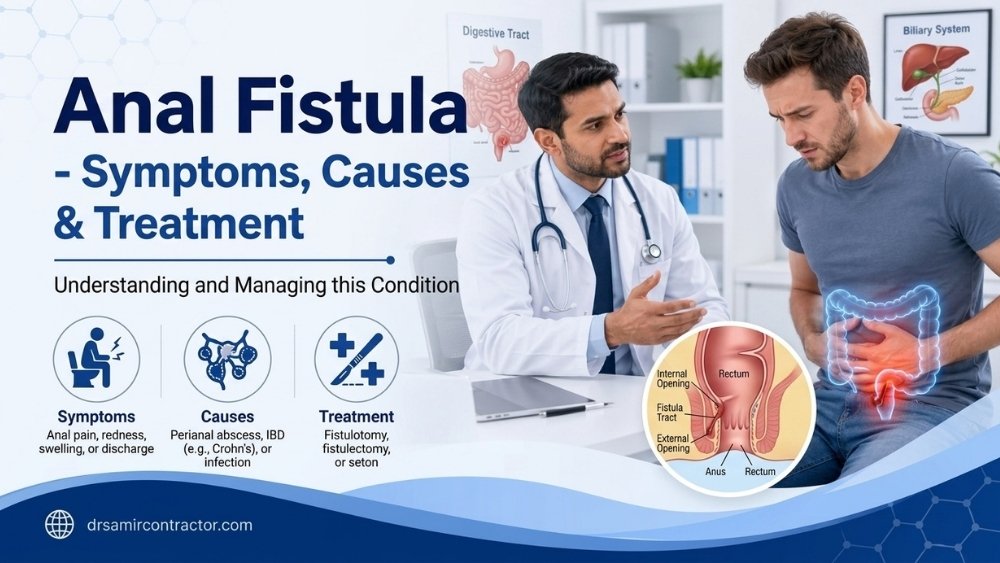
An anal fistula (also called fistula-in-ano) is an abnormal tunnel that forms between the inner lining of the anal canal and the skin surface near the anus. Think of it as a small underground passage - one end (the internal opening) sits inside the anal canal, and the other end (the external opening) appears as a tiny hole on the perianal skin.
Fistulas are not simply open wounds. The tunnel becomes lined with granulation tissue or epithelium over time, which is precisely why they do not close on their own. The track keeps draining intermittently, and without surgical intervention, the cycle of discharge, temporary relief, and recurrent swelling continues indefinitely.
How Does an Anal Fistula Form?
The most common pathway follows a predictable sequence:
- Anal gland infection: Small glands inside the anal canal become blocked and infected.
- Abscess formation: The infection collects into a perianal abscess - a painful, swollen pocket of pus.
- Drainage (spontaneous or surgical): The abscess either bursts on its own or is drained by a surgeon.
- Incomplete healing: In roughly 30-50% of cases, the internal opening does not seal. A persistent track remains - this is the fistula.
Less common causes include Crohn's disease, tuberculosis (especially relevant in India), previous anorectal surgery, radiation therapy, and rarely, malignancy. In Crohn's-associated fistulas, multiple and complex tracks are frequently seen.
Types of Anal Fistula - Parks Classification
The Parks classification, universally used by colorectal surgeons, categorises fistulas by their relationship to the anal sphincter muscles:
- Intersphincteric (most common, ~45%): The track runs between the internal and external sphincter muscles. Usually the simplest to treat.
- Trans-sphincteric (~30%): The track passes through the external sphincter. Surgical planning must protect continence.
- Suprasphincteric (~5%): The track loops over the top of the external sphincter before exiting to the perianal skin. Requires advanced repair techniques.
- Extrasphincteric (rare, <5%): The track runs from the rectum through the levator muscles to the perianal skin, completely outside the sphincter complex. Often associated with Crohn's disease, trauma, or iatrogenic injury.
Accurate classification is critical because the choice of surgical technique depends directly on how much sphincter muscle the fistula track involves. Cutting through too much sphincter causes incontinence; leaving part of the track untreated causes recurrence.
Symptoms of Anal Fistula
Patients typically report a combination of the following:
- Persistent discharge: Pus, blood-tinged fluid, or mucus draining from a small opening near the anus. Underwear staining is a hallmark complaint.
- Recurrent perianal abscess: The same spot swells up repeatedly, drains partially, and then settles - only to return weeks or months later.
- Perianal pain: Dull throbbing that worsens during bowel movements, sitting, or physical activity. Pain typically intensifies when the external opening seals temporarily and pus re-accumulates.
- Visible external opening: A small raised or flat opening on the skin near the anus, sometimes with a bead of pus visible at the surface.
- Skin irritation and itching: Constant moisture from discharge leads to maceration and pruritus of the perianal skin.
- Fever and malaise: Present during acute flare-ups when the track becomes blocked and pus collects again.
If you have pus or discharge near the anus that keeps coming back despite antibiotic courses, an underlying fistula is the most likely explanation.
Diagnosis - How Is a Fistula Confirmed?
Clinical examination by an experienced surgeon can identify most external openings. However, the internal opening and the exact course of the track through the sphincter complex require imaging:
- MRI fistulogram: The gold standard. MRI provides a detailed 3D map of the fistula track, side branches, and the relationship to the sphincter muscles. This information is indispensable for surgical planning.
- Examination Under Anaesthesia (EUA): The surgeon probes the fistula track in the operating theatre with the patient under anaesthesia. This confirms the MRI findings and identifies subtle secondary tracks.
- Endoanal ultrasound: Useful when MRI is unavailable. It offers good visualization of the sphincter complex but is less accurate for complex branching tracks.
Dr Samir Contractor routinely obtains a pre-operative MRI fistulogram for all fistula patients. This step alone significantly reduces missed tracks and lowers recurrence rates after surgery.
Treatment Options for Anal Fistula
Surgery is the only reliable cure for anal fistula. The specific technique is selected based on fistula complexity, sphincter involvement, and the patient's continence status.
1. Fistulotomy (Laying Open)
The fistula track is cut open along its entire length and allowed to heal from the base upward. This is the gold standard for simple, low intersphincteric fistulas. Cure rates exceed 95%. It is not suitable for fistulas involving significant amounts of sphincter muscle.
2. Seton Placement
A thin silicone or silk thread (seton) is passed through the fistula track. A loose (draining) seton keeps the track open, prevents abscess recurrence, and allows inflammation to settle before definitive repair. A cutting seton gradually slices through the sphincter muscle over weeks. Setons are particularly useful as a first stage in complex fistulas.
3. LIFT Procedure (Ligation of the Intersphincteric Fistula Track)
The fistula track is accessed through the intersphincteric groove. The track is ligated (tied off) at the internal opening and the intersphincteric portion is removed. LIFT preserves the external sphincter entirely, making it an excellent option for trans-sphincteric fistulas. Success rates range from 65-85%.
4. Advancement Flap
A flap of rectal tissue is raised and used to cover and seal the internal opening. This technique is reserved for complex or recurrent fistulas, particularly in patients with Crohn's disease. It avoids cutting any sphincter muscle.
5. VAAFT (Video-Assisted Anal Fistula Treatment)
A tiny endoscope (fistuloscope) is inserted into the external opening to visualise the entire track from the inside. The track lining is destroyed under direct vision, and the internal opening is closed with a stapler or sutures. VAAFT is minimally invasive, sphincter-sparing, and allows the surgeon to identify and treat secondary branches that might otherwise be missed.
Other Approaches
Fibrin glue injection, fistula plug, laser ablation (FiLaC), and stem cell injection are newer techniques with variable success rates. They may be considered in selected cases, particularly recurrent fistulas or those associated with Crohn's disease.
Recurrence Risk
Fistula recurrence remains the central challenge. Reported rates by technique:
- Fistulotomy: 2-5%
- LIFT: 5-15%
- Advancement flap: 10-20%
- VAAFT: 10-20%
- Fibrin glue / fistula plug: 30-50%
The two biggest factors that reduce recurrence are accurate pre-operative MRI mapping and a surgeon experienced in fistula surgery. Missed secondary tracks are the most common reason fistulas return.
Red Flags - See a Surgeon Urgently
- Spreading redness, swelling, and fever - suggests a new or enlarging abscess
- Inability to pass stool or urine alongside perianal swelling
- Foul-smelling faecal discharge from the fistula opening - may indicate a recto-vaginal or high rectal fistula
- Multiple external openings appearing over a short period - consider Crohn's disease or tuberculosis
- Unexplained weight loss and altered bowel habits alongside a fistula - requires colonoscopy to rule out malignancy
- Progressive worsening despite prior fistula surgery - needs specialist re-evaluation
Reassuring Signs - Likely Straightforward
- Single external opening with minimal clear or whitish discharge
- No history of Crohn's disease, TB, or prior anorectal surgery
- MRI shows a simple intersphincteric or low trans-sphincteric track with no branches
- No signs of sepsis (fever, chills, malaise)
- First-time presentation - recurrence risk is lowest with initial surgery
What Happens If a Fistula Is Ignored?
An untreated anal fistula does not stay static. Over months and years, several complications can develop:
- Recurrent abscesses: The blocked track leads to repeated painful collections that require emergency drainage.
- Track complexity increases: Simple fistulas develop secondary branches, horseshoe extensions, and additional external openings. What could have been a straightforward fistulotomy now requires multi-stage surgery.
- Chronic discharge and skin damage: Constant moisture leads to perianal dermatitis, fungal infection, and significant quality-of-life impairment.
- Sphincter damage from repeated abscesses: Each abscess episode causes scarring and weakening of the sphincter muscles, increasing the risk of incontinence - even before surgery.
- Malignant transformation (rare): Chronic, long-standing fistulas (10+ years) carry a small but documented risk of developing cancer within the fistula track.
The take-away: Early treatment is simpler, less invasive, and has better outcomes than treating a fistula that has been left to become complex over years.
Anal Fistula in the Indian Context
Kshar Sutra - The Ayurvedic Tradition
Kshar sutra (a medicated alkaline thread) is one of the oldest documented treatments for fistula-in-ano, described in the Sushruta Samhita. A specially prepared thread is passed through the fistula track and changed periodically. The alkaline medication gradually cuts through and cauterises the track. While kshar sutra has a cultural and historical role in India, it has limitations: treatment duration extends over several weeks to months, patient compliance can be challenging, and standardisation of the thread preparation varies across practitioners. Modern sphincter-preserving surgeries such as LIFT and VAAFT typically offer faster healing with comparable or better cure rates.
Tubercular (TB) Fistula
India has a high burden of tuberculosis, and TB is a well-recognised cause of atypical anal fistulas. TB fistulas often present with multiple external openings, watery discharge, and undermined skin edges. Tissue biopsy and culture are essential. Anti-tubercular therapy (ATT) must be given alongside surgical treatment - operating without ATT leads to invariable recurrence.
Recurrence After Incomplete Treatment
Many patients across India present after failed treatments - whether from general surgeons unfamiliar with complex fistula anatomy, kshar sutra practitioners who did not map the track adequately, or patients who stopped treatment prematurely. These recurrent cases require expert re-evaluation with MRI, and surgery by a specialist who is comfortable with multiple fistula repair techniques.
Fistula Treatment in Vadodara
Dr Samir Contractor treats the full spectrum of anal fistulas at Sterling Hospital, Vadodara - from simple intersphincteric tracks to complex recurrent and Crohn's-associated fistulas. His approach includes:
- Mandatory pre-operative MRI fistulogram for every patient - no guesswork.
- Technique matched to anatomy: Fistulotomy for simple tracks, LIFT or VAAFT for complex tracks, staged seton when needed.
- Sphincter-first philosophy: Continence preservation is the priority in every surgical plan.
- Same-day or next-day discharge for most fistula procedures.
- Structured follow-up protocol - post-operative wound checks, sitz bath guidance, and long-term recurrence surveillance.
Patients travel from across Gujarat and neighbouring states for fistula surgery at Sterling Hospital. If you have a recurrent or complex fistula, a specialist opinion can make the difference between repeated surgeries and a lasting cure.
ગુજરાતીમાં સમજો - Anal Fistula
ભગંદર એ ગુદા માર્ગ (anal canal) અને ગુદાની નજીકની ચામડી વચ્ચે બનેલી એક અસામાન્ય ટનલ છે. મોટાભાગે ગુદા પાસેના ફોલ્લા (abscess) પછી આ સમસ્યા થાય છે.
ગુદાની નજીક સતત પરુ કે પ્રવાહી નીકળવું, વારંવાર ફોલ્લો થવો, દુખાવો, અને ચામડી પર નાનું છિદ્ર દેખાવું - આ બધા ભગંદરના સંકેતો છે.
ના. એન્ટિબાયોટિક્સ ચેપ ઘટાડી શકે, પણ ભગંદરની ટનલ બંધ કરવા માટે ઓપરેશન જરૂરી છે. દવા માત્ર અસ્થાયી રાહત આપે છે.
આધુનિક સ્ફિંક્ટર-સ્પેરિંગ ટેકનિકો (LIFT, VAAFT) ખૂબ સલામત છે. અનુભવી સર્જન દ્વારા કરવામાં આવે ત્યારે ગુદા નિયંત્રણ પર અસર થવાનું જોખમ ખૂબ ઓછું હોય છે.
MRI ફિસ્ટુલાની ટનલ, તેની શાખાઓ, અને સ્નાયુઓ સાથેનો સંબંધ ચોક્કસ રીતે બતાવે છે. આ માહિતી વિના ઓપરેશન કરવાથી ફરી ભગંદર થવાનું જોખમ વધે છે.
ડૉ. સમીર કોન્ટ્રાક્ટર સ્ટર્લિંગ હોસ્પિટલ, વડોદરા ખાતે તમામ પ્રકારના ભગંદરની સારવાર કરે છે - સાદાથી લઈને જટિલ અને વારંવાર થતા ભગંદર સુધી.
Get Expert Fistula Treatment
Stop the cycle of discharge, pain, and recurring abscesses. Book a consultation with Dr Samir Contractor for a definitive surgical plan.
Frequently Asked Questions - Anal Fistula
Related Pages
Why Trust This Page?
- Written by a specialist: Dr Samir Contractor (MS, FMAS, FIAGES) is a senior GI and laparoscopic surgeon with 25+ years of clinical experience and 8,000+ surgeries.
- Hospital-based practice: All consultations and procedures are performed at Sterling Hospital, Vadodara - a NABH-accredited multi-specialty facility.
- Evidence-informed content: This page reflects current clinical guidelines, peer-reviewed literature, and real-world surgical experience.
- No AI-only content: Every clinical statement has been reviewed and approved by Dr Contractor.
- Transparent intent: This page is educational. It is not a substitute for an in-person consultation.