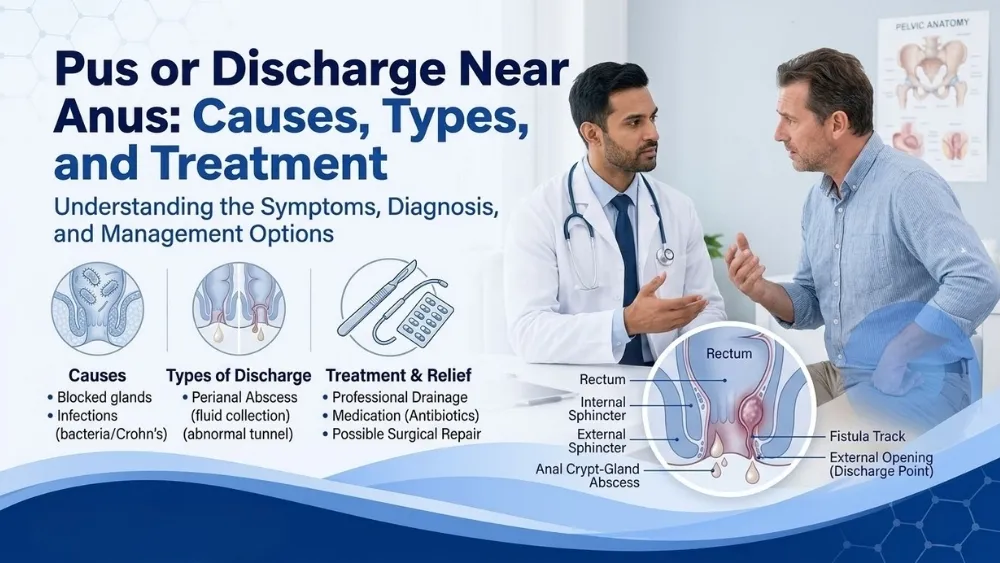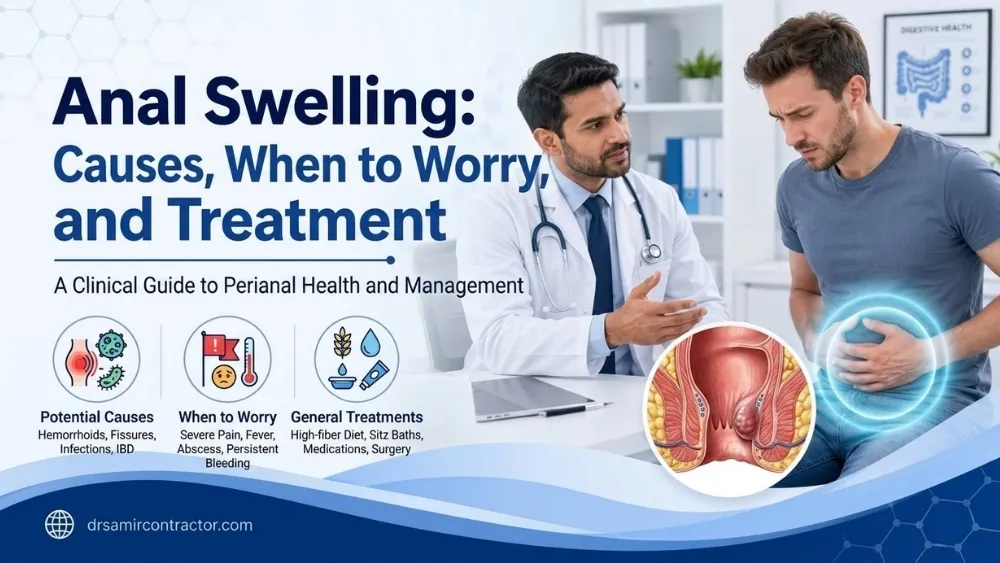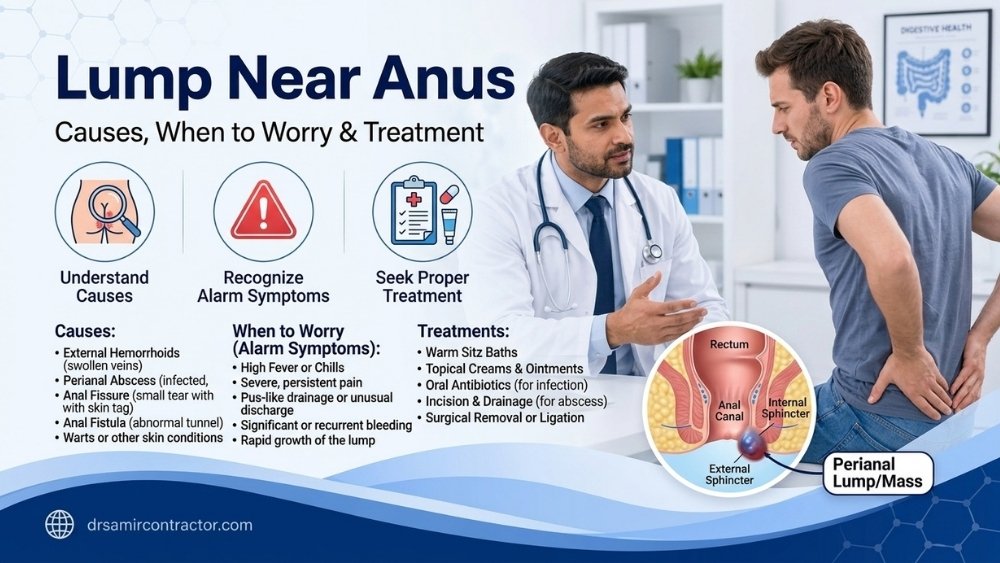
In plain language: If you have discovered a lump near your anus, take a breath. Most perianal lumps are not cancer. The commonest culprits are skin tags, swollen piles (hemorrhoids) and small abscesses. This page explains seven likely causes, the warning signs that need urgent attention, and treatment options - so you can have an informed conversation with your doctor instead of panicking after a late-night Google search.
Quick Answers - Lump Near Anus
What Could a Lump Near Your Anus Actually Be?
The skin and tissue around the anus is rich in blood vessels, glands and nerve endings. Swelling in this zone can arise from vascular congestion (piles), infection (abscess), viral growth (warts), or simple skin excess (tags). Because the area is hidden, patients often discover a lump only when they feel discomfort while sitting or notice something during bathing.
The important point: a lump is a symptom, not a diagnosis. Identical-feeling lumps can have very different origins - and each origin has a different treatment. That is why a clinical examination by an experienced proctologist is the fastest route to peace of mind.
7 Common Causes of a Lump Near the Anus
1. Anal Skin Tag
A small, soft, painless flap of excess skin at the anal verge. Skin tags often develop after a healed hemorrhoid or anal fissure. They are entirely benign and do not become cancerous. Removal is optional - usually for hygiene or cosmetic reasons.
2. Prolapsed Hemorrhoid (Pile)
An internal hemorrhoid that has pushed through the anal canal and is visible or palpable outside. Prolapsed piles feel soft, may bleed during bowel movements, and can often be pushed back inside in the early stages (Grade II-III). They are not dangerous in themselves, but can worsen without management.
3. Thrombosed External Hemorrhoid
When blood clots inside an external pile, the result is a firm, bluish-purple, intensely painful lump - often described as pea-sized to grape-sized. Pain peaks around 48-72 hours and then slowly eases over 1-3 weeks. If caught within 72 hours, a quick office procedure (excision under local anaesthesia) provides immediate relief.
4. Perianal Abscess
An abscess is a pocket of pus caused by an infected anal gland. It presents as a hot, red, throbbing swelling that worsens day by day. Fever and malaise are common. An abscess will not resolve with antibiotics alone - it must be drained surgically. Left untreated, it can progress to a fistula or spread deeper into tissue planes (a surgical emergency).
5. Anal Wart (Condyloma)
Caused by certain strains of the Human Papillomavirus (HPV), anal warts appear as small, flesh-coloured or whitish bumps - sometimes single, sometimes in clusters. They are painless but can itch. Treatment includes topical agents, electrocautery or surgical excision. Vaccination (HPV vaccine) can prevent many causative strains.
6. Pilonidal Sinus (Near the Tailbone)
Strictly speaking, a pilonidal sinus sits in the natal cleft (crease between the buttocks) rather than at the anus itself, but patients frequently describe it as a "lump near my bum." It is a small tunnel in the skin that traps hair and debris, leading to recurring infections. Definitive treatment is surgical excision.
7. Anal Cancer (Rare)
Anal cancer can present as a persistent, hard lump that may bleed, ulcerate or be accompanied by a change in bowel habit. Risk factors include HPV infection, immunosuppression and smoking. While uncommon, it underlines why any lump that does not improve within two weeks warrants professional evaluation.
At-a-Glance Comparison
| Condition | Feel / Look | Pain? | Fever? | Urgency |
|---|---|---|---|---|
| Skin tag | Soft flap, skin-coloured | None | No | Routine |
| Prolapsed pile | Soft, moist, may bleed | Mild | No | Soon |
| Thrombosed pile | Firm, bluish, pea-grape sized | Severe | No | Within 72 hrs |
| Perianal abscess | Hot, red, tense swelling | Severe, throbbing | Often yes | Urgent / ER |
| Anal wart | Flesh-coloured bumps, may cluster | None | No | Routine |
| Pilonidal sinus | Lump in natal cleft, may ooze | Moderate if infected | Sometimes | Soon |
| Anal cancer | Hard, fixed, may ulcerate | Variable | Late stage | Urgent referral |
When Is a Lump Near the Anus an Emergency?
Most perianal lumps are not emergencies, but two scenarios demand same-day care:
- Perianal abscess with fever: A hot, expanding swelling accompanied by temperature above 100.4 °F (38 °C), chills or inability to sit. Untreated, the infection can track into deeper tissue planes - an event called necrotising fasciitis that is life-threatening.
- Strangulated prolapse: A large prolapsed hemorrhoid or rectal prolapse that cannot be pushed back inside, turns dark or dusky, and causes extreme pain. Blood supply to the tissue is being cut off, and without timely intervention necrosis can occur.
Red-Flag Symptoms - See a Doctor Promptly
- Lump that is growing in size week after week
- Bleeding that is dark, persistent or mixed with stool
- Unexplained weight loss alongside a perianal lump
- Fever above 100.4 °F (38 °C) with local swelling
- Pus discharge with foul odour
- Hard, fixed lump that does not move when pressed
- New lump in someone with a history of HPV or immunosuppression
- Change in bowel habit lasting more than 3 weeks
Likely Benign Signs (But Still Worth Checking)
- Small, soft, painless skin flap present for months - likely a skin tag
- Lump that appears only during straining and retracts on its own - likely a Grade II pile
- Pea-sized tender lump that appeared suddenly and is easing after 3-4 days - likely a thrombosed pile resolving
- Cluster of tiny painless bumps - possibly warts (still need treatment)
How Is a Lump Near the Anus Diagnosed?
Diagnosis usually takes under ten minutes in an experienced proctologist's clinic:
- Visual inspection: The doctor examines the perianal skin with the patient lying on their side (left lateral position). Many conditions - skin tags, warts, thrombosed piles, abscesses - are diagnosed on sight.
- Digital rectal examination (DRE): A gloved, lubricated finger gently checks inside the anal canal for internal piles, masses or tenderness. It takes seconds and is less uncomfortable than most patients expect.
- Proctoscopy / Anoscopy: A short tube with a light is inserted to see the lower rectum and anal canal. This confirms internal hemorrhoids or polyps.
- Biopsy (if needed): If the lump looks atypical, a small tissue sample is taken and sent to a lab. Results usually return within 5-7 days.
- Imaging (rare): MRI or endoanal ultrasound may be ordered if an abscess is suspected to track deep or if cancer staging is required.
Treatment Options by Cause
Treatment depends entirely on the underlying diagnosis:
- Skin tags: No treatment required unless they cause hygiene issues. Elective excision under local anaesthesia takes 10-15 minutes.
- Prolapsed piles: Grade I-II respond well to dietary fibre, hydration and topical creams. Grade III-IV may need rubber-band ligation, stapled hemorrhoidopexy or laser hemorrhoidoplasty.
- Thrombosed external pile: If within 72 hours, office excision gives immediate relief. Beyond that, warm sitz baths, analgesics and time usually suffice.
- Perianal abscess: Incision and drainage (I&D) is mandatory - antibiotics alone will not cure it. Follow-up is essential because roughly 30-50 % of abscesses may develop into a fistula.
- Anal warts: Topical agents (podophyllin, imiquimod), electrocautery, or surgical excision depending on size and number. Recurrence is common; follow-up visits are important.
- Pilonidal sinus: Acute abscess is drained first. Definitive cure involves excision procedures such as Limberg flap or endoscopic pilonidal sinus treatment (EPSiT).
- Anal cancer: Managed by a multidisciplinary oncology team. First-line treatment is usually chemo-radiation (the Nigro protocol). Surgery is reserved for residual or recurrent disease.
What Happens If You Ignore a Lump Near the Anus?
Outcomes vary by cause, but ignoring the symptom rarely makes things better:
- Skin tags stay the same - no harm, but they can trap moisture and cause itching.
- Piles tend to progress from Grade II to III to IV over months or years, making eventual treatment more complex.
- Thrombosed piles may resolve but often leave behind a residual skin tag. Repeated thrombosis is likely without addressing the underlying pile.
- Abscesses do not self-drain safely. They can burst unpredictably, form a chronic fistula-in-ano, or - in worst cases - spread to cause life-threatening pelvic sepsis.
- Warts can multiply, enlarge, and - in rare cases - undergo malignant transformation (Buschke-Lowenstein tumour).
- Pilonidal sinus goes through painful infect-settle-infect cycles, each episode leaving more scarring.
- Cancer is stage-dependent: caught early (Stage I), five-year survival exceeds 80 %. Caught late (Stage IV), it drops below 30 %. Every week of delay matters.
Why Perianal Lumps Are Common in India
Several factors contribute to a higher prevalence of anorectal conditions in India:
- Diet shift: Urbanisation has led to lower fibre intake and more processed food, increasing constipation and pile formation.
- Prolonged sitting: IT-sector jobs, long commutes and rising desk-work culture increase pelvic congestion.
- Delayed care: Cultural embarrassment around anorectal symptoms means many patients wait months or years before consulting - by which time simple conditions have become complex.
- Quack treatments: Unregulated Kshar-Sutra or injection therapies performed by unqualified practitioners can create scarring, strictures and recurrence.
- Sanitation and hygiene: In some communities, limited access to clean water and sanitation increases infection risk for abscesses and pilonidal sinus.
At the same time, India has world-class proctologists and hospitals offering advanced laser, stapled and minimally invasive surgeries at a fraction of Western costs. The key is reaching the right specialist early.
Expert Perianal Lump Assessment in Vadodara
Dr Samir Contractor consults at Sterling Hospital, Vadodara - a NABH-accredited facility with state-of-the-art endoscopy, laser and Day-Care surgery suites. Here is what a typical consultation looks like:
- Confidential history-taking in a private consultation room.
- Gentle clinical examination (visual + DRE) - diagnosis is usually established within minutes.
- Same-day proctoscopy if needed (no separate appointment required).
- Clear explanation of the diagnosis, treatment options and expected costs.
- If surgery is required, most procedures are Day-Care - you go home the same evening.
Patients visit from across Gujarat (Ahmedabad, Surat, Rajkot, Bharuch, Anand) and neighbouring states for Dr Contractor's expertise in advanced anorectal surgery.
ગુજરાતીમાં સામાન્ય પ્રશ્નો (FAQs in Gujarati)
મોટાભાગે નહીં. ગુદા કેન્સર ખૂબ જ દુર્લભ છે. મોટાભાગની ગાંઠો સ્કિન ટેગ, મસા (પાઇલ્સ) અથવા ફોલ્લી (abscess) હોય છે - આ બધી સારવારયોગ્ય છે.
હા. દુખાવો ન હોય એનો અર્થ એ નથી કે ગાંઠ હાનિકારક નથી. સ્કિન ટેગ, મસા અને ક્યારેક કેન્સર પણ શરૂઆતમાં દુખાવો નથી કરતા. તપાસ કરાવવી જરૂરી છે.
કારણ પ્રમાણે સારવાર બદલાય છે: સ્કિન ટેગ માટે નાની સર્જરી, મસા માટે લેસર/સ્ટેપ્લર, ફોલ્લી માટે ડ્રેનેજ, અને મસાના ગઠ્ઠા (warts) માટે દવા અથવા ઇલેક્ટ્રોકોટરી.
Thrombosed pile 2-3 અઠવાડિયામાં ઘટી શકે, પણ સ્કિન ટેગ, ફોલ્લી અને warts જાતે મટતા નથી. ડૉક્ટરની સલાહ લો.
ડૉ. સમીર કોન્ટ્રાક્ટર સ્ટર્લિંગ હોસ્પિટલ, વડોદરામાં અદ્યતન પ્રોક્ટોલોજી સેવાઓ આપે છે. મોટાભાગની સર્જરી Day-Care છે - સાંજે ઘરે જઈ શકાય.
હા. ગર્ભાવસ્થામાં પેલ્વિક વિસ્તારમાં રક્ત પ્રવાહ વધવાથી અને ગર્ભાશયના દબાણથી મસા (piles) થવા સામાન્ય છે. ડિલિવરી પછી ઘણીવાર સુધારો થાય છે.
Worried About a Lump? Get Clarity Today.
Most perianal lumps are benign and treatable. A quick consultation can replace weeks of anxiety.
Frequently Asked Questions
Why Trust This Page?
- Experience: Dr Samir Contractor has personally treated thousands of patients with perianal lumps over a career spanning 25 + years.
- Expertise: Board-certified surgeon (MS) with advanced fellowship credentials - FMAS (Fellow of Minimal Access Surgery) and FIAGES (Fellow of Indian Association of Gastrointestinal Endo-Surgeons).
- Authoritativeness: Practising at Sterling Hospital, Vadodara - a NABH-accredited multi-specialty institution recognised for surgical excellence.
- Trustworthiness: Content is written for patient education, references current clinical guidelines, and is regularly updated. No misleading claims; no promotion of unproven therapies.