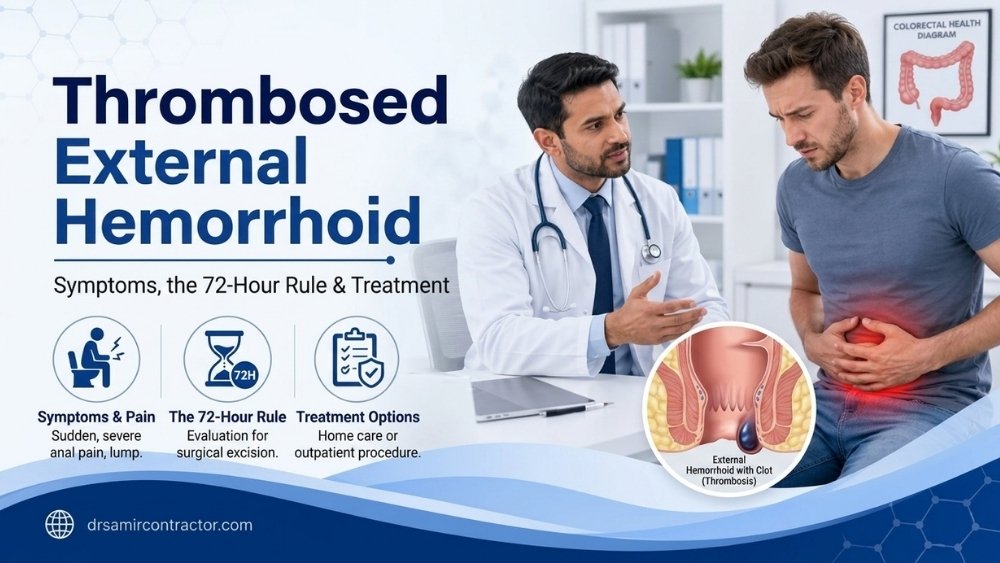
In plain language: A thrombosed external hemorrhoid is a blood clot that forms inside a swollen vein just under the skin at the edge of your anus. It shows up suddenly as a firm, bluish, painful lump - sometimes after straining, heavy lifting or prolonged sitting. The critical window is 72 hours: if you reach a surgeon within that time, a quick office procedure can remove the clot and give you near-instant relief. Wait longer, and the body begins absorbing the clot on its own - but you face 2 to 4 weeks of discomfort and a likely residual skin tag. This page explains exactly what happens, what your options are, and why timing matters.
The 72-Hour Window Matters
Pain from a thrombosed pile peaks between 48 and 72 hours. If you are reading this within that window, contact a proctologist today - a 15-minute office procedure can end your pain immediately. After 72 hours, conservative management is usually the better choice.
Quick Answers - Thrombosed External Hemorrhoid
What Exactly Is a Thrombosed External Pile?
External hemorrhoids are normal vascular cushions that sit beneath the skin just outside the anal opening. They are covered by sensitive skin (anoderm), which is why problems here hurt so much. A thrombosed external hemorrhoid forms when blood pools inside one of these cushions and clots. The clot stretches the overlying skin, triggering intense pain and visible swelling.
Unlike internal hemorrhoids - which sit above the dentate line and are covered by relatively insensitive mucosa - external hemorrhoids are richly supplied with pain-sensing nerve fibres. That is why a thrombosed external pile produces sharp, constant, sometimes throbbing pain that makes even sitting on a soft cushion uncomfortable.
What Does a Thrombosed External Hemorrhoid Look Like?
Patients typically notice:
- A firm, tense lump at the edge of the anus - not soft or squishy like a normal pile.
- A bluish or dark purple colour visible through the stretched skin, caused by the underlying blood clot.
- Size ranging from a small pea to a large grape (5 mm to 3 cm).
- The lump appears suddenly - often overnight or after a specific triggering event.
- The overlying skin may appear shiny and taut because of the pressure from within.
If the skin over the clot breaks spontaneously, you may see a small amount of dark blood ooze out and experience partial pain relief. This is not a cause for alarm - the clot is partially decompressing - but it does warrant medical review to rule out infection and manage the residual tissue.
Why Does It Happen?
Any event that raises pressure in the perianal veins or slows venous return can trigger clot formation:
- Straining at stool: Hard stools and constipation are the most common trigger.
- Diarrhoea: Repeated forceful bowel movements irritate the vascular cushions.
- Heavy lifting: Sudden spikes in intra-abdominal pressure push blood into the hemorrhoidal plexus.
- Prolonged sitting or standing: Long road trips, flights, desk jobs - anything that keeps pelvic blood from circulating efficiently.
- Pregnancy and childbirth: The growing uterus compresses pelvic veins, and the act of pushing during delivery is a powerful trigger.
- Vigorous exercise: Squats, deadlifts and intense core work increase abdominal pressure.
- Spicy food and alcohol: They do not directly cause thrombosis, but they can worsen vascular congestion in someone already predisposed.
The 72-Hour Rule - Why Timing Is Everything
The natural course of a thrombosed external hemorrhoid follows a predictable timeline:
- Hours 0 - 24: Sudden onset of pain. The lump appears and swells rapidly.
- Hours 24 - 72: Pain intensifies and reaches its peak. The clot is fresh, well-defined, and easy to remove.
- Days 3 - 7: Pain begins to plateau and then gradually eases. The clot starts to organise - it becomes adherent to surrounding tissue and harder to evacuate cleanly.
- Weeks 2 - 4: The body slowly reabsorbs the clot. Pain fades, but the stretched skin remains as a deflated pouch - a residual skin tag.
The clinical implication is clear: intervention during the first 72 hours - while the clot is fresh and pain is at its worst - gives the best combination of immediate pain relief, clean removal, and lowest recurrence. After 72 hours, the diminishing pain means the patient often feels the worst is behind them, and conservative management (sitz baths, analgesics, stool softeners) is a reasonable path.
Treatment Options
1. Incision & Evacuation (Within 72 Hours)
This is an office or outpatient procedure performed under local anaesthesia. The surgeon makes a small incision over the clot and squeezes or scoops out the thrombus. Relief is almost immediate. The wound is left open to heal by secondary intention over 7 to 10 days. A major advantage: it can be done in a consultation room - no operating theatre required.
Limitation: If the hemorrhoid has multiple loculated clots, simple incision may not remove all of them, and the clot can re-form.
2. Excision of the Thrombosed Hemorrhoid (Within 72 Hours)
Instead of just evacuating the clot, the entire thrombosed hemorrhoid - clot plus the overlying skin ellipse - is excised. This is considered the gold-standard procedure for thrombosed external piles because it:
- Removes all clot material in one go, reducing recurrence.
- Eliminates the redundant skin, preventing a residual skin tag.
- Can still be done under local anaesthesia in most cases.
Recovery takes about 10 to 14 days. Sitz baths and mild analgesics are usually sufficient for aftercare.
3. Conservative Management (After 72 Hours or Patient Preference)
When the 72-hour window has passed, or when the patient prefers to avoid a procedure, conservative measures are the standard approach:
- Warm sitz baths: 10 to 15 minutes, three to four times daily. The warm water improves local blood flow and helps the body reabsorb the clot.
- Oral analgesics: Paracetamol or ibuprofen to control pain. Avoid aspirin, which may thin the blood and prolong oozing if the skin breaks.
- Stool softeners: Ispaghula husk (psyllium) or lactulose to prevent straining during bowel movements.
- Topical agents: Lignocaine gel for local pain relief. Over-the-counter pile creams can provide modest comfort.
- Ice packs: Wrapped in a cloth, applied for 10 minutes at a time to reduce swelling in the first 48 hours.
Most patients managed conservatively see significant improvement by 7 to 10 days and full resolution by 3 to 4 weeks. The trade-off is prolonged discomfort and a high likelihood of a residual skin tag.
When Is Formal Surgery Preferred?
Beyond the standard 72-hour excision, certain situations call for surgery under regional or general anaesthesia in an operating theatre:
- Multiple thrombosed piles: When two or more external hemorrhoids are clotted simultaneously, an in-theatre excision ensures complete clearance.
- Circumferential thrombosis: Clotting around the entire anal circumference creates severe oedema and pain. This requires careful, staged excision to avoid removing too much anoderm.
- Co-existing conditions: If the patient also has a large prolapsing internal hemorrhoid or anal fissure, addressing everything in one session under anaesthesia is more practical.
- Recurrent thrombosis: Patients who have had multiple episodes often benefit from a definitive hemorrhoidectomy - removing the underlying hemorrhoidal tissue to prevent future clots.
- Patient anxiety: Some patients cannot tolerate an office procedure due to pain sensitivity or anxiety. A short general anaesthetic makes the experience comfortable.
Aftercare Following Clot Removal or Excision
- Sitz baths: Warm water soaks after every bowel movement and before bedtime for 7 to 10 days.
- Fibre-rich diet: Whole grains, fruits, vegetables and adequate water (2 to 3 litres per day) keep stools soft and prevent straining.
- Analgesics: Take as prescribed - typically paracetamol or ibuprofen for 3 to 5 days.
- Wound care: Keep the area clean and dry. A small gauze pad between the buttocks can absorb any oozing.
- Activity: Light walking is encouraged from day one. Avoid heavy lifting for two weeks.
- Follow-up: A review at 7 to 10 days confirms healing. If the wound is granulating well, no further visits are needed.
At-a-Glance: Procedure vs. Conservative Management
| Factor | Excision / Evacuation (Within 72 hrs) | Conservative Management |
|---|---|---|
| Pain relief | Near-immediate | Gradual over 2-4 weeks |
| Procedure setting | Clinic / Day-Care OT | Home-based |
| Anaesthesia | Local (usually) | None required |
| Residual skin tag | Unlikely with excision | Likely |
| Recurrence risk | Lower | Higher (underlying pile remains) |
| Time off work | 1-3 days | Variable (pain-dependent) |
| Best suited for | Presentation within 72 hours | Presentation after 72 hours or patient preference |
Red-Flag Situations - Seek Urgent Care
- Strangulated hemorrhoid: A prolapsed internal pile that cannot be pushed back in, turns dark or dusky, and causes extreme pain. Blood supply is being cut off - this is a surgical emergency.
- Circumferential thrombosis: Clotting around the entire anal ring, causing massive swelling and the inability to sit, stand or pass stool comfortably. Requires in-theatre management.
- Fever with perianal swelling: May indicate a secondary infection or an abscess forming alongside the thrombosed pile.
- Uncontrolled bleeding: If the skin over the clot ruptures and bleeding does not stop with gentle pressure within 15 minutes.
- Urinary retention: Inability to pass urine due to severe perianal pain - uncommon but requires emergency attention.
Signs That Conservative Management Is Reasonable
- The lump appeared more than 72 hours ago and pain is already easing.
- You can sit, walk and pass stool - uncomfortable, but manageable with analgesics.
- No fever, no expanding swelling, no difficulty urinating.
- The lump is a single, small (pea-sized) swelling - not circumferential.
- You have no history of repeated thrombosed piles.
Even when conservative management is appropriate, a single clinical review is recommended to confirm the diagnosis and rule out mimics like a perianal abscess.
What Happens If a Thrombosed External Hemorrhoid Is Ignored?
A thrombosed pile is not life-threatening, but ignoring it has consequences:
- Weeks 1-2: Persistent pain interferes with sitting, working and sleeping. Bowel movements become dreaded events.
- Weeks 2-4: Pain gradually settles as the clot reabsorbs. The lump shrinks but does not vanish entirely.
- Long term: A deflated, wrinkled skin tag remains at the anal verge. It can trap moisture, cause itching and make hygiene difficult.
- Recurrence: The underlying hemorrhoid has not been removed. Future clots are common, especially if the triggers (constipation, straining, sitting) are not addressed.
- Psychological impact: Chronic anal discomfort and repeated episodes lead many patients to avoid exercise, social activities and even medical consultation - a cycle that worsens the problem.
India-Specific Concerns - Thrombosed Piles
- Confusion with "piles" and cancer: In India, any perianal lump is loosely called "piles." Patients often assume the worst (cancer) or the least (nothing serious). A thrombosed pile is neither - it is a specific, time-sensitive condition that benefits from early professional evaluation.
- Fear of surgery: Many patients delay because they fear an operation. In reality, clot evacuation or excision is a minor office procedure under local anaesthesia - not a full surgery. The procedure takes 10 to 15 minutes and you go home the same day.
- Self-treatment with creams: Pharmacy counters are stocked with pile ointments, and patients often spend weeks applying cream to a thrombosed pile. Topical agents cannot dissolve a blood clot - they may soothe surface discomfort slightly but do not address the core problem.
- Ayurvedic and Kshar-Sutra confusion: Kshar-Sutra (medicated thread) has a role in chronic fistula management, but it is not appropriate for an acute thrombosed hemorrhoid. Misapplication can cause chemical burns and scarring.
- Late presentation: Cultural embarrassment means many patients cross the 72-hour window before seeking help. If you are reading this page and your lump appeared in the last three days, you still have time to benefit from an office procedure - act now.
Same-Day Thrombosed Pile Treatment in Vadodara
Dr Samir Contractor consults at Sterling Hospital, Vadodara - a NABH-accredited multi-specialty facility with dedicated Day-Care procedure rooms. Here is what to expect:
- Call or WhatsApp to describe your symptoms. If a thrombosed pile is suspected, you will be offered the earliest available slot - often the same day.
- A brief examination confirms the diagnosis within minutes.
- If within the 72-hour window and suitable, clot evacuation or excision is performed immediately under local anaesthesia in a clean, private procedure room.
- You walk out within an hour, with pain relief that most patients describe as dramatic.
- A follow-up call at 48 hours and an in-person review at one week ensure smooth healing.
Patients travel from across Gujarat - Ahmedabad, Surat, Rajkot, Bharuch, Anand - for Dr Contractor's expertise in anorectal conditions. If you are within driving distance, the 72-hour window is still open.
Within 72 Hours? Act Now for the Best Outcome.
A quick office procedure can end your pain today. Do not let the window close.
Frequently Asked Questions
ગુજરાતીમાં સામાન્ય પ્રશ્નો (FAQs in Gujarati)
ગુદાની બહારની નસમાં લોહીનો ગઠ્ઠો (clot) જામી જાય ત્યારે તેને thrombosed external pile કહે છે. તે વાદળી રંગની, સખત અને ખૂબ દુખાવાવાળી ગાંઠ તરીકે દેખાય છે.
ગાંઠ દેખાયાના 72 કલાકની અંદર ડૉક્ટર પાસે જાવ તો local anaesthesia હેઠળ clot કાઢી શકાય છે - દુખાવો તરત જ ઘટે છે. 72 કલાક પછી, શરીર જાતે clot ઓગાળવા લાગે છે અને conservative સારવાર વધુ યોગ્ય બને છે.
ના. ક્રીમ ફક્ત બહારની ત્વચાને થોડી રાહત આપે છે. અંદરના ગઠ્ઠાને ઓગાળવાની ક્ષમતા કોઈ ક્રીમમાં નથી. ડૉક્ટરની તપાસ કરાવવી જરૂરી છે.
Clot evacuation અથવા excision માત્ર 10 થી 15 મિનિટનું procedure છે. Local anaesthesia હેઠળ થાય છે. એક કલાકમાં ઘરે જઈ શકાય છે.
ગરમ પાણીના sitz bath, દુખાવાની દવા અને stool softener વડે 2 થી 4 અઠવાડિયામાં ગાંઠ ધીમે ધીમે ઓગળી જાય છે. પણ મોટાભાગે skin tag રહી જાય છે.
ડૉ. સમીર કોન્ટ્રાક્ટર, સ્ટર્લિંગ હોસ્પિટલ, વડોદરામાં same-day thrombosed pile સારવાર ઉપલબ્ધ છે. WhatsApp પર appointment લો: wa.me/919824593464.
Why Trust This Page?
- Experience: Dr Samir Contractor has treated thousands of thrombosed hemorrhoids over a career spanning 25 + years - from simple office evacuations to complex circumferential excisions.
- Expertise: Board-certified surgeon (MS) with advanced fellowship credentials - FMAS (Fellow of Minimal Access Surgery) and FIAGES (Fellow of Indian Association of Gastrointestinal Endo-Surgeons).
- Authoritativeness: Practising at Sterling Hospital, Vadodara - a NABH-accredited multi-specialty institution recognised for surgical excellence.
- Trustworthiness: Content is written for patient education, references current clinical guidelines, and is regularly updated. No misleading claims; no promotion of unproven therapies.