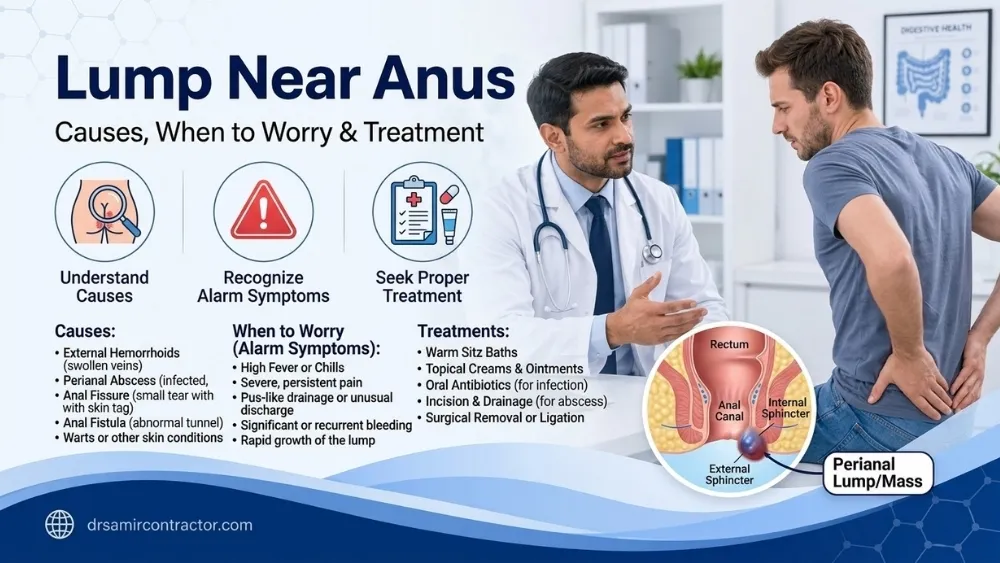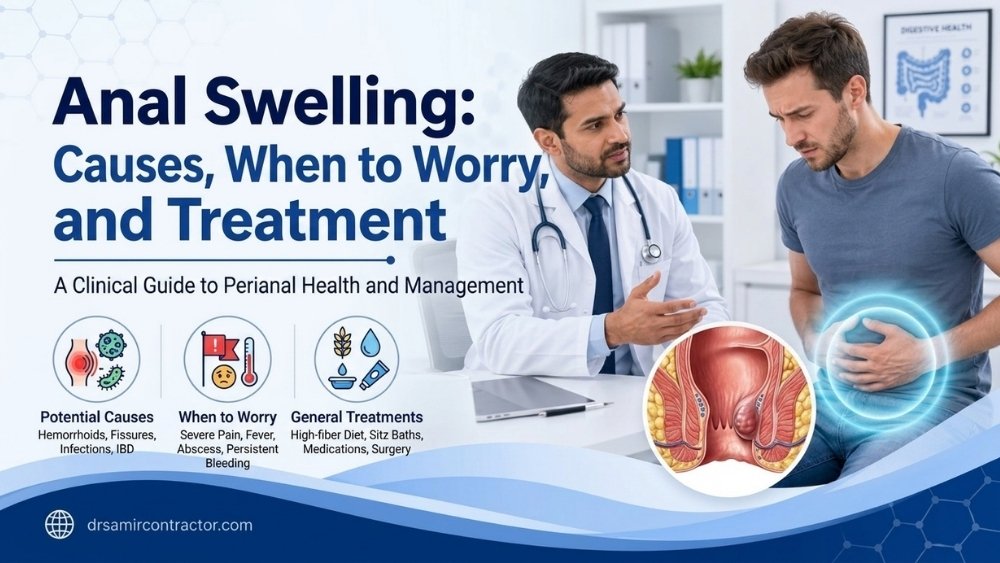
A swelling or lump near the anus is one of the most alarming things a person can discover. The good news: the overwhelming majority of perianal swellings are benign and treatable - thrombosed piles, skin tags, or a small abscess. This page helps you understand what your swelling might be, which situations need urgent attention, and when you can safely wait for an elective appointment.
Quick Answers
You step out of the bathroom and feel something that was not there before - a firm lump at the edge of your anus. Your first thought may be the worst-case scenario. That reaction is natural, but it is almost always disproportionate to the actual problem. Most perianal swellings are caused by conditions that are common, well understood, and straightforward to treat.
This page is designed as a decision-making guide. It walks you through the likely causes of your swelling, helps you sort urgent situations from non-urgent ones, and explains the diagnostic and treatment pathway. If you arrived here from our lump near anus or anal pain page, this page adds the next layer of detail.
What Does Anal Swelling Mean?
"Anal swelling" is a symptom, not a diagnosis. It describes any abnormal fullness, lump, or bulge at or around the anal opening. The swelling may originate from the anal canal itself (internal structures that have prolapsed outward) or from the perianal skin and tissue (external lumps). Determining the cause requires a short clinical examination, because several different conditions can produce a very similar-looking lump.
Common Causes of Anal Swelling
The table below lists the most frequent causes in order of how often they are seen in clinical practice. Each condition has a distinct character, and your surgeon can usually tell them apart within minutes.
| Cause | What it feels like | Key clue |
|---|---|---|
| Thrombosed external hemorrhoid | Sudden, firm, very painful bluish lump at the anal verge | Appears within hours; pain peaks in the first 48 hours then gradually fades |
| Prolapsed internal hemorrhoid | Soft, purplish mass that comes out during straining; may or may not go back in | Associated with bleeding; often reducible (can be pushed back inside) |
| Perianal abscess | Tender, warm, red swelling near the anus that grows over days | Fever, throbbing pain that worsens with sitting; pus may drain spontaneously |
| Anal skin tag | Small, painless, soft flap of skin at the anal margin | Present for weeks or months; no pain, no bleeding - a cosmetic and hygiene concern |
| Sentinel tag (of fissure) | Small, firm tag at the lower end of an anal fissure | Associated with sharp pain during stool and a visible crack in the anal skin |
| Rectal prolapse | Concentric rings of tissue protruding from the anus | Comes out during straining; feels like a large, circular, wet mass - not just a lump on one side |
| Anal canal tumour (rare) | Hard, slowly growing, often painless lump that does not resolve | Persistent growth over weeks, may bleed; associated with weight loss in advanced cases |
Thrombosed External Hemorrhoid - The Most Common Sudden Swelling
A blood clot forms inside one of the small veins beneath the perianal skin, producing a tense, bluish, exquisitely tender lump. It is often triggered by straining, heavy lifting, prolonged sitting, or a bout of constipation. The pain is most severe in the first 48 to 72 hours. If you present to a surgeon within this window, a small incision under local anaesthesia to remove the clot provides immediate relief. After 72 hours the clot starts organising, and conservative management (sitz baths, analgesics, stool softeners) is usually preferred, with resolution over 2 to 4 weeks.
Prolapsed Internal Hemorrhoid
Internal piles (Grade III or IV) can slip out during a bowel movement and present as a soft, wet, purplish swelling. Grade III piles can be pushed back manually; Grade IV remain outside permanently. The main concern with prolapse is strangulation - if the anal sphincter traps the prolapsed pile, cutting off its blood supply. This causes severe pain, swelling, and discoloration and requires emergency treatment.
Perianal Abscess - The Swelling That Needs Same-Day Attention
An abscess is a collection of pus in the tissue beside the anus. It begins as a small area of redness and tenderness, then swells rapidly over 2 to 5 days into a hot, fluctuant (feels like it has fluid inside) mass. Fever, chills, and inability to sit comfortably are common. An abscess will not resolve with antibiotics alone - it needs surgical drainage. Untreated, it can burst spontaneously (partial relief but recurrence is likely) or extend deeper to form complex tracks (fistula).
Skin Tags and Sentinel Tags
Anal skin tags are harmless folds of perianal skin, often left behind after a previous thrombosed pile has resolved or after pregnancy. They cause no pain and no bleeding but can make hygiene difficult and cause cosmetic concern. A sentinel tag is a specific type found at the lower edge of a chronic anal fissure - it is the body's scarring response to the fissure. Treating the fissure usually addresses the tag.
Rectal Prolapse
Full-thickness rectal prolapse is more common in older women and involves the entire wall of the rectum protruding through the anus. Unlike a prolapsed pile (which is a localised cushion), rectal prolapse produces concentric mucosal folds in a circular pattern. It requires surgical repair, and several minimally invasive options exist.
When Is Anal Swelling an Emergency?
Seek Same-Day Surgical Care If
- Swelling + fever (above 100.4 F / 38 C): this combination strongly suggests a perianal abscess that needs drainage
- Prolapsed pile that cannot be pushed back and is turning dark or dusky: strangulation - the blood supply is being cut off
- Rapidly increasing swelling with throbbing pain: abscess expanding; delay increases the risk of a fistula forming
- Pus draining from the swelling: confirms abscess; drainage is still needed even if some pus has escaped
- Inability to pass urine alongside perianal swelling: deep abscess may be compressing the urethra - an uncommon but serious sign
Red Flags That Need Prompt (Not Emergency, but Soon) Evaluation
- A lump that has been growing slowly for more than 4 weeks without resolution
- A hard, fixed, painless lump - different from the typical soft or tender swellings listed above
- Bleeding from the lump, especially if dark-coloured or associated with weight loss
- Recurrent swelling at the same site (may indicate an underlying fistula tract)
- Any perianal swelling in a patient with diabetes, immune suppression, or on steroids - these patients are at higher risk of rapid abscess progression
Usually Safe to Wait for an Elective Appointment
- A small, painless skin tag that has been present for weeks or months
- A thrombosed pile where the worst pain has already passed (beyond 72 hours) and is improving
- A soft prolapse that reduces back inside easily and is not getting worse
- A sentinel tag associated with a known chronic fissure already under treatment
Even "safe" swellings deserve a one-time evaluation to confirm the diagnosis. Self-diagnosis of perianal lumps is unreliable.
How Is Anal Swelling Diagnosed?
The examination is brief and performed with your privacy fully maintained. Dr Samir Contractor follows a standard three-step assessment:
- Visual inspection: The perianal area is examined in a lateral (side-lying) position. The colour, size, location, and surface of the swelling are noted. A bluish, tense lump points to a thrombosed pile. A red, warm swelling with surrounding skin changes suggests abscess. A fleshy, concentric protrusion indicates prolapse.
- Digital rectal examination (DRE): A gloved, lubricated finger gently examines the anal canal to assess sphincter tone, detect internal lumps, and check for tenderness or induration (hardness). This takes under 30 seconds.
- Proctoscopy (when indicated): A short, rigid tube is passed into the anal canal to directly visualise internal piles, fissures, or other mucosal abnormalities. This takes 2 to 3 minutes and is done in the OPD.
Additional investigations are not routine but may include:
- MRI of the perineum: ordered when an abscess is suspected to be deep (ischiorectal or supralevator) or when a fistula tract needs mapping before surgery.
- Biopsy: if the lump is hard, fixed, or has unusual features - to rule out malignancy.
- Blood tests: complete blood count and blood sugar if abscess or infection is present, especially in diabetic patients.
Treatment
Thrombosed External Hemorrhoid
- Within 48-72 hours: Incision and clot evacuation under local anaesthesia in the clinic. Immediate pain relief. Takes 10 to 15 minutes.
- After 72 hours: Conservative treatment - sitz baths (warm water, 10 to 15 minutes, 3 times/day), analgesics, stool softeners. The clot resorbs over 2 to 4 weeks. A residual skin tag may remain.
Prolapsed Hemorrhoids
- Grade III (reducible): Laser hemorrhoidectomy, stapler hemorrhoidopexy, or conventional excision depending on size and number of piles.
- Grade IV (irreducible): Stapler or conventional excision surgery.
- Strangulated pile: Emergency reduction under anaesthesia followed by definitive surgery, sometimes in the same sitting.
Perianal Abscess
- Incision and drainage - the definitive treatment. Done under local or short general anaesthesia. The wound is left open to heal from inside out.
- Antibiotics are an adjunct, not a substitute. They are given alongside drainage, especially in diabetics.
- About 30 to 50% of drained abscesses develop a fistula tract later. Follow-up is essential. See our fistula surgery page for details.
Skin Tags
- Excision under local anaesthesia if they cause hygiene difficulty or cosmetic concern.
- No treatment needed if asymptomatic.
Rectal Prolapse
- Surgical repair - options include laparoscopic rectopexy (mesh-assisted fixation of the rectum) or perineal approaches for older or frail patients.
What Happens If Anal Swelling Is Ignored?
- Abscess spreads deeper. A simple perianal abscess, if not drained, can track into the ischiorectal fossa or above the pelvic floor, turning a 15-minute procedure into a complex operation.
- Fistula formation. An untreated or incompletely drained abscess commonly leaves behind a persistent tract (fistula) between the anal canal and skin, requiring more extensive surgery.
- Strangulation of prolapsed piles. A prolapse that is repeatedly left unreduced risks getting trapped, losing blood supply, and becoming gangrenous - a surgical emergency.
- Chronic anaemia. Prolapsed or thrombosed piles that bleed repeatedly can lead to iron-deficiency anaemia over months.
- Missed diagnosis. Self-treating a lump as "just piles" for months without examination risks overlooking an abscess, fistula, or, in rare cases, a tumour.
- Worsening quality of life. Persistent swelling, pain, discharge, and difficulty with hygiene take a significant toll on daily comfort, work productivity, and mental well-being.
Anal Swelling in India
Why This Matters in India
Perianal conditions are among the most common reasons for a surgical consultation in India, yet most patients delay seeking help for months - sometimes years. The reasons are familiar:
- Embarrassment. Discussing a lump near the anus is difficult for many patients. This delay is the single biggest reason simple conditions become complicated ones.
- Self-medication. Over-the-counter pile creams and Ayurvedic ointments are widely available. They may relieve mild symptoms but cannot drain an abscess, fix a prolapse, or diagnose a fistula.
- Fear of surgery. Many patients believe any anorectal surgery means weeks of bed rest. Modern techniques - laser, stapler, day-care drainage - have shortened recovery to 3 to 5 days for most procedures.
- Dietary pattern. The typical Indian diet high in refined flour (maida-based snacks, white bread, bakery items) and low in fibre creates chronic constipation, the root cause of most hemorrhoid-related swellings.
A 10-minute clinical examination can distinguish a harmless skin tag from an abscess that needs same-day drainage. That single visit often prevents weeks of unnecessary suffering.
Anal Swelling Treatment in Vadodara
Dr Samir Contractor evaluates and treats all types of perianal swellings at Sterling Hospital, Race Course Road, Vadodara. From a same-day abscess drainage to elective laser hemorrhoidectomy and fistula surgery, the full range of anorectal procedures is available under one roof.
Desi Patient Questions (Gujarati / Hinglish)
Pahela garam pani ma 10-15 minute beso (sitz bath) ane paracetamol lo. Jho taav aave, dard vadhtu jaay, ke pus nikalti hoy to same day surgeon ne batavo. Taav vagar hoy to 2-3 divas ma appointment lo - pan check-up jarur karavo.
Gantho piles hoy shake, abscess (pus) hoy shake, skin tag hoy shake, ke fissure no sentinel tag hoy shake. Joyu joyu thi khabar na padhe - doctor ne ekvaar batavvu jaruri chhe. Check-up 5-10 minute no j hoy chhe.
Nahi. Abscess ma pus bhareilu hoy chhe - ae nikalvanu j padhe (incision and drainage). Antibiotic ekaale aapi ne chhe pan pus nikalya vagar kaam na thay. Moda karsho to aage jaine fistula banay chhe.
48-72 kalak ma aavo to doctor nanu cut kari ne clot kadhi naakhe - turant rahat thaay. 72 kalak pachi ho to sitz bath, dard ni dawa, ane stool softener thi 2-4 aathvadia ma thik thay. Operation nahi - bas nanu procedure chhe.
Pregnancy ma sitz bath, fibre vadharu, ane safe cream thi manage kariye. Operation delivery pachi j thay - jho strangulation ke abscess na hoy to. Doctor ne jarur batavo - sharam na rakho, aa bahu common chhe pregnancy ma.
Ek j jagya ae varamvaar aave to mota bhag e fistula hoy chhe - anal canal thi chamdi sudhi nani ek nali hoy chhe. Ae nali band na thay tyaan sudhi varamvaar abscess thaya karshe. Fistula surgery thi j kalami aat upay thay chhe.
Noticed a Swelling Near Your Anus?
Most perianal swellings are treatable - many in a single OPD visit. A brief examination tells you exactly what it is and what needs to be done. Do not wait for it to get worse.