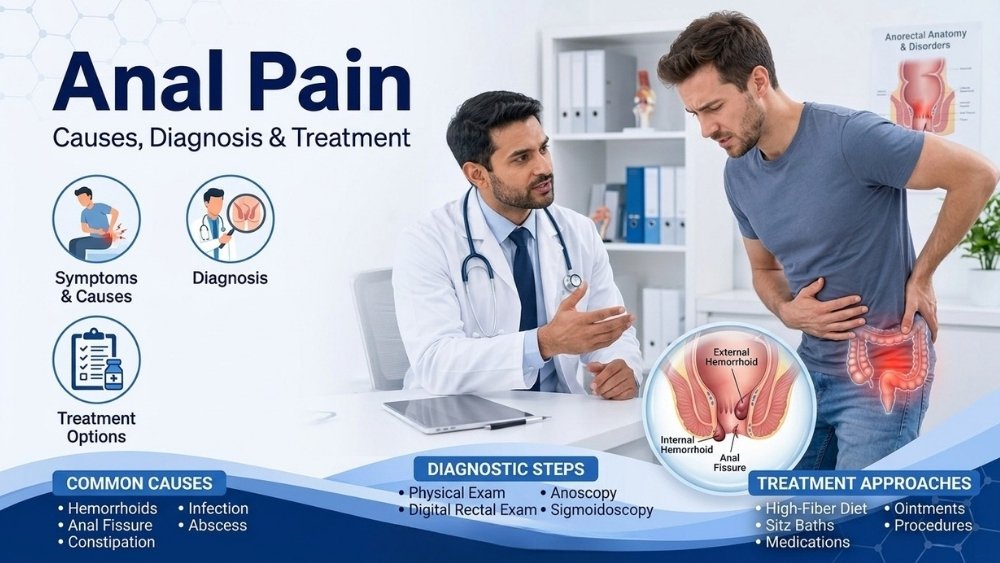
Anal pain is one of the most common anorectal complaints - and one of the most frequently ignored. This page explains every major cause of anal pain, organises them by timing pattern (during stool, constant, or episodic), lists red-flag signs, and outlines how a proctologist diagnoses and treats the underlying condition.
Quick Answers - Anal Pain at a Glance
What Does Anal Pain Mean?
Anal pain (also called rectal pain, perianal pain or proctalgia) refers to any discomfort felt in or around the anus and lower rectum. The anal canal is densely supplied with sensory nerves - which is why even a tiny crack can produce intense, disproportionate pain.
Pain in this area is not a diagnosis by itself; it is a symptom that points to an underlying cause. The character, timing and associated features of the pain help a proctologist narrow down the exact problem.
Because patients often describe their pain differently - "sharp during stool," "constant throbbing," "comes and goes at night" - this page organises causes by the timing pattern you actually experience, making it easier to identify what may be going on before you see a specialist.
Causes of Anal Pain - Organised by Timing
Understanding when your pain occurs is the single most useful clue. Below are the major causes grouped into three timing categories.
Group 1 - Pain During or Immediately After Passing Stool
This is the most common pattern. The act of defecation triggers or worsens the pain.
Anal Fissure
A linear tear in the anoderm (lining of the anal canal), usually at the posterior midline. It causes a sharp, tearing or cutting sensation during stool that can persist as a burning ache for minutes to hours afterwards. A small amount of bright red blood on the tissue is typical. Hard stools and straining are the usual triggers.
Thrombosed Haemorrhoid (Pile)
When blood clots inside an external haemorrhoid, a firm, bluish, intensely tender lump appears at the anal verge. Pain is worst during stool and when sitting. Unlike a fissure, the dominant finding is a visible, palpable swelling rather than a tear.
Large Prolapsing Internal Haemorrhoids
Grade III-IV internal piles that prolapse during defecation may cause a dragging, pressure-type pain combined with mucus discharge and difficulty cleaning. The pain worsens with prolonged straining.
Group 2 - Constant or Progressively Worsening Pain
Pain that is present around the clock - and often worsens over hours or days - suggests an infective or inflammatory process.
Perianal Abscess
A collection of pus in the tissue around the anus. It presents as a swollen, hot, extremely tender area that throbs continuously. Fever and malaise are common. An abscess will not resolve with antibiotics alone - it requires surgical drainage.
Anal Fistula
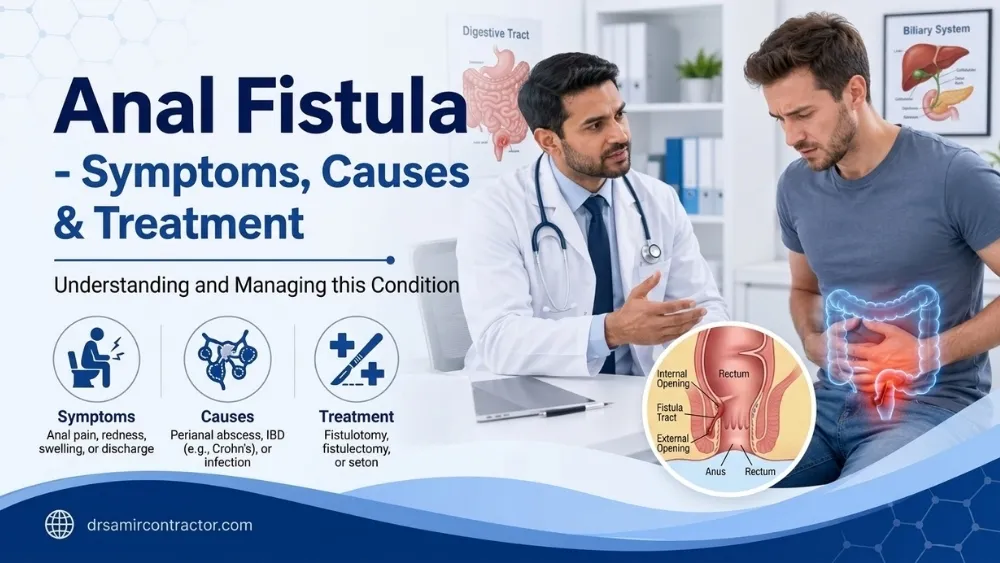
An abnormal tunnel between the anal canal and the perianal skin, often the sequel of a drained abscess. Patients notice persistent dull aching, intermittent discharge and a small opening near the anus. Pain may fluctuate - it builds as pus collects and eases when it drains spontaneously.
Pilonidal Sinus
Strictly a disease of the natal cleft (between the buttocks) rather than the anus itself, but patients frequently report it as "anal pain." When infected, it creates a painful, swollen, discharging lump near the tailbone. It tends to recur without definitive surgery.
Group 3 - Episodic or Intermittent Pain
Pain that comes and goes in spasms - often at night or with no obvious trigger - falls into this category.
Proctalgia Fugax
Sudden, severe, cramping rectal pain lasting seconds to minutes, often waking the patient from sleep. Episodes are self-limiting and infrequent. The cause is thought to be involuntary spasm of the internal anal sphincter. Between episodes, the patient is completely pain-free and examination is normal.
Levator Ani Syndrome
A vague, dull aching or pressure sensation high in the rectum, often described as "sitting on a ball." It is worse with sitting and partially relieved by standing or walking. Episodes last longer than proctalgia fugax (20 minutes to hours). Physical therapy, biofeedback and muscle relaxants are the mainstays of treatment.
Red Flags - See a Doctor Urgently If You Have:
- Fever (above 100.4 °F / 38 °C) with anal pain - suggests abscess or spreading infection
- Rapidly enlarging perianal swelling - may need emergency drainage
- Heavy rectal bleeding (soaking pads or dripping into the toilet bowl)
- Inability to pass urine alongside anal pain - possible urinary retention from severe spasm or abscess
- Constant pain worsening over 48-72 hours with no relief from home measures
- Unexplained weight loss or change in bowel habit persisting for more than 4 weeks
- Pain after anorectal surgery that suddenly worsens - may indicate secondary infection or bleeding
Reassuring Signs - Likely Manageable at Home Initially
- Pain only during hard stool, improves within 30 minutes, no fever, no lump
- Mild discomfort after a bout of diarrhoea that settles in 1-2 days
- Occasional brief episodes (seconds) of cramping at night with completely normal periods in between
- Small, non-tender skin tag at the anus with no bleeding or discharge
Even reassuring presentations warrant a specialist visit if symptoms persist beyond 7-10 days or recur frequently.
Timing-Based Differential - Summary Table
| Timing Pattern | Likely Cause | Key Feature |
|---|---|---|
| Sharp pain during stool | Anal fissure | Tearing pain + streak of blood |
| Pain during stool + lump | Thrombosed pile | Firm, tender, bluish swelling |
| Constant throbbing + fever | Perianal abscess | Hot, red, fluctuant swelling |
| Dull ache + discharge | Anal fistula | External opening with pus |
| Constant pain + tailbone lump | Pilonidal sinus | Midline natal cleft swelling |
| Brief cramping at night | Proctalgia fugax | Seconds-to-minutes, self-limiting |
| Prolonged dull ache, worse sitting | Levator ani syndrome | "Sitting on a ball" feeling |
How Is Anal Pain Diagnosed?
A proctologist follows a systematic approach:
1. Detailed History
The timing, character, duration and associated symptoms (bleeding, discharge, fever, lump) already narrow the differential significantly. Your doctor will ask about bowel habits, diet, past anorectal conditions and any recent procedures.
2. Visual Inspection
Gentle separation of the buttocks reveals external conditions: thrombosed piles, abscess swelling, fistula openings, fissure at the anal verge, or pilonidal sinus openings.
3. Digital Rectal Examination (DRE)
When pain allows, a gloved, lubricated finger examination assesses sphincter tone, identifies internal lumps, checks for tenderness and rules out rectal masses. In acute fissure or abscess, this step may be deferred or performed under anaesthesia.
4. Proctoscopy / Anoscopy
A short, lighted scope lets the doctor visualise the anal canal and lower rectum directly. Internal haemorrhoids, fissures and low rectal pathology are easily identified.
5. Additional Investigations (When Needed)
- MRI pelvis - the gold standard for mapping fistula tracts and deep abscesses
- Endoanal ultrasound - evaluates sphincter integrity and intersphincteric collections
- Colonoscopy - if there is suspicion of inflammatory bowel disease, polyps or colorectal malignancy
- Blood tests - CBC, ESR, CRP for infection markers; blood sugar to screen for diabetes (which impairs wound healing)
Treatment of Anal Pain
Because anal pain is a symptom, treatment targets the underlying cause. Below is an overview.
Conservative / Medical Management
- Sitz baths - warm water soaks for 10-15 minutes, 2-3 times daily. Relaxes the sphincter and improves blood flow.
- High-fibre diet + hydration - softens stool, reduces straining and allows tears to heal.
- Stool softeners (e.g., ispaghula husk, lactulose) - adjunct when dietary changes alone are insufficient.
- Topical agents - diltiazem 2% or glyceryl trinitrate 0.2% cream for fissures (relaxes internal sphincter); lignocaine gel for short-term pain relief.
- Analgesics - oral paracetamol or NSAIDs for acute episodes. Avoid opioids (they worsen constipation).
Surgical Management
- Lateral internal sphincterotomy (LIS) - the gold-standard surgery for chronic anal fissure unresponsive to 6-8 weeks of medical therapy.
- Thrombosed pile excision - removal of the clot and overlying skin under local anaesthesia for immediate relief.
- Haemorrhoidectomy / stapled haemoidopexy - for large, prolapsing or recurrent piles.
- Incision and drainage (I&D) - definitive first-line treatment for perianal abscess. Antibiotics alone are not enough.
- Fistulotomy / LIFT / advancement flap - surgical options for anal fistula based on tract complexity and sphincter involvement.
- Pilonidal sinus excision - wide excision or Limberg flap for recurrent pilonidal disease.
- Biofeedback therapy - for levator ani syndrome: teaches voluntary relaxation of pelvic floor muscles.
What Happens If Anal Pain Is Ignored?
Many patients delay seeking help because of embarrassment or the hope that pain will resolve on its own. Here is what happens when common causes are left untreated:
- Acute fissure into chronic fissure: The tear becomes fibrotic with sentinel pile and hypertrophied papilla. What could have healed with cream and diet now needs surgery.
- Thrombosed pile into ulcerated pile: The overlying skin breaks down, leading to bleeding, secondary infection and prolonged recovery.
- Undrained abscess into fistula: Roughly 30-50% of perianal abscesses progress to a fistula-in-ano if not drained promptly. A fistula is a more complex surgical problem.
- Simple fistula into complex fistula: Untreated tracts may branch, forming horseshoe or suprasphincteric extensions that are harder to repair.
- Pilonidal sinus into recurrent flares: Each infection episode causes more scarring, making eventual surgery more extensive.
- Missed malignancy: Rarely, persistent anal pain is the first symptom of anal canal carcinoma. Delay in diagnosis worsens prognosis.
Key message: Early evaluation almost always means simpler treatment, faster recovery and better outcomes.
Anal Pain in India - Why Patients Delay Treatment
In Indian society, anorectal symptoms carry a layer of stigma that directly affects health outcomes. Here is what Dr Samir Contractor observes in daily practice:
- Stigma and embarrassment: Many patients - particularly women and younger men - wait months or even years before discussing anal pain with a doctor. The area is considered "private" beyond what is medically helpful.
- Self-medication culture: Over-the-counter haemorrhoid creams, ayurvedic "piles powders" and home remedies are used for prolonged periods without an accurate diagnosis. A fissure, abscess or fistula cannot be cured by a generic piles cream.
- Fear of surgery: The outdated belief that all anorectal surgery is painful and requires prolonged bed rest prevents timely referral. Modern techniques - stapled procedures, laser-assisted surgery, LIFT - offer faster recovery and minimal pain.
- Late presentation: By the time patients finally consult a specialist, an acute fissure has become chronic, an abscess has formed a fistula, or a simple fistula has become complex. This means more extensive surgery and longer recovery - exactly what the patient feared in the first place.
- Lack of specialist access: In many tier-2 and tier-3 cities, general surgeons manage anorectal conditions. A dedicated proctologist offers focused expertise, better surgical outcomes and lower recurrence rates.
Consult Dr Samir Contractor in Vadodara
If you are experiencing anal pain - whether sharp during stool, constant throbbing, or episodic cramping - a focused consultation can identify the cause and start the right treatment promptly at Sterling Hospital, Vadodara.
Desi Patient Questions (Gujarati / Hinglish)
"I have severe burning pain during stool - what should I do?" - This burning is usually caused by an anal fissure. Start warm sitz baths and increase fibre. If it continues beyond one week, consult a proctologist.
"There is a lump near my anus and it hurts - is it piles?" - A painful lump could be a thrombosed pile, abscess or skin tag. Only a clinical examination can differentiate these. Do not apply random creams - see a specialist.
"Pain stays only after passing stool - do I need a doctor?" - Pain lasting more than 30 minutes after stool, especially with blood, is typical of a fissure and deserves medical evaluation.
"It hurts in the anus when I sit - why?" - Sitting pain suggests a thrombosed pile, perianal abscess, or levator ani syndrome. Each condition has a different treatment approach.
"I get sudden cramps in the anus at night - what is the problem?" - This is likely proctalgia fugax - brief involuntary spasms of the anal sphincter. It is benign, but if episodes are frequent or prolonged, see a proctologist.
"I applied piles cream but there is no relief - will I need surgery?" - Generic piles cream treats haemorrhoids only. If your problem is a fissure, abscess or fistula, the cream will not work. Correct diagnosis comes first; surgery is only advised when medical therapy fails.
Take the Next Step - Get an Accurate Diagnosis
Anal pain has many causes. The right treatment starts with identifying the right one. Book a confidential consultation with Dr Samir Contractor today at Sterling Hospital, Vadodara.