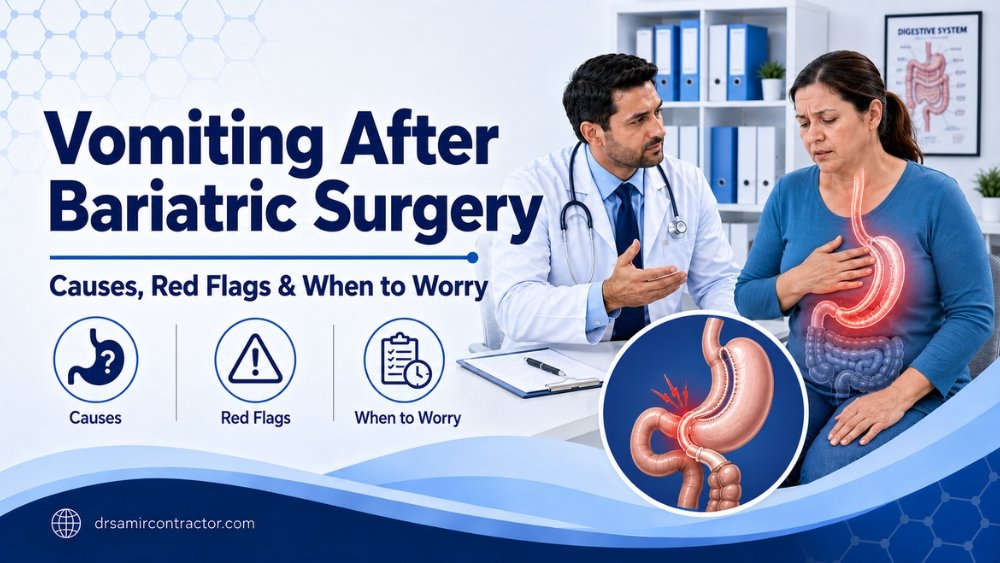
Vomiting after bariatric surgery is one of the most common post-operative complaints. In many cases, it is caused by eating too fast, too much, or the wrong food texture. However, persistent or worsening vomiting is a warning sign that must be investigated promptly - it can indicate a stricture, marginal ulcer, internal hernia, or bowel obstruction.
✦ Quick Answers
Bariatric surgery - whether sleeve gastrectomy or gastric bypass - fundamentally changes the anatomy and capacity of the stomach. After surgery, the stomach pouch holds only a fraction of what it once did (about 60 to 120 ml in the first few months). This smaller reservoir means that eating habits must change completely. When they do not, the body responds with nausea and vomiting.
For a significant number of patients, occasional vomiting in the first 4 to 8 weeks is part of the adjustment period. The stomach is still healing, swelling has not fully resolved, and the patient is learning new eating patterns. This type of vomiting is usually self-limiting and responds well to dietary counselling.
The concern arises when vomiting does not stop, becomes more frequent over time, or starts weeks or months after surgery when the patient was previously doing well. In these cases, a structural or medical cause must be identified and treated. Ignoring persistent vomiting is not just uncomfortable - it is medically risky and can lead to dehydration, malnutrition, and serious vitamin deficiencies.
Why Does Vomiting Happen After Bariatric Surgery?
The causes of vomiting after bariatric surgery fall into two broad categories: behavioural (diet-related) and structural (surgery-related). Recognising the difference is critical.
Diet and Behaviour Causes
- Eating too fast - not giving the small pouch time to process food
- Taking bites that are too large - food gets stuck at the narrow outlet
- Not chewing thoroughly - large chunks cannot pass through easily
- Eating too much in one sitting - even 30 to 50 ml extra can trigger vomiting
- Drinking fluids during or immediately after meals - fills the pouch and displaces food
- Eating dry, fibrous, or tough-textured foods too early (dry chicken, bread, tough roti)
- Advancing diet phases too quickly - skipping from liquids to solids before the pouch is ready
- Eating while distracted - not paying attention to fullness signals
Structural and Medical Causes
- Stricture - narrowing at the anastomosis (bypass) or along the sleeve (sleeve gastrectomy)
- Marginal ulcer - ulcer at the surgical connection in gastric bypass patients
- Internal hernia - bowel slips through an internal opening, causing obstruction
- Small bowel obstruction - adhesions or twist in the intestine
- Sleeve kinking or twist - angulation of the tubular stomach
- Gastroesophageal reflux (GERD) - new or worsened reflux after surgery
- Gallstones - rapid weight loss increases gallstone formation
- Medication irritation - NSAIDs, certain supplements, or large tablets irritating the pouch
Sleeve Gastrectomy vs Gastric Bypass: Different Causes of Vomiting
The type of bariatric surgery you had affects which causes of vomiting are more likely. Your surgeon will consider this when evaluating your symptoms.
| Feature | Sleeve Gastrectomy | Gastric Bypass (Roux-en-Y) |
|---|---|---|
| Most common benign cause | Eating too fast or too much for the tubular stomach | Eating too fast; food blocking the small pouch outlet |
| Stricture location | Along the sleeve body (incisura angularis) or at the GE junction | At the gastrojejunal anastomosis (surgical connection) |
| Marginal ulcer risk | Rare | Significant - occurs at or near the anastomosis; risk increases with smoking and NSAID use |
| Internal hernia risk | Rare (no bowel rearrangement) | Present - bowel rearrangement creates potential hernia spaces (Petersen's, mesenteric defect) |
| GERD risk | May worsen or develop new reflux | Usually improves reflux; new reflux less common |
| Gallstone vomiting | Possible with rapid weight loss | Possible with rapid weight loss |
| Key investigation | Upper GI endoscopy, CT scan, upper GI contrast study | Upper GI endoscopy, CT abdomen with oral contrast, upper GI series |
Red Flags: When Vomiting Becomes an Emergency
Most post-bariatric vomiting is short-lived and linked to eating habits. But certain patterns signal a potentially dangerous situation that requires immediate medical attention. Do not wait at home if any of the following apply.
Go to the emergency department or call your surgeon immediately if:
- You cannot keep any liquids (including water) down for more than 12 hours
- You are vomiting multiple times daily for more than 2 to 3 days
- Vomiting is accompanied by severe, worsening, or colicky abdominal pain
- You notice blood in your vomit - bright red or dark (coffee-ground appearance)
- You feel dizzy, lightheaded, or your heart is racing (signs of dehydration)
- You develop confusion, difficulty walking, or vision changes (signs of Wernicke's encephalopathy from thiamine deficiency)
- Your abdomen is distended (swollen) and you cannot pass gas or stool
- You have fever with vomiting and abdominal pain
- Vomiting started suddenly weeks or months after surgery when you were previously eating normally
These red flags do not always indicate a life-threatening problem, but they must be evaluated urgently. Conditions like internal hernia and bowel obstruction can progress rapidly if not treated in time.
Thiamine (Vitamin B1) Deficiency: A Hidden Danger of Prolonged Vomiting
Wernicke's Encephalopathy Warning
Bariatric patients who vomit persistently are at high risk for thiamine (vitamin B1) deficiency. The body's thiamine stores are limited and can be depleted within 2 to 3 weeks of persistent vomiting and poor oral intake.
Severe thiamine deficiency leads to Wernicke's encephalopathy - a neurological emergency characterised by confusion, unsteady gait (difficulty walking in a straight line), and eye movement abnormalities. If not treated immediately with intravenous thiamine, the damage can become permanent.
This is why persistent vomiting after bariatric surgery is never just a nuisance - it is a medical problem that needs evaluation and often supplementation even before the cause of vomiting is fully identified.
Any bariatric patient who has been vomiting for more than 1 to 2 weeks should have their thiamine levels checked and, in many centres, empiric thiamine supplementation is started while awaiting results. Prevention is far easier than treating established neurological damage.
Dehydration: The Immediate Risk of Ongoing Vomiting
After bariatric surgery, patients already struggle to meet their daily fluid requirements because of the small stomach capacity. When vomiting is added, dehydration develops quickly - often within 24 to 48 hours.
Signs of dehydration to watch for
- Dark yellow or concentrated urine, or reduced urine output
- Dry mouth, dry lips, and excessive thirst
- Dizziness or lightheadedness, especially when standing up
- Rapid heartbeat (tachycardia)
- Fatigue, weakness, and difficulty concentrating
- Headache that worsens through the day
If you cannot keep even small sips of water down, you likely need intravenous fluids. Do not try to manage this at home for more than 12 to 24 hours. Contact your surgeon or present to the nearest emergency department.
When Vomiting Is Likely Not Serious
Reassuring features - vomiting is likely diet-related and benign when:
- It happens occasionally (not daily) and only after specific meals
- You can clearly identify a trigger - ate too fast, took a bite that was too large, tried a new food too early
- Vomiting stops once the food is brought up, and you feel relief immediately
- You can keep liquids and soft foods down between episodes
- It is within the first 4 to 8 weeks after surgery, and you are still learning your new eating pattern
- There is no abdominal pain, fever, blood in vomit, or signs of dehydration
- Your weight is dropping at the expected rate and you are otherwise feeling well
Even when vomiting is benign, repeated episodes should be discussed with your bariatric team. They can help refine your eating technique and diet plan to reduce these events.
Vomiting Frequently After Bariatric Surgery? Do Not Ignore It.
Dr Samir Contractor offers comprehensive post-bariatric evaluation - clinical assessment, endoscopy, nutritional work-up, and surgical revision when needed.
How Doctors Evaluate Post-Bariatric Vomiting
Your bariatric surgeon will take a detailed history to understand the pattern, timing, and character of your vomiting before deciding on investigations.
Key questions your surgeon will ask
- When did the vomiting start - in the early weeks or later?
- How often do you vomit - once a week, daily, or multiple times a day?
- Does vomiting happen with every meal, only certain foods, or even with liquids?
- What does the vomit look like - undigested food, liquid, bile, or blood?
- Do you have pain? Where is it? How severe?
- How much fluid are you able to keep down each day?
- Are you taking your vitamins and supplements? Any NSAIDs?
- Are you smoking, using tobacco, or drinking alcohol?
Tests that may be ordered
- Upper GI endoscopy - the most important test. Allows direct visualisation of the pouch, anastomosis, sleeve, and food pipe. Can detect stricture, ulcer, kinking, and inflammation. Treatment (balloon dilatation of stricture) can often be done at the same time.
- CT abdomen with oral contrast - essential to rule out internal hernia and small bowel obstruction, especially if there is pain with vomiting
- Upper GI contrast study (barium or gastrografin swallow) - shows the anatomy, identifies narrowing, kinking, or obstruction in real time
- Blood tests - check for dehydration (electrolytes, kidney function), thiamine level, iron, B12, and other nutritional markers
- Abdominal ultrasound - if gallstones are suspected as a contributing factor
Treatment: What Can Be Done
Treatment depends entirely on the cause. That is why proper investigation before treatment is critical.
Treatment Pathway Based on Cause
- Diet-related vomiting (most common): Eating behaviour retraining - eat slowly (20 to 30 minutes per meal), take small bites, chew each bite 20 to 30 times, stop at the first sensation of fullness. Avoid dry or fibrous foods until tolerance improves. Separate fluids from meals by 30 minutes. A session with a bariatric dietitian is often the most effective intervention.
- Stricture (narrowing): Endoscopic balloon dilatation - a controlled procedure where a balloon is inflated at the narrowing point to widen it. Often effective within 1 to 3 sessions. Rarely, surgical revision is needed for refractory strictures.
- Marginal ulcer: High-dose acid suppression (PPI therapy), stop smoking and NSAIDs immediately, test and treat H. pylori. Severe or non-healing ulcers may require surgical revision of the anastomosis.
- Internal hernia or bowel obstruction: Surgical emergency. Requires urgent CT imaging and usually laparoscopic surgical exploration to reduce the hernia and close the defect. Delay increases the risk of bowel compromise.
- Dehydration and nutritional deficiency: Intravenous fluids, electrolyte correction, and empiric thiamine supplementation while the underlying cause is being identified and treated. Hospital admission is often necessary.
Indian Diet Tips to Reduce Post-Bariatric Vomiting
- Start with: Thin dal water, diluted buttermilk, mashed khichdi, well-cooked soft vegetables (lauki, turai), curd, mashed paneer
- Progress slowly to: Soft idli, upma (small portions), soft poha, well-cooked dal-rice, steamed fish, minced chicken
- Avoid early on: Dry roti/chapati, tough meat, raw salads, fibrous vegetables (bhindi, beans), fried snacks, sticky rice, bread
- Eating technique: Use a small spoon or fork. Time your meals - aim for 20 to 30 minutes. Put the spoon down between each bite. Stop the moment you feel a sensation of pressure or fullness in the chest or upper abdomen.
- Fluid rule: No liquids during meals. Drink 30 minutes before or 30 minutes after eating. Sip slowly - do not gulp water.
What Happens If Post-Bariatric Vomiting Is Ignored?
Persistent vomiting that is left uninvestigated can lead to a cascade of problems, some of which are difficult to reverse.
- Dehydration and electrolyte imbalance - can cause kidney injury, cardiac arrhythmias, and muscle cramps
- Thiamine (B1) deficiency and Wernicke's encephalopathy - confusion, difficulty walking, vision changes; can cause permanent brain damage if untreated
- Protein-calorie malnutrition - muscle wasting, hair loss, poor wound healing, weakened immunity
- Other vitamin and mineral deficiencies - iron deficiency anaemia, B12 deficiency, calcium and vitamin D depletion
- Oesophageal damage - repeated forceful vomiting can tear the lower oesophagus (Mallory-Weiss tear) or damage dental enamel
- Progression of surgical complications - an untreated stricture worsens over time; an undetected internal hernia can cause bowel strangulation
- Weight regain paradox - patients who cannot tolerate solid food may rely on high-calorie liquids and soft foods, leading to poor weight loss or even weight regain
- Psychological impact - fear of eating, social withdrawal, regret about surgery, anxiety, and depression
Every one of these consequences is avoidable with timely evaluation and treatment.
Preventing Vomiting After Bariatric Surgery
Most diet-related vomiting is preventable. These practical steps significantly reduce the frequency of post-operative nausea and vomiting.
- Follow your post-operative diet phases strictly. Do not skip from liquids to solids before your surgeon or dietitian clears you to advance.
- Eat slowly and mindfully. Set a timer for 20 to 30 minutes per meal. Take small bites. Chew each bite thoroughly until the food is a smooth paste before swallowing.
- Stop eating at the first sign of fullness. A sensation of tightness, pressure, or discomfort in the upper abdomen means the pouch is full. Do not push through it.
- Separate solids and liquids. Do not drink during or immediately after meals. Wait at least 30 minutes.
- Introduce new foods one at a time. This helps identify which foods you tolerate and which you do not.
- Avoid NSAIDs. Non-steroidal anti-inflammatory drugs (ibuprofen, aspirin, diclofenac) irritate the pouch and anastomosis. Use paracetamol for pain relief instead.
- Take your vitamins and supplements daily. This does not prevent vomiting directly but protects against the nutritional consequences of any vomiting episodes.
- Do not smoke. Smoking dramatically increases the risk of marginal ulcer in gastric bypass patients.
- Attend all follow-up appointments. Your bariatric team can detect and address problems early - before they cause persistent symptoms.
Vomiting After Bariatric Surgery in India - What Patients Should Know
Why this matters for Indian bariatric patients
- Bariatric surgery volumes in India are growing rapidly, with thousands of procedures performed each year across major cities. Post-operative symptoms like vomiting are becoming an increasingly common reason for emergency visits and follow-up consultations.
- The Indian diet includes many foods that are challenging in the early post-bariatric period - dry roti, fibrous vegetables, sticky rice, and fried snacks. Patients often face social and family pressure to resume normal eating earlier than recommended.
- Cultural meal patterns (eating quickly during work breaks, large family meals, festival foods) work against the slow, mindful eating required after bariatric surgery.
- Thiamine deficiency is already more prevalent in the Indian population due to dietary patterns. Bariatric patients who vomit are at even higher risk.
- Many patients present late to their bariatric surgeon when vomiting persists, either because they assume it is normal or because they seek help from non-bariatric physicians who may not recognise the urgency.
- Access to bariatric-trained dietitians is limited outside major centres. Dietary counselling gaps contribute significantly to preventable vomiting episodes.
Frequently Asked Questions
Desi Patient Questions (Gujarati / Hinglish)
Sharu na 2-4 week ma thodi nausea ke occasional ulti hoy to normal hoi shake - jyare sudhi tamé navu eating pattern shikhta ho. Pan rooj ulti aave, ya pani pan na rehé to turant surgeon ne contact karo.
Soft bhaat 6-8 week pachhi try kari shakay nani quantity ma. Roti dry hoy chhe etle 3 mahina pachhi try karo - patli, naram roti nana tukda ma, barabar chavi ne. Jyare sudhi tolerate na thay, wait karo.
Ha, bariatric surgery pachhi dehydration bahu jaldi thay chhe. Jyo pani pan na rehé 12 kalak sudhi, to hospital javo zaruri chhe - IV fluids joiye. Dark urine, chakkar, dry mouth - aa badha signs chhe.
Aa red flag chhe. Jyo months pachhi new vomiting start thay to stricture, ulcer, ya internal hernia hoi shake. Turant surgeon ne malvo - endoscopy ane CT scan zaruri hoi shake.
Vitamin B1 (thiamine) body ma limited store ma hoy chhe. 2-3 week ulti chalu rahe to thiamine khuthi jaay chhe. Aa thi brain problem - confusion, chalva ma takleef - thay shake, jene Wernicke's encephalopathy kahe chhe. Bahu serious chhe - jaldi treatment joiye.
Na. Ibuprofen, aspirin, diclofenac - aa badhi dava bariatric surgery pachhi avoid karvi joiye. Marginal ulcer nu risk vadhare chhe. Pain mate paracetamol lo, ane surgeon ne puchho.