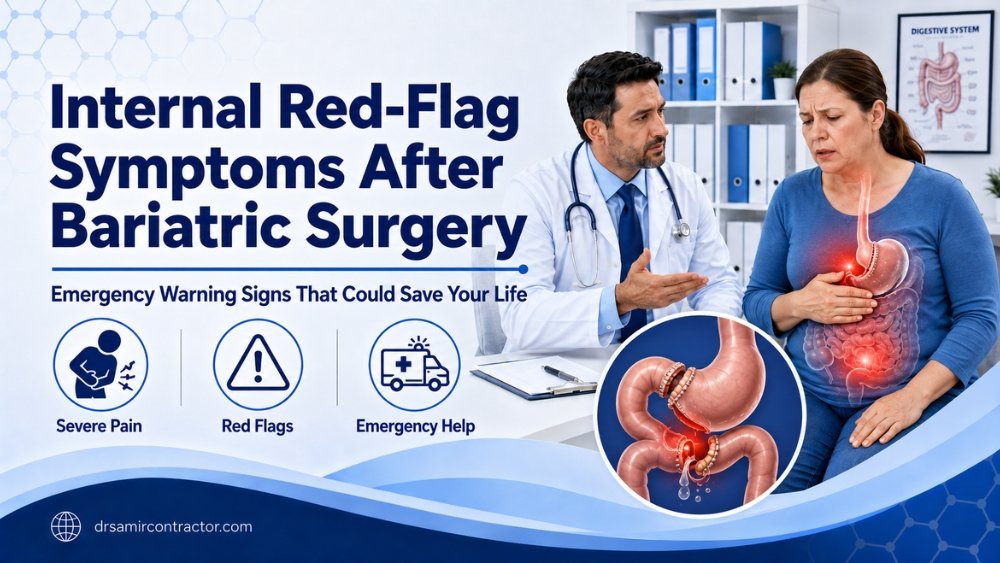
Not every post-bariatric symptom is routine. Some symptoms after weight loss surgery signal life-threatening emergencies - internal hernia, anastomotic leak, bowel obstruction, or perforated ulcer - that demand immediate action. This page is your critical safety reference. Knowing these red-flag symptoms, and acting on them without delay, can be the difference between a straightforward recovery and a catastrophic outcome.
✦ Critical Quick Answers
? Why Every Bariatric Patient Must Read This Page
Bariatric surgery - whether sleeve gastrectomy, gastric bypass, or another procedure - is one of the most effective treatments for severe obesity and its associated health conditions. Thousands of these procedures are performed safely every year. However, like all major surgery, bariatric operations carry a risk of complications, and some of those complications are surgical emergencies.
The problem is this: many patients do not know what to watch for. They may dismiss severe pain as "gas" or "something I ate." They may wait until the next morning, or until their next scheduled follow-up, before reporting symptoms that needed attention hours earlier. In the case of internal hernia or anastomotic leak, that delay can mean the difference between a straightforward repair and a life-threatening situation involving dead bowel, sepsis, or multi-organ failure.
This page exists because awareness saves lives. It is written for patients, their families, and caregivers. Print it. Save it on your phone. Share it with anyone who has had bariatric surgery. If even one person reads this page and goes to the ER instead of waiting until morning, this page has served its purpose.
? The Master Red-Flag List - Call 108 or Go to the ER Immediately
If you experience any of the following symptoms after bariatric surgery - whether it is 5 days, 5 months, or 5 years since your operation - seek emergency care without delay.
EMERGENCY - Act immediately if you have:
- Severe abdominal pain that is getting worse - especially sudden-onset, colicky, or pain that wakes you from sleep
- Heart rate persistently above 100 beats per minute at rest - even without severe pain, tachycardia alone is a red flag
- Fever above 38°C (100.4°F) combined with abdominal pain - suggests infection, leak, or abscess
- Inability to keep any fluids down for more than 12 hours - risk of dehydration and possible obstruction
- Distended, swollen, rigid abdomen - suggests bowel obstruction or peritonitis
- Vomiting blood or coffee-ground-like material - bleeding ulcer or staple-line bleed
- Black, tarry stools (melena) - internal gastrointestinal bleeding
- Complete inability to pass gas or stool - bowel obstruction
- Severe pain that comes and goes in waves (colicky) - classic for internal hernia or bowel obstruction
- Pain with dizziness, lightheadedness, or fainting - possible internal bleeding or severe dehydration
- Breathing difficulty combined with abdominal symptoms - can indicate diaphragmatic involvement or sepsis
- Left shoulder pain after sleeve gastrectomy - referred pain from a possible leak irritating the diaphragm
DO NOT WAIT UNTIL MORNING
If these symptoms occur at night, on a weekend, or on a holiday - go to the ER immediately.
Tell the ER team: "I have had bariatric surgery" - this changes their entire assessment approach.
? Early vs Late Emergencies: A Timing-Based Guide
The timing of your symptoms after bariatric surgery is the most important clue to the type of emergency. Complications fall into two broad windows: early (within 30 days of surgery) and late (beyond 30 days, sometimes years later).
| Timing | Emergency Complication | Key Warning Signs | Urgency |
|---|---|---|---|
| Early (< 30 days) |
Anastomotic / staple-line leak | Tachycardia, fever, left-sided pain (sleeve), worsening malaise | EMERGENCY |
| Post-operative haemorrhage | Increasing pain, dizziness, drop in blood pressure, bloody drain output | EMERGENCY | |
| Pulmonary embolism (blood clot to lungs) | Sudden breathing difficulty, chest pain, rapid heart rate, calf swelling | EMERGENCY | |
| Late (> 30 days) |
Internal hernia (Petersen's hernia, mesenteric defect hernia) | Severe colicky pain, nausea, vomiting, pain around umbilicus or left side | EMERGENCY |
| Small bowel obstruction (adhesions) | Crampy pain, distension, vomiting, inability to pass gas or stool | EMERGENCY | |
| Marginal ulcer with perforation | Sudden severe epigastric pain, rigid abdomen, fever, peritonitis signs | EMERGENCY | |
| Marginal ulcer with bleeding | Vomiting blood, black tarry stools, dizziness, pallor | EMERGENCY | |
| Intussusception (rare) | Intermittent severe colicky pain, bloody stools, palpable mass | EMERGENCY |
Early Emergency Window (< 30 Days)
- Anastomotic / staple-line leak
- Post-operative haemorrhage
- Pulmonary embolism
- Complete stricture with dehydration
- Rhabdomyolysis (rare)
Late Emergency Window (> 30 Days to Years)
- Internal hernia (Petersen's, mesenteric)
- Adhesive small bowel obstruction
- Perforated marginal ulcer
- Bleeding marginal ulcer
- Intussusception at jejunojejunostomy
- Acute cholecystitis from gallstones
? Internal Hernia - The #1 Post-Bypass Emergency
If you have had a Roux-en-Y gastric bypass, internal hernia is the single most important diagnosis you and your family must understand. This is not an exaggeration - it is the leading cause of emergency reoperation and preventable death in gastric bypass patients worldwide.
What is an internal hernia?
During gastric bypass, the small intestine is divided and rearranged. This creates gaps - called mesenteric defects - in the tissue (mesentery) that holds the intestines in position. The two main defect sites are the Petersen's space (between the Roux limb and the transverse mesocolon) and the jejunojejunostomy mesenteric defect (at the lower intestinal connection point).
As patients lose weight after surgery, intra-abdominal fat decreases. The mesenteric defects that were once filled with fat become wider. Loops of small bowel can then slip through these openings, becoming trapped. If the blood supply to the trapped bowel is compressed, the bowel can die (strangulate) within hours.
How does an internal hernia present?
- Severe, colicky (crampy) abdominal pain - often periumbilical or left-sided
- Pain that comes and goes - intermittent internal hernias can spontaneously reduce and then recur, giving a dangerous false sense of reassurance
- Nausea and vomiting - from bowel obstruction
- Pain after meals - particularly after eating, when intestinal peristalsis pulls bowel through the defect
- Pain waking the patient from sleep - positional changes can trigger herniation
Critical rule for every gastric bypass patient:
- Severe, unexplained abdominal pain - even if intermittent and even if it temporarily resolves - must be treated as internal hernia until proven otherwise
- CT scan may be normal in up to 10-20% of cases - a negative scan does NOT rule out internal hernia
- If clinical suspicion is high, emergency laparoscopic exploration is indicated even with normal imaging
- A negative diagnostic laparoscopy is far better than a missed internal hernia with dead bowel
Why internal hernia is so dangerous
The trapped bowel loses its blood supply progressively. Initially, venous drainage is blocked (congestion). Then arterial inflow is cut off (ischaemia). Within 4-6 hours of complete strangulation, the bowel can become necrotic - dead tissue that must be surgically removed. If large segments of bowel die, the patient faces short bowel syndrome, prolonged ICU stays, multiple reoperations, and a significant risk of death.
The insidious aspect of internal hernia is that it can present as intermittent pain over weeks or months before a catastrophic episode occurs. Patients learn to "live with" occasional crampy pain, not realizing that each episode represents bowel slipping through a defect. One day the bowel gets trapped and does not spontaneously reduce - and that is when the emergency begins.
? Anastomotic Leak - The Most Feared Early Complication
An anastomotic leak (or staple-line leak) occurs when the surgical connection or staple line fails to heal, allowing gastric or intestinal contents to spill into the abdominal cavity. It is the most feared complication in the first 30 days after bariatric surgery, with rates of 1-3% depending on procedure type and surgeon experience.
When does a leak typically present?
Most leaks declare themselves between post-operative day 3 and day 14. After sleeve gastrectomy, leaks most commonly occur at the top of the staple line, near the gastro-oesophageal junction. After gastric bypass, leaks can occur at the gastrojejunal anastomosis (upper connection) or, less commonly, at the jejunojejunostomy (lower connection).
How to recognize a leak
- Tachycardia - the earliest and most reliable sign. A resting heart rate consistently above 100-120 bpm in the days after surgery should raise immediate suspicion, even if other symptoms are absent.
- Fever - temperature above 38°C (100.4°F), especially rising progressively
- Worsening abdominal pain - pain that is getting worse rather than better, particularly left upper abdominal pain after sleeve gastrectomy
- Left shoulder pain - referred pain from diaphragmatic irritation by leaked fluid
- General malaise out of proportion to expected recovery - the patient feels "something is very wrong"
- Breathing difficulty - from diaphragmatic irritation or developing sepsis
The tachycardia rule:
- If your resting heart rate is persistently above 100-110 bpm in the days after bariatric surgery, contact your surgeon immediately - even if pain is mild and you have no fever
- Tachycardia can precede other leak symptoms by 12-24 hours - acting on tachycardia alone can catch a leak before it causes peritonitis
Why leaks are so dangerous
Leaked gastric acid and intestinal contents cause chemical peritonitis - intense inflammation of the abdominal lining - which rapidly progresses to bacterial peritonitis, sepsis, and multi-organ failure if not contained. Treatment involves urgent return to the operating room, washout of the abdomen, drainage, IV antibiotics, and often a prolonged hospital stay. Early detection and intervention dramatically improve outcomes.
? Marginal Ulcer - When It Becomes an Emergency
Marginal ulcers form at the anastomotic site after gastric bypass (where the small stomach pouch connects to the intestine). While many marginal ulcers are manageable with medication, they become surgical emergencies when they perforate (create a hole through the wall) or bleed heavily.
Marginal ulcer perforation
- Presents with sudden, severe epigastric pain - often described as the worst pain the patient has ever experienced
- Abdomen becomes rigid and board-like (guarding) - a classic sign of peritonitis
- Fever, tachycardia, and signs of systemic illness develop rapidly
- Requires emergency surgery - repair of the perforation, peritoneal washout, and often revision of the anastomosis
Marginal ulcer with major bleeding
- Vomiting large amounts of fresh blood (haematemesis) or coffee-ground-like material
- Passing black, tarry stools (melena) - indicating digested blood from the upper GI tract
- Dizziness, pallor, rapid heart rate, drop in blood pressure - signs of significant blood loss
- Requires emergency endoscopy to locate and stop the bleeding; surgery if endoscopy fails
Risk factors for marginal ulcer
The three biggest modifiable risk factors are: NSAID use (ibuprofen, diclofenac, Combiflam - absolutely contraindicated after bypass), smoking (dramatically increases ulcer risk), and H. pylori infection (should be tested and treated before surgery). Stopping PPIs too early also increases risk.
? Small Bowel Obstruction and Intussusception
Small bowel obstruction from adhesions
Adhesions - bands of scar tissue - can form after any abdominal surgery. In bariatric patients, adhesions can kink or compress the small bowel, blocking the passage of food and fluid. Bowel obstruction (SBO) is a surgical emergency because the bowel upstream of the blockage distends, and if left untreated, blood supply to the distended bowel can be compromised.
Warning signs of bowel obstruction:
- Severe, crampy abdominal pain that comes and goes in waves
- Abdominal distension (the belly looks and feels swollen and tight)
- Vomiting - often bilious (green-yellow) or faeculent (foul-smelling)
- Complete inability to pass gas or have a bowel movement (obstipation)
- High-pitched bowel sounds initially, then silence (absent bowel sounds) - a worrying sign
Intussusception - rare but serious
Intussusception occurs when one segment of the bowel telescopes into an adjacent segment. After gastric bypass, this most commonly occurs at the jejunojejunostomy (the lower intestinal connection). It is rare - reported in less than 1% of bypass patients - but can cause obstruction and bowel ischaemia if not treated.
Symptoms include intermittent severe colicky pain, occasionally with bloody stools, and a palpable abdominal mass. CT scan typically shows a characteristic target sign or sausage-shaped mass. Treatment is surgical - laparoscopic reduction or resection of the affected segment.
✅ Signs That Are Usually NOT Emergencies
Not every symptom after bariatric surgery is a crisis. Recognizing what is typically safe can reduce unnecessary anxiety - while keeping your focus sharp for genuine red flags.
Usually safe to discuss at your next scheduled appointment:
- Mild discomfort after eating that resolves within 30-60 minutes and is clearly related to eating too fast or too much
- Occasional mild nausea without vomiting, fever, or significant pain
- Gradual improvement in surgical site soreness during the first 2 weeks
- Mild bloating or gas pain that is not worsening and not associated with distension
- Food intolerance to specific items (bread, rice, red meat) that you can identify and avoid
- Mild acid reflux controlled with PPI medication (after sleeve gastrectomy)
- Occasional loose stools without blood, fever, or severe cramping
- Hair thinning - common at 3-6 months, related to nutritional changes, not a surgical emergency
The key principle: Symptoms that are mild, stable or improving, clearly food-related, and not associated with fever, tachycardia, or systemic illness are usually not emergencies. But if you are ever uncertain, call your surgeon. An unnecessary phone call is infinitely better than a missed complication.
? What to Do When You Suspect a Post-Bariatric Emergency
If you or a family member who has had bariatric surgery develops red-flag symptoms, here is your action plan.
Emergency Action Steps
- 1️⃣ Do not wait - call for help immediately: Call 108 (India ambulance) or go directly to the nearest hospital with CT scan and surgical capability. Do not drive yourself if you are in severe pain, dizzy, or feeling faint.
- 2️⃣ Tell the ER team about your bariatric surgery: State the type of procedure (sleeve gastrectomy, gastric bypass), the date of surgery, and your surgeon's name. This completely changes how they assess you. Post-bariatric anatomy is different from normal anatomy - the ER team must know.
- 3️⃣ Call your bariatric surgeon: Even if you are at a different hospital, call your bariatric surgeon to inform them. They can guide the ER team and arrange transfer if needed. Keep your surgeon's number saved on your phone at all times.
- 4️⃣ Request a CT scan with oral contrast: This is the most important investigation for post-bariatric emergencies. If the ER team is unfamiliar with bariatric complications, advocate for a CT. A plain X-ray is usually not sufficient.
- 5️⃣ Carry your surgical documentation: Keep a card or phone note with: procedure type, date, surgeon name, contact number, and current medications. This speeds up emergency assessment dramatically.
? Emergency Signs Mapped to Specific Complications
This table helps you and your family quickly connect symptoms to the most likely emergency cause, so you can communicate clearly with the ER team.
| What You Experience | What It May Indicate | What You Should Do |
|---|---|---|
| Severe colicky pain, nausea, vomiting (bypass patient) | Internal hernia | ER - immediately |
| Heart rate >100, fever, left-sided pain (early post-op) | Anastomotic leak | ER - immediately |
| Vomiting blood, black tarry stools, dizziness | Bleeding marginal ulcer or staple-line bleed | ER - immediately |
| Sudden severe epigastric pain, rigid abdomen | Perforated marginal ulcer | ER - immediately |
| Distension, vomiting, unable to pass gas/stool | Small bowel obstruction | ER - immediately |
| Intermittent severe pain with bloody stools | Intussusception | ER - immediately |
| Sudden breathing difficulty, chest pain, calf swelling | Pulmonary embolism | ER - immediately |
| Right upper pain after meals, fever, jaundice | Acute cholecystitis / gallstone complications | Urgent - same-day evaluation |
?️ Reducing Your Risk of Post-Bariatric Emergencies
While no one can eliminate all risk, there are concrete steps every bariatric patient should take to lower the chance of a life-threatening complication.
Medication compliance
- Take PPIs as prescribed - proton pump inhibitors protect against marginal ulcer. Do not stop early without discussing with your surgeon.
- Take ursodeoxycholic acid (Udiliv) - if prescribed, this reduces gallstone formation during the rapid weight loss phase. Take it for the full prescribed duration.
- Never take NSAIDs - ibuprofen, diclofenac, aspirin, Combiflam are absolutely contraindicated after gastric bypass. They cause marginal ulcers that can perforate or bleed. Use paracetamol (Crocin, Dolo) instead.
Lifestyle measures
- Stop smoking completely - smoking increases the risk of marginal ulcer by 3-5 times. It also impairs healing and increases infection risk.
- Attend all follow-up appointments - regular check-ups allow your surgeon to detect developing problems (nutrient deficiencies, early gallstones, weight regain patterns) before they become emergencies.
- Follow dietary guidelines strictly - proper eating habits reduce the risk of obstruction, dumping, and food bolus impaction.
Preparedness
- Carry a bariatric surgery identification card - listing your procedure, date, surgeon, and contact details
- Know the location of the nearest ER with surgical capability - especially if you travel frequently or live in a smaller city
- Educate your family - make sure your spouse, parents, or close family members know the red-flag symptoms listed on this page
- Do not hesitate to call your surgeon - even if it turns out to be nothing, calling is always the right decision when symptoms are concerning
?? Post-Bariatric Emergencies in India - Special Considerations
Challenges facing Indian bariatric patients in emergencies
- Follow-up geography: Many Indian patients travel to metropolitan centres (Mumbai, Delhi, Ahmedabad, Vadodara) for bariatric surgery but return to smaller cities or rural areas for recovery. Local hospitals and doctors may have limited experience with post-bariatric complications, making patient self-advocacy critical.
- 108 ambulance service: The 108 emergency ambulance service covers most Indian states including Gujarat, but response times vary by location. In urban areas, response is typically 15-30 minutes. In rural or semi-urban areas, it can take longer. Know your nearest hospital with CT and surgical capability - you may need to arrange private transport.
- ER awareness gap: Many emergency room physicians in India have limited exposure to post-bariatric complications. Internal hernia, in particular, is often not considered in the initial differential diagnosis. Patients must clearly state their bariatric surgical history and, if needed, request a CT scan and bariatric surgical consultation.
- NSAID availability: Over-the-counter NSAID use is extremely common in India. Patients frequently self-medicate with ibuprofen, diclofenac, or combination painkillers (Combiflam) for headaches, back pain, or joint pain - not realizing these drugs can cause perforated marginal ulcers after bypass. This is one of the most preventable causes of post-bariatric emergencies in India.
- Delayed presentation: Cultural tendencies to endure pain, family consultations before seeking medical help, and concerns about hospital costs can all contribute to delayed presentation. In post-bariatric emergencies, every hour of delay increases risk. The message must be clear: act immediately, sort out logistics later.
- Insurance and cost concerns: Some patients delay ER visits due to uncertainty about insurance coverage for complications. Most health insurance policies in India cover emergency surgical complications as part of the original bariatric surgery claim. Cost should never be the reason for delaying emergency care.
? Emergency Post-Bariatric Care in Vadodara
Dr Samir Contractor at Sterling Hospital, Vadodara, provides round-the-clock emergency bariatric surgical care. Sterling Hospital is equipped with 24/7 CT imaging, emergency endoscopy, a fully staffed operating theatre, and an ICU - all essential for managing post-bariatric emergencies including internal hernia repair, leak management, bleeding control, and bowel obstruction surgery.
With 25+ years of laparoscopic surgical experience and 8,000+ procedures, Dr Contractor manages both patients who had their original surgery at Sterling Hospital and patients who had surgery elsewhere but now need emergency evaluation or revision. If you are in Vadodara, Ahmedabad, or anywhere in Gujarat and experiencing post-bariatric warning symptoms, Sterling Hospital is a centre where definitive management is available.
Key message: If you are a bariatric patient in Gujarat experiencing red-flag symptoms, do not wait for your scheduled follow-up. Call Dr Contractor's team or present directly to Sterling Hospital Emergency. Time is the most important factor in post-bariatric emergencies.
❓ Frequently Asked Questions
Desi Patient Questions (Gujarati / Hinglish)
Joh pet ma bahuj tez dard hoy ane vadhto jaato hoy, taav aave, heart beat 100 thi upar jaay, ulti ma lohee aave, ya pet phulelu ane tight lage - to aa emergency chhe. Turant 108 call karo ya najik na hospital javo jya CT scan ane surgeon hoy. Wait na karo - internal hernia ma 4-6 kalak ma aantarda mavi shake chhe.
Internal hernia ma aantarda pet ni andar na gaps ma thi phasai jaay chhe - aa gaps bypass surgery ma banay chhe. Vazan ochu thay pachhi aa gaps vadhé chhe. Aa 6 mahina pachhi, 2 varsh pachhi, 5-10 varsh pachhi pan thavi shaké chhe. Koi pan samay tez pet no dard aave bypass patient ne, to internal hernia check karavo j joiye.
Bilkul nahi! Combiflam, ibuprofen, diclofenac - aa badha NSAIDs bypass pachhi marginal ulcer karay chhe jé phuti shaké chhe ya moti bleeding karay chhe. Fakar paracetamol (Crocin, Dolo) leva. Koi pan bija painkiller mate surgeon ne pucho. Dukan thi potaani meli thi painkiller na leshoo.
Joh dard tez hoy, taav hoy, ulti bandh na thay, ya heart beat vadhi hoy - to raatré pan turant hospital javo. Savaar sudhi wait na karo. Internal hernia ane leak ratri ma pan khatarnak thavi shaké chhe. 108 call karo ya koi ne laine najik na hospital javo.
Leak no sabhu thi pahélo sign heart beat vadhvu chhe - 100-110 thi upar jaay aaram ma pan. Pachhi taav aave, dard vadhé (sleeve pachhi dabhi baju), ane tamné lagé ke khaik bahuj kharaab thavi rahyu chhe. Aa symptoms surgery pachhi 3-14 divas ma aavé chhe. Turant surgeon ne call karo.
Emergency ma sabhu thi najik nu hospital javo jya CT scan ane surgeon available hoy - pehla stabilise thavo. Pan bariatric complications nu definitive treatment bariatric experience dhravta surgeon j barabar kari shaké. Etle joh local hospital stabilise karé, to bariatric centre transfer ni request karo. Hamesha tamara surgeon no number phone ma save rakhjo.