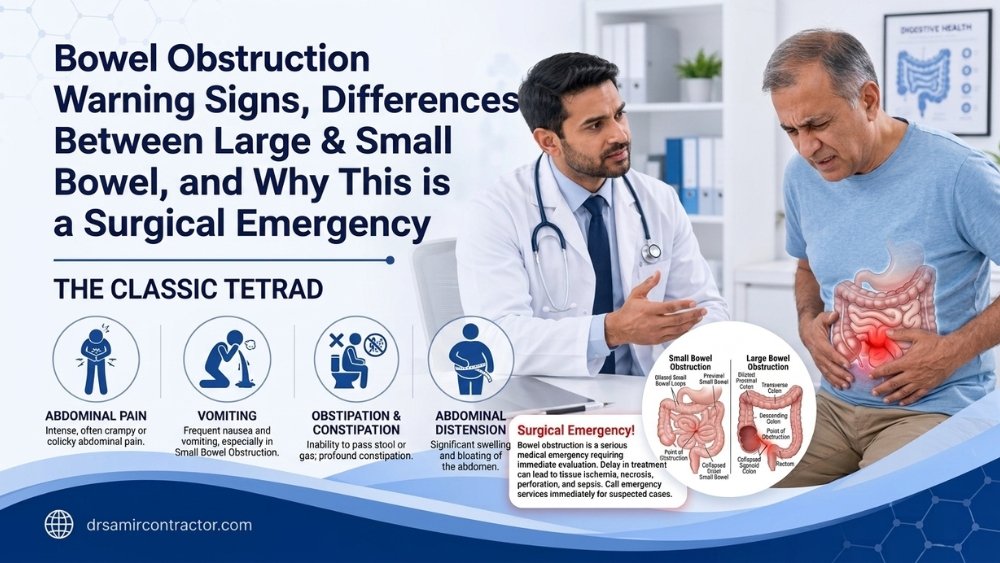
In simple terms: A bowel obstruction means something is blocking your intestine so that food, liquid, and gas cannot pass through. The four hallmark warning signs are: (1) cramping abdominal pain that comes and goes in waves, (2) a belly that is visibly swollen and getting bigger, (3) vomiting that may become foul-smelling, and (4) complete inability to pass stool or gas. Bowel obstruction can affect the small intestine, the large intestine, or both. It is treated as a surgical emergency because a blocked bowel can lose its blood supply within hours, leading to tissue death and life-threatening infection. This page covers all types of bowel obstruction - for information specifically about small-bowel obstruction and adhesion-related blockages, see our dedicated small-bowel obstruction page.
✦ Quick Answers
What Is Bowel Obstruction?
Bowel obstruction occurs when a mechanical blockage or functional failure prevents the normal downstream movement of intestinal contents - food, digestive secretions, and gas. The intestine is a long, continuous tube running from the stomach to the anus, and any point along this tube can become blocked. When it does, the contents upstream of the blockage accumulate, the bowel distends, pressure rises, and a cascade of dangerous consequences begins.
The obstruction may be mechanical (a physical barrier such as a tumour, adhesion band, or twisted bowel) or functional (the bowel is intact but paralysed, as in post-operative ileus or pseudo-obstruction). This page focuses primarily on mechanical obstruction - the type that most frequently demands emergency surgical intervention.
Bowel obstruction is among the most common acute surgical emergencies worldwide. It accounts for approximately 15-20% of all emergency department admissions for acute abdominal pain. The condition can affect anyone at any age, but certain risk factors - particularly previous abdominal surgery - make it significantly more likely.
Understanding the warning signs of bowel obstruction can save your life or the life of someone you care for. The difference between recognising these symptoms early and waiting too long can be the difference between a straightforward surgical repair and a life-threatening complication.
The Classic Tetrad: Four Cardinal Warning Signs
Surgeons worldwide recognise a classic tetrad of symptoms that, when present together, strongly suggest bowel obstruction:
1. Colicky Abdominal Pain
This is cramping pain that comes in waves, builds to a peak, and then temporarily eases before returning. The pattern corresponds to the bowel trying to push its contents past the blockage with forceful contractions (peristalsis). In small bowel obstruction, the pain is typically felt in the centre of the abdomen around the navel. In large bowel obstruction, the pain is often felt lower in the abdomen or across the entire belly.
Critical warning: If the pain changes from colicky (intermittent, cramping) to constant and severe, this suggests the bowel may be strangulating - losing its blood supply. This shift in pain character is one of the most important warning signs that emergency surgery is needed without delay.
2. Abdominal Distension
As gas and fluid accumulate behind the blockage, the abdomen becomes visibly swollen. The degree of abdominal distension depends on where the obstruction is located:
- Small bowel obstruction (high): Distension may be minimal or central, because there is less bowel involved upstream of the blockage.
- Small bowel obstruction (low/distal): Moderate distension, predominantly central.
- Large bowel obstruction: Marked distension - often dramatic - because the entire small bowel and proximal colon fill with gas. The abdomen may appear globally swollen and tympanic (drum-like) on tapping.
Progressive distension that worsens hour by hour is a red flag that the obstruction is not resolving and intervention is needed. If you notice your belly growing visibly larger while experiencing pain and inability to pass gas, treat this as an emergency. For broader information on distension causes, see our page on visible abdominal swelling.
3. Vomiting
Vomiting occurs because intestinal contents cannot move forward and are forced backward. The timing and nature of the vomit provide diagnostic clues:
- Early, profuse, bilious (green/yellow) vomiting: Typical of upper small bowel obstruction. Patients may vomit large volumes repeatedly.
- Late vomiting, feculent (foul-smelling, brown): Suggests distal small bowel or large bowel obstruction. The vomit takes on a faecal odour because stagnant intestinal contents have been colonised by bacteria. This is a late and ominous sign.
- Absent or minimal vomiting: Can occur in large bowel obstruction if the ileocaecal valve is competent (preventing reflux back into the small bowel). This creates a dangerous "closed-loop" obstruction where pressure builds rapidly.
4. Absolute Constipation
This means the complete inability to pass both stool and gas (flatus). It is the most specific sign of complete obstruction. Patients often describe it as "nothing at all is coming out - not even wind." Partial obstruction may still allow some gas or liquid stool to pass, which is why absolute constipation specifically points to complete blockage.
Note: In early small bowel obstruction, a patient may still pass some stool and gas that were already present in the colon below the obstruction. This does not mean the obstruction has resolved - it simply means the colon is emptying its remaining contents. Once this residual content passes, absolute constipation develops.
Large Bowel vs Small Bowel Obstruction - Key Differences
The location of the obstruction profoundly affects the clinical presentation. The following table summarises the critical differences that help surgeons determine the site and plan management:
| Feature | Small Bowel Obstruction (SBO) | Large Bowel Obstruction (LBO) |
|---|---|---|
| Most common cause | Adhesions from prior surgery (60-75%) | Colorectal cancer (50-60%) |
| Pain location | Central / peri-umbilical | Lower abdomen / diffuse |
| Distension | Moderate, central | Marked, often dramatic |
| Vomiting | Early and profuse; bilious | Late; may become feculent |
| Constipation | Late feature; may pass residual stool initially | Early and prominent feature |
| Bowel sounds | High-pitched, tinkling, hyperactive | Low-pitched, borborygmi, may become silent |
| X-ray appearance | Central dilated loops with valvulae conniventes (ladder pattern) | Peripheral dilated loops with haustral markings |
| Dehydration | Rapid due to profuse vomiting | Slower onset; less fluid loss initially |
| Risk of closed-loop | Possible (band adhesion, hernia) | High if ileocaecal valve is competent |
| Conservative management success | Higher (especially adhesive SBO) | Lower; usually requires intervention |
For a focused discussion on adhesive small-bowel obstruction specifically, including the role of water-soluble contrast and conservative management protocols, see our dedicated page on small-bowel obstruction warning signs.
Common Causes of Bowel Obstruction
Understanding what causes bowel obstruction helps identify who is at risk and why certain patients need closer follow-up after surgery or diagnosis of specific conditions:
Adhesions (Post-Surgical Scar Tissue)
Adhesions are the single most common cause of small bowel obstruction, responsible for 60-75% of all cases. They are bands of fibrous scar tissue that form between loops of bowel or between the bowel and the abdominal wall after surgery. Any abdominal or pelvic operation - including appendicectomy, hysterectomy, colorectal surgery, or caesarean section - can produce adhesions. These bands can kink, compress, or trap a loop of bowel, creating an obstruction months or even decades after the original surgery.
Hernias
An inguinal hernia, incisional hernia, femoral hernia, or internal hernia can trap a loop of bowel in its sac, cutting off the passage of contents and potentially compromising the blood supply (strangulated hernia). Obstructed hernias are the second most common cause of small bowel obstruction and are particularly common in India, where patients sometimes live with large, long-standing hernias before seeking repair.
Tumours (Especially Colorectal Cancer)
Colorectal cancer is the leading cause of large bowel obstruction, accounting for 50-60% of cases. The tumour grows around the inside of the bowel wall, gradually narrowing the lumen until the passage is completely blocked. Left-sided colon cancers and rectal cancers are more likely to cause obstruction than right-sided tumours because the bowel lumen is narrower on the left side. For more on this, see our page on colorectal cancer warning signs.
Volvulus
Volvulus is a twisting of the bowel around its mesenteric axis, creating a closed-loop obstruction with compromised blood supply. The sigmoid colon is the most common site (sigmoid volvulus), followed by the caecum (caecal volvulus). Sigmoid volvulus is particularly prevalent in elderly, institutionalised, or neuropsychiatric patients and is more common in parts of Africa, South America, and India than in Western populations.
Inflammatory Strictures
Chronic inflammatory conditions such as Crohn's disease can cause thickening and narrowing (stricture) of the bowel wall, leading to recurrent episodes of partial or complete obstruction. Diverticular disease can similarly cause strictures in the sigmoid colon through repeated episodes of inflammation and fibrosis.
Other Causes
- Intussusception: One segment of bowel telescopes into the adjacent segment - more common in children but can occur in adults due to a polyp or tumour acting as a lead point.
- Gallstone ileus: A large gallstone erodes from the gallbladder into the duodenum and impacts in the distal ileum.
- Faecal impaction: Severe constipation, particularly in elderly or bed-bound patients, can cause complete large bowel obstruction.
- Foreign body ingestion: Swallowed objects, bezoars (undigested masses), or parasitic worm bolus (roundworm obstruction, still seen in rural India).
- Radiation strictures: Fibrosis from previous radiation therapy to the abdomen or pelvis.
RED FLAGS - Go to the Emergency Department Immediately If You Have:
- Severe, constant abdominal pain that is no longer coming in waves (suggests strangulation)
- Inability to pass gas or stool for more than 12-24 hours with worsening pain
- Feculent (foul-smelling, brown) vomiting - a late and dangerous sign
- Rapidly increasing abdominal distension that is tight and tender
- Fever, rapid heart rate, or dropping blood pressure (signs of sepsis or peritonitis)
- A hernia lump that is hard, tender, and cannot be pushed back in (strangulated hernia)
- Bloody stool or blood in vomit in the setting of obstruction symptoms
- History of abdominal cancer with new obstruction symptoms
- Previous abdominal surgery with acute onset of cramping pain, vomiting, and constipation
Do not wait to see if symptoms improve. Do not take laxatives or attempt enemas. Do not eat or drink. Go to the nearest hospital with surgical facilities.
Why Bowel Obstruction Is a Surgical Emergency
The urgency of bowel obstruction stems from two potentially lethal complications that can develop rapidly:
Strangulation
When the blood supply to the obstructed segment is compromised - as in a tight adhesive band, a strangulated hernia, or a volvulus - the bowel begins to die. This is called strangulation. Gangrenous (dead) bowel releases toxins and bacteria into the bloodstream, causing sepsis. Strangulation can develop within 6 hours of complete vascular compromise, and the mortality rate rises sharply once bowel necrosis sets in.
Perforation
As pressure builds behind the obstruction, the bowel wall can tear, spilling faecal contents into the sterile abdominal cavity. This causes peritonitis - a severe intra-abdominal infection that is immediately life-threatening. Perforation is particularly dangerous in large bowel obstruction with a competent ileocaecal valve, where the caecum (the widest part of the large bowel) is at greatest risk of bursting due to the law of Laplace.
These complications are the reason every patient with suspected complete bowel obstruction must be assessed urgently by a surgeon, and why delaying treatment in the hope that things will settle on their own can be fatal.
When It Is LESS Likely to Be Bowel Obstruction
- You are still passing gas regularly - this makes complete obstruction unlikely (though partial obstruction is still possible).
- Bloating comes and goes with meals and resolves overnight - this pattern is more consistent with functional bloating or food intolerance.
- Pain is diffuse and constant (not colicky/cramping) without distension or vomiting - consider other causes such as gastritis, pancreatitis, or muscular pain.
- Gurgling sounds are present with normal stool passage - active bowel sounds with regular bowel movements suggest normal peristalsis, not obstruction.
- Symptoms started after a large meal and are improving - likely related to overeating or recurrent abdominal discomfort rather than mechanical blockage.
Even if your symptoms seem mild, consult a doctor if you have had previous abdominal surgery, a known hernia, or a history of inflammatory bowel disease - these conditions place you at higher risk for obstruction even when early symptoms are subtle.
Do not ignore persistent cramping pain with a swollen belly. Get a surgical opinion before it becomes an emergency.
What to Do If You Suspect Bowel Obstruction
If you or someone you know is experiencing the classic tetrad of symptoms, follow these steps:
- Stop eating and drinking immediately. An obstructed bowel cannot process anything you consume, and oral intake will worsen vomiting and distension.
- Go to the nearest hospital emergency department. Do not wait at home to see if symptoms improve. Do not drive yourself if you are in severe pain - call an ambulance or have someone drive you.
- Do not take laxatives or attempt an enema. Laxatives can increase bowel contractions against the blockage, potentially worsening pain and increasing the risk of perforation.
- Bring a list of your previous surgeries. This is the single most useful piece of information for the emergency team, as it guides the differential diagnosis (adhesive obstruction is the most likely cause in patients with prior surgery).
- Inform the triage team that you suspect bowel obstruction. Mention the specific symptoms: cramping pain, swollen belly, vomiting, and inability to pass gas.
How Is Bowel Obstruction Diagnosed?
In the emergency department, the surgical team will typically follow this approach:
- Clinical examination: Inspecting the abdomen for distension and scars from previous surgery, palpating for tenderness and hernias, percussing for tympany (gas) or dullness (fluid), and auscultating for bowel sounds (high-pitched and tinkling in mechanical obstruction, absent in ileus or late strangulation).
- Plain abdominal X-ray: The first-line imaging study. Dilated loops of bowel with air-fluid levels on an erect film are the hallmark of obstruction. Small bowel loops show valvulae conniventes (complete lines across the bowel); large bowel shows haustra (incomplete lines).
- CT scan of the abdomen: The gold standard. CT identifies the site, cause, and severity of obstruction with high accuracy. It can detect strangulation (reduced bowel wall enhancement, mesenteric haziness), identify tumours, localise a transition point, and reveal hernias. Contrast-enhanced CT is the most informative single investigation.
- Blood tests: Complete blood count (raised white cells suggest infection or strangulation), serum electrolytes (dehydration and hypokalaemia are common), renal function, lactate (elevated in ischaemia), and arterial blood gas in severe cases.
- Water-soluble contrast study: Gastrografin given via nasogastric tube can be both diagnostic and therapeutic in adhesive small bowel obstruction - if contrast reaches the colon within 24 hours, the obstruction is likely to resolve without surgery.
Treatment of Bowel Obstruction
Treatment depends on the type, location, cause, and severity of the obstruction:
Initial Resuscitation (All Patients)
- Nil by mouth (NPO): No food or water by mouth.
- Nasogastric tube: Inserted through the nose into the stomach to decompress the bowel by draining accumulated fluid and gas. This provides immediate relief of vomiting and reduces distension.
- Intravenous fluids: Aggressive fluid replacement to correct dehydration and electrolyte imbalances (sodium, potassium, chloride).
- Urinary catheter: To monitor fluid output and guide resuscitation.
- Analgesia: Pain relief, carefully balanced to avoid masking signs of deterioration.
Conservative Management (Selected Cases)
Partial adhesive small bowel obstruction without signs of strangulation may be managed non-operatively with nasogastric decompression, IV fluids, and close monitoring. The bowel is given 24-48 hours to recover. Gastrografin challenge helps predict which patients will resolve without surgery. However, if there is no improvement within 48-72 hours, or if signs of strangulation appear at any point, surgery is indicated.
Surgical Intervention
Surgery is required for:
- Complete obstruction that does not respond to conservative measures
- Any obstruction with signs of strangulation (peritonitis, fever, tachycardia, constant pain)
- Closed-loop obstruction (volvulus, obstructed hernia)
- Large bowel obstruction due to tumour (most cases)
- Failure of conservative management after 48-72 hours
Surgical options include laparoscopic adhesiolysis (dividing adhesion bands through keyhole surgery), hernia repair, bowel resection with anastomosis (removing the blocked or dead segment and joining the healthy ends), or creation of a stoma (bringing the bowel to the skin surface) if the bowel is too inflamed for a safe join. Emergency colorectal surgery is frequently necessary for obstructing left-sided colon tumours, either as a one-stage resection or a Hartmann's procedure with later reversal.
Endoscopic Options
In select cases of malignant large bowel obstruction, an endoscopic self-expanding metal stent (SEMS) can be placed through a colonoscopy to relieve the blockage temporarily, allowing the patient to be stabilised and undergo planned (rather than emergency) surgery. Sigmoid volvulus can often be managed initially by flexible sigmoidoscopic decompression, with definitive surgery planned subsequently.
Who Is at Greatest Risk?
Certain groups should be especially vigilant for obstruction warning signs:
- Anyone with prior abdominal or pelvic surgery: The risk of adhesive obstruction persists lifelong after surgery. The more operations you have had, the higher the risk.
- Patients with known hernias: An inguinal, femoral, or incisional hernia that has not been repaired is a constant risk factor for incarceration and strangulation.
- People with a history of colorectal cancer or polyps: Tumour recurrence or a new primary tumour can cause obstruction.
- Patients with Crohn's disease: Stricturing Crohn's can cause repeated episodes of partial or complete obstruction.
- Elderly, bed-bound, or institutionalised patients: Higher risk of faecal impaction, sigmoid volvulus, and delayed presentation.
- Those with a history of abdominal or pelvic radiation: Radiation strictures can develop years after treatment.
Bowel Obstruction in the Indian Context
Several factors make bowel obstruction a particularly significant surgical problem in India:
- Large, long-standing hernias: Many patients in India live with inguinal or incisional hernias for years without seeking surgical repair, either due to cost concerns, fear of surgery, or lack of awareness. These neglected hernias are a leading cause of obstructed and strangulated bowel, and patients often present late with advanced complications.
- Worm infestations: Ascaris lumbricoides (roundworm) bolus remains a recognised cause of small bowel obstruction in rural India, particularly in children and young adults.
- Tuberculosis: Abdominal tuberculosis can cause strictures, adhesions, and obstruction of the small bowel - a cause that is far more common in India than in Western countries. Ileocaecal TB mimicking Crohn's disease is a well-known diagnostic challenge.
- Late presentation with colorectal cancer: Due to limited screening infrastructure, many patients with colorectal cancer in India present for the first time with acute large bowel obstruction rather than at an early stage. This necessitates emergency surgery rather than planned intervention.
- Sigmoid volvulus: High-fibre diets and the resulting elongated sigmoid colon make sigmoid volvulus more common in India and other developing nations than in Western countries.
- Delayed access to surgical care: Patients in rural or semi-urban areas may travel many hours to reach a hospital with surgical facilities, leading to more advanced disease at presentation.
If you are in Gujarat or western India and suspect bowel obstruction, reach a hospital with a dedicated surgical team as quickly as possible. Time lost in transit directly impacts outcomes.
Common Questions in Gujarati & Hinglish
When the intestine gets blocked, food and gas cannot pass through. The belly swells up, you get severe cramping pain, you vomit repeatedly, and you cannot pass stool or gas at all. This is a serious emergency - you must go to the hospital immediately without waiting.
If your belly is swelling and you have severe pain, especially if you cannot pass gas, this could be a bowel obstruction. Do not take any medicine at home. Do not eat or drink anything. Go directly to the emergency department of the nearest hospital where a surgeon is available.
After any stomach operation, scar tissue (adhesions) can form inside. These scars can sometimes trap or kink the intestine months or even years later, causing a blockage. This is why doctors always ask about previous surgeries when you come with stomach pain and vomiting.
Yes, a hernia can definitely block the intestine. If a loop of intestine gets stuck inside the hernia and cannot go back in, it becomes trapped (obstructed). If the blood supply gets cut off, the intestine starts to die. This is why doctors always advise getting a hernia repaired on time - do not wait until it becomes an emergency.
Yes, colon cancer is actually the most common cause of large bowel blockage. The tumour grows slowly inside the intestine and narrows the passage until nothing can pass through. This is why any person over 45 with changed bowel habits, blood in stool, or unexplained weight loss should get a colonoscopy done to check for cancer early.
Yes, children can also get intestinal blockage. In small babies, one part of the intestine can slide into another part (intussusception), causing severe crying, vomiting, and blood in stool. In older children in India, a ball of roundworms can block the intestine. If a child has sudden severe belly pain with vomiting, rush to the hospital - early treatment avoids surgery in many cases.
Frequently Asked Questions
The earliest symptom is usually colicky (cramping) abdominal pain that comes and goes in waves. This is often accompanied by nausea and a sense that the belly is becoming tighter. Vomiting and inability to pass gas follow as the obstruction progresses. Some patients initially mistake the symptoms for severe gastroenteritis or food poisoning.
A strangulated obstruction (where the blood supply is cut off) can cause bowel death within 6 hours. Even without strangulation, a complete obstruction left untreated for 24-48 hours can lead to perforation, peritonitis, and sepsis. The timeline depends on the cause and location, but any delay increases risk significantly.
Yes. Partial (or incomplete) obstruction means some gas and liquid can still pass through the narrowed area. Patients may have intermittent cramping, altered bowel habits, and episodes of distension that partially resolve. While less immediately dangerous than complete obstruction, partial obstruction still requires medical evaluation because it can progress to complete blockage at any time.
The pain is typically described as cramping or squeezing that builds in intensity over several seconds, peaks, and then fades for a brief period before returning. This "wave-like" pattern (colicky pain) is characteristic. If the pain becomes constant and unrelenting, this suggests the bowel is losing its blood supply (strangulation), which is far more dangerous.
Severe faecal impaction can cause large bowel obstruction, particularly in elderly, bed-bound, or neurologically impaired patients. However, ordinary constipation does not typically cause true mechanical obstruction. If you have been constipated and develop worsening distension, pain, and vomiting, seek medical attention to distinguish simple constipation from obstruction.
No. Approximately 60-75% of adhesive small bowel obstructions resolve with conservative management (nasogastric tube, IV fluids, nil by mouth). However, surgery is necessary for complete obstruction that does not resolve, any obstruction with strangulation signs, large bowel obstruction due to tumour, and obstructed hernias.
The surgeon opens the abdomen (laparotomy) or uses keyhole techniques (laparoscopy) to identify the cause of the blockage. Adhesion bands are divided, hernias are reduced and repaired, and dead bowel is removed (resected). The healthy bowel ends are then joined (anastomosis). If the bowel is too inflamed or contaminated for a safe join, a temporary stoma may be created.
Yes, recurrence is possible. Adhesive small bowel obstruction has a recurrence rate of approximately 20-30% over a patient's lifetime, because surgery itself creates new adhesions. Patients with Crohn's disease may develop new strictures. However, hernia repair and tumour resection address the underlying cause and have lower recurrence rates for obstruction specifically.
Large bowel obstruction tends to cause more dramatic distension, later vomiting, and earlier constipation. It is most commonly caused by colorectal cancer rather than adhesions. It is also more likely to require surgery because the tumour causing the blockage rarely resolves on its own. Conservative management is less successful for large bowel obstruction.
A closed-loop obstruction occurs when a segment of bowel is blocked at two points, forming a sealed-off loop. This prevents decompression in either direction, causing pressure to build rapidly. Volvulus and some hernias create closed-loop obstruction. The risk of strangulation and perforation is very high, and emergency surgery is almost always required.
Yes. In infants, the most common cause is intussusception (one segment of bowel telescopes into another), which can often be reduced by an air or contrast enema. In older children, adhesions from prior surgery, Meckel's diverticulum, and worm bolus (particularly in India) are important causes. Hirschsprung's disease (absent nerve cells in the bowel wall) causes functional obstruction in newborns.
A nasogastric (NG) tube is inserted through the nose into the stomach to drain accumulated fluid and gas, reducing abdominal distension and relieving vomiting. It is one of the first steps in managing any bowel obstruction and provides immediate symptomatic relief while the surgical team determines whether operative or conservative management is appropriate.
Without treatment, a complete bowel obstruction can be fatal within days due to dehydration, electrolyte imbalance, strangulation, perforation, and sepsis. The exact timeline varies - strangulated obstruction can cause death within 24-48 hours, while partial obstruction may cause a slower deterioration over days to weeks. The key message is that bowel obstruction always requires medical treatment.
Absolutely. An inguinal, femoral, incisional, or umbilical hernia can trap a loop of bowel (incarceration). If the trapped bowel cannot be pushed back and its blood supply is compromised, it becomes strangulated. Hernia-related obstruction is the second most common cause of small bowel obstruction and is entirely preventable with timely hernia repair surgery.
Yes, these terms mean the same thing. "Bowel obstruction" is the medical term, while "bowel blockage" and "blocked intestine" are commonly used by patients. Both refer to a condition where the intestine is partially or completely blocked, preventing the normal passage of digestive contents.
An abdominal X-ray (erect and supine) is the first-line investigation, showing dilated bowel loops and air-fluid levels. A CT scan of the abdomen with contrast is the gold standard, providing detailed information about the site, cause, and severity of obstruction and whether strangulation is present. Water-soluble contrast (Gastrografin) studies may be used to predict resolution of adhesive small bowel obstruction.
No. Patients with suspected bowel obstruction must remain nil by mouth (nothing to eat or drink) until the obstruction has been assessed and treated. Any oral intake will worsen vomiting, increase the risk of aspiration (inhaling vomit into the lungs), and add to the bowel's distension.
Volvulus is a condition where the bowel twists around its own blood supply (mesentery), creating both a mechanical blockage and a cut-off of blood flow. Sigmoid volvulus (twisting of the sigmoid colon) is the most common type in adults. It causes sudden, severe distension and pain and typically requires urgent decompression - either endoscopically or surgically.
Not always. Early obstruction or high small bowel obstruction may not show classic X-ray findings. The sensitivity of plain X-ray for bowel obstruction is approximately 60-70%. This is why CT scan is recommended when clinical suspicion is high but the X-ray is inconclusive. CT has a sensitivity of over 90% for detecting obstruction.
Yes. Untreated bowel obstruction can cause death from dehydration, bowel gangrene, perforation, peritonitis, and sepsis. The overall mortality rate for acute bowel obstruction is approximately 3-5% with timely treatment, but rises to 25-30% or higher when strangulation, perforation, or delayed treatment occurs. Early recognition and prompt surgical care dramatically improve survival.
Related Pages
Bowel obstruction is a surgical emergency. Do not wait. If you have symptoms or concerns, contact Dr Samir Contractor for urgent evaluation.
Medical Disclaimer: The information on this page is provided for educational and informational purposes only. It is not a substitute for professional medical advice, diagnosis, or treatment. Always seek the advice of a qualified healthcare provider with any questions you may have regarding a medical condition. Never disregard professional medical advice or delay seeking it because of something you have read on this website. If you think you may have a medical emergency, call your doctor or local emergency services immediately. Bowel obstruction is a potentially life-threatening condition - if you suspect it, go to the nearest emergency department without delay.
© 2026 Dr Samir Contractor. All rights reserved.