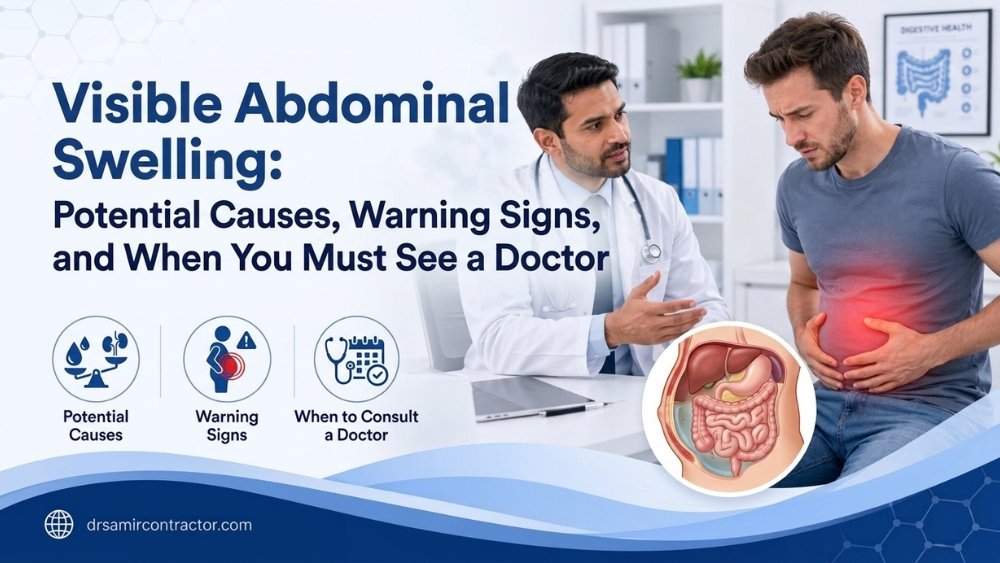
When your stomach is visibly getting bigger and it is not simply weight gain, something may be wrong. Visible abdominal swelling - noticed by you, your family, or your tailor - can signal hernia, fluid accumulation (ascites), enlarged organs, tumour, or bowel obstruction. This page explains what causes pathological abdominal swelling, what doctors look for on examination, and why new visible swelling should never be ignored.
✦ Quick Answers
Why Visible Abdominal Swelling Matters
Most people who feel bloated have a normal-sized abdomen on examination. The distinction between feeling bloated and looking swollen is critical. When the abdomen is genuinely getting bigger - when clothes no longer fit, when a family member comments, or when you can see the change in a mirror - it moves the clinical concern from functional bloating to potential structural or pathological causes.
Visible abdominal swelling is not a diagnosis. It is a physical sign that demands an explanation. The causes range from entirely benign (simple weight gain) to life-threatening (intestinal obstruction, intra-abdominal malignancy). What separates the two is the speed of onset, associated symptoms, and pattern of the swelling.
This page is written for patients and families who have noticed the abdomen getting bigger and are trying to understand what it could mean. The key message throughout is: new visible abdominal swelling that is not explained by weight gain should always be evaluated by a doctor.
Common Causes of Visible Abdominal Swelling
Surgeons and physicians use the classic teaching framework when a patient presents with a swollen abdomen. The causes fall into distinct categories based on what is filling the space:
1. Fluid (Ascites)
Ascites refers to free fluid accumulating in the peritoneal cavity - the space between the abdominal organs. When enough fluid collects (typically more than 500 ml), the abdomen becomes visibly distended. The flanks bulge outward when the patient lies flat, giving a characteristic appearance.
- Liver disease (cirrhosis) - the most common cause of ascites in India. Alcohol-related, hepatitis B, hepatitis C, and fatty liver disease can all progress to cirrhosis and ascites
- Abdominal tuberculosis - an important cause in India, especially in younger patients with fever, weight loss, and progressive abdominal swelling
- Malignancy - ovarian cancer, stomach cancer, colon cancer, and peritoneal carcinomatosis can all produce malignant ascites
- Heart failure - right-sided heart failure causes back-pressure and fluid accumulation in the abdomen
- Kidney disease (nephrotic syndrome) - protein loss causes generalised fluid retention including ascites
2. Hernia
A hernia is a protrusion of abdominal contents through a weakness or defect in the abdominal wall. Hernias are among the most common causes of a visible abdominal or groin lump. Key types that cause visible swelling include:
- Incisional hernia - occurs at the site of a previous surgical scar. A bulge appears through the scar that increases with straining or standing
- Umbilical hernia - a bulge at or around the navel. Common in adults with obesity, pregnancy, or ascites
- Inguinal hernia - a bulge in the groin or scrotum. May extend significantly and become visible through clothing
- Epigastric hernia - a small lump in the midline between the navel and breastbone
- Ventral / paraumbilical hernia - a protrusion near the umbilicus through the linea alba
3. Organomegaly (Enlarged Organs)
The liver and spleen can enlarge significantly and cause visible abdominal swelling, particularly in thin patients:
- Hepatomegaly (enlarged liver) - causes: fatty liver, hepatitis, liver abscess, liver cancer, heart failure, lymphoma
- Splenomegaly (enlarged spleen) - causes: portal hypertension (from liver disease), blood disorders, infections (malaria, kala-azar), lymphoma
- Hepatosplenomegaly - both liver and spleen enlarged together, often indicating chronic liver disease with portal hypertension
- Kidney enlargement - polycystic kidney disease can cause massively enlarged kidneys palpable in the flanks
4. Abdominal Mass or Tumour
A mass within the abdomen may become visible when it reaches a sufficient size. An abdominal lump that is new, growing, firm, or fixed to surrounding structures always needs urgent investigation.
- Ovarian cyst or tumour - can grow very large (sometimes filling the entire abdomen) before causing symptoms
- Colorectal cancer - advanced right-sided colon cancer can present as a palpable abdominal mass
- Lymphoma - enlarged intra-abdominal lymph nodes can form a mass
- Retroperitoneal tumour - tumours in the back of the abdomen (sarcoma, kidney tumour) may present as progressive swelling
- Mesenteric or omental mass - cysts, GIST tumours, or desmoid tumours of the mesentery
5. Bowel Obstruction
When the intestine is blocked, gas and fluid accumulate proximal to the obstruction, causing the abdomen to swell - often rapidly over hours. The abdomen becomes visibly distended, tense, and tender. Bowel obstruction is a surgical emergency.
- Adhesive obstruction - the most common cause, especially in patients with previous abdominal surgery
- Obstructing tumour - colorectal cancer or small bowel tumour blocking the passage
- Incarcerated hernia - a hernia trapping bowel, preventing contents from passing
- Volvulus - twisting of the bowel on its mesentery, more common in the sigmoid colon in elderly patients
6. Fat and Weight Gain
This is the most common cause of a gradually bigger abdomen. Central (visceral) obesity causes the waistline to expand over months to years. It is distinguished from pathological causes by its gradual onset, symmetric distribution, and absence of associated alarm features. However, weight gain does not exclude a concurrent pathological cause - a hernia or mass can coexist with obesity.
7. Pregnancy and Pseudo-pregnancy (Pseudocyesis)
In women of reproductive age, pregnancy must always be considered. Beyond confirmed pregnancy, rare cases of pseudocyesis (false pregnancy) exist where the abdomen enlarges in the absence of an actual foetus. Additionally, ectopic pregnancy and molar pregnancy can cause abnormal abdominal or pelvic swelling. A urine pregnancy test is a routine first step in evaluating abdominal swelling in pre-menopausal women.
8. Gas and Functional Distension
Excessive intestinal gas from dietary factors, aerophagia (swallowing air), small intestinal bacterial overgrowth (SIBO), or functional gastrointestinal disorders can cause the abdomen to appear larger than normal, particularly toward the end of the day. The key difference from pathological swelling is that gas-related distension fluctuates throughout the day, is typically worst in the evening, and improves overnight. It does not produce a fixed mass or fluid signs on examination.
How a Doctor Evaluates Visible Abdominal Swelling
The physical examination of a swollen abdomen follows a systematic approach: inspection, palpation, percussion, and auscultation. Specific clinical signs help distinguish between the various causes:
| Clinical Sign | What It Means | Suggests |
|---|---|---|
| Shifting dullness | Percussion note changes from dull to resonant when the patient turns to one side | Free fluid (ascites) - at least 500 ml present |
| Fluid thrill | A flick on one side of the abdomen is felt as a wave on the other side | Large-volume ascites (typically >2 litres) |
| Visible peristalsis | Intestinal movements visible through the abdominal wall | Bowel obstruction - loops of intestine working against a blockage |
| Cough impulse | A visible bulge appears or increases when the patient coughs | Hernia - abdominal contents pushing through a defect |
| Firm, fixed, irregular mass | A hard lump that does not move with respiration and has irregular edges | Malignant tumour or advanced disease |
| Smooth, mobile mass | A well-defined lump that moves and has smooth borders | Benign cyst, lipoma, or mobile organ enlargement |
| Caput medusae | Dilated veins radiating from the umbilicus | Portal hypertension from liver cirrhosis |
| High-pitched tinkling bowel sounds | Abnormal bowel sounds heard with a stethoscope | Mechanical bowel obstruction |
The clinical examination remains the most important initial step. A skilled examiner can often narrow down the diagnosis to one or two possibilities before ordering any tests. The combination of history (speed of onset, associated symptoms) and physical findings (pattern of swelling, percussion note, presence of a mass) guides the investigation pathway efficiently.
After the clinical examination, investigations are guided by the suspected cause:
- Ultrasound abdomen - the first-line imaging test; can detect free fluid, liver disease, organ enlargement, masses, and large hernias
- CT scan abdomen - provides detailed cross-sectional imaging to characterise masses, identify the level and cause of obstruction, and stage malignancies
- Blood tests - liver function tests, complete blood count, kidney function, tumour markers (CA-125, CEA, AFP), thyroid function
- Diagnostic paracentesis - a needle is used to draw out a sample of ascitic fluid for analysis (protein content, cell count, culture for TB, cytology for cancer cells)
- Colonoscopy - when colorectal malignancy or large bowel obstruction is suspected
- Upper GI endoscopy - when varices (from portal hypertension) or upper GI malignancy is suspected
Red Flags - When Visible Abdominal Swelling Is Urgent
Do Not Ignore These Features
- Rapid onset - swelling developing over hours to days (not months) suggests obstruction, acute ascites, or internal bleeding
- Inability to pass gas or stool - absolute constipation with distension is a hallmark of complete bowel obstruction
- Severe abdominal pain with distension - suggests strangulation, obstruction, or peritonitis
- Vomiting with abdominal distension - especially if vomit becomes green (bilious) or foul-smelling (faeculent)
- Visible peristalsis - intestinal movements visible through the skin indicate obstructed bowel
- A hernia that becomes painful and cannot be pushed back - strangulated or incarcerated hernia, a surgical emergency
- Swelling with unintended weight loss - paradox of a bigger abdomen with a thinner body suggests malignancy or liver disease
- Jaundice (yellow eyes or skin) with abdominal swelling - indicates liver disease, bile duct obstruction, or hepatic malignancy
- Swelling with ankle oedema and breathlessness - suggests heart failure or advanced liver disease
- New abdominal lump that is hard, irregular, or growing - must be investigated to exclude malignancy
The core message: if your abdomen has visibly become bigger over a period shorter than several months, and it is not explained by weight gain - see a doctor. Do not wait for other symptoms to appear. Early evaluation can identify treatable causes and prevent complications.
When Visible Swelling Is Usually Not Alarming
Features That Suggest a Benign Cause
- Gradual weight gain over months to years with proportionate increase in the rest of the body
- Abdominal swelling that varies with meals and resolves overnight (functional bloating pattern)
- A soft, reducible lump at the umbilicus or groin that appears with straining and disappears when lying down (likely a small, uncomplicated hernia - still needs medical review but is not urgent)
- Swelling limited to the lower abdomen in women around menstruation (hormonal fluid retention)
- Mild generalised swelling after a large meal or high-sodium diet that resolves within a day
- No associated pain, weight loss, vomiting, bowel disturbance, or change in appetite
Even in these situations, if the swelling is persistent or you remain concerned, a clinical examination and ultrasound can provide definitive reassurance. It is always better to have a benign cause confirmed than to assume it is benign and miss something important.
Noticed Your Abdomen Getting Bigger? Get It Evaluated.
Dr Samir Contractor provides clinical evaluation, ultrasound referral, and surgical treatment for all causes of abdominal swelling at Sterling Hospital, Vadodara.
Differentiating the Causes: A Quick-Reference Table
| Cause | Speed of Onset | Pattern | Key Distinguishing Feature |
|---|---|---|---|
| Ascites | Days to weeks | Generalised, flanks bulge when supine | Shifting dullness positive, fluid thrill if large volume |
| Hernia | Weeks to months | Localised lump at scar, umbilicus, or groin | Cough impulse positive, reducible (in uncomplicated cases) |
| Organomegaly | Weeks to months | Asymmetric - right upper quadrant (liver) or left upper (spleen) | Palpable organ edge, moves with respiration |
| Abdominal mass / tumour | Weeks to months | Localised or diffuse depending on size | Firm, fixed, irregular; may cross the midline |
| Bowel obstruction | Hours to days | Central or generalised, tense and tympanic | Visible peristalsis, absent bowel movements, vomiting |
| Obesity / weight gain | Months to years | Generalised, proportionate | No physical signs of pathology, BMI elevated, subcutaneous fat |
What Happens After a Cause Is Found?
Once the cause of visible abdominal swelling has been identified, treatment is directed at the underlying condition. The approach varies widely depending on the diagnosis - from medical management for liver disease to emergency surgery for bowel obstruction. Here is what each pathway typically involves:
- Ascites - treatment of the underlying cause (diuretics for liver disease, anti-tubercular therapy for TB, chemotherapy for malignant ascites); therapeutic paracentesis (draining the fluid) for symptom relief in large-volume ascites
- Hernia - surgical repair is the definitive treatment. Laparoscopic hernia repair offers faster recovery and lower recurrence for most types. Emergency surgery is required for strangulated hernias
- Organomegaly - treatment of the underlying condition: antiviral therapy for hepatitis, drainage for liver abscess, chemotherapy for lymphoma, supportive care for heart failure
- Abdominal mass or tumour - biopsy to determine the nature of the mass, followed by appropriate surgery, chemotherapy, or radiotherapy depending on the diagnosis
- Bowel obstruction - initial management with nasogastric decompression, IV fluids, and monitoring. Many adhesive obstructions resolve with conservative management. Surgery (laparoscopic or open) is required for complete obstruction, strangulation, or obstruction caused by tumour or hernia
- Obesity - dietary and lifestyle modifications. For morbid obesity (BMI >35 with comorbidities or BMI >40), bariatric surgery may be appropriate
What You Should Tell Your Doctor
If you are seeing a doctor about visible abdominal swelling, the following information will help them reach a diagnosis faster:
- Timeline - when did you first notice the swelling? Has it been days, weeks, or months?
- Speed of change - is it getting bigger rapidly, slowly, or has it stayed the same?
- Location - is it generalised or in one area? Is it central, to one side, or in the groin?
- Variation - does it change with posture, meals, time of day, coughing, or straining?
- Associated symptoms - pain, vomiting, constipation, inability to pass gas, weight loss, appetite changes, jaundice, ankle swelling, breathlessness
- Previous surgery - any prior abdominal or groin operations (increases risk of incisional hernia and adhesive obstruction)
- Medical history - known liver disease, heart disease, kidney disease, cancer, TB
- Alcohol intake - relevant because chronic alcohol use is a major cause of liver cirrhosis and ascites in India
- Family history - cancer, polycystic kidney disease, or other relevant conditions
Visible Abdominal Swelling vs Abdominal Distension vs Bloating
These three terms are related but describe different things, and distinguishing between them helps in understanding the level of concern:
| Term | Definition | Level of Concern |
|---|---|---|
| Bloating | A subjective sensation of fullness, tightness, or pressure in the abdomen. The abdomen may or may not actually be bigger. | Usually functional (IBS, dietary). Rarely dangerous on its own. |
| Abdominal distension | Measurable increase in abdominal girth. Can be caused by gas, fluid, fat, or solid organ/mass. | Moderate - warrants evaluation if new, progressive, or persistent. |
| Visible abdominal swelling | Swelling that is obvious to the patient or observer - the abdomen visibly looks bigger, clothes do not fit, a lump is noticeable. | Higher concern - structural cause should be excluded. This page. |
If you are on this page, you or someone in your family has noticed visible swelling. That places you in the category that needs a proper medical assessment - even if the cause turns out to be benign. The purpose of evaluation is to confirm that it is benign rather than to assume it.
A Note on Timing and Urgency
The speed at which abdominal swelling develops is one of the most important clues. Swelling that appears over hours to a few days suggests an acute surgical problem - bowel obstruction, internal bleeding, or a strangulated hernia. Swelling that builds over weeks suggests ascites, a growing mass, or an enlarging organ. Swelling over months to years is more consistent with weight gain or a slow-growing benign condition. Regardless of the speed, a medical evaluation is the only reliable way to determine the cause and decide whether treatment is needed.
In practice, the most dangerous scenario is when patients or families normalise progressive swelling by attributing it to age or eating habits. A large proportion of late-presenting abdominal tumours and advanced liver disease cases in India could have been diagnosed earlier if the visible swelling had prompted a medical visit. The single most important takeaway from this page is: if the abdomen is visibly getting bigger and it is not clearly weight gain, see a doctor.
Abdominal Swelling in the Indian Context
India-Specific Considerations
- Abdominal tuberculosis is an important cause of ascites in India, particularly in younger patients. It can mimic ovarian cancer and peritoneal carcinomatosis. Ascitic fluid analysis and tissue biopsy are often required for diagnosis
- Liver disease from hepatitis B and C remains highly prevalent. Many patients present late - when ascites or variceal bleeding has already developed - because the earlier stages of liver disease were asymptomatic
- Alcohol-related liver disease is increasingly common in urban India. Heavy alcohol consumption over 10-15 years can lead to cirrhosis, portal hypertension, and ascites
- Late presentation of hernias is common. Patients often tolerate reducible hernias for years before presenting - sometimes only when the hernia becomes irreducible or obstructed. Early elective repair is safer than emergency surgery for a complicated hernia
- Ovarian tumours can grow to enormous sizes before presentation in India, partly due to delayed access to gynaecological care in rural areas. An unexplained progressive lower abdominal swelling in a woman should always prompt pelvic ultrasound
- Cultural factors - abdominal swelling in women may be attributed to weight gain or dismissed for extended periods. In men, it may be attributed to a "beer belly." Both assumptions can delay diagnosis of serious underlying conditions
Desi Patient Questions (Gujarati)
Pet vadhvu ane body patlu thavu - aa combination serious hoi shake chhe. Ascites (pet ma pani), liver disease, ya abdominal tumour possible chhe. Turant doctor ne batavo - ultrasound ane blood tests karavu zaruri chhe. Weight loss sathe pet vadhvu ignore na karo.
Aa hernia hoi shake chhe - pet ni dival ma kamjori thi andar nu bahar aave chhe. Jyare suvo tyare ghayadh thay ane uthva par aave - aa typical hernia sign chhe. Elective laparoscopic repair recommended chhe jyathi hernia aagal vadhine complicated na thay. Jyare hernia dukhvu sharu thay ane ghayadh na thay - turant hospital javo, emergency surgery zaruri hoi shake chhe.
Pet ma pani - jene ascites kahevay chhe - common causes chhe: liver disease (cirrhosis), abdominal TB, cancer, heart failure, kidney disease. India ma liver disease ane TB sabhu thi common causes chhe. Doctor ascitic fluid ni sample kadhine test karshe - protein, cell count, TB culture, cancer cells. Treatment cause par depend kare chhe.
Ha - severe constipation thi pet phuli shake chhe, pan aa usually generalised bloating hoy chhe, visible swelling nahi. Jyo pet visibly vadhtu hoy, clothes tight thata hoy, ane sathe constipation puri tarah band thay - gas ane stool nahi nikle - toh bowel obstruction possible chhe. Aa emergency situation chhe - turant hospital javo.
Jaundice (pili aankh) ane pet vadhvu sathe - liver disease ni strong indication chhe. Cirrhosis, hepatitis, ya liver cancer hoi shake chhe. Urgent evaluation zaruri chhe - liver function tests, ultrasound, ane specialist ni consultation. Delay na karo - early treatment ma outcome better chhe.
Operation na scar par bulge aavvu - aa incisional hernia chhe. 10-15% open surgery pachi thay chhe. Aa normal nathi pan common chhe. Time sathe motu thay chhe. Laparoscopic mesh repair thi saru thay chhe - jaldi karavo, motu thay pachi repair difficult thay chhe ane complications nu risk vadhe chhe.
Frequently Asked Questions
Related Pages
Visible Abdominal Swelling? Get a Proper Evaluation in Vadodara
Dr Samir Contractor at Sterling Hospital provides clinical assessment, imaging coordination, and surgical treatment for all causes of abdominal swelling - hernia repair, tumour surgery, bowel obstruction, and more.
Medical Disclaimer: The information on this page is intended for general patient education and awareness only. It does not constitute medical advice, diagnosis, or treatment. Every patient's situation is unique. Visible abdominal swelling has many possible causes - some benign, some serious - and requires proper clinical evaluation. Do not use this information to self-diagnose or delay seeking professional medical care. Always consult a qualified medical professional for your specific health concerns. Content reviewed by Dr Samir Contractor, MS, FMAS, FIAGES, Sterling Hospital, Vadodara.