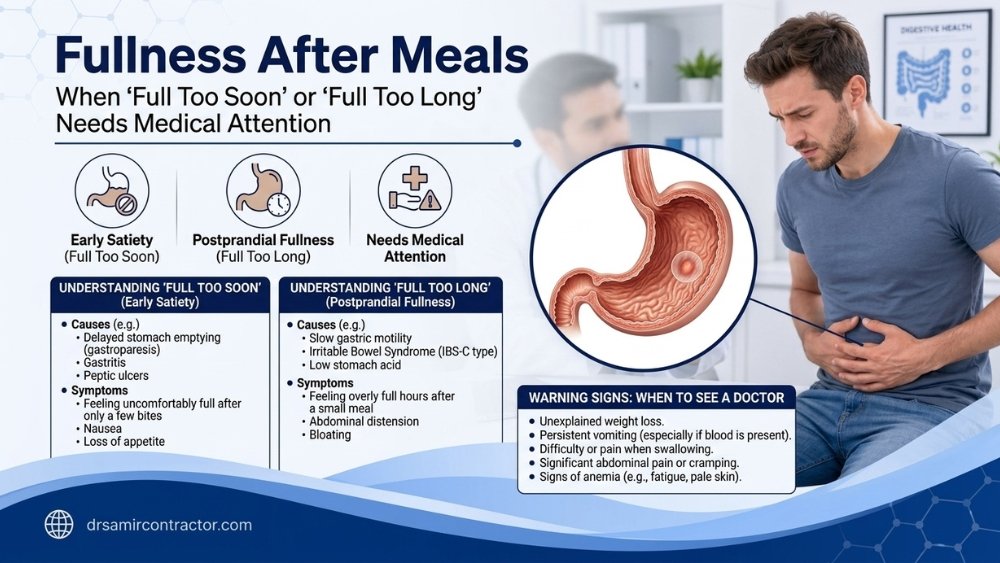
Everyone feels full after a large meal. That is normal physiology. What is not normal is feeling uncomfortably full after eating a modest portion, or finding that the sensation of fullness persists for hours - meal after meal, day after day. This page explains the two distinct patterns of abnormal meal-related fullness recognised by the Rome IV criteria - early satiety and postprandial fullness - why the distinction matters for diagnosis, the conditions each pattern points to, and when evaluation is needed.
✦ Quick Answers
Understanding Fullness After Meals - Two Distinct Patterns
Patients who present with "feeling full" after eating are describing one of two different experiences, and distinguishing between them is the first step in identifying the cause. The Rome IV criteria - the international standard for classifying functional gastrointestinal disorders - formally separate these two patterns because they carry different diagnostic implications.
Early Satiety - "Full Too Soon"
- Feeling full after only 2-3 bites of food
- Unable to finish a normal-sized meal
- Often leads to progressive reduction in food intake
- Associated with weight loss when persistent
- Suggests impaired gastric accommodation, gastroparesis, or reduced stomach capacity
- A red-flag symptom when new, progressive, and above age 45
Postprandial Fullness - "Full Too Long"
- Unpleasant fullness during or after a normal-sized meal
- Feels as though food is "sitting there" and not moving
- Persists 1-3 hours or longer after eating
- Often accompanied by bloating, belching, nausea
- Suggests functional dyspepsia, delayed emptying, or gastritis
- The more common of the two presentations in clinical practice
Both patterns can coexist in the same patient and frequently overlap with bloating and upper abdominal discomfort. Together, they form the postprandial distress syndrome (PDS) - one of two subtypes of functional dyspepsia (the other being epigastric pain syndrome). Understanding which pattern predominates helps the clinician target the right investigation and treatment.
What Causes Fullness After Meals?
Common and correctable causes
- Functional dyspepsia (postprandial distress syndrome): The most common cause worldwide. No structural abnormality is found on investigation. The stomach is hypersensitive to normal food volumes and fails to relax adequately as food enters (impaired accommodation). Patients feel full despite eating modest portions, and the fullness lingers for hours.
- H. pylori gastritis: Infection with Helicobacter pylori causes chronic inflammation of the stomach lining. This impairs gastric motility and sensitivity, producing post-meal fullness, nausea, and discomfort. H. pylori prevalence in India ranges from 40-60%, making it one of the most under-tested treatable causes of this symptom.
- GERD (gastro-oesophageal reflux disease): Acid reflux reduces gastric accommodation and slows emptying. Patients with GERD frequently report post-meal fullness alongside heartburn and regurgitation.
- Overeating and eating too quickly: The stomach needs time to accommodate food. Rapid eating fills the stomach before it can relax adequately, and swallowed air adds to the distension. This is particularly relevant in Indian thali culture where large, multi-item meals are the norm.
- High-fat and heavy meals: Fat is the macronutrient that most slows gastric emptying. Ghee-laden preparations, oily curries, deep-fried items (samosa, bhajia, gathiya), and heavy gravies physiologically prolong the time the stomach takes to empty.
- Medications: Certain drugs slow gastric motility - opioid painkillers, anticholinergics, some antidepressants, calcium channel blockers, and GLP-1 receptor agonists (increasingly prescribed for diabetes and weight management).
- Stress and anxiety: The gut-brain axis directly affects gastric function. Psychological stress slows gastric emptying, impairs accommodation, and increases visceral sensitivity - amplifying the sensation of fullness from a normal volume of food.
Causes requiring investigation
- Gastroparesis: Delayed gastric emptying from nerve damage - most commonly seen in long-standing diabetes (diabetic gastroparesis). The stomach fails to contract normally. Patients experience persistent fullness, nausea, and may vomit partially digested food hours after eating. Diagnosed by gastric emptying scintigraphy.
- Gallstone-related dyspepsia: Gallstones can produce post-meal fullness and bloating, particularly after fatty meals, even without classic biliary colic. This pattern is frequently misattributed to acidity in Indian practice. Ultrasound identifies gallstones. Laparoscopic cholecystectomy resolves gallstone-related dyspepsia in the majority of patients.
- Gastric outlet obstruction: Scarring from chronic peptic ulcer disease or a tumour at the pylorus (stomach outlet) physically prevents food from leaving the stomach. Causes progressive fullness, persistent vomiting of large volumes of old food, and significant weight loss. This is an urgent surgical condition.
- Gastric malignancy: New-onset early satiety with weight loss in a patient above 45 must be taken seriously. A tumour within the stomach wall reduces compliance (the stomach cannot stretch normally) and may obstruct the outlet. Endoscopy with biopsy is mandatory to exclude this.
- Chronic pancreatitis or pancreatic mass: The pancreas sits behind the stomach. Chronic inflammation or a mass can compress the stomach from behind, producing early satiety with back pain and weight loss.
Fullness After Meals vs. Bloating - Why the Distinction Matters
| Feature | Fullness After Meals | Abdominal Bloating |
|---|---|---|
| Core sensation | Food sitting in the stomach; unable to eat more | Abdominal tightness, pressure, visible swelling |
| Timing | During or immediately after eating | May worsen through the day; not always meal-related |
| Location | Upper abdomen (epigastric region) | Diffuse - can be upper, lower, or generalised |
| Key diagnostic direction | Gastric pathology - dyspepsia, gastroparesis, gallstones, upper GI mass | Small bowel, colonic, or functional - IBS, SIBO, functional bloating |
| Primary investigation | Upper GI endoscopy, H. pylori test, ultrasound | Colonoscopy, hydrogen breath test, abdominal imaging |
Patients frequently use the words "fullness" and "bloating" interchangeably. In clinical practice, the distinction directs investigation toward the stomach (fullness after meals) or the intestines (bloating and distension). A careful history clarifies which pattern predominates.
Red Flags - When Fullness After Meals Needs Urgent Evaluation
Seek medical attention promptly if fullness is associated with:
- Unintended weight loss - even gradual, over weeks to months
- Progressive early satiety - unable to finish increasingly smaller amounts of food
- Vomiting of old or partially digested food - hours after a meal
- Difficulty swallowing accompanying the fullness
- Blood in vomit or black, tarry stool
- New onset above age 45 - particularly with any of the features above
- Palpable lump or hardness in the upper abdomen
- Rapid worsening over 2-4 weeks
- Persistent vomiting preventing adequate nutrition
- Family history of gastric cancer combined with new symptoms
When fullness is usually not a cause for alarm
- Fullness after genuinely large meals - festivals, celebrations, thali meals - that resolves within a few hours
- Fullness clearly related to specific trigger foods (oily, fried, heavy) that resolves when those foods are avoided
- Mild, intermittent fullness that has been stable for months without weight loss, vomiting, or progressive worsening
- Fullness during periods of high stress that improves when stress reduces
- Post-bariatric surgery - early satiety after sleeve gastrectomy or gastric bypass is expected and intentional; it is the mechanism through which the procedure works
Who Is at Higher Risk?
- Patients with H. pylori infection: Chronic gastritis from H. pylori is one of the most common treatable causes of post-meal fullness in India. The infection impairs gastric motility and increases mucosal sensitivity - producing fullness, nausea, and discomfort that persists until the infection is eradicated.
- People with long-standing diabetes: Diabetic gastroparesis develops after years of poorly controlled blood glucose damaging the vagus nerve. Patients with diabetes for 10 years or more and HbA1c consistently above 8% are at highest risk. Gastroparesis may also cause erratic glucose levels by making food absorption unpredictable.
- Patients with chronic GERD: Acid reflux impairs the stomach's ability to relax and accommodate food, adding fullness to the existing symptoms of heartburn and regurgitation.
- Those on certain medications: Opioid painkillers, tricyclic antidepressants, anticholinergics, calcium channel blockers, and GLP-1 receptor agonists all slow gastric emptying. Patients on these medications who develop fullness should have this possibility assessed.
- People who eat large, infrequent, high-fat meals: The Indian pattern of two major meals - a heavy lunch and a large dinner - combined with oil-rich cooking creates the perfect physiological setup for prolonged post-meal fullness.
- Patients above age 45 with new symptoms: The risk of gastric malignancy and gastroparesis increases with age. New-onset fullness in this age group warrants earlier investigation.
- Post-bariatric surgery patients: Expected early satiety is part of the surgical mechanism, but excessive fullness with vomiting, pain, or nutritional decline may signal a complication requiring evaluation.
- People under chronic psychological stress: Stress-related functional dyspepsia with impaired gastric motility is increasingly recognised in India's urban working population.
How Doctors Evaluate Fullness After Meals
A structured clinical history is the most important step. Your doctor will determine:
- Whether the predominant pattern is early satiety (full too soon) or postprandial fullness (full too long) - or both
- Duration and progression - stable for months or worsening over weeks
- Relationship to meal size and type - all meals, or only large or fatty meals
- Associated symptoms - nausea, vomiting, heartburn, belching, abdominal pain
- Weight change - any unintentional loss
- Medication history - particularly NSAIDs, diabetes drugs, opioids, antidepressants
- Diabetes status - duration and glucose control (HbA1c)
- Red-flag features - as listed above
Investigations that may be needed
| Test | What It Identifies | When Indicated |
|---|---|---|
| H. pylori test (breath test, stool antigen, or biopsy) | H. pylori gastritis - a treatable cause of fullness and dyspepsia | First-line in all patients with persistent dyspepsia symptoms |
| Upper GI endoscopy (OGD) | Gastritis, peptic ulcer, gastric mass, gastric outlet obstruction, hiatal hernia | Red flags present; age above 45; symptoms not improving after 4-8 weeks of treatment |
| Ultrasound abdomen | Gallstones, liver and pancreatic pathology | Suspected gallstone-related dyspepsia; right upper abdominal symptoms after fatty meals |
| Gastric emptying scintigraphy | Gastroparesis (delayed gastric emptying) | Persistent fullness with nausea and vomiting, especially in diabetics |
| Blood tests (CBC, glucose, HbA1c, thyroid, liver and kidney function) | Anaemia, uncontrolled diabetes, hypothyroidism, nutritional impact | Routine baseline in most patients with persistent symptoms |
Treatment - Matched to the Cause
1. Dietary and lifestyle modification - the foundation in all cases
Regardless of the underlying cause, adjusting how and what you eat produces measurable improvement in the majority of patients with fullness after meals.
Practical Portion Guidance for Indian Patients
- Shift from 2-3 large meals to 4-5 smaller ones: The traditional Indian pattern of a heavy lunch thali and a large dinner overloads the stomach twice daily. Splitting the same total quantity across 4-5 smaller sittings allows better gastric accommodation and faster emptying.
- Reduce fat content per meal: Use less oil and ghee in daily cooking. Favour steaming, roasting, and light tempering over deep-frying. This is the single most impactful dietary change for post-meal fullness - fat is the primary factor that slows gastric emptying.
- Best-tolerated foods: Soft khichdi, plain dal, curd rice, steamed vegetables (dudhi, turia, tinda), soft roti with light sabzi, banana, chaas (buttermilk).
- Reduce gas-forming foods in large portions: Rajma, chole, whole urad dal, cabbage, and cauliflower produce intestinal gas that adds to the fullness sensation when combined with slow gastric emptying.
- Eat slowly and chew well: Rapid eating - a common habit during busy Indian work days - leads to air swallowing and insufficient mechanical breakdown of food. Taking 20-25 minutes per meal significantly reduces post-meal discomfort.
- Walk briefly after meals: A 10-15 minute walk after eating improves gastric motility. Avoid lying down for at least 1.5-2 hours after meals.
2. H. pylori eradication (if positive)
A 14-day combination course of antibiotics and a proton pump inhibitor. Eradication resolves dyspepsia symptoms in a significant proportion of H. pylori-positive patients - often without the need for any ongoing medication. Confirmation of eradication by breath test 4-6 weeks after completing treatment is recommended.
3. Acid suppression therapy (PPIs)
Proton pump inhibitors reduce acid production, heal inflamed gastric mucosa, and improve gastric accommodation. Prescribed for 4-8 weeks initially in GERD-related and gastritis-related fullness, then reassessed. Long-term PPI use should be guided by a doctor based on the underlying diagnosis.
4. Prokinetic agents
Medications that improve the coordinated movement of food through the stomach - domperidone, itopride, and metoclopramide. These are particularly useful for functional dyspepsia with prominent fullness and bloating, and for gastroparesis. They are prescribed under medical supervision as they have specific side-effect profiles that require monitoring.
5. Gastroparesis - specialised management
Low-fat, low-fibre, small frequent meals form the dietary foundation. Prokinetic therapy is the pharmacological mainstay. In diabetic gastroparesis, strict optimisation of blood glucose control (targeting HbA1c below 7%) is critical. Severe refractory cases may require gastroenterology input for options including gastric electrical stimulation.
6. Treatment of structural causes
- Gallstone-related dyspepsia: Laparoscopic cholecystectomy - removal of the gallbladder - resolves gallstone-related post-meal fullness and bloating in most patients. A daycare or one-night-stay procedure with rapid recovery.
- Gastric outlet obstruction: Endoscopic balloon dilatation may be attempted first for peptic ulcer scarring. Surgical bypass or resection when dilatation is not feasible or when a tumour is the cause.
- Gastric malignancy: Surgical resection with curative intent in early-stage disease. Palliative bypass or stenting for advanced cases. Early detection through timely endoscopy offers the best outcomes.
7. Addressing the gut-brain axis
In patients where functional dyspepsia is the diagnosis and stress is a clear trigger, addressing the psychological component is not optional - it is part of the treatment. Regular meal timing, adequate sleep (7-8 hours), physical activity (even 30 minutes of brisk walking daily), and structured stress-management techniques have all been shown to improve gastric motility and reduce visceral hypersensitivity. In select patients with refractory functional dyspepsia, low-dose tricyclic antidepressants (such as amitriptyline at 10-25 mg nightly) are used not as antidepressants but as neuromodulators - reducing the stomach's over-sensitivity to normal food volumes. This is prescribed and monitored by a specialist.
Persistent Fullness After Meals? Get the Right Diagnosis.
Churan and digestive tonics manage the symptom - they do not treat the cause. A focused evaluation identifies why you feel full and what treatment will actually work.
What Happens If Fullness After Meals Is Ignored?
- Progressive dietary restriction: Patients eat less and less to avoid discomfort, leading to nutritional deficiency, weakness, anaemia, and unintentional weight loss over months.
- Untreated H. pylori: Persistent gastritis, increased risk of peptic ulcer formation, and long-term risk of gastric MALT lymphoma and gastric adenocarcinoma if left untreated for years.
- Worsening diabetic gastroparesis: Without management, gastroparesis leads to erratic blood glucose control (unpredictable food absorption), recurrent hospitalisations for vomiting, and bezoar formation (food solidifying into a mass inside the stomach).
- Delayed cancer diagnosis: Early satiety and progressive fullness as presenting symptoms of gastric malignancy, when attributed to routine dyspepsia and managed with antacids, results in late-stage diagnosis with significantly reduced treatment options.
- Gallstone complications: Gallstone-related dyspepsia managed as "acidity" delays cholecystectomy. Meanwhile, the gallstone disease can progress to acute cholecystitis, CBD stones, or gallstone pancreatitis - all more complex surgical situations.
Recovery and What Patients Can Expect
| Timeframe | What Typically Improves |
|---|---|
| 1-2 weeks | Dietary modification response: Patients who shift to smaller, more frequent meals and reduce fat intake often notice significant improvement within 1-2 weeks. This is the fastest and most durable intervention for functional dyspepsia. |
| 2-4 weeks | H. pylori eradication: Post-meal fullness related to H. pylori gastritis typically improves within 2-4 weeks of completing the eradication course. Long-term resolution rates are high. |
| 4-8 weeks | PPI and prokinetic therapy: Acid suppression and motility agents improve fullness in most patients within this window. Response guides whether long-term maintenance is needed. |
| Post-surgery | Gallstone-related dyspepsia: Most patients report improvement in post-meal fullness within 2-4 weeks of laparoscopic cholecystectomy. Full dietary normalisation typically occurs by 6-8 weeks. |
| Long-term | Functional dyspepsia: A recurring condition. With dietary discipline, stress management, and periodic medical review, most patients maintain good symptom control. Flares during periods of stress or dietary excess are expected and manageable. |
Fullness After Meals in India - What Matters for You
- Thali culture and large servings: The Indian tradition of large, multi-item thali meals - rice, 2-3 sabzis, dal, roti, papad, pickle, sweet - presented simultaneously encourages rapid, voluminous eating. The stomach receives more food than it can comfortably accommodate in a single sitting. This cultural meal pattern is a major contributor to post-meal fullness in otherwise healthy individuals.
- Fat-heavy cooking: Generous use of oil, ghee, and deep-frying in everyday Indian cooking physiologically slows gastric emptying. In patients with underlying dyspepsia or gastroparesis, this dietary pattern amplifies symptoms significantly.
- High H. pylori prevalence: With 40-60% prevalence across India, H. pylori gastritis is one of the most common treatable causes of post-meal fullness - and one of the most under-tested. A simple breath test or stool antigen test can identify it; a 14-day course can cure it.
- Growing diabetic population: India has over 100 million people with diabetes. Diabetic gastroparesis - delayed stomach emptying from autonomic nerve damage - is an important and under-recognised cause of persistent fullness, nausea, and poor nutritional intake in long-standing diabetics.
- Churan and home remedy culture: Ajmo (carom seed) water, hing (asafoetida) solutions, digestive churan, and Ayurvedic digestive tonics provide temporary symptom relief but do not treat the underlying cause. Prolonged reliance on these remedies delays proper evaluation.
- Stress as a trigger: Work pressure, family responsibilities, financial stress, and urban lifestyle factors are consistently reported triggers for worsening post-meal fullness in Indian patients with functional dyspepsia.
- Late presentation to specialists: Patients often self-manage with OTC antacids and home remedies for months to years before seeking specialist evaluation. By this time, conditions like H. pylori gastritis have become chronic, gallstone disease may have progressed, and nutritional deficiencies may have developed.
Common Questions in Gujarati & Hinglish
Meaning: "I feel full after eating just a little - even with normal food - is this serious?" - Aa early satiety kehvay chhe. Functional dyspepsia most common cause chhe, pan jyaare weight loss hoy ke progressively ochhun khavatu jaay to evaluation zaruri chhe. Doctor ne batavo ketlu khavathij full thaao chhe.
Meaning: "After eating, my stomach feels heavy for hours - as if food is just sitting there - what should I do?" - Aa postprandial fullness chhe. Nana portions ma divide karo - 4-5 vaaru khao, 2-3 vaaru nahi. Oil ane ghee ochhu karo. Jyaare 4 athvadiya sudhi farak na pade to H. pylori test ane doctor ni salah lo.
Meaning: "I have had diabetes for 15 years - I feel nauseated and full after eating - is there a connection?" - Ha - diabetic gastroparesis hoy sake chhe. Diabetes vagus nerve ne damage kare chhe jene leedhey stomach slowly empty thay. Gastric emptying scan confirm kare chhe. Diabetes control optimize karo, nana meals khao, ane prokinetic medicines doctor pase thi lo.
Meaning: "I get terrible fullness after oily food - but at home they use lots of oil - what do I do?" - Fat gastric emptying slow kare chhe - aa physiology chhe. Thoda thoda changes karo: tel ni jagya air-fryer vaapro, ghee halving karo, deep-fry ne bake ma convert karo. Cooking method badlavo - taste bahuj ochho farke chhe pan fullness ma moto farak pade chhe.
Meaning: "I take churan and carom water daily - I get brief relief but the problem always returns - is there a permanent solution?" - Churan symptom mask kare chhe, cause treat nathi karto. H. pylori test karo - positive hoy to 14-day treatment thi permanent relief male chhe. Negative hoy to lifestyle changes ane proper medication long-term ma churan karta vadhare effective chhe.
Meaning: "The doctor says I need an endoscopy - I'm scared - is it necessary?" - Endoscopy bahuj safe ane quick procedure chhe - 5-7 minute ma thai jaay chhe sedation sathe. Jyaare doctor recommend kare chhe, to tena maate reason hoy chhe - khaas karane age 45+ hoy, weight loss hoy, ya treatment thi farak na padyo hoy. Majority ma normal result male chhe - reassurance aape chhe. Delay karto nahi.
Frequently Asked Questions
Related Pages
Take the Next Step - Find Out Why You Feel Full
Digestive tonics mask the symptom. A proper evaluation identifies
the cause.
Book a consultation with Dr
Samir Contractor at Sterling Hospital, Vadodara.
Medical Disclaimer: The information on this page is intended for patient education only and does not constitute medical advice, diagnosis, or treatment. Every patient's condition is unique. Do not self-diagnose or self-treat based on online content. Always consult a qualified medical professional for personalised evaluation and management. If you are experiencing severe symptoms - persistent vomiting, inability to eat, blood in vomit or stool, or rapid weight loss - visit the nearest emergency department immediately.