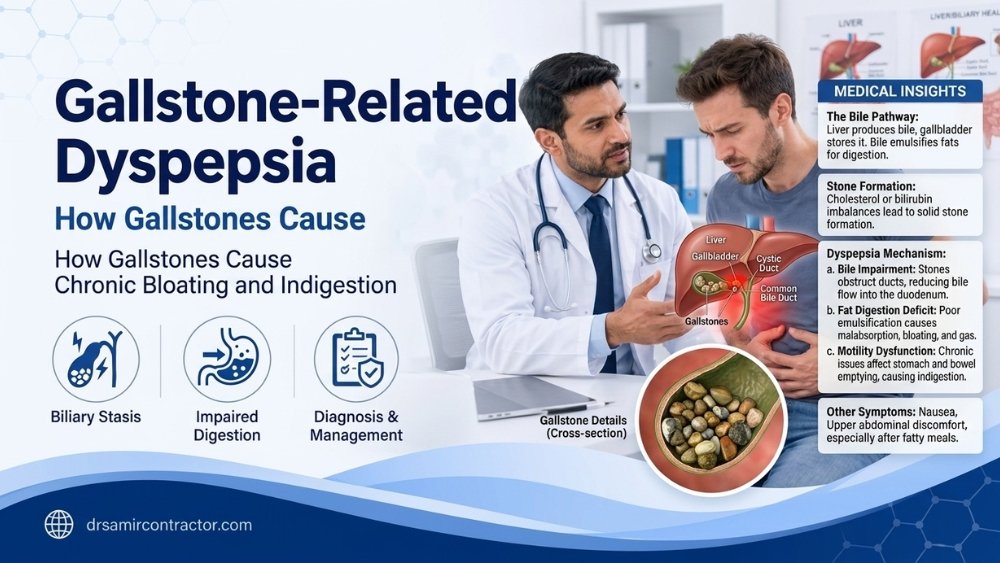
Gallstone-related dyspepsia - also called biliary dyspepsia - is a pattern of chronic upper abdominal bloating, heaviness after meals, nausea, and intolerance to fatty food caused by gallstones. Many patients are treated for "gas" or "acidity" for months or years before an ultrasound reveals gallstones as the actual cause.
✦ Quick Answers
What Is Gallstone-Related Dyspepsia?
When most people think of gallstones, they picture an acute attack - sudden, severe pain under the right ribs, often after a rich meal, sometimes accompanied by vomiting and fever. And while that presentation (biliary colic or acute cholecystitis) is certainly real and important, it represents only one part of the clinical picture.
A much larger group of gallstone patients experience something subtler: persistent bloating after eating, a heavy feeling in the upper abdomen, discomfort that worsens with oily or fried food, frequent nausea, and excessive belching. They do not get the dramatic attacks. Instead, they have a chronic, nagging indigestion that does not respond to antacids, digestive enzymes, or dietary adjustments. This pattern is what surgeons and gastroenterologists call gallstone-related dyspepsia or biliary dyspepsia.
In my practice at Sterling Hospital, Vadodara, I see this pattern frequently - particularly in women over 40, patients with a family history of gallstones, and those who have been labelling their symptoms as "gas problem" or "chronic acidity" for months or even years. The diagnosis is often missed because the symptoms mimic functional dyspepsia so closely that unless an ultrasound is performed, the gallstones go undetected.
Why Gallstones Cause Bloating and Indigestion
To understand biliary dyspepsia, it helps to understand the normal role of the gallbladder. The gallbladder stores bile - a digestive fluid produced by the liver - and releases it into the small intestine after you eat, particularly after a fatty meal. Bile is essential for breaking down and absorbing dietary fat.
When gallstones are present, this process is disrupted in several ways:
- Impaired gallbladder contraction: Stones physically obstruct the neck or cystic duct of the gallbladder, preventing proper contraction and bile release. The result is incomplete fat digestion, which causes bloating, heaviness, and nausea after meals.
- Chronic gallbladder inflammation: Even when stones are not causing acute obstruction, their chronic presence irritates the gallbladder wall (chronic cholecystitis). This low-grade inflammation impairs gallbladder motility and bile concentration.
- Gallbladder dyskinesia: In some patients, the gallbladder wall becomes thickened and fibrotic from repeated mild inflammation, leading to poor contractility even when stones are small. The gallbladder functions as a sluggish reservoir rather than an active pump.
- Visceral hypersensitivity: Chronic irritation from gallstones can sensitize the nerve pathways of the upper abdomen, making patients perceive normal digestive activity as discomfort or bloating - a mechanism similar to what occurs in functional dyspepsia.
- Altered gut motility: Gallbladder dysfunction affects the coordinated release of bile and pancreatic enzymes. This disrupts the normal digestive cascade and slows gastric emptying, contributing to the feeling of early fullness and prolonged postprandial bloating.
Symptoms of Gallstone-Related Dyspepsia
The symptom profile of biliary dyspepsia is distinct from classic biliary colic, although there can be overlap. Here is the pattern I most commonly see in clinical practice:
- Postprandial bloating: A feeling of fullness and heaviness in the upper abdomen that starts 20 to 60 minutes after eating. It is worse after larger meals and particularly after fatty, oily, or fried food.
- Fatty food intolerance: This is a hallmark symptom. Patients report that they can no longer tolerate foods they previously ate without difficulty - puri, paratha, samosa, fried snacks, paneer-based dishes, and creamy gravies.
- Nausea: A persistent queasy feeling after meals, sometimes lasting hours. Actual vomiting is less common in dyspeptic presentations than in acute attacks.
- Excessive belching: Patients often describe constant belching (dakaar) after meals, which provides only brief or no relief.
- Right upper quadrant discomfort: A dull ache or pressure under the right ribs, not the sharp, severe colic of an acute attack. Many patients describe it as a "heaviness" rather than pain.
- Early satiety: Feeling full after eating only a small amount, even when hungry. This occurs because impaired bile release slows gastric emptying.
- Epigastric discomfort: A burning or pressure sensation in the central upper abdomen (pit of the stomach) that patients often mistake for hyperacidity.
Biliary Dyspepsia vs. Functional Dyspepsia: How to Tell the Difference
This distinction is clinically important because the treatment is fundamentally different. Functional dyspepsia is managed with medication and lifestyle changes. Biliary dyspepsia is best treated by removing the gallbladder. Getting this distinction wrong leads either to unnecessary surgery or to prolonged, ineffective medical treatment.
| Feature | Gallstone-Related (Biliary) Dyspepsia | Functional Dyspepsia |
|---|---|---|
| Trigger | Clearly linked to meals, especially fatty or oily food | May or may not be meal-related; often stress-linked |
| Location | Right upper abdomen or epigastrium | Central epigastrium predominantly |
| Fatty food intolerance | Prominent and consistent | Variable; not a defining feature |
| Nausea | Common, postprandial, reproducible | May be present but less predictable |
| Ultrasound | Gallstones or sludge present; gallbladder wall may be thickened | Normal gallbladder; no stones |
| Response to antacids | Poor or no response | Partial or temporary relief common |
| Response to PPIs | Minimal improvement | Often provides some relief |
| Definitive treatment | Laparoscopic cholecystectomy | Dietary modification, prokinetics, neuromodulators |
| Age and risk profile | More common in women over 40, obesity, multiparity, family history | Can occur at any age; often in younger, stressed patients |
In practice, these two conditions can coexist. A patient can have both gallstones and an element of functional dyspepsia. This is why a careful clinical evaluation - history, examination, ultrasound, and sometimes endoscopy - is essential before deciding on surgery. Removing the gallbladder will address the biliary component, but if a significant functional component is also present, the patient needs to understand that some degree of bloating may persist after surgery.
Who Is at Risk for Gallstone-Related Dyspepsia?
Gallstones are common, and certain populations are at significantly higher risk. The classic teaching uses the "5 F's" - Female, Fat (overweight or obese), Forty (age over 40), Fertile (multiparity), and Family history - but the risk factors in Indian practice extend beyond this.
- Women over 40: Oestrogen increases cholesterol secretion into bile and reduces gallbladder motility. Post-menopausal women and those who have had multiple pregnancies are at highest risk.
- Obesity and metabolic syndrome: Excess body weight increases cholesterol saturation of bile. Patients with diabetes, insulin resistance, and high triglycerides have significantly higher gallstone rates.
- Rapid weight loss: Patients who lose weight quickly - including those after bariatric surgery - develop gallstones at accelerated rates because the liver mobilizes cholesterol faster than bile can dissolve it.
- Family history: Gallstone formation has a strong genetic component. If a first-degree relative has gallstones, your risk is two to four times higher.
- High-carbohydrate, low-fibre diet: Diets heavy in refined flour (maida), sugar, and polished rice with limited fibre increase gallstone formation. This pattern is common in urban Indian diets.
- Sedentary lifestyle: Physical inactivity reduces gallbladder motility and promotes cholesterol supersaturation in bile.
- Prolonged fasting or meal skipping: Irregular meal patterns - particularly skipping breakfast - reduce gallbladder emptying, allowing bile to concentrate and form stones.
How Gallstone-Related Dyspepsia Is Diagnosed
Diagnosis requires putting together the clinical picture and confirming the presence of gallstones. In my practice, I follow a structured approach:
Step 1: Clinical History
The history itself often points strongly toward biliary dyspepsia. I ask specifically about the relationship between symptoms and meals, tolerance for fatty food, right-sided discomfort, family history of gallstones, and response (or lack thereof) to antacids and acid-suppressing medication. A patient who says "I have had bloating and heaviness after meals for months, and Pantoprazole does not help" immediately raises the possibility of a biliary cause.
Step 2: Abdominal Examination
In biliary dyspepsia, the examination may show mild tenderness in the right upper abdomen (right hypochondrium). Murphy's sign - pain on deep inspiration while pressing under the right ribs - may be mildly positive. In many patients with chronic dyspeptic symptoms, the examination is unremarkable, which is why imaging is essential.
Step 3: Ultrasound Abdomen
This is the single most important investigation. A transabdominal ultrasound can detect gallstones with over 95 percent sensitivity. It also shows gallbladder wall thickening (suggesting chronic cholecystitis), gallbladder sludge, and any dilatation of the bile duct. In Vadodara, this is readily available, affordable, and gives results within minutes.
Step 4: Blood Tests
I routinely check a complete blood count, liver function tests (bilirubin, alkaline phosphatase, SGOT, SGPT), blood sugar, and lipid profile. In uncomplicated biliary dyspepsia, these may be entirely normal. Mild elevations of alkaline phosphatase can occur with chronic gallbladder inflammation. Elevated bilirubin or significantly raised liver enzymes suggest a stone may have migrated into the common bile duct - a more serious situation.
Step 5: Upper GI Endoscopy (When Indicated)
Not every patient with gallstones and dyspepsia needs an endoscopy. However, I recommend it in the following situations:
- If there is significant epigastric burning or heartburn alongside the biliary symptoms - to check for gastritis, peptic ulcer, or H. pylori infection
- If the patient is over 45 with new-onset dyspepsia - to rule out upper GI malignancy
- If symptoms persist after cholecystectomy - to identify a co-existing cause
- If the clinical picture is ambiguous and I need to confirm that the gallbladder, not the stomach, is the primary problem
An upper GI endoscopy is a day-care procedure done under sedation at Sterling Hospital. It takes 10 to 15 minutes and provides direct visualization of the oesophagus, stomach, and duodenum.
Red Flags: When Gallstone Symptoms Need Urgent Attention
While biliary dyspepsia is a chronic, non-emergency condition, gallstones can occasionally cause serious complications. Seek urgent medical care if you experience:
- Sudden, severe pain in the right upper abdomen lasting more than 4 to 6 hours (acute cholecystitis)
- Fever or chills with abdominal pain (infected gallbladder or ascending cholangitis)
- Jaundice - yellowing of the eyes or skin (possible bile duct stone)
- Dark tea-coloured urine with pale or clay-coloured stools
- Persistent vomiting with inability to keep fluids down
- Severe upper abdominal pain radiating to the back (possible gallstone pancreatitis)
- Rapid onset of abdominal distension with high fever
- Unintentional weight loss with progressive loss of appetite
Reassurance: When Gallstone Dyspepsia Is Not an Emergency
If your symptoms are chronic and limited to postprandial bloating, mild nausea, fatty food intolerance, and upper abdominal heaviness - without fever, jaundice, severe pain, or vomiting - you have time to plan a proper evaluation. Biliary dyspepsia is a condition that warrants elective treatment, not emergency intervention. A planned ultrasound and consultation can confirm the diagnosis, and if surgery is needed, it is performed as an elective, day-care laparoscopic procedure.
Treatment of Gallstone-Related Dyspepsia
The treatment approach depends on the severity of symptoms, the findings on ultrasound, and the patient's overall health and preferences.
Dietary Modification (Symptomatic Relief)
Dietary changes can reduce symptom frequency and severity but do not eliminate gallstones or prevent progression. They are useful as a bridge to definitive treatment.
- Reduce dietary fat: Limit fried foods, oily gravies, butter, ghee, full-fat dairy, and processed snacks. Fat is the strongest trigger for gallbladder contraction and symptom provocation.
- Eat smaller, frequent meals: Large meals cause a greater demand on the gallbladder. Four to five smaller meals are better tolerated than two or three large ones.
- Avoid known triggers: Patients quickly learn which foods provoke symptoms. Common culprits in Indian diets include puri, paratha, samosa, pakoda, paneer makhani, rich non-vegetarian curries, and creamy desserts.
- Increase fibre intake: Whole grains, vegetables, and fruits improve overall digestive function and may reduce cholesterol saturation of bile.
- Stay hydrated: Adequate water intake supports bile flow and general digestive health.
Medical Management
Medications can provide temporary symptom relief but do not dissolve gallstones or cure the underlying condition.
- Antispasmodics: Hyoscine, drotaverine, or mebeverine can relieve cramping associated with gallbladder spasm.
- Prokinetics: Domperidone or itopride can improve gastric emptying and reduce the sensation of postprandial fullness.
- Ursodeoxycholic acid (UDCA): In select patients with small cholesterol stones and a functioning gallbladder, UDCA can reduce stone size over 6 to 12 months. However, recurrence after stopping the drug is high (over 50 percent), and this approach is generally reserved for patients who are not surgical candidates.
- Acid suppression: PPIs and H2 blockers do not treat biliary dyspepsia specifically but may help if co-existing gastritis or reflux is present.
Definitive Treatment: Laparoscopic Cholecystectomy
For patients with confirmed symptomatic gallstones causing biliary dyspepsia, laparoscopic cholecystectomy (keyhole removal of the gallbladder) is the gold standard treatment. It is the only approach that permanently eliminates the source of symptoms.
- Procedure: Performed under general anaesthesia through 3 to 4 small incisions (5 to 10 mm each). The gallbladder is detached from the liver and removed along with all stones.
- Duration: Typically 30 to 60 minutes for uncomplicated cases.
- Hospital stay: Most patients go home the same day or the next morning. Day-care cholecystectomy is standard at Sterling Hospital.
- Recovery: Return to desk work in 3 to 5 days. Full physical activity in 2 to 3 weeks. Dietary restrictions are temporary - most patients resume a normal diet within 4 to 6 weeks.
- Success rate: When patients are properly selected and the diagnosis of biliary dyspepsia is confirmed, 80 to 90 percent experience complete or near-complete resolution of bloating, nausea, and fatty food intolerance after surgery.
What Happens If Gallstone Dyspepsia Is Ignored?
Biliary dyspepsia itself is not a surgical emergency, but ignoring symptomatic gallstones carries real risks over time:
- Acute cholecystitis: A stone can block the gallbladder outlet at any time, causing acute inflammation, severe pain, and fever - often requiring emergency surgery under less-than-ideal conditions. For more details, see our page on acute cholecystitis.
- Bile duct stone (choledocholithiasis): Small stones can migrate from the gallbladder into the common bile duct, causing jaundice, infection (cholangitis), and potentially life-threatening sepsis.
- Gallstone pancreatitis: A stone lodged at the ampulla can block the pancreatic duct, triggering acute pancreatitis - a serious condition requiring hospitalization.
- Chronic gallbladder changes: Years of chronic inflammation lead to a thickened, fibrotic, non-functioning gallbladder (porcelain gallbladder) that is technically more difficult to remove laparoscopically and carries a small risk of malignant transformation.
- Quality of life impact: Ongoing dietary restriction, persistent bloating, and the anxiety of potential acute attacks significantly affect daily life, social eating, and overall well-being.
Life After Gallbladder Removal
A common concern I hear from patients is: "Can I live normally without a gallbladder?" The answer is a clear yes. The gallbladder stores bile but does not produce it. After cholecystectomy, the liver continues to produce bile, which flows directly into the small intestine. The body adapts within a few weeks.
- Diet: For the first 2 to 4 weeks, I advise patients to follow a low-fat diet to allow the body to adjust. After that, most patients gradually return to a normal, balanced diet without restrictions.
- Digestion: The vast majority of patients digest food normally after cholecystectomy. A small percentage (5 to 10 percent) may experience post-cholecystectomy diarrhoea - loose stools, especially after fatty meals - which is usually temporary and manageable.
- Long-term health: There are no significant long-term health consequences of living without a gallbladder. Patients live completely normal lives.
Chronic bloating not responding to antacids? It could be your gallbladder. A focused evaluation can give you clarity and the right treatment plan.
Gallstone-Related Dyspepsia in India: Why It Is Often Missed
Gallstones are a growing health concern in India, and the dyspeptic presentation - bloating, heaviness, nausea - is frequently misattributed to other causes. Several factors specific to the Indian context contribute to this diagnostic delay.
- Cultural normalization of "gas": In India, upper abdominal bloating and belching are commonly attributed to "gas" or "acidity." Patients and families accept these symptoms as a normal part of life and do not seek investigation. Many patients I see in Vadodara have been taking Pudin Hara, digestive enzymes, or antacids for years before an ultrasound is ever ordered.
- Rising gallstone prevalence: Urbanization, increasing obesity rates, and dietary shifts toward refined carbohydrates and processed food have substantially increased gallstone prevalence in Indian populations over the last two decades. Northern and western India, including Gujarat, have among the highest rates.
- Vegetarian diet paradox: While the Indian vegetarian diet is heart-healthy, certain patterns - high intake of refined flour, fried snacks, and ghee-laden preparations with low fibre - actually promote gallstone formation. The misconception that vegetarian diets protect against gallstones causes many patients and doctors to look elsewhere for the cause of dyspepsia.
- Gender bias in symptom reporting: Indian women - who are at highest risk - often underreport their symptoms. A woman who mentions chronic bloating may be told to "adjust your diet" or given a prescription for gas tablets without further investigation.
- Fear of surgery: Many patients delay treatment even after gallstones are detected because of fear of surgery. In reality, laparoscopic cholecystectomy is one of the safest and most commonly performed operations in the world, with a recovery time of just a few days.
- Multiple Consultations: Patients frequently visit multiple practitioners - general physicians, gastroenterologists, ayurvedic doctors - for their bloating before being referred for surgical evaluation. Each consultation may result in different medication but the same unresolved symptoms.
તમારી ભાષામાં સવાલો · Questions in Gujarati / Hinglish
Haa, khub possible chhe. Gallstones ma jaman pachhithi - khas karine oily ke fried khavanu khaidhiya pachhithi - upper pet ma heaviness, bloating, ane nausea aave chhe. Aa "gas" ke "acidity" nathi - gallbladder ni problem chhe. Simple ultrasound thi 10 minute ma khabar padi jay chhe.
Oily khavanu khaidhiya pachhithi nausea aavvu ane pet bhari lagvu - aa biliary dyspepsia nu typical symptom chhe. Gallbladder barabar bile release nathi kari shaktu jyare stones hoy, ane fat digest nathi thatu. Jyo aa regularly thay chhe to ultrasound karavo. Ghanu badhu gallstones confirm thai jay chhe.
Jyo tumne bloating, heaviness, ke nausea chhe ane ultrasound ma gallstones malya chhe - to haa, operation consider karvu joiye. Dard na hoy toi bija symptoms gallstones na lidhe hoi shake chhe. Ane jyo treatment na karvo to future ma acute attack - severe pain, fever, jaundice - nu risk rahe chhe. Planned laparoscopic surgery safest chhe.
Haa, bilkul. Liver bile banave chhe, gallbladder nahi. Gallbladder fakatnah bile store kare chhe. Operation pachhithi bile seedhu intestine ma jay chhe. 2-4 weeks diet thodi light rakhvo, pachhithi normal khavanu start kari shako. 90% patients ne koi restriction nathi rahetu.
UDCA nami dawai chhe je chhota cholesterol stones ne thodi reduce kari shake chhe, pan aa 6-12 months lagey chhe, success rate limited chhe, ane dawai band karya pachhithi 50% ma pachi stones aave chhe. Symptomatic gallstones ma laparoscopic cholecystectomy - gallbladder nu operation - ekloj permanent solution chhe.
Operation sadharan 30 thi 60 minute nu chhe. Nana 3-4 punctures thi thay chhe - moto cut nathi. Majority patients bijja divas gharey jay chhe. Desk work 3-5 divas ma start, ane full activity 2-3 weeks ma. Sterling Hospital ma day-care cholecystectomy available chhe.
Frequently Asked Questions
Related Pages
Book your consultation with Dr. Samir
Contractor
Sterling Hospital, Vadodara