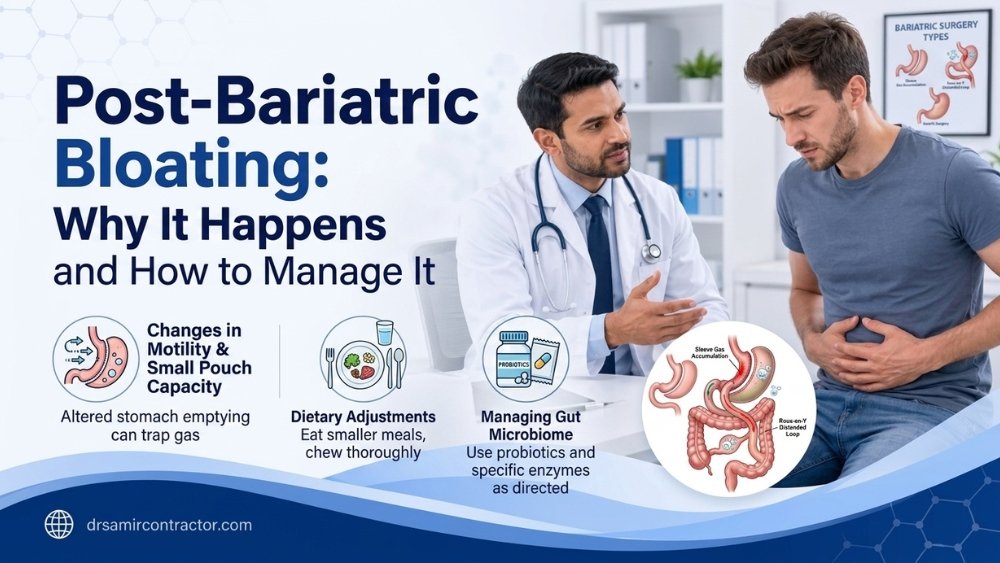
Bloating after bariatric surgery is one of the most common concerns patients bring up during follow-up visits. In most cases, it is a temporary and manageable consequence of altered gut anatomy, dietary changes, and microbiome shifts - but knowing when it signals something more serious is essential for every bariatric patient.
✦ Quick Answers
Why Does Bloating Occur After Bariatric Surgery?
Bariatric surgery is one of the most effective treatments for severe obesity and its metabolic consequences. Whether a patient undergoes sleeve gastrectomy, Roux-en-Y gastric bypass, or mini gastric bypass, the procedure fundamentally changes how the digestive system processes food. This is precisely what makes the surgery work - but it also means the gut must adapt to an entirely new anatomy.
In my practice at Sterling Hospital, Vadodara, where I have performed thousands of bariatric procedures, I tell every patient before surgery: some degree of bloating, gas, and digestive adjustment is expected in the months after the operation. This is not a sign that something has gone wrong. It is part of the normal adaptation process. The critical question is knowing the difference between expected post-surgical adjustment and symptoms that need attention.
Post-bariatric bloating is not a single condition with a single cause. It is a symptom that can arise from multiple mechanisms - some dietary, some anatomical, some bacterial. Understanding these mechanisms is the first step toward effective management.
Causes of Bloating After Bariatric Surgery
The causes of bloating after weight loss surgery can be grouped into several categories. In clinical practice, most patients have more than one contributing factor at the same time.
1. Altered Gastric and Intestinal Anatomy
After sleeve gastrectomy, the stomach is reduced to a narrow tube roughly 15 to 20 percent of its original volume. After gastric bypass, the stomach is divided into a small pouch and the small intestine is rearranged. In both cases, the way food moves through the gut changes fundamentally.
The smaller stomach fills faster. Food empties into the small intestine differently than before. The pyloric valve - which normally controls how quickly food leaves the stomach - is either altered (in sleeve gastrectomy) or bypassed entirely (in gastric bypass). This means food can enter the intestine more rapidly, leading to fermentation, gas production, and a sensation of fullness and pressure that patients describe as bloating.
2. Eating Too Fast and Inadequate Chewing
This is the single most common cause of post-bariatric bloating that I see in follow-up consultations. Before surgery, patients are accustomed to eating normal-sized bites at normal speed. After surgery, the reduced stomach cannot accommodate this volume or pace.
Eating too fast leads to air swallowing (aerophagia), which directly causes upper abdominal bloating and belching. It also means food arrives in the small pouch or sleeve in larger, poorly chewed pieces, which take longer to break down and produce more gas during digestion. Every bariatric patient must re-learn how to eat - smaller bites, thorough chewing (20 to 30 times per bite), and meals that last at least 20 to 30 minutes.
3. Rapid Dietary Progression
After bariatric surgery, patients follow a structured dietary progression - typically from clear liquids to full liquids to pureed foods to soft foods and finally to regular solid foods over 4 to 8 weeks. When patients advance too quickly - introducing solid foods before the gut is ready - the result is poor digestion, fermentation, gas, cramping, and bloating.
I see this particularly when patients feel well and assume they can return to normal eating ahead of schedule. The surgical site is still healing internally, and the gut motility patterns are still adjusting. Following the prescribed timeline is not optional - it is essential for preventing bloating and protecting the surgical repair.
4. Carbonated Beverages and Straws
Carbonated drinks - soda, sparkling water, beer, fizzy drinks of any kind - are strongly discouraged after bariatric surgery. Carbon dioxide gas enters the small stomach pouch or sleeve, causing immediate distension, discomfort, and bloating. In a normal-sized stomach, this gas is absorbed relatively easily. In a surgically reduced stomach, even small amounts of gas can cause significant symptoms.
Drinking through straws has a similar effect - it causes the patient to swallow excess air with each sip. Both habits should be avoided indefinitely after bariatric surgery.
5. Small Intestinal Bacterial Overgrowth (SIBO)
SIBO is a recognized complication after bariatric surgery, particularly after Roux-en-Y gastric bypass and mini gastric bypass. The rearrangement of the small intestine creates a blind loop - a segment of intestine where food no longer passes directly. Bacteria can accumulate in this stagnant segment and overgrow.
These excess bacteria ferment food prematurely, producing hydrogen and methane gas. The result is bloating - often severe - that typically begins within 30 to 60 minutes of eating. SIBO after bariatric surgery can also cause diarrhoea, foul-smelling gas, abdominal cramping, and nutritional deficiencies (particularly vitamin B12 and iron) because the bacteria consume nutrients before the body can absorb them.
SIBO is diagnosed with a hydrogen-methane breath test and treated with targeted antibiotics such as rifaximin. In my experience, SIBO is underdiagnosed in post-bariatric patients because the symptoms are often attributed solely to dietary factors.
6. Unmasked Lactose Intolerance
Many patients discover that they are lactose intolerant only after bariatric surgery. Before surgery, the larger stomach and normal intestinal transit time may have partially compensated for mild lactose malabsorption. After surgery, the reduced stomach volume and faster intestinal transit mean that even small amounts of milk, paneer, or dairy-based protein shakes can trigger significant bloating, gas, and loose stools.
This is especially relevant in Indian patients, where population-level lactose malabsorption affects 60 to 70 percent of adults. I advise all my bariatric patients to monitor their response to dairy carefully and switch to curd, buttermilk (chaas), or lactose-free alternatives if bloating is prominent after dairy consumption.
7. Dumping Syndrome
Dumping syndrome occurs when food - particularly sugary or high-fat food - moves too rapidly from the stomach into the small intestine. It is more common after gastric bypass than after sleeve gastrectomy, though it can occur after either procedure.
Early dumping happens within 15 to 30 minutes of eating and causes bloating, cramping, nausea, diarrhoea, sweating, and a feeling of light-headedness. Late dumping occurs 1 to 3 hours after a meal and is caused by a reactive drop in blood sugar, producing shakiness, weakness, and sweating.
The bloating in dumping syndrome is caused by the rapid influx of undigested food drawing water into the intestinal lumen (osmotic effect) and triggering fermentation. Avoiding concentrated sugars, eating protein first, and separating solids from liquids during meals are the primary management strategies.
| Cause | Mechanism | More Common After |
|---|---|---|
| Eating too fast | Aerophagia + poor mechanical breakdown of food | Both sleeve and bypass |
| Rapid dietary progression | Gut not ready for solid food; fermentation | Both (early postoperative) |
| Carbonated drinks / straws | Direct CO2 introduction into small stomach | Both |
| SIBO | Bacterial overgrowth in blind loop; premature fermentation | Gastric bypass (blind loop) |
| Lactose intolerance (unmasked) | Reduced lactase activity exposed by faster transit | Both; more noticeable after bypass |
| Dumping syndrome | Rapid gastric emptying; osmotic fluid shift into intestine | Gastric bypass > sleeve |
| Constipation | Low fibre + reduced food volume + dehydration | Both (especially early months) |
| Sugar alcohols in supplements | Sorbitol, mannitol in sugar-free products cause fermentation | Both |
8. Constipation After Bariatric Surgery
Constipation is extremely common after bariatric surgery and is a frequently overlooked cause of bloating. Patients eat much less food after surgery, which means less fibre reaching the colon. Combined with reduced fluid intake (many patients struggle to drink enough water in the early months), iron supplements that slow gut motility, and reduced physical activity during recovery, constipation develops in a large number of patients.
When stool sits in the colon for extended periods, bacterial fermentation produces excess gas, and the retained stool itself creates a mechanical feeling of abdominal pressure and fullness. Addressing constipation - with adequate hydration, gradual fibre increase, and stool softeners when needed - often reduces bloating significantly.
9. Sugar Alcohols and Protein Supplements
Many bariatric patients rely on protein shakes, bars, and sugar-free products to meet their protein targets. These products commonly contain sugar alcohols - sorbitol, mannitol, xylitol, and erythritol - which are poorly absorbed in the small intestine and fermented by colonic bacteria, producing gas and bloating.
Whey protein concentrate (as opposed to whey protein isolate) also contains lactose, which can trigger bloating in lactose-intolerant patients. I recommend checking supplement labels carefully and switching to whey protein isolate or plant-based protein if dairy-based supplements cause symptoms.
Red Flags: When Post-Bariatric Bloating Needs Urgent Attention
While most post-bariatric bloating is benign, certain patterns indicate potentially serious surgical complications. Seek urgent evaluation if you experience:
- Sudden severe abdominal pain with bloating - may indicate internal hernia, a serious complication where intestine herniates through a gap created during surgery. This is a surgical emergency.
- Persistent vomiting or inability to keep liquids down - may indicate anastomotic stricture (narrowing at the surgical connection), which can often be treated with endoscopic balloon dilation.
- Fever with abdominal pain and bloating - may indicate anastomotic leak or abscess, particularly in the first 4 to 6 weeks after surgery.
- Progressive bloating that worsens steadily over days - rather than the fluctuating bloating typical of dietary causes
- Complete inability to pass gas or stool - suggests possible intestinal obstruction from internal hernia or adhesions
- Severe pain that comes in waves (colicky) - classic for small bowel obstruction, which can occur due to internal hernia or adhesive bands
- Rapid heart rate, dizziness, or fainting with abdominal pain - may indicate compromised blood supply to the intestine
- Worsening abdominal pain when eating after initially doing well - do not assume it is dietary; internal hernia can present weeks to months after surgery
Important: Internal hernia after gastric bypass can have a normal CT scan in early stages. If your surgeon suspects it clinically, diagnostic laparoscopy may be needed even with a normal scan.
Signs That Your Post-Bariatric Bloating Is Likely Benign
- Bloating is worse after meals and improves between meals or overnight
- It is associated with specific foods (dairy, carbonated drinks, sugar-free products)
- You are within the first 3 to 6 months after surgery and the bloating is gradually improving
- Passing gas relieves the discomfort
- No associated vomiting, fever, or severe pain
- You can identify a dietary trigger or eating habit that worsens it
- Your surgeon has cleared you at your follow-up visits
How Post-Bariatric Bloating Is Diagnosed
When a bariatric patient comes to me with persistent bloating, my approach combines a careful history with targeted investigations based on the type of surgery performed and the timing of symptom onset.
Clinical History
I assess the timing of bloating (immediately after eating, 30 to 60 minutes later, or hours later), its relationship to specific foods, the patient's eating speed and technique, fluid intake, bowel habits, and whether symptoms are improving, stable, or worsening over time. A detailed food diary for one week is often revealing.
Investigations When Indicated
- Blood tests: Complete blood count, iron, vitamin B12, folate, albumin - to check for nutritional deficiencies that may suggest malabsorption or SIBO
- Upper GI endoscopy: Essential if there is vomiting, difficulty swallowing, or suspicion of anastomotic stricture. Also useful to examine the surgical pouch or sleeve directly
- Hydrogen-methane breath test: The standard test for diagnosing SIBO. Non-invasive and highly informative in post-bariatric patients with persistent bloating
- Lactose breath test: To confirm or rule out lactose intolerance as a contributing factor
- CT abdomen with oral contrast: If internal hernia, obstruction, or leak is suspected - though a normal CT does not fully exclude internal hernia
- Ultrasound abdomen: To rule out gallstones, which develop in up to 30 percent of patients after rapid weight loss
- Diagnostic laparoscopy: Reserved for suspected internal hernia when clinical suspicion is high despite normal imaging
Experiencing persistent bloating after bariatric
surgery?
Dr. Samir Contractor provides
comprehensive post-bariatric care at Sterling Hospital, Vadodara.
Managing Bloating After Bariatric Surgery
Treatment depends on the underlying cause, but a structured approach works for the majority of patients. Here is how I guide my bariatric patients through bloating management.
Step 1: Optimise Eating Technique
This alone resolves or significantly improves bloating in a large proportion of patients.
- Take 20 to 30 minutes for each meal - no rushing
- Cut food into small pieces (pencil-eraser size) and chew 20 to 30 times per bite
- Stop eating as soon as you feel the first sensation of fullness - do not push further
- Separate liquids from solids: do not drink during meals. Wait 30 minutes before and after eating
- Avoid talking while chewing - this increases air swallowing
Step 2: Dietary Modifications
| Avoid / Reduce | Replace With |
|---|---|
| Carbonated drinks (soda, sparkling water, beer) | Plain water, nimbu pani, coconut water |
| Milk and paneer (if lactose intolerant) | Curd, chaas, lactose-free milk, soy milk |
| Sugar-free products with sorbitol/mannitol | Products sweetened with stevia or monk fruit |
| Whey protein concentrate | Whey protein isolate or plant-based protein |
| High-fat fried foods | Grilled, steamed, or baked preparations |
| Large meals | 5 to 6 small meals spread throughout the day |
| Raw cabbage, cauliflower, broccoli in excess | Well-cooked vegetables; introduce slowly |
| Chewing gum | Saunf (fennel seeds) after meals |
Step 3: Probiotics and Gut Microbiome Support
Bariatric surgery causes a significant shift in the composition of gut bacteria. Research shows that the microbiome after surgery is markedly different from the pre-surgical state, and this transition contributes to bloating and gas in the early months.
I recommend a multi-strain probiotic containing Lactobacillus and Bifidobacterium species for most of my bariatric patients. Probiotics help restore microbial balance, reduce gas production, and improve overall gut comfort. Naturally fermented foods - curd, kanji, and homemade buttermilk - also support gut health.
Step 4: Enzyme Supplements
Specific enzyme supplements can help when a clear trigger is identified:
- Lactase enzyme: Taken before consuming dairy products if lactose intolerance is confirmed or suspected
- Alpha-galactosidase: Helps digest oligosaccharides in legumes (dal, rajma, chole) that produce gas
- Pancreatic enzymes: Occasionally needed after gastric bypass if there is evidence of fat malabsorption (oily, foul-smelling stools)
Step 5: Treating Specific Causes
- SIBO: Targeted antibiotics (rifaximin is the most studied) followed by probiotics to prevent recurrence. SIBO can recur after bariatric surgery, and some patients need periodic retreatment
- Dumping syndrome: Dietary management - avoid concentrated sugars, eat protein first, separate solids from liquids. In resistant cases, acarbose may be prescribed for late dumping
- Constipation: Adequate hydration (minimum 1.5 to 2 litres of fluid daily), gradual fibre increase, stool softeners, and osmotic laxatives when needed
- Stricture: Endoscopic balloon dilation under sedation - a day-care procedure that usually provides immediate relief
- Internal hernia: Surgical repair via laparoscopy - this is urgent and should not be delayed
- Gallstones: Laparoscopic cholecystectomy if gallstones are causing symptoms. Some surgeons perform prophylactic cholecystectomy at the time of bariatric surgery
Bloating After Sleeve Gastrectomy vs. Gastric Bypass: Key Differences
While the general causes of bloating overlap between procedures, there are important distinctions.
| Feature | Sleeve Gastrectomy | Gastric Bypass (Roux-en-Y) |
|---|---|---|
| Dumping syndrome | Less common; can still occur | More common due to bypassed pylorus |
| SIBO risk | Lower (no blind loop) | Higher (blind limb creates stagnation) |
| Internal hernia risk | Very rare | Recognized complication (Petersen's space, jejunojejunostomy mesentery) |
| Stricture risk | At the incisura (mid-sleeve narrowing) | At the gastrojejunal anastomosis |
| Lactose intolerance presentation | Noticeable; manageable | Often more pronounced due to malabsorption |
| Fat malabsorption | Not typical | Can occur; produces foul-smelling gas and bloating |
| Typical bloating timeline | Peaks at 1-3 months; improves by 6 months | Similar; SIBO may cause later-onset bloating |
Long-Term Outlook: Does Post-Bariatric Bloating Go Away?
For the large majority of patients, yes. Bloating after bariatric surgery is most intense in the first two to three months and progressively improves as the gut adapts, eating habits are refined, and the microbiome stabilises. By six months after surgery, most patients report that bloating is either resolved or reduced to a very manageable level.
A small number of patients - particularly those with SIBO or those who do not follow dietary guidelines consistently - may have persistent symptoms that require ongoing management. The key is not to accept persistent bloating as inevitable. It almost always has an identifiable and treatable cause.
In my practice, I emphasise that bariatric surgery is not just an operation - it is the beginning of a long-term relationship between the patient and the surgical team. Regular follow-up visits at 1 month, 3 months, 6 months, 1 year, and then annually allow us to catch and address issues like bloating, nutritional deficiencies, and weight regain early.
Post-Bariatric Bloating: The Indian Patient Context
India has seen a significant rise in bariatric surgery over the past decade, driven by increasing awareness of obesity as a medical condition and the growing burden of type 2 diabetes and metabolic syndrome. With this rise comes a growing population of post-bariatric patients navigating digestive adjustments.
Several factors make post-bariatric bloating particularly relevant in the Indian context:
- High baseline prevalence of lactose intolerance: With 60 to 70 percent of Indian adults having some degree of lactose malabsorption, dairy-related bloating after surgery is extremely common. Patients who previously tolerated milk may find that surgery tips them into symptomatic intolerance.
- Traditional Indian diet rich in fermentable carbohydrates: Staples like dal, rajma, chole, and wheat-based rotis contain oligosaccharides and fibre that produce gas during digestion. Post-bariatric patients need guidance on which dals and preparations are better tolerated (moong dal is generally gentler than urad or chana dal).
- Cultural emphasis on large, communal meals: Gujarati thali culture, festival eating, and social pressure to eat more can conflict with the small-portion, slow-eating requirements after bariatric surgery. Family education is an important part of post-surgical care.
- Reliance on home remedies: Hing water, jeera water, and saunf are commonly used for gas relief in Indian households. While these carminatives can help with mild symptoms, they do not address underlying causes like SIBO or stricture. Patients should not delay medical evaluation if symptoms persist.
- Protein supplementation challenges: Many Indian patients are vegetarian and rely on whey protein or soy protein supplements. Checking for lactose content in supplements and ensuring adequate protein intake without excessive gas-producing ingredients requires careful planning with a bariatric dietitian.
તમારી ભાષામાં સવાલો · Questions in Gujarati / Hinglish
Surgery pachhi pet no size nano thai gay chhe, ane gut ni anatomy badlai gai chhe. Jaldi khavanu, carbonated drinks pivanu, dairy products, ane SIBO - aa badha karanonu combination bloating kare chhe. Majority ma aa temporary chhe ane 3-6 mahina ma sudharai jay chhe. Jyo vadhu laambu chale to doctor ne batavo.
Sleeve pachhi ghanu khareh lactose intolerance vadhare noticeable thai jay chhe. Dudh ni jagya ae dahi, chaas, ke lactose-free milk try karo. Protein shake ma pan whey isolate vapro - concentrate ma lactose hoy chhe. Jyo dairy aapvathi gas ochhu thay to cause clear chhe.
Haa, sabauthi common karan aa j chhe. Surgery pachhi nanu pet chhe - jaldi khavathi hava gale chhe ane khavanu barabar digest nathi thatu. Dareki bite 20-30 vaar chavjo. Ek meal ma minimum 20-30 minute lakho. Aa ek change j ghanu bloating ghataadi shake chhe.
Aa dumping syndrome chhe. Bypass pachhi meethu ke oily khavanu stomach mathi sidhu nani aanatadi ma jaay chhe - jethithi cramp, bloating, nausea, ane kabhi kabhi loose motion thay chhe. Meethu ochhu karo, pehla protein khao, ane jaman sathe paani na piyo. Majority cases ma dietary changes thi control thai jay chhe.
Possible chhe, khas karine gastric bypass pachhi. SIBO ma khavanu khaidhiya pachhithi 30-60 minute ma bahuj gas ane bloating thay chhe, ane kabhi kabhi loose motion ane badbu vaadhe chhe. Breath test thi diagnose thai chhe ane antibiotics thi treat thai chhe. Doctor ne consultation lo.
Haa, gastric bypass pachhi internal hernia ek serious complication chhe. Jyo pet ma achanak tivra dard aave, ulfat band na thay, gas na niklai, ke tav aave - to turant hospital jao. Aa emergency chhe. CT scan normal hoi shake chhe pan toi surgeon nu clinical judgment important chhe. Wait na karo.
Frequently Asked Questions
Related Pages
Book your consultation with Dr. Samir
Contractor
Sterling Hospital, Vadodara -
Comprehensive Bariatric & Post-Bariatric Care