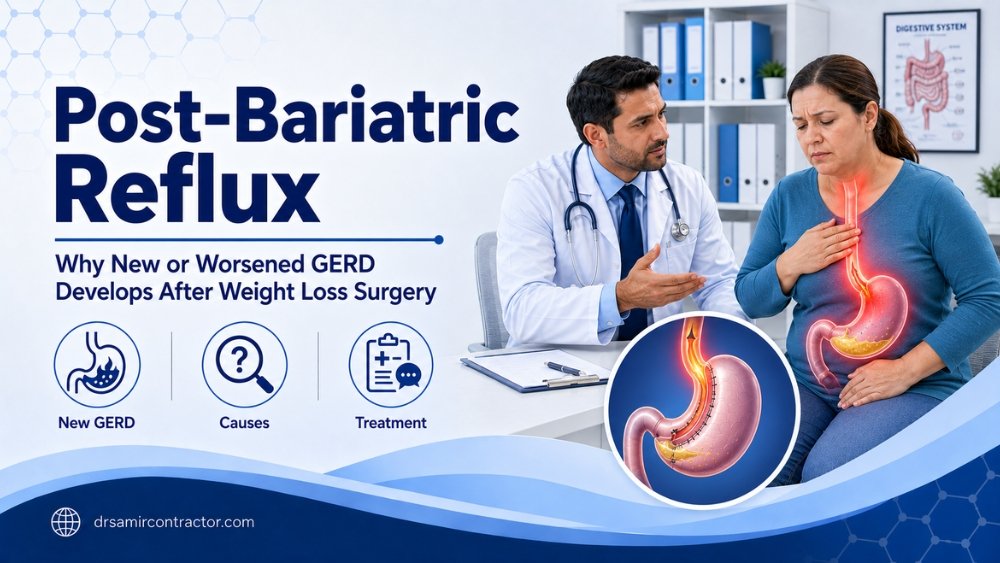
In plain language: Post-bariatric reflux is acid reflux that appears for the first time - or gets significantly worse - after weight loss surgery. It is most common after sleeve gastrectomy, where 20-30% of patients develop new heartburn, acid regurgitation, or chest discomfort they never had before. This page explains why it happens, how it differs from the reflux that existed before surgery, what treatments are available (from PPIs and dietary changes to conversion surgery), and when you should contact your bariatric surgeon.
✦ Quick Answers: Post-Bariatric Reflux
What Is Post-Bariatric Reflux?
Post-bariatric reflux refers to gastro-oesophageal reflux disease (GERD) that develops for the first time or becomes significantly worse specifically after bariatric (weight loss) surgery. While bariatric surgery is one of the most effective treatments for obesity and many of its complications, certain procedures - most notably sleeve gastrectomy - can create new reflux problems that the patient never experienced before their operation.
In my practice at Sterling Hospital, Vadodara, I evaluate patients who present with new or worsened acid reflux after bariatric surgery on a regular basis. Some arrive confused because they expected surgery to fix their digestive problems, not create new ones. Others had a successful sleeve gastrectomy for weight loss but now struggle with daily heartburn that medications barely control. Understanding why this happens, and knowing that effective treatments exist, is the first step toward resolution.
This page is specifically about reflux that develops or worsens after bariatric surgery. It is different from reflux caused by obesity itself (a pre-existing problem driven by excess weight) and from GERD as a chronic disease in obese patients (a broader condition page). If you had a bariatric procedure and are now experiencing acid reflux symptoms that are new or worse than before, this page is written for you.
Which Bariatric Procedures Cause Reflux?
Not all bariatric surgeries carry the same reflux risk. The two most commonly performed procedures - sleeve gastrectomy and Roux-en-Y gastric bypass - have opposite effects on acid reflux.
Sleeve Gastrectomy: The Main Offender
Sleeve gastrectomy (also called vertical sleeve gastrectomy or laparoscopic sleeve gastrectomy) involves removing approximately 75-80% of the stomach, leaving a narrow, banana-shaped tube. While this produces excellent weight loss results, it is the bariatric procedure most strongly associated with new-onset reflux. Published data consistently show that de novo GERD develops in 20-30% of patients after sleeve gastrectomy, and patients with mild pre-existing reflux may see their symptoms increase substantially.
Roux-en-Y Gastric Bypass: The Anti-Reflux Procedure
Gastric bypass works in the opposite direction. By creating a small gastric pouch (approximately 30 ml) separated from the acid-producing stomach, and by routing food through a Roux limb that diverts bile and pancreatic secretions away from the oesophagus, bypass both reduces acid exposure and eliminates bile reflux. GERD resolves in 80-90% of gastric bypass patients, and new-onset reflux occurs in fewer than 5%. This is why gastric bypass is the preferred primary operation for obese patients who already have significant GERD, and why it is the most common conversion procedure when post-sleeve reflux proves refractory.
Why Sleeve Gastrectomy Causes New Reflux: Four Key Mechanisms
The reflux that follows sleeve gastrectomy is not a random complication. It results from specific anatomical and physiological changes created by the operation. Understanding these mechanisms helps explain why certain patients are at higher risk and why targeted treatments work.
1. Increased Intragastric Pressure
The normal stomach is a compliant, expandable organ. The sleeve converts it into a rigid, narrow tube with dramatically reduced volume and compliance. When food or liquid enters this tube, the pressure inside rises much higher than in a normal stomach. This elevated intragastric pressure pushes gastric contents - including acid - upward toward the lower oesophageal sphincter (LOS). If the sphincter cannot withstand this pressure, reflux occurs. Studies using high-resolution manometry have confirmed that intragastric pressure in a sleeve is significantly higher than in the pre-operative stomach or in a gastric bypass pouch.
2. Disruption of the Angle of His
The angle of His is the acute angle formed where the oesophagus meets the stomach on its left side. This angle functions as a natural one-way valve: when intra-abdominal pressure rises, the angle tightens and prevents reflux. During sleeve gastrectomy, the fundus (upper part) of the stomach is removed, which alters or eliminates this protective angle. Without this natural valve mechanism, the barrier against reflux is weakened, and acid can move upward more freely.
3. Hiatal Hernia: Missed or Newly Developed
Hiatal hernia - a condition where the upper stomach slides through the diaphragm into the chest - is present in a significant proportion of obese patients undergoing bariatric surgery. If a hiatal hernia is not identified and repaired during the initial sleeve gastrectomy, it becomes a persistent source of reflux. Additionally, the chronic increase in intragastric pressure within the sleeve can promote new hiatal hernia formation over time. Studies report that hiatal hernia is present in 30-40% of patients with post-sleeve reflux, many of whom had no documented hernia before surgery.
4. Altered Gastric Emptying Patterns
The sleeve changes how quickly food exits the stomach. If the lower portion of the sleeve (near the pylorus) is relatively tight, food pools in the sleeve and raises pressure further, worsening reflux. Conversely, if the sleeve empties too rapidly into the small intestine, the resulting negative pressure can also trigger transient LOS relaxations. Both patterns have been documented in patients with post-bariatric reflux, and the exact effect depends on the surgical technique and the individual patient’s anatomy.
Reflux Outcomes: Sleeve Gastrectomy vs. Gastric Bypass
| Outcome Measure | Sleeve Gastrectomy | Roux-en-Y Gastric Bypass |
|---|---|---|
| De novo GERD rate | 20-30% | < 5% |
| Pre-existing GERD resolution | ~50% improve, ~25% worsen | 80-90% resolution |
| Long-term PPI dependence | 20-35% require ongoing PPIs | < 10% require ongoing PPIs |
| Erosive oesophagitis on follow-up endoscopy | Reported in 15-35% at 3-5 years | Reported in < 5% at 3-5 years |
| Barrett’s oesophagus risk | Emerging concern (2-5% in long-term data) | Very low; may cause regression of existing Barrett’s |
| Need for revisional/conversion surgery | 5-10% require conversion to bypass for reflux | Rarely needed for reflux |
| Patient-reported quality of life (reflux-related) | Variable; worse in patients with de novo GERD | Consistently improved |
Symptoms of Post-Bariatric Reflux
Reflux after bariatric surgery presents with many of the same symptoms as standard GERD, but the timing is the critical distinguishing feature. Symptoms begin weeks to months after the bariatric procedure and may progressively worsen over the first one to two years. Common presentations include:
- New heartburn: A burning sensation behind the breastbone that was not present before surgery. Often worse after meals and at night.
- Acid regurgitation: Sour or bitter fluid rising into the throat. This is frequently the most distressing symptom and can disrupt sleep.
- Nocturnal cough or choking: Acid reaching the upper airways during sleep causes coughing spells, throat clearing, or waking with a choking sensation.
- Hoarseness and sore throat: Laryngopharyngeal reflux (acid reaching the voice box) causes a raspy voice, especially in the morning.
- Chest discomfort: A pressure or burning feeling in the chest that patients may initially mistake for a cardiac problem.
- Nausea: Particularly after eating, and sometimes accompanied by a bitter taste.
- Difficulty swallowing: If reflux causes oesophageal inflammation or narrowing over time, patients may notice food getting stuck or a sensation of tightness when swallowing.
Red Flags - Contact Your Bariatric Surgeon Urgently
Certain symptoms after bariatric surgery require prompt evaluation, as they may indicate serious complications:
- Vomiting blood (haematemesis) or passing black, tarry stools (melaena) - suggests bleeding from oesophageal erosions or ulceration
- Progressive difficulty swallowing that worsens over days or weeks - may indicate stricture formation
- Severe, constant chest or upper abdominal pain that does not respond to PPIs - requires ruling out staple-line issues or other surgical complications
- Unintended further weight loss beyond your target, combined with reflux - warrants endoscopic evaluation
- Persistent vomiting that prevents you from keeping down food or medications
- New reflux symptoms developing more than 2 years after bypass surgery - unusual and requires investigation for anatomical problems
Reassuring Signs
- Mild heartburn in the first 3-6 months after sleeve that responds well to a PPI
- Symptoms improve with dietary adjustments (smaller meals, avoiding late eating)
- No difficulty swallowing, no blood in stool or vomit
- Reflux is manageable with once-daily medication and does not disrupt sleep
- Follow-up endoscopy shows no erosive oesophagitis or Barrett’s changes
- Symptoms gradually improve as weight stabilises in the first year
Diagnosis: Evaluating Reflux After Bariatric Surgery
When a patient reports new or worsened reflux after bariatric surgery, a structured diagnostic workup is essential. This is not the same as evaluating reflux in someone who has not had surgery, because the altered anatomy changes both the likely causes and the appropriate investigations.
- Upper GI endoscopy (OGD): The most important first test. It allows direct visualisation of the oesophagus, the gastric sleeve or bypass pouch, and the staple line. It can identify oesophagitis, hiatal hernia, staple-line problems, and Barrett’s oesophagus.
- 24-hour pH monitoring (with or without impedance): Measures actual acid exposure in the oesophagus over a full day and night. This is the gold standard for confirming that reflux is occurring and for quantifying its severity.
- Barium swallow study: A contrast X-ray that shows the shape of the sleeve, the presence of a hiatal hernia, and whether reflux is visible during the study. It is particularly useful for assessing sleeve anatomy and any twisting or narrowing.
- High-resolution oesophageal manometry: Measures the pressure and function of the LOS and the oesophageal body. Important when considering conversion surgery, as it helps assess the motility of the food pipe.
Treatment of Post-Bariatric Reflux
Treatment follows a stepwise approach, beginning with conservative measures and progressing to surgical revision only when necessary.
Step 1: Proton Pump Inhibitor (PPI) Therapy
PPIs remain the first-line treatment for acid reflux after bariatric surgery, just as they are for standard GERD. Pantoprazole 40 mg or esomeprazole 40 mg once daily (taken 30 minutes before breakfast) is the typical starting dose. If symptoms are not adequately controlled, the dose may be increased to twice daily. Most patients with mild post-sleeve reflux respond well to PPIs, and some can eventually taper off the medication as their anatomy stabilises.
Step 2: Dietary and Lifestyle Modifications
These modifications are essential and should be followed alongside PPI therapy:
- Eat small, frequent meals rather than large portions - this reduces intragastric pressure in the sleeve
- Do not eat within 3 hours of bedtime
- Elevate the head of the bed by 15-20 cm using a wedge pillow or bed blocks
- Avoid known reflux triggers: fatty foods, spicy preparations, citrus, caffeine, carbonated beverages, and alcohol
- Chew food thoroughly and eat slowly to reduce air swallowing
- Avoid tight clothing around the waist, which increases abdominal pressure
- If vomiting after bariatric surgery accompanies your reflux, report this to your surgeon - it may indicate a mechanical problem
Step 3: Hiatal Hernia Repair
If a hiatal hernia is identified on endoscopy or barium swallow, laparoscopic repair of the hernia can significantly improve reflux. In some cases, this can be performed as a standalone procedure without converting the sleeve to a bypass. Hernia repair is especially effective when the hernia is the primary driver of reflux and the sleeve anatomy is otherwise acceptable.
Developed Reflux After Your Bariatric Surgery?
Dr Samir Contractor provides thorough evaluation and individualised treatment plans for post-bariatric reflux, including conversion surgery when needed. Book a consultation at Sterling Hospital, Vadodara.
Step 4: Conversion Surgery - Sleeve to Roux-en-Y Gastric Bypass
When post-sleeve reflux does not respond to PPIs and lifestyle changes after 6-12 months of adequate treatment, or when endoscopy reveals progressive oesophagitis or Barrett’s changes, conversion from sleeve gastrectomy to Roux-en-Y gastric bypass is the most effective intervention. This is sometimes called reflux conversion surgery.
During conversion, the existing sleeve is disconnected from the oesophagus, a small pouch is created, and a Roux limb (a loop of small intestine) is connected to this pouch. This new configuration achieves three goals simultaneously:
- The tiny pouch produces far less acid than the sleeve
- The Roux limb prevents bile from reaching the oesophagus
- The high intragastric pressure of the sleeve is eliminated
Conversion surgery resolves reflux in over 85% of patients. It also frequently provides additional weight loss in patients who had incomplete weight loss or weight regain after their sleeve. The operation is performed laparoscopically and typically requires 2-3 days of hospital stay, with most patients returning to normal activities within 2-3 weeks.
In my experience, patients who undergo conversion for intractable post-sleeve reflux report dramatic improvement in quality of life. Many describe it as finally being free of the constant burning and regurgitation that PPIs could only partially control.
Step 5: Endoscopic Interventions (Selected Cases)
For patients who are not candidates for or prefer to avoid revision surgery, endoscopic anti-reflux procedures are an emerging option. These include transoral incisionless fundoplication (TIF) and endoscopic sleeve gastroplasty revision. While these techniques show promise, long-term data in the post-bariatric population remain limited, and conversion to bypass remains the gold standard for refractory cases.
Heartburn After Gastric Bypass: A Different Problem
While reflux after sleeve gastrectomy is well-recognised, heartburn after gastric bypass is uncommon and usually indicates a specific problem when it does occur. Possible causes of reflux symptoms after gastric bypass include:
- Marginal ulcer: An ulcer at the junction between the gastric pouch and the small intestine. This causes burning pain and can mimic reflux.
- Bile reflux into the pouch: Rare, and typically related to technical aspects of the surgical construction.
- Pouch dilation: Over years, the gastric pouch may enlarge, allowing more acid production and reflux.
- Candy cane Roux limb: A blind loop of bowel that can accumulate food and secretions, causing symptoms.
Any new reflux symptoms developing after gastric bypass should be investigated with endoscopy to identify the specific cause and guide appropriate treatment.
Long-Term Monitoring After Post-Bariatric Reflux
Patients with post-bariatric reflux - whether managed with PPIs or after conversion surgery - require ongoing surveillance. Recommended follow-up includes:
- Annual or biannual review with your bariatric surgeon
- Upper GI endoscopy every 2-3 years for patients on long-term PPIs after sleeve, to screen for Barrett’s oesophagus
- Nutritional monitoring, as both PPIs and bariatric anatomy can impair absorption of calcium, iron, vitamin B12, and magnesium
- Assessment of weight trajectory, since reflux can affect eating patterns and nutritional intake
- Quality-of-life evaluation, because persistent reflux significantly affects sleep, eating habits, and daily comfort
Post-Bariatric Reflux in the Indian Context
India has seen a rapid increase in bariatric surgery volumes over the past decade, driven by rising obesity rates and growing awareness of surgical weight loss options. Sleeve gastrectomy has become the most commonly performed bariatric procedure in India, accounting for an estimated 60-70% of all bariatric operations nationally. This means that post-bariatric reflux is an increasingly common clinical problem across the country.
Why Post-Sleeve Reflux Is Particularly Relevant in India
- Sleeve dominance: The popularity of sleeve gastrectomy in India - driven partly by its shorter operative time, perceived simplicity, and lower cost compared to bypass - means a larger proportion of Indian bariatric patients are exposed to sleeve-related reflux risk.
- Dietary factors: Indian dietary habits can compound post-sleeve reflux. Spicy foods, heavy use of oil and ghee, fried snacks (farsan, pakoda, samosa), and late-night dinners all aggravate acid production and reflux in a stomach that is already high-pressure after sleeve surgery.
- Late-night eating culture: Many Indian families eat dinner at 9-10 PM and sleep by 10:30-11 PM. This short gap between the last meal and lying down is one of the strongest triggers for nocturnal reflux, especially in a sleeve.
- Milky chai and coffee: Consuming 3-4 cups of full-fat milk tea daily provides repeated acid-stimulating triggers that worsen reflux in the post-sleeve patient.
- Follow-up gaps: In some parts of India, patients may not maintain regular follow-up after bariatric surgery, which means post-operative reflux goes undiagnosed and untreated for months or years, increasing the risk of complications.
Practical Advice for Indian Patients After Sleeve Gastrectomy
- Aim for dinner before 8 PM, and remain upright for at least 2-3 hours before sleeping
- Reduce oil, ghee, and fried foods - shift to grilling, baking, and air-frying
- Choose roasted snacks (khakhra, roasted chana, makhana) over fried alternatives
- Limit milky chai to one cup daily; switch to green tea or black tea for additional cups
- Do not skip follow-up appointments with your bariatric surgeon - early detection of reflux prevents complications
- If you develop new heartburn after your sleeve, do not ignore it or self-medicate indefinitely - get a proper evaluation
Frequently Asked Questions: Post-Bariatric Reflux
ગુજરાતી પ્રશ્નો (Gujarati FAQs)
સ્લીવ સર્જરી લીધેલા 20-30% દર્દીઓમાં નવી એસિડિટી થાય છે, જેમાં પેટ દબાઈ જાય છે અને એસિડ ઉપર ધકેલાય છે. શરૂઆતના 3-6 મહિનામાં આ સામાન્ય છે.
હા, ઘણા દર્દીઓમાં PPI દવા, ખોરાકમાં ફેરફાર અને જીવનશેલીમાં બદલાવથી સુધારો થાય છે. જો દવા કામ ન કરે તો ગેસ્ટ્રિક બાયપાસમાં કન્વર્શન સર્જરી કરી શકાય છે.
કન્વર્ઝન સર્જરીમાં સ્લીવમાંથી ગેસ્ટ્રિક બાયપાસમાં બદલવામાં આવે છે. આ પ્રોસેસથી 85% થી વધુ દર્દીઓમાં રિફ્લક્સ મટી જાય છે.
જરૂરી નથી, પણ જો તમને વધુ પડતો ખાટો ઓડકાર, છાતીમાં બળતરા, અને શ્વાસ લેવામાં તકલીફ થતી હોય તો 3 મહિના પછી ડોક્ટરની સલાહ લેવી.
સ્ટર્લિંગ હોસ્પિટલ, વડોદરાના ડો. સમીરને +91-98245 93464 પર ફોન કરો. WhatsApp પર પણ સંપર્ક કરી શકો છો.