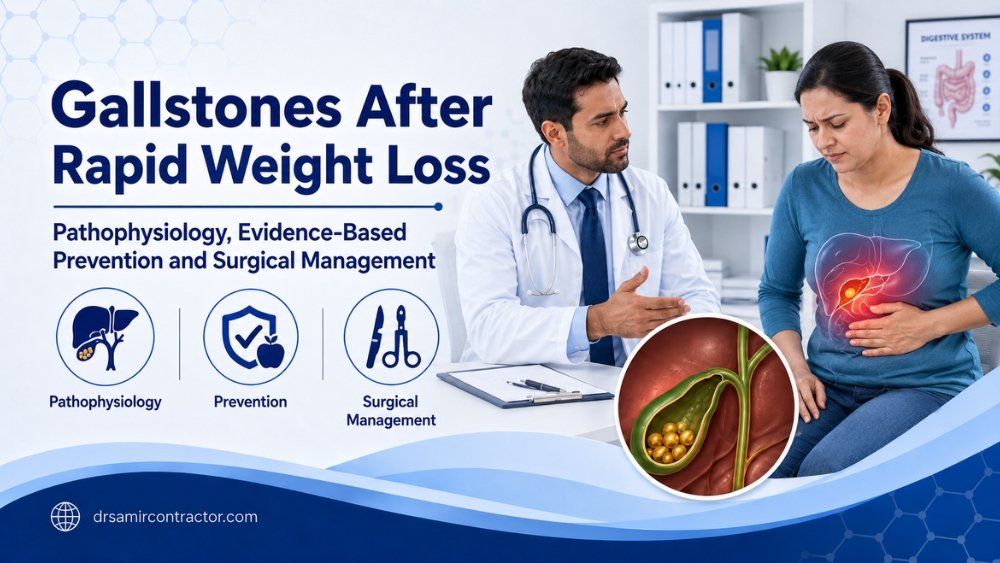
Rapid weight loss - whether from bariatric surgery, very low calorie diets, or GLP-1 agonist therapy - triggers a well-characterised pathophysiological cascade of cholesterol supersaturation, gallbladder hypomotility, and accelerated nucleation that produces gallstones in 20-40% of patients within 12-18 months. This disease page provides clinical depth on the underlying mechanisms, the robust evidence for ursodiol prophylaxis (600 mg/day for 6 months, NNT 3-4), the management algorithm for symptomatic versus asymptomatic post-bariatric gallstones, and the indications for concurrent cholecystectomy during bariatric surgery. For patient-facing symptom information, see Gallstones After Weight Loss (Symptom Page).
✦ Clinical Quick Reference
⚖ Disease Definition and Clinical Context
Post-rapid-weight-loss cholelithiasis refers to the formation of cholesterol-predominant gallstones as a direct consequence of accelerated fat mobilisation during rapid weight reduction. It is a distinct clinical entity within the broader category of cholelithiasis because the causative mechanism, patient population, timing, and prevention strategy differ meaningfully from typical gallstone disease.
Obesity itself is one of the strongest risk factors for gallstone formation - obese individuals carry a 2-3 fold increased risk due to chronically elevated hepatic cholesterol secretion. The clinical paradox is that the treatment of obesity (weight loss) transiently amplifies the same lithogenic pathway before ultimately reducing it. During active rapid weight loss, the rate of new gallstone formation exceeds that seen in stable obesity, making the first 6-18 months a period of heightened vulnerability.
This disease page exists as a companion to the patient-facing symptom page, providing the pathophysiological depth, evidence grading, and management protocols needed for informed clinical decision-making. The content reflects current bariatric surgical guidelines and Dr Samir Contractor's clinical experience managing post-bariatric gallstone disease at Sterling Hospital, Vadodara.
Pathophysiology: The Lithogenic Triad
Three converging mechanisms drive gallstone formation during rapid weight loss. Each is necessary but insufficient alone - it is their simultaneous occurrence that produces the high incidence observed clinically.
Mechanism 1: Cholesterol Supersaturation of Bile
- Accelerated adipose tissue lipolysis releases large quantities of free fatty acids into the portal circulation. The liver takes up these fatty acids and converts a significant proportion to cholesterol.
- Hepatic cholesterol hypersecretion into bile follows. The rate of biliary cholesterol output increases disproportionately to bile salt and phospholipid secretion, raising the cholesterol saturation index (CSI) above 1.0 - the physicochemical threshold for cholesterol precipitation.
- Supersaturation is dose-dependent: the faster the weight loss, the greater the lipolytic flux, and the higher the CSI. Studies show CSI values of 1.2-1.8 in patients losing >1.5 kg/week, compared to 0.8-1.0 in gradual weight loss (<0.5 kg/week).
- Bile salt pool depletion compounds the problem in RYGB patients, where the malabsorptive limb reduces enterohepatic bile salt recirculation, further diminishing the cholesterol-solubilising capacity of bile.
Mechanism 2: Gallbladder Hypomotility
- Reduced caloric intake - particularly fat intake - means fewer meals that trigger cholecystokinin (CCK) release from duodenal I-cells. CCK is the primary hormonal stimulus for gallbladder contraction.
- Incomplete gallbladder emptying results, with residual bile volumes increasing from a normal post-prandial residual of 10-20% to 40-60% in severely calorie-restricted patients.
- Prolonged bile stasis allows the supersaturated bile to remain in contact with the gallbladder mucosa for extended periods, providing the time needed for cholesterol crystal nucleation and growth.
- Hormonal factors: In RYGB patients, altered gut hormone profiles (reduced ghrelin, altered GLP-1 and PYY levels) may independently suppress gallbladder contractility. GLP-1 receptors on gallbladder smooth muscle, when activated by high endogenous or exogenous GLP-1 levels, directly reduce contraction amplitude.
Mechanism 3: Accelerated Nucleation
- Mucin hypersecretion by the gallbladder epithelium is stimulated by the chemical irritation of supersaturated, stagnant bile. Mucin glycoprotein forms a gel layer on the inner gallbladder surface.
- Mucin acts as a nucleation scaffold - cholesterol monohydrate crystals adhere to the mucin matrix, creating a nidus for further crystal aggregation. Without this scaffold, cholesterol crystals might remain as dispersed microcrystals or sludge.
- Calcium salts (calcium carbonate, calcium bilirubinate, calcium phosphate) co-precipitate with cholesterol crystals, cementing the growing stone and converting soft sludge into hard, clinically significant calculi.
- Pronucleating proteins in bile (immunoglobulins, aminopeptidase N, phospholipase C) are present in higher concentrations during rapid weight loss, further accelerating the crystallisation process.
Incidence and Risk Stratification
| Weight Loss Modality | Gallstone Incidence (No Prophylaxis) | Peak Onset Window | Dominant Mechanisms |
|---|---|---|---|
| Roux-en-Y Gastric Bypass | 30-40% | 6-18 months | All three mechanisms: maximal lipolytic rate + bile salt pool depletion (malabsorptive limb) + severe caloric restriction |
| Sleeve Gastrectomy | 20-30% | 6-18 months | Mechanisms 1 and 2 dominant. No bile salt depletion (no malabsorptive component). Altered ghrelin may reduce GB motility. |
| VLCD (<800 kcal/day) | 25-35% | 4-16 weeks | Mechanism 2 dominant (extreme fat restriction). Rapid onset due to near-complete gallbladder stasis. |
| GLP-1 Receptor Agonists | 1.5-5% (emerging) | 6-12 months | Moderate Mechanism 1 (slower weight loss rate). Mechanism 2 via direct GLP-1 receptor-mediated gallbladder inhibition. |
| Conventional diet (>1200 kcal) | <5% | Variable | Minimal supersaturation. Adequate dietary fat maintains gallbladder emptying. Lowest risk. |
Additional risk factors that compound weight-loss lithogenesis
- Female sex - Oestrogen increases hepatic cholesterol secretion and progesterone reduces gallbladder contractility. Post-bariatric gallstone rates are approximately 1.5x higher in women than men.
- Pre-existing biliary sludge - Sludge identified on pre-operative ultrasound indicates an already-primed lithogenic environment. These patients have the highest conversion rates to symptomatic gallstones.
- Family history of gallstones - Genetic polymorphisms in ABCG5/ABCG8 (cholesterol transporters) and LITH genes amplify biliary cholesterol secretion.
- Rapid initial weight loss velocity - Patients losing >1.5 kg/week in the first 3 months have the highest stone formation rates, regardless of the weight loss method.
- High baseline BMI - Patients with BMI >50 who undergo bariatric surgery have higher biliary cholesterol loads due to larger adipose tissue stores undergoing mobilisation.
Evidence-Based Prevention: Ursodiol Prophylaxis Protocol
Ursodiol (ursodeoxycholic acid, UDCA) is a hydrophilic bile acid that reduces biliary cholesterol saturation, inhibits cholesterol monohydrate crystal nucleation, and promotes cholesterol-phospholipid vesicle stabilisation. It is the single most effective intervention for preventing post-bariatric gallstones and carries the strongest evidence base in this clinical setting.
Randomised controlled trial evidence
| Study Context | Control Arm (No UDCA) | UDCA 600 mg/day Arm | Relative Risk Reduction | NNT |
|---|---|---|---|---|
| Post-RYGB, 12 months | 32-38% gallstones | 2-8% gallstones | ~85% | 3-4 |
| Post-sleeve gastrectomy, 12 months | 22-28% gallstones | 3-7% gallstones | ~78% | 4-5 |
| VLCD programmes, 16 weeks | 25-35% sludge/stones | 3-6% sludge/stones | ~85% | 3-4 |
| UDCA 300 mg/day (lower dose) | 32-38% | 8-15% | ~60-65% | 5-6 |
The 600 mg/day dose consistently outperforms 300 mg/day, with a dose-response relationship demonstrated across multiple trials. The 300 mg/day dose is reasonable in lower-risk patients (sleeve gastrectomy, moderate weight loss rate) but the 600 mg/day dose is preferred for RYGB, super-obese patients, and those with pre-existing sludge.
Dr Samir Contractor's ursodiol protocol at Sterling Hospital
- Dose: 300 mg twice daily (total 600 mg/day) for all bariatric surgery patients
- Start: Day 1 post-operatively, once oral intake is established
- Duration: 6 months (covers the period of maximum weight loss velocity)
- Monitoring: Ultrasound at 6 months and 12 months post-operatively. Interim ultrasound for any new biliary symptoms.
- Extension: In patients with ongoing rapid weight loss beyond 6 months, or those who develop biliary sludge on the 6-month ultrasound, ursodiol is continued for up to 12 months.
- Cost: Rs 3,000-5,000 for a 6-month course - a fraction of the cost of treating a single gallstone complication.
Need a Post-Bariatric Gallstone Prevention Protocol?
Dr Samir Contractor provides comprehensive bariatric follow-up including ursodiol prophylaxis, ultrasound surveillance, and staged cholecystectomy when indicated.
Management Algorithm: Symptomatic vs Asymptomatic Post-Bariatric Gallstones
The clinical management of gallstones discovered after rapid weight loss follows a structured decision pathway based on symptom status, stone characteristics, and the patient's bariatric surgical history.
Pathway 1: Asymptomatic gallstones (incidental finding on surveillance ultrasound)
- Continue or initiate ursodiol if within the high-risk window (first 12-18 months post-bariatric surgery).
- Surveillance ultrasound every 6 months for 2 years.
- Ensure adequate dietary fat intake (7-10 g per meal minimum) to maintain gallbladder contractility.
- Cholecystectomy is not indicated for asymptomatic stones in most patients. The majority of asymptomatic stones discovered on surveillance remain asymptomatic indefinitely.
- Exception: Consider elective cholecystectomy for asymptomatic stones in patients with a porcelain gallbladder, stones >3 cm, or gallbladder polyps >1 cm (gallbladder cancer risk factors, particularly relevant in the Indian population).
Pathway 2: Symptomatic gallstones (biliary colic or complications)
- Uncomplicated biliary colic: Laparoscopic cholecystectomy. Timing depends on symptom frequency and severity. Elective surgery within 4-6 weeks of first episode is standard.
- Acute cholecystitis: IV antibiotics followed by laparoscopic cholecystectomy within 72 hours (early cholecystectomy) or after 6-8 weeks of cooling (delayed approach). The early approach is preferred when expertise is available.
- CBD stone: ERCP for stone extraction followed by laparoscopic cholecystectomy. In post-RYGB patients, ERCP access is limited by bypassed duodenum - alternatives include laparoscopy-assisted transgastric ERCP, balloon-enteroscopy-assisted ERCP, or laparoscopic CBD exploration.
- Gallstone pancreatitis: Hospitalisation, supportive care, ERCP if indicated, followed by cholecystectomy during the same admission (if mild) or within 2-4 weeks (if severe).
Technical considerations: cholecystectomy after bariatric surgery
| Bariatric Procedure | Cholecystectomy Difficulty | Special Considerations |
|---|---|---|
| Post-sleeve gastrectomy | Standard difficulty. Anatomy is preserved. | Adhesions around the staple line and left upper quadrant may require careful dissection. Gallbladder access is usually straightforward. Standard 4-port laparoscopic technique. |
| Post-RYGB | Moderately increased difficulty. | Adhesions from the Roux limb and gastrojejunostomy. Bypassed duodenum makes ERCP inaccessible via standard route. Intraoperative cholangiography recommended. Surgeon experienced in post-bariatric anatomy is important. |
| Post-gastric banding | Variable. Band-related adhesions. | If band is still in place, consideration of concurrent band removal. Peri-gastric adhesions may limit exposure. |
Red Flags Requiring Urgent Surgical Evaluation
- Fever >38.5°C with right upper quadrant pain - acute cholecystitis, possible empyema
- Jaundice with dark urine and pale stools - CBD obstruction requiring ERCP
- Severe epigastric pain radiating to back - gallstone pancreatitis
- Charcot's triad (fever + jaundice + RUQ pain) - ascending cholangitis, a surgical emergency
- Reynolds' pentad (Charcot's triad + confusion + hypotension) - suppurative cholangitis with sepsis, requires immediate ERCP and ICU care
- Unrelenting pain >6 hours - cholecystitis progressing, no longer simple colic
Indicators Favouring Conservative Observation
- Asymptomatic stones found on routine surveillance ultrasound
- Biliary sludge without symptoms - may resolve with continued ursodiol and dietary fat
- Patient within the weight loss nadir window (actively losing) - elective cholecystectomy technically easier after weight stabilisation
- Small (<5 mm) stones with normal gallbladder wall thickness and no bile duct dilatation
- Patient on ursodiol with stable or improving ultrasound findings at 6-month follow-up
Concurrent Cholecystectomy During Bariatric Surgery: When Dr Samir Recommends It
The question of whether to remove the gallbladder at the same time as bariatric surgery has been debated for decades. The pendulum has shifted away from routine concurrent cholecystectomy toward selective, indication-based concurrent surgery supported by ursodiol prophylaxis for remaining patients.
Current indications for concurrent cholecystectomy
- Documented symptomatic gallstones - Patient has a history of biliary colic, prior cholecystitis, or biliary pancreatitis. Leaving a symptomatic gallbladder in situ during bariatric surgery is not defensible.
- Gallstones with gallbladder wall thickening or polyps >1 cm - Indicators of chronic cholecystitis or malignancy risk, particularly in the Indian population where gallbladder cancer prevalence is high.
- Patient unlikely to comply with ursodiol prophylaxis - In selected patients where medication compliance is expected to be poor, prophylactic cholecystectomy eliminates the need for post-operative prophylaxis. This is a clinical judgement call.
When Dr Samir Contractor does NOT recommend concurrent cholecystectomy
- Asymptomatic gallstones discovered incidentally on pre-operative ultrasound - Ursodiol prophylaxis is preferred. The majority of these stones will not become symptomatic, and removing a normal-functioning gallbladder adds surgical risk without clear benefit.
- No pre-existing gallstones, no sludge - Prophylactic cholecystectomy in patients with a normal gallbladder is not justified. The risk of never developing gallstones (60-70% with prophylaxis and natural history combined) outweighs the marginal benefit.
- Technically hostile operative field - Dense adhesions, aberrant hepatic arterial anatomy, or other intraoperative findings that make the additional procedure unsafe. Patient safety takes precedence.
| Factor | Concurrent Cholecystectomy | Ursodiol + Watchful Waiting |
|---|---|---|
| Added operative time | 15-30 minutes | None (medication only) |
| Second anaesthetic avoided? | Yes - if stones would have become symptomatic | Only if stones remain asymptomatic (majority) |
| Risk of biliary injury | Marginally higher in obese patients with acute inflammation | Deferred surgery in lighter patient - potentially safer access |
| Cost-effectiveness | Cost-effective only if gallstone complication rate exceeds 20-25% in the non-operated group | Cost-effective when ursodiol compliance is good (complication rate <8%) |
| Dr Samir's practice | Symptomatic stones, chronic cholecystitis, polyps >1 cm, or poor expected compliance | All other patients - ursodiol 600 mg/day for 6 months + surveillance US |
Biliary Sludge: The Precursor Stage
Biliary sludge represents the earliest phase of the lithogenic cascade - a suspension of cholesterol monohydrate crystals, calcium bilirubinate granules, and mucin in viscous bile. It is the precursor to macroscopic gallstone formation and is commonly seen on early post-bariatric ultrasound (4-8 weeks post-surgery).
Clinical significance of sludge
- Sludge is detected in up to 40-50% of post-bariatric patients not receiving ursodiol at the 6-week mark.
- Approximately 50-60% of patients with sludge will progress to macroscopic gallstones if untreated.
- Sludge itself can cause biliary symptoms (microlithiasis-related biliary colic, pancreatitis from small crystal passage through the CBD).
- Ursodiol initiated at the sludge stage can reverse sludge in the majority of patients and prevent progression to formed stones.
Prevention Strategies Beyond Ursodiol
While ursodiol is the primary pharmacological intervention, the following evidence-supported strategies reduce gallstone risk through complementary mechanisms.
| Strategy | Mechanism | Evidence Level | Practical Recommendation |
|---|---|---|---|
| Adequate dietary fat intake | Fat intake >7-10 g/meal triggers CCK release, maintaining gallbladder contractility and preventing bile stasis | Moderate (observational + physiological rationale) | Ensure at least 7-10 g fat per meal even during post-bariatric dietary progression. Zero-fat diets are contraindicated for gallbladder health. |
| Moderate weight loss velocity | Slower lipolysis reduces cholesterol supersaturation. Threshold: <1.5 kg/week | Strong (multiple cohort studies) | Relevant for non-surgical weight loss. Bariatric surgery inherently produces rapid loss - ursodiol compensates. |
| Regular structured meals | Prevents prolonged gallbladder stasis between meals. Maintains CCK cycling. | Moderate (physiological rationale) | Three structured meals daily minimum, even if portions are small post-bariatric. |
| Dietary fibre | Binds biliary cholesterol in intestinal lumen, reducing cholesterol reabsorption and biliary saturation | Low-moderate (observational) | Target 20-25 g/day fibre from soluble and insoluble sources as tolerated. |
| Physical activity | Improves gallbladder motility via autonomic nervous system modulation and insulin sensitisation | Moderate (epidemiological) | 150 minutes/week moderate activity - aligns with general post-bariatric exercise guidance. |
| Adequate hydration | Supports bile fluidity, reduces mucin viscosity | Low (physiological rationale) | Minimum 1.5-2 L/day as tolerated post-bariatric. |
Complications of Untreated Post-Weight-Loss Gallstones
Gallstones formed after rapid weight loss carry identical complication potential to gallstones of any aetiology. However, in post-bariatric patients, complications are more consequential because of altered anatomy, ongoing nutritional recovery, and the potential to undermine the metabolic benefits of the bariatric procedure.
| Complication | Pathophysiology | Post-Bariatric Considerations | Management |
|---|---|---|---|
| Acute cholecystitis | Cystic duct obstruction → gallbladder distension, inflammation, secondary bacterial infection | May be misattributed to surgical site pain in early post-operative period. Ultrasound is diagnostic. | IV antibiotics + laparoscopic cholecystectomy within 72 hours |
| Choledocholithiasis | Stone migration into CBD → obstructive jaundice | Post-RYGB: standard ERCP impossible due to bypassed duodenum. Requires laparoscopy-assisted or balloon-enteroscopy ERCP. | ERCP for stone extraction + subsequent cholecystectomy |
| Ascending cholangitis | Infected obstructed CBD → Charcot's triad → Reynolds' pentad if progressing to sepsis | Mortality is higher in immunocompromised or malnourished post-bariatric patients. Rapid intervention is critical. | Emergency: IV antibiotics + urgent ERCP + ICU support |
| Gallstone pancreatitis | Stone impaction at ampulla of Vater → pancreatic duct obstruction | Post-bariatric patients may present with atypical pain patterns. Lipase/amylase testing is essential for any acute abdominal pain in this population. | Hospitalisation, IV fluids, pain management, ERCP if indicated, cholecystectomy during same admission or within 2-4 weeks |
| Gallbladder empyema | Pus-filled obstructed gallbladder → systemic sepsis | Increased morbidity in early post-bariatric patients still recovering from index surgery. | Emergency cholecystectomy or percutaneous drainage if surgery is high-risk |
Post-Bariatric Gallstones in India: Clinical Context
India-Specific Considerations
- Rising bariatric surgery volumes: Over 25,000 bariatric procedures are performed annually in India, with year-on-year growth of 15-20%. Post-bariatric gallstone disease is an increasingly significant clinical burden requiring standardised prophylaxis protocols.
- GLP-1 agonist uptake: Semaglutide and liraglutide are now widely prescribed across Indian metros for weight management. This creates a new patient population at gallstone risk who may not receive the same structured follow-up as bariatric surgical patients.
- Gallbladder cancer prevalence: India has one of the highest gallbladder cancer rates globally, particularly in the Gangetic belt. Any new gallstone disease - including post-weight-loss stones - warrants surgical evaluation rather than prolonged conservative management. Chronic cholecystitis from untreated stones is a recognised risk factor.
- Unsupervised crash diets: Extreme caloric restriction without medical supervision is common in India's urban weight loss culture. These individuals develop gallstones without the benefit of ursodiol prophylaxis and often present late with complications.
- Ursodiol availability: Ursodeoxycholic acid is available as a generic medication across India. A 6-month prophylactic course costs Rs 3,000-5,000 - making universal post-bariatric prophylaxis economically feasible even in cost-sensitive settings.
- Dietary patterns: Indian vegetarian diets high in refined carbohydrates and low in dietary fibre can increase biliary cholesterol saturation. Post-bariatric dietary counselling should specifically address adequate protein, fat, and fibre intake to support gallbladder health alongside weight loss goals.
Frequently Asked Questions
Desi Patient Questions (Gujarati)
Jyare vazan jaldi ghate chhe, body fat break thay ne liver ma cholesterol vadhare jaay chhe. Liver aa extra cholesterol bile ma mokle chhe. Bile ma cholesterol solubility limit cross thay to crystals bane chhe - aa first step chhe. Saathej ochi calorie na lidhe gallbladder barabar contract nathi thatu (CCK hormone oche chhe), to bile stagnant thay chhe. Stagnant supersaturated bile ma mucin gel bane chhe jo crystal ne scaffold aape chhe - ane calcium salts stones ne solid banave chhe. Aa trijo mechanism chhe. Aa tran sathe male to stones bane chhe - aa ne "lithogenic triad" kahe chhe.
Ursodiol bile ma cholesterol nu level balance rakhhe chhe - cholesterol crystals banta atkaave chhe. 600 mg/day (300 mg savar ane 300 mg raat) thi gallstone risk 32% thi ghati ne 2-8% thay chhe - aa 85% reduction chhe. 300 mg/day thi pan faydo chhe pan 60-65% reduction j malle chhe. 600 mg dose ma side effects pan 300 mg jetla j chhe. NNT (number needed to treat) 3-4 chhe - aetle ke 3-4 patients ne dawai aapiye to 1 patient ni gallstone complication atkaai jaay chhe. Sterling Hospital ma Dr Samir badhaj bariatric patients ne 600 mg/day 6 months sudhi aape chhe.
Jadi bariatric surgery pehla gallstones na symptoms hoy (biliary colic, cholecystitis nu history) to surgery time j cholecystectomy karvi joie - same sitting ma 15-30 minute vadhare lage chhe. Pan jadi stones asymptomatic hoy to concurrent cholecystectomy ni jarur nathi - ursodiol aapine ultrasound follow-up karvo vadhare safe chhe. 60-70% asymptomatic stones kabhi symptomatic nathi thata - etle unnecessary surgery avoid thay chhe.
Biliary sludge stones nu pehlu stage chhe - cholesterol crystals ane mucin bile ma suspend thayela hoy chhe. 50-60% cases ma sludge ma thi proper stones bane chhe jadi treatment na karo to. Ursodiol sharu karo (jadi pehla thi nathi leti) - majority cases ma sludge resolve thay chhe. Dietary fat adequate rakhho (7-10 gram per meal) jathi gallbladder contract thay. Symptoms hoy to surgeon ne batavo - recurrent biliary colic with sludge only (stones nathi dikhata) pan cholecystectomy nu indication hoy shake chhe.
Ha, India ma - khas karine North India ma - gallbladder cancer nu prevalence Western countries karta ghanu vadhare chhe. Chronic cholecystitis (gallstones na lidhe lambu inflammation) gallbladder cancer nu risk factor chhe. Etle Indian context ma gallstones ne Western guidelines karta vadhare seriously levo joie. Symptomatic gallstones ma cholecystectomy definitely karavi. Asymptomatic stones ma pan large stones (>3 cm), porcelain gallbladder, ke polyps >1 cm hoy to surgery ni salah aapie chhe. Baaki asymptomatic stones ma regular follow-up jaruri chhe.
Ha, koi pan method thi 1.5 kg/week thi jaldi vazan ghate to gallstone risk chhe - surgery hoy ke na hoy. GLP-1 dawai (Ozempic, Wegovy, Mounjaro) ma weight loss uprant direct gallbladder motility pan ghate chhe (GLP-1 receptors gallbladder muscle par hoy chhe). Crash diet (<800 kcal/day) ma 25-35% loko ne 4-16 weeks ma sludge ke stones thay chhe. Jadi rapid weight loss karo to doctor ne janavvo, ursodiol ni jaruriat discuss karo, ane right upper quadrant ma dard aave to turant ultrasound karavo.