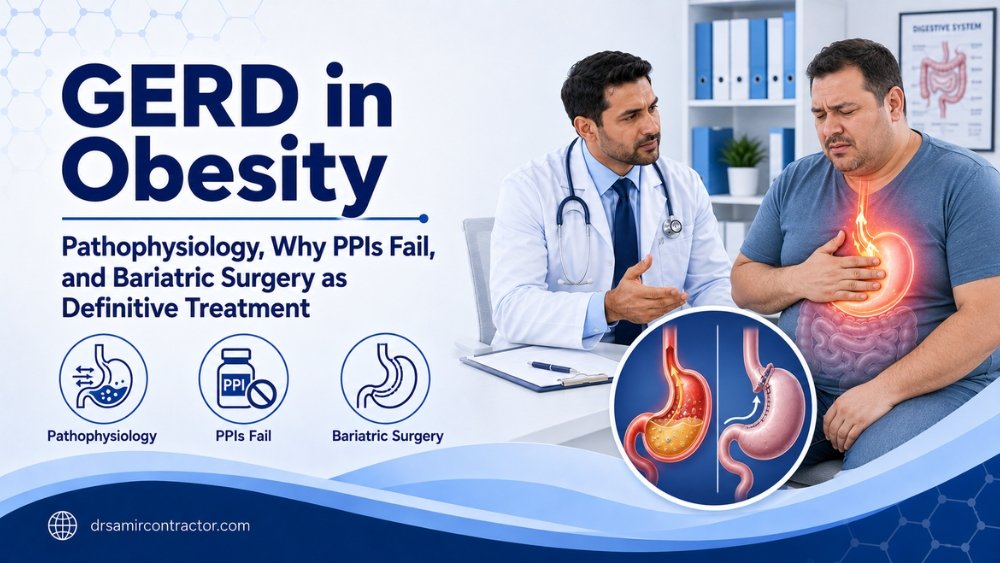
In plain language: GERD in obesity is not simply heartburn that happens to occur in a heavier person. It is a distinct clinical entity driven by the mechanical and biochemical effects of excess body fat. Visceral adiposity raises intra-abdominal pressure, promotes hiatal hernia, releases inflammatory cytokines that weaken the lower oesophageal sphincter, and impairs oesophageal clearing. This is why proton pump inhibitors (PPIs) alone cannot control the disease in most obese patients. Bariatric surgery - specifically Roux-en-Y gastric bypass - is now recognised as the gold standard for definitive GERD treatment in obese individuals. This page explains every mechanism, compares surgical options, and addresses the important risk of Barrett’s oesophagus.
✦ Quick Answers: GERD in Obesity
GERD in Obesity: Defining the Disease
Gastroesophageal reflux disease (GERD) in obesity is a chronic condition in which the abnormal backward flow of gastric acid and bile into the oesophagus is specifically caused or significantly worsened by excess body weight. Unlike occasional heartburn that most people experience after a heavy meal, GERD in obesity is persistent, progressive, and frequently resistant to standard medical therapy.
In my practice at Sterling Hospital, Vadodara, obesity-related GERD is one of the most common presentations I encounter. Patients arrive having taken pantoprazole or esomeprazole for months or years, often at escalating doses, without lasting symptom control. The reason is straightforward: they are treating the acid but not the underlying mechanical and metabolic forces that their excess body fat generates.
This page serves as the definitive disease reference for GERD in obesity - covering pathophysiology, the limitations of medication, the surgical decision between sleeve gastrectomy and gastric bypass, and the critical risk of Barrett’s oesophagus that makes timely treatment essential.
Pathophysiology: The Four Mechanisms That Drive Obesity-Related GERD
Understanding why obese patients develop refractory gastroesophageal reflux requires examining four distinct but interconnected pathways. Each one compounds the others, creating a disease burden that medication alone cannot adequately address.
1. Increased Intra-Abdominal Pressure
Visceral fat - the metabolically active fat stored around the abdominal organs - physically compresses the stomach. This compression raises intra-abdominal pressure (IAP), which pushes gastric contents upward against the lower oesophageal sphincter (LOS). When IAP exceeds the sphincter’s closing pressure, reflux occurs.
Studies using direct pressure measurements have shown that IAP increases in near-linear proportion to BMI. A patient with a BMI of 40 may have intra-abdominal pressures nearly double those of someone with a BMI of 22. This constant upward force explains why obese patients experience reflux not only after meals but also when lying flat, bending forward, or simply sitting for extended periods.
Critically, this mechanical pressure cannot be reduced by any medication. Only physical reduction of visceral fat - through sustained weight loss or bariatric surgery - addresses this root cause.
2. Hiatal Hernia: The Anatomical Amplifier
A hiatal hernia develops when the upper portion of the stomach pushes through the diaphragmatic hiatus into the chest cavity. The diaphragm normally acts as an external sphincter, reinforcing the LOS. When a hiatal hernia is present, this reinforcement is lost, and a reservoir of gastric acid forms above the diaphragm where it can reflux freely.
In the general population, hiatal hernias affect approximately 15-20% of adults. In obese individuals, prevalence jumps to 40-60%. The combination of chronically elevated abdominal pressure and weakened diaphragmatic tissue in obesity makes hernia formation far more likely. Once established, a hiatal hernia dramatically increases both the frequency and severity of acid reflux.
This is one of the strongest arguments for surgical intervention: bariatric surgery can be combined with concurrent hiatal hernia repair during the same laparoscopic operation, addressing both the obesity and the anatomical defect simultaneously.
3. Visceral Adiposity and Pro-Inflammatory Cytokines
Visceral fat is not a passive energy store. It functions as an active endocrine organ that releases a cascade of inflammatory mediators, including tumour necrosis factor-alpha (TNF-alpha), interleukin-6 (IL-6), leptin, and adiponectin. These cytokines create a state of chronic systemic inflammation that directly affects oesophageal tissue.
In the context of GERD, this inflammation weakens the LOS by reducing its resting tone and increasing the frequency of transient lower oesophageal sphincter relaxations (TLESRs) - brief, involuntary openings that are the primary mechanism through which acid escapes into the food pipe. Visceral adiposity also promotes insulin resistance, which independently contributes to oesophageal and gastric dysfunction.
The inflammatory component of obesity-related GERD explains why even patients with modest weight excess but high waist circumference (central obesity) can develop severe reflux. Waist circumference is, in fact, a stronger predictor of GERD severity than BMI alone.
4. Impaired Oesophageal Motility
The oesophagus normally clears refluxed acid through coordinated peristaltic contractions. In obese patients, high-resolution manometry studies have demonstrated a significantly higher rate of ineffective oesophageal motility (IEM) - a condition where more than 50% of swallows produce weak or failed peristaltic waves.
When acid refluxes into the oesophagus and the clearing mechanism is impaired, acid contact time increases. Prolonged acid exposure causes more mucosal damage, more inflammation, more symptom severity, and a higher risk of complications such as oesophagitis, stricture formation, and Barrett’s oesophagus.
Why PPIs Alone Are Insufficient in Obese GERD Patients
Proton pump inhibitors remain the first-line medical treatment for GERD worldwide. In normal-weight patients with mild-to-moderate reflux, PPIs are highly effective. However, in obese GERD patients, PPIs have fundamental limitations that clinicians and patients must understand.
| Parameter | PPI Therapy Alone | Bariatric Surgery (Roux-en-Y Bypass) |
|---|---|---|
| Acid suppression | Effective (reduces acid production by 80-90%) | Effective (small pouch produces minimal acid) |
| Addresses intra-abdominal pressure | No effect | Yes - significant weight loss reduces IAP |
| Addresses hiatal hernia | No effect | Concurrent repair during surgery |
| Controls bile reflux | No effect | Roux limb diverts bile away from oesophagus |
| Reduces inflammatory cytokines | No effect | Yes - visceral fat loss reduces systemic inflammation |
| Long-term GERD resolution | Symptom control only while taking medication | 80-90% sustained resolution at 5 years |
| Barrett’s regression | Slows progression; does not cause regression | Documented regression in some post-bypass patients |
| Long-term risks | B12 deficiency, magnesium depletion, fracture risk, rebound acid on discontinuation | Nutritional monitoring required; surgical risks (low with experienced surgeon) |
The table above illustrates a key clinical principle: PPIs address one dimension of GERD (acid production) while leaving the other three disease mechanisms (pressure, anatomy, inflammation) completely untreated. For obese patients with moderate-to-severe reflux, this partial treatment is why symptoms persist or recur whenever medication is reduced.
Bariatric Surgery as Definitive GERD Treatment
The recognition that bariatric surgery can serve as definitive anti-reflux treatment - not merely a weight-loss procedure that incidentally improves heartburn - represents one of the most important advances in GERD management over the past two decades. For obese patients, surgery simultaneously addresses all four disease mechanisms: it reduces visceral fat (lowering IAP and inflammatory cytokines), permits concurrent hiatal hernia repair, and the gastric bypass configuration specifically diverts bile away from the oesophagus.
The Sleeve vs. Bypass Decision: A Critical Algorithm for GERD Patients
Choosing between sleeve gastrectomy and Roux-en-Y gastric bypass is one of the most consequential decisions in bariatric surgery, and for patients with GERD, the stakes are particularly high. The two procedures have fundamentally different effects on gastroesophageal reflux.
| Factor | Sleeve Gastrectomy | Roux-en-Y Gastric Bypass |
|---|---|---|
| GERD resolution rate | ~50-60% (through weight loss) | 80-90% |
| De novo GERD risk | 15-30% (significant concern) | <5% |
| Mechanism of reflux effect | Weight loss helps, but tubular shape raises intragastric pressure; angle of His disrupted | Small pouch with minimal acid; Roux limb eliminates bile contact with oesophagus |
| Suitability for pre-existing GERD | Caution - may worsen symptoms | Preferred procedure for established GERD |
| Barrett’s oesophagus | Not recommended - ongoing acid exposure risk | Preferred - documented Barrett’s regression in some patients |
| Hiatal hernia >3 cm | Higher risk of persistent reflux post-sleeve | Better reflux outcomes when combined with hernia repair |
| Conversion if reflux worsens | Sleeve can be converted to bypass (revision surgery) | Rarely requires revision for reflux |
| PPI use post-surgery | May still need PPIs in 20-30% | Most patients stop PPIs within 6-12 months |
Clinical Decision Algorithm
Based on current evidence and my experience with over 8,000 bariatric procedures, I follow this decision framework when counselling obese patients with GERD:
- No GERD or mild, intermittent symptoms with normal endoscopy: Either sleeve gastrectomy or gastric bypass is appropriate. The choice can be guided by other factors (metabolic profile, patient preference, diabetes status).
- Moderate GERD (daily symptoms, PPI-dependent) with or without small hiatal hernia: Roux-en-Y gastric bypass is the preferred option. Sleeve may be considered only after thorough counselling about de novo GERD risk.
- Severe GERD (refractory to maximum-dose PPIs, erosive oesophagitis, large hiatal hernia): Roux-en-Y gastric bypass with concurrent hiatal hernia repair is strongly recommended.
- Barrett’s oesophagus confirmed on biopsy: Roux-en-Y gastric bypass is the clear choice. Sleeve gastrectomy is contraindicated due to ongoing acid and bile exposure risk.
- Previous sleeve gastrectomy with new or worsened GERD: Conversion from sleeve to Roux-en-Y bypass resolves reflux in over 85% of cases.
De Novo GERD After Sleeve Gastrectomy: A Growing Concern
One of the most significant complications of sleeve gastrectomy is the development of new-onset GERD in patients who had no reflux before surgery. This occurs through several mechanisms:
- Increased intragastric pressure: The sleeve creates a narrow, high-pressure tube. Food and acid are forced upward against the LOS more aggressively than in the original stomach.
- Disruption of the angle of His: The sleeve operation alters the natural acute angle between the oesophagus and the stomach (angle of His), which normally acts as a flap valve preventing reflux.
- Unrepaired hiatal hernia: If a small hiatal hernia was present but not identified or repaired during the sleeve procedure, post-operative reflux is significantly more likely.
- Sleeve dilation over time: As the sleeve stretches in some patients over months to years, it can form a reservoir that pools acid near the gastro-oesophageal junction.
De novo GERD after sleeve is an important reason why pre-operative endoscopy and careful patient selection are essential. When it occurs, treatment options include long-term PPI therapy, endoscopic interventions, or revision surgery converting the sleeve to a Roux-en-Y bypass.
Red Flags - When Obese GERD Requires Urgent Evaluation
Certain symptoms in obese patients with GERD suggest complications that demand prompt investigation:
- Progressive difficulty swallowing (dysphagia worsening over weeks) - may indicate stricture or malignancy
- Unintentional weight loss despite obesity - a red flag for oesophageal or gastric malignancy
- Vomiting blood (haematemesis) or black tarry stools (melaena) - indicates gastrointestinal bleeding
- Persistent vomiting preventing adequate nutrition
- Iron-deficiency anaemia with chronic reflux - suggests occult mucosal bleeding
- New-onset GERD after age 55 - higher suspicion for Barrett’s or malignancy
- GERD unresponsive to maximum-dose dual PPI therapy - requires endoscopic evaluation
- Hoarseness, chronic cough, or recurrent aspiration pneumonia with reflux - suggests severe laryngopharyngeal reflux
All of these warrant upper GI endoscopy and specialist consultation without delay.
Reassuring Signs in Obese GERD Patients
- Symptoms respond to PPIs and are well-controlled on standard doses
- Reflux improves noticeably with even modest weight loss (3-5 kg)
- No difficulty swallowing, no blood in vomit or stool
- Upper GI endoscopy shows no erosive oesophagitis or Barrett’s changes
- Symptoms are predictable and meal-related
- Normal haemoglobin and no signs of nutritional deficiency
- Symptoms improve with head-of-bed elevation and late-meal avoidance
Barrett’s Oesophagus Risk in Obese GERD
Barrett’s oesophagus is a condition in which the normal squamous lining of the lower oesophagus is replaced by columnar (intestinal-type) epithelium. This metaplastic change is a direct consequence of chronic acid and bile exposure and is the single most important risk factor for oesophageal adenocarcinoma.
The GERD BMI connection is particularly dangerous when it comes to Barrett’s. Obese patients with chronic reflux have a 2-3 times higher risk of developing Barrett’s oesophagus compared to normal-weight GERD patients. The reasons are compounding:
- Longer duration of acid exposure due to refractory GERD
- Combined acid and bile reflux (bile is a stronger promoter of Barrett’s than acid alone)
- Pro-inflammatory cytokines from visceral fat accelerate metaplastic transformation
- Insulin resistance and hyperinsulinaemia promote cell proliferation in Barrett’s tissue
For obese patients with confirmed Barrett’s oesophagus, the clinical pathway is clear: regular endoscopic surveillance with biopsies, maximum acid suppression with PPIs, and strong consideration of Roux-en-Y gastric bypass as both a weight-loss and anti-reflux procedure. Sleeve gastrectomy is not recommended in Barrett’s patients because it does not adequately protect the oesophagus from ongoing acid and bile exposure.
Struggling With GERD and Excess Weight?
Dr Samir Contractor provides expert assessment to determine whether bariatric surgery can resolve your reflux. Comprehensive evaluation including endoscopy at Sterling Hospital, Vadodara.
Long-Term Outcomes: What the Evidence Shows
Large, multi-centre studies following obese GERD patients after bariatric surgery for 5-10 years have demonstrated outcomes that far exceed what lifelong PPI therapy can achieve:
- GERD symptom resolution in 80-90% of Roux-en-Y gastric bypass patients at 5 years
- PPI discontinuation in 75-85% of patients who were taking daily medications before surgery
- Regression of Barrett’s oesophagus documented in some patients following sustained post-bypass weight loss
- Significant reduction in oesophageal acid exposure time as measured by 24-hour pH monitoring
- Reduced risk of oesophageal adenocarcinoma in post-bypass patients compared to non-operated obese GERD patients
- Improvement in extra-oesophageal symptoms (chronic cough, hoarseness, asthma-like symptoms) in over 60% of patients
These results confirm that for obese patients with established GERD, bariatric surgery is not simply an option - it is, in many cases, the most effective and durable treatment available.
The Role of Upper GI Endoscopy in Obese GERD
Upper GI endoscopy is an essential investigation for obese patients with GERD, particularly those being considered for bariatric surgery. It serves multiple critical functions:
- Identifying hiatal hernia: Determines size and type, which directly influences surgical planning
- Detecting oesophagitis: Grades the severity of mucosal damage (Los Angeles classification)
- Screening for Barrett’s oesophagus: Biopsy-confirmed Barrett’s changes the surgical recommendation from sleeve to bypass
- Excluding malignancy: Rules out oesophageal or gastric cancer before proceeding with bariatric surgery
- Assessing H. pylori status: Important for pre-operative planning, as H. pylori eradication is recommended before bypass
In my practice, every bariatric surgery candidate undergoes a pre-operative endoscopy. For patients with GERD symptoms, this is not optional - it is mandatory. The findings directly determine which procedure is safest and most effective for that individual patient.
Obesity-Related GERD in India: A Growing Public Health Burden
India is witnessing a rapid increase in both obesity and GERD prevalence. The National Family Health Survey (NFHS-5) reports that approximately 24% of Indian women and 23% of Indian men are now overweight or obese, with Gujarat recording rates above the national average in several urban districts. Simultaneously, GERD prevalence in Indian adults has been estimated at 8-22% depending on the region, with higher rates in urban centres where obesity is more common.
The convergence of rising obesity and GERD creates a population of patients who need more than antacid prescriptions. They need access to modern bariatric and anti-reflux surgical care.
Indian Dietary and Lifestyle Factors That Worsen Obese GERD
- High oil and ghee consumption: Traditional Gujarati and North Indian cooking relies on generous use of oil, ghee, and vanaspati. High-fat meals slow gastric emptying and increase transient sphincter relaxations.
- Fried snack culture: Farsan, pakoda, samosa, bhajiya, and other deep-fried items are staples of daily and social eating in Gujarat. These are simultaneously high-calorie (promoting obesity) and high-fat (triggering reflux).
- Late-night dinners: Dinner at 9-10 PM followed by sleep at 10:30-11 PM is standard in many Indian households. The 1-1.5 hour gap is insufficient for gastric emptying, promoting nocturnal acid reflux.
- Chai dependency: Three to four cups of milky, sugary chai daily provides repeated reflux triggers. Full-fat milk stimulates acid secretion, caffeine relaxes the LOS, and sugar adds to caloric excess.
- Post-meal reclining: The practice of afternoon rest (especially on weekends and during festivals) after large lunches directly promotes gravitational reflux.
- Festival and wedding eating patterns: Extended multi-course meals during celebrations, with rich, oily, and spicy preparations, cause acute reflux flare-ups that are compounded by baseline obesity.
Why Bariatric Surgery Uptake Remains Low in India
Despite the clear benefits, several barriers limit access to bariatric surgery for GERD in Indian patients:
- Widespread misconception that obesity is a lifestyle problem rather than a disease
- Fear of surgery and preference for prolonged medical management with PPIs
- Limited awareness among primary care physicians about bariatric surgery as GERD treatment
- Insurance coverage gaps for bariatric procedures in many Indian health plans
- Cultural resistance to the idea that surgery is necessary for a condition perceived as simple heartburn
Frequently Asked Questions: GERD in Obesity
ગુજરાતી પ્રશ્નો (Gujarati FAQs)
GERD એટલે ખોરાકની નળીમાં પેટનું એસિડ પાછું આવવું. મોટાપામાં પેટની ચર્બી વધારે દબાણ કરે છે, જે સામાન્ય દવાઓથી મટતું નથી. આ માટે સર્જરી જરૂરી બને છે.
હા, Roux-en-Y ગેસ્ટ્રિક બાયપાસ પછી 80-90% દર્દીઓમાં GERD મટી જાય છે. મોટા ભાગના દર્દીઓ 6-12 મહિનામાં દવાઓ બંધ કરી શકે છે.
હા, 15-30% દર્દીઓમાં સ્લીવ પછી નવું GERD થઈ શકે છે. આ માટે જેમને પહેલેથી GERD હોય તેમને બાયપાસ સર્જરી અપાવામાં આવે છે.
Barrett's oesophagus એ અન્નનળીમાં થતો બદલાવ છે. આ પ્રી-કેન્સર સ્થિતિ છે જે કેન્સરમાં બદલાઈ શકે છે. મોટાપા GERD દર્દીઓમાં આનું જોખમ 2-3 ગણું વધારે છે.
સ્ટર્લિંગ હોસ્પિટલ, વડોદરામાં અપોઇન્ટમેન્ટ માટે અથવા +91 98245 93464 પર ફોન કરો. WhatsApp પર પણ સંપર્ક કરી શકો છો.
લેપ્રોસ્કોપિક ગેસ્ટ્રિક બાયપાસ માટે 2-3 દિવસ અને સ્લીવ માટે 2 દિવસ હોસ્પિટલમાં રહેવું પડે. 1-2 અઠવાડિયામાં સામાન્ય કામ પર જઈ શકો છો.