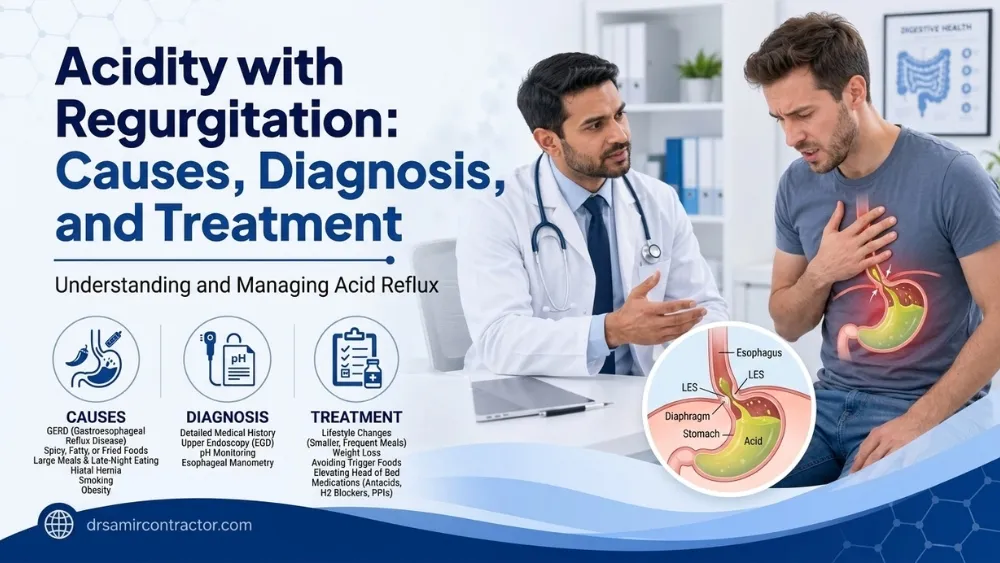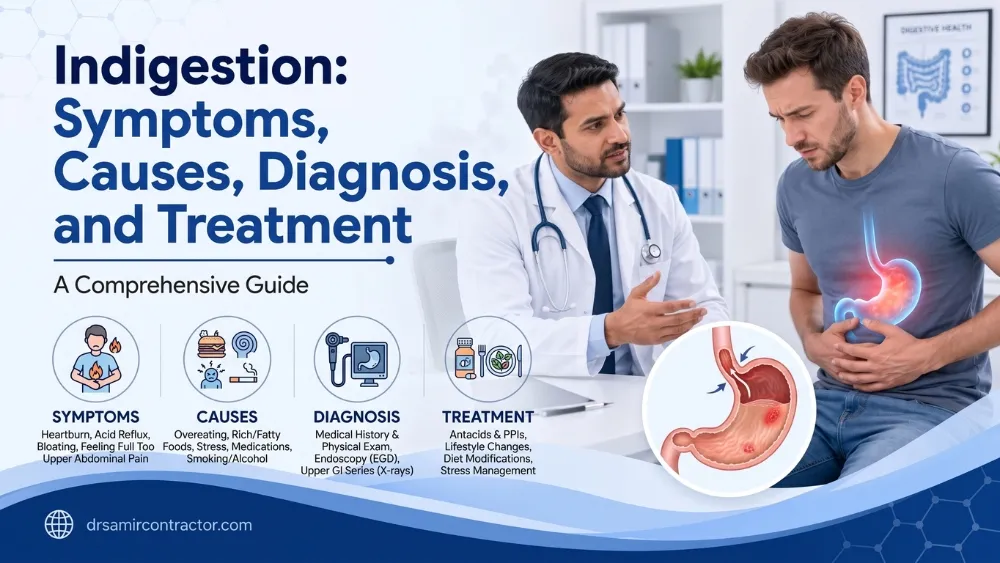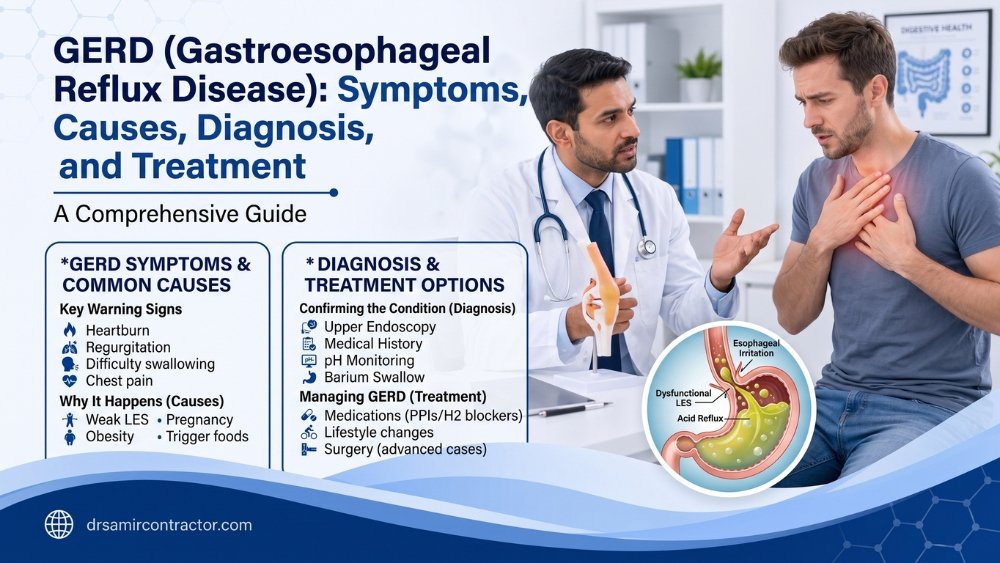
GERD is a chronic condition in which stomach acid flows back into the food pipe frequently enough to cause symptoms or damage the esophageal lining. It is one of the most common GI conditions in India and affects millions of people across all age groups. Most cases are managed effectively with lifestyle changes and medication. A minority need surgical correction.
✦ Quick Answers
GERD is not simply occasional heartburn. It is a chronic disease in which the mechanism protecting the food pipe from stomach acid is persistently or frequently failing. The lower esophageal sphincter - the muscular valve between the food pipe and stomach - does not close properly, allowing acid and sometimes food to rise into the esophagus regularly.
In India, GERD is extremely prevalent. Dietary habits, rising obesity rates, and the widespread practice of eating late and sleeping soon after are major drivers. Many patients manage with antacids for years before receiving a proper diagnosis. This page covers what GERD actually is, how severe it can be, and what treatment is appropriate at each stage.
What Is GERD?
GERD (gastroesophageal reflux disease) is diagnosed when acid reflux occurs frequently enough - more than twice a week - or causes measurable damage to the food pipe. The medical definition distinguishes GERD from occasional acid reflux, which is a common and usually benign event.
GERD has two main forms:
- Erosive GERD (ERD) - acid reflux has caused visible inflammation, erosions, or ulcers of the esophageal lining (esophagitis). This is seen on endoscopy and graded A-D by severity (Los Angeles classification)
- Non-erosive GERD (NERD) - symptoms of GERD are present but the esophageal lining appears normal on endoscopy. This is the more common form. Diagnosis is confirmed by 24-hour pH monitoring.
Los Angeles Classification of Esophagitis
| Grade | Finding on Endoscopy | Clinical Significance |
|---|---|---|
| A | One or more mucosal breaks ≤5 mm, not crossing mucosal folds | Mild - usually responds well to PPI therapy |
| B | One or more mucosal breaks >5 mm, not crossing mucosal folds | Moderate - PPI therapy, lifestyle change |
| C | Mucosal breaks crossing at least two mucosal folds but covering <75% of circumference | Significant - higher-dose PPI, consider surgery evaluation |
| D | Mucosal breaks covering ≥75% of esophageal circumference | Severe - high complication risk; surgical evaluation often indicated |
Symptoms of GERD
Typical (esophageal) symptoms
- Heartburn - burning sensation in the chest or throat, worst after meals and at night
- Regurgitation - sour or bitter material rising into the throat or mouth
- Chest pain - from acid-induced esophageal spasm; must be distinguished from cardiac pain
- Difficulty swallowing - when complications (stricture, severe esophagitis) have developed
Atypical (extra-esophageal) symptoms
- Chronic dry cough - particularly at night or early morning; from acid reaching the airways (LPR)
- Hoarseness of voice - from acid affecting the vocal cords
- Sore throat or globus sensation (lump in throat)
- Worsening or refractory asthma
- Dental erosion - acid repeatedly reaching the mouth
- Chronic sinusitis in some patients
What Causes GERD?
GERD results from a failure of the anti-reflux mechanism. Contributing factors include:
- Weak or transiently relaxing lower esophageal sphincter (LES) - the primary mechanism; allows acid to escape upward between swallows
- Hiatal hernia - the stomach slides into the chest cavity, displacing the LES and disrupting the anti-reflux barrier
- Obesity - central abdominal fat increases intra-abdominal pressure, chronically overloading the LES
- Late-night eating and large meals - a full stomach at bedtime is the most powerful precipitating factor for GERD in Indian patients
- Dietary triggers - fatty and fried food, spicy food, coffee, tea, alcohol, carbonated drinks - all reduce LES pressure or increase acid production
- Smoking - nicotine directly weakens the LES
- Pregnancy - hormonal relaxation of the LES combined with uterine pressure
- NSAIDs and certain medications - aspirin, calcium channel blockers, nitrates, and some antidepressants weaken the LES
Red Flags in GERD - When to Escalate
Urgent endoscopy is needed if GERD is associated with:
- Difficulty swallowing - possible stricture or cancer development
- Unintended weight loss
- Blood in vomit or black stool - upper GI bleeding
- Symptoms present for 5+ years without a single endoscopy - Barrett's risk
- New-onset symptoms in a person above 45
- Progressive worsening despite adequate PPI therapy
Who Is at Higher Risk?
- Overweight or obese individuals - particularly central obesity, extremely common in urban India
- Those who eat late, eat large meals, or sleep within 2 hours of eating
- People with a confirmed hiatal hernia
- Pregnant women - particularly in the second and third trimester
- Smokers and regular alcohol users
- People on NSAIDs, aspirin, or certain antihypertensive medications
- Post-bariatric surgery patients (sleeve gastrectomy) - incidence of new or worsened GERD is high
How GERD Is Evaluated
The diagnosis of GERD can be made clinically in most patients with typical symptoms (heartburn + regurgitation) and a positive response to PPI therapy. Investigation is added when:
- Symptoms are atypical or the diagnosis is uncertain
- Red-flag features are present
- Symptoms persist despite adequate PPI therapy
- Surgery is being considered
- Patient has had symptoms for 5+ years (Barrett's surveillance)
Tests That May Be Needed
Upper GI Endoscopy
Direct visualisation of the food pipe, stomach, and duodenum. Identifies esophagitis grade (A-D), hiatal hernia, Barrett's esophagus, peptic ulcer, and malignancy. Biopsies confirm H. pylori and Barrett's histology.
24-hour pH monitoring / pH impedance
The gold standard for confirming GERD. Measures acid exposure in the food pipe over 24 hours and correlates with symptoms. Essential before surgical planning. pH impedance also detects non-acid reflux.
Esophageal manometry
Measures LES pressure and esophageal peristalsis. Mandatory before anti-reflux surgery to ensure adequate esophageal motility and to exclude achalasia or other motility disorders.
H. pylori testing
Urea breath test or stool antigen. H. pylori eradication reduces upper GI symptom burden and is part of comprehensive GERD management in India.
Treatment of GERD
Indian Dietary Guidance for GERD
- Most impactful: Dinner no later than 7-7:30 PM; sleep no earlier than 10-10:30 PM - this single 2-3 hour gap reduces nighttime symptoms dramatically
- Best choices: Soft khichdi, plain dal, soft roti with light sabzi, curd (at lunch, not dinner), banana, chaas, steamed vegetables
- Reduce significantly: Ghee-heavy curries, oily preparations, deep-fried snacks, very spicy food, large thali portions at night
- Head elevation: A wedge pillow or raising the head of the bed by 15-20 cm - not just extra pillows under the head - reduces nocturnal acid exposure measurably
When Is Surgery the Right Choice?
Laparoscopic fundoplication (most commonly Nissen or Toupet) wraps the upper stomach around the lower food pipe to reinforce the anti-reflux valve. It provides durable long-term symptom control in well-selected patients.
Indications:
- Confirmed GERD on objective testing (endoscopy + pH study)
- Significant hiatal hernia confirmed on endoscopy
- Inadequate symptom control on optimised, correctly taken PPI therapy
- Patient preference for surgical correction over lifelong medication
- Aspiration from severe regurgitation - a safety indication
- Obese patient where bariatric surgery is also being considered - gastric bypass preferred over sleeve (sleeve worsens GERD)
Pre-operative workup:
- Upper GI endoscopy - confirms diagnosis, grades severity
- 24-hour pH monitoring - objectively documents acid exposure
- Esophageal manometry - confirms adequate peristalsis before fundoplication
What Happens If GERD Is Left Untreated?
- Progressive esophagitis - grade A to D over years
- Esophageal ulceration - bleeding, pain
- Esophageal stricture - progressive narrowing causing increasing difficulty swallowing
- Barrett's esophagus - precancerous change; small but real cancer risk requiring surveillance
- Esophageal adenocarcinoma - the most serious long-term complication of chronic, untreated GERD
- Aspiration pneumonia - from nighttime regurgitation
- Dental erosion and chronic ENT symptoms - from acid reaching the mouth and airways
Recovery and What Patients Can Expect
- With lifestyle + PPI: Most patients achieve good symptom control within 2-4 weeks. Full esophagitis healing at 8 weeks. Many patients can step down to maintenance dosing or stop altogether with sustained lifestyle changes.
- After laparoscopic fundoplication: Hospital stay 1-2 days. Soft diet for 3-4 weeks. Return to normal activity in 1 week. Most patients stop or significantly reduce PPIs within 3 months. Long-term symptom control is excellent in well-selected patients.
Frequently Asked Questions
GERD in India - What Is Relevant for You
India-specific context for GERD
- GERD prevalence in urban India is estimated at 15-20% - making it one of the most common GI conditions in the country
- The Indian eating pattern - large oily dinner eaten late, followed by sleep - is one of the most powerful GERD triggers in the world and is rarely modified without specific dietary counselling
- Barrett's esophagus surveillance is inadequately practised in India - many patients with long-standing GERD have never had an endoscopy to identify it
- Post-sleeve gastrectomy GERD is an emerging major problem in India's growing bariatric surgical population - all sleeve patients with reflux should be evaluated
- H. pylori coexists with GERD in a high proportion of Indian patients - eradication is part of comprehensive GERD management here
Seek Care in Vadodara
For persistent GERD, suspected Barrett's esophagus, or GERD surgery consideration - consult Dr Samir Contractor at Sterling Hospital, Vadodara. Endoscopy, pH monitoring, manometry, and laparoscopic surgery are all available in one centre.
Desi Patient Questions
Simple acidity occasional hoy chhe - heavy meal pachhi. GERD chronic chhe - week ma 2+ vaar hoy, raat ne disturb kare, medicine thi manage thatu hoy. GERD ma long-term esophagus damage thay shake chhe - evaluation ane proper treatment zaruri chhe.
Barrett's esophagus = food pipe ni cells change thay chhe acid thi. Cancer nu risk slightly higher chhe - but majority patients ne cancer nathi thato. Surveillance endoscopy every 3-5 years recommended chhe. PPI therapy continue karo. Early detection thi, if anything develops, treatment excellent chhe.
Bahu patients ma medicine + lifestyle thi long-term chale chhe. Surgery specifically recommended thay jyaré: hiatal hernia confirmed hoy, medicine proper leva pachi pan nathi kaam kartu, ya long-term medicine avoid karvani patient ki ichha hoy. Endoscopy + pH study - first. Surgery decision after workup.
Post-sleeve GERD serious concern chhe. PPI start karo ane bariatric team ne inform karo. Severe cases ma gastric bypass conversion evaluate thay chhe - e GERD improve kare chhe. Dismiss na karo - proper follow-up important chhe.