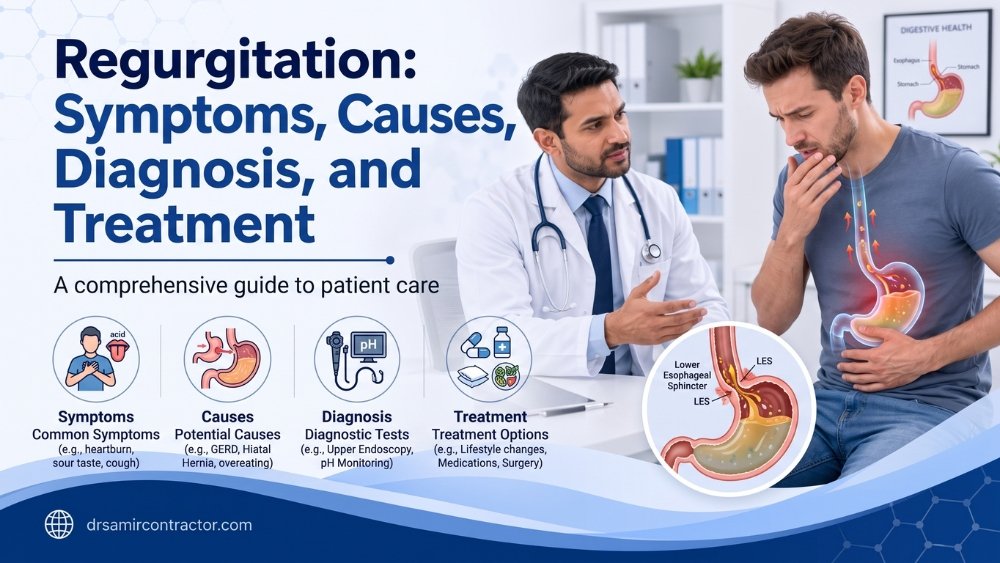
Regurgitation is the effortless return of food or stomach acid back into the throat or mouth - without nausea or forceful vomiting. It is one of the most reliable signs of acid reflux and GERD, but when persistent or severe, it can indicate other esophageal conditions that need evaluation.
✦ Quick Answers
Many patients describe regurgitation as "food coming back up" or "acid reaching the throat" - often without warning and without the nausea that precedes vomiting. It is a symptom that patients frequently dismiss or manage with antacids for months before seeking a proper evaluation.
In most cases, regurgitation is a symptom of gastroesophageal reflux disease (GERD) and responds well to dietary changes and medication. But when regurgitation is frequent, severe, or associated with difficulty swallowing, it can indicate a structural or motility problem in the food pipe that needs proper investigation.
What Is Regurgitation?
Regurgitation occurs when the contents of the stomach or esophagus (food pipe) flow back upward into the throat or mouth without effort. There is no nausea beforehand and no forceful muscle contraction - the material simply moves up passively.
What comes back up can vary: it may be sour or bitter liquid (stomach acid), partially digested food from a recent meal, or undigested food that has been sitting in the lower food pipe. Each pattern gives clues about the underlying cause.
Three types - and what they suggest
Acid Regurgitation
- Sour or bitter taste
- Liquid only - no food
- Happens after meals or at night
- Most common type
- Suggests GERD or hiatal hernia
Food Regurgitation
- Recent food returns shortly after eating
- No sour taste - food recognisable
- May suggest esophageal dysmotility
- Or severely weak anti-reflux valve
- Needs endoscopy assessment
Undigested Food
- Old food returns - hours after eating
- No acid taste - foul smelling
- Suggests esophageal obstruction
- Or achalasia (motility disorder)
- Requires urgent evaluation
Symptoms Associated with Regurgitation
Regurgitation is itself a symptom, but it rarely appears alone. These are the complaints most patients describe alongside it:
Typical presentation
- Sour or acidic taste at the back of the mouth - especially after meals or in the morning
- Sensation of food or liquid rising into the throat
- Wet burps or gurgling sensation in the chest or throat
- Burning in the chest (heartburn) following the regurgitation episode
- Discomfort when bending forward, exercising, or lying down
- Waking at night with a mouthful of liquid or sour taste
Associated symptoms that commonly occur together
- Chronic cough or throat clearing - from acid reaching the larynx
- Hoarse voice in the mornings
- Bloating and belching after meals
- Nausea (in more severe or complicated cases)
- Difficulty swallowing - when regurgitation has an esophageal cause
What Causes Regurgitation?
The cause of regurgitation depends on which part of the digestive tract is involved. The most common cause is a weak anti-reflux valve, but food pipe motility disorders are an important and often missed cause.
Common and Correctable Causes
- Acid reflux (GERD) - weak lower esophageal sphincter allowing acid to rise
- Overeating or eating too quickly
- Eating and lying down immediately after
- High-fat, spicy, or heavy meals
- Excess tea or coffee on empty stomach
- Obesity - especially central abdominal fat
- Pregnancy - increased abdominal pressure
- Tight clothing or heavy exercise after meals
Structural and Medical Causes
- Hiatal hernia - stomach sliding up into chest weakens the anti-reflux mechanism
- Achalasia - food pipe fails to relax and push food into stomach; undigested food regurgitates hours later
- Esophageal stricture - narrowing of the food pipe causes food to back up
- Esophageal diverticulum - a pouch in the food pipe that traps food
- Eosinophilic esophagitis - allergic inflammation of the food pipe
- Esophageal motility disorders - abnormal muscle contractions
- Esophageal or gastric cancer (rare - but must be excluded in new-onset regurgitation over age 45)
When Should You Worry? Red Flags
Simple acid regurgitation after a heavy meal is usually not alarming. The following features, however, should prompt you to see a doctor without delay.
Seek prompt medical evaluation if regurgitation is associated with:
- Difficulty swallowing - food getting stuck or feeling like it won't go down
- Return of old, undigested food - hours after the meal was eaten
- Unintended weight loss over weeks
- Blood in the regurgitated material or vomit
- Regurgitation in someone above 45 with no prior history
- Regurgitation that is worsening progressively despite treatment
- Regurgitation that causes choking or aspiration - especially at night
- Associated chest pain that is severe or does not resolve
The pattern of undigested food returning hours after eating - with no sour taste - is a specific warning sign for achalasia or esophageal obstruction. It must not be dismissed as ordinary reflux.
Who Is at Higher Risk?
- People with GERD or a known hiatal hernia - the most common underlying cause
- Overweight or obese individuals - abdominal fat increases upward pressure on the stomach
- Those who eat large meals late at night - common in Indian households
- People who eat rapidly - swallowing air and food together, predisposing to regurgitation
- Pregnant women - particularly in the second and third trimester when uterine pressure on the stomach peaks
- People with known esophageal disorders - achalasia, stricture, diverticula
- Those above 45 with new symptoms - structural and malignant causes become more relevant
- People on certain medications - including calcium channel blockers and benzodiazepines, which relax the lower esophageal sphincter
How Doctors Evaluate Regurgitation
The clinical history is the most important starting point. Your doctor will ask precise questions to distinguish acid regurgitation (suggesting GERD) from food regurgitation (suggesting a mechanical or motility problem):
- What does the regurgitated material look like - liquid acid, recent food, or old undigested food?
- How soon after eating does regurgitation happen?
- Is there nausea, or does it happen without warning?
- Is there any difficulty swallowing?
- Has there been any weight loss?
- Does it happen at night and disturb sleep?
- How long have the symptoms been present?
A physical examination will follow, including an abdominal check and assessment of nutritional status. The answers to these questions guide which investigations are needed and how urgently.
Tests That May Be Needed
Upper GI Endoscopy (most important)
A flexible camera examines the esophagus, stomach, and upper small intestine. It can identify GERD, esophagitis, hiatal hernia, stricture, Barrett's esophagus, achalasia features, and rule out malignancy. This is the single most useful test in evaluating persistent regurgitation.
Esophageal manometry
Measures the pressure and muscle activity inside the food pipe. Essential for diagnosing achalasia and other esophageal motility disorders that cause regurgitation of undigested food. Also performed as a pre-surgical assessment before GERD surgery.
24-hour pH monitoring or impedance testing
Confirms whether acid or non-acid reflux is present and correlates it with symptoms. Particularly useful when regurgitation is the dominant complaint and endoscopy is normal, or before surgical planning.
Barium swallow
An X-ray study using a contrast liquid. Useful for identifying hiatal hernia, strictures, diverticula, and the characteristic findings of achalasia (bird-beak appearance). Gives a functional picture of swallowing that endoscopy cannot fully capture.
CT scan of chest and abdomen
In selected cases - particularly when a mass, stricture, or structural cause needs further characterisation beyond what endoscopy can provide.
Treatment Options for Regurgitation
Treatment is directed at the underlying cause. Acid regurgitation from GERD is treated very differently from regurgitation caused by achalasia or stricture. This is why accurate diagnosis matters.
Treatment Decision Pathway
- 1️⃣ Lifestyle and Dietary Modification (Always First for GERD-Related): Smaller meals, avoid late eating, weight reduction, elevate head of bed, avoid trigger foods. Effective for mild acid regurgitation. Always the starting point before medication.
- 2️⃣ Acid Suppression (PPIs) for GERD-Related Regurgitation: Proton pump inhibitors reduce acid and heal esophageal inflammation. Significant improvement in most patients within 4-8 weeks. Note: PPIs reduce acid but do not fully stop the physical act of regurgitation - positional and dietary changes remain important.
- 3️⃣ Endoscopy and Cause-Specific Treatment: If endoscopy reveals a stricture, it may be dilated (stretched) during the same procedure. If achalasia is found, specific treatment - pneumatic dilation or POEM (per-oral endoscopic myotomy) - is recommended. Treatment for regurgitation must match the diagnosis.
- 4️⃣ Surgical Treatment for Structural Causes: Laparoscopic fundoplication for confirmed GERD with hiatal hernia. Laparoscopic Heller myotomy for achalasia in selected patients. Surgical correction of large diverticula when symptomatic. Surgery is reserved for patients in whom endoscopic and medical options have been exhausted or are not suitable.
Practical Indian Diet Adjustments for Regurgitation
- Eat smaller portions: Instead of one large thali, divide meals - a lighter lunch and dinner with a small afternoon snack
- Choose: Light dal, soft khichdi, curd rice, steamed vegetables, banana, plain roti without excess ghee
- Reduce or avoid: Very heavy curries, deep-fried snacks (gathiya, chakli, bhajia), large volumes of curd at night
- Do not lie down after meals: Remain upright for at least 2 hours after eating - this simple change reduces regurgitation significantly
- Slow down: Eating quickly predisposes to swallowing air and worsens regurgitation. Take time to eat, chew well
When Is Surgery Needed?
Surgery is not the first step for regurgitation. It becomes relevant when a structural or motility cause is confirmed and non-surgical treatment has not been adequate.
Surgical indications include:
- Confirmed GERD with hiatal hernia causing persistent regurgitation despite optimised medical treatment
- Large symptomatic hiatal hernia with frequent regurgitation and aspiration risk
- Achalasia not responding to endoscopic balloon dilation - laparoscopic Heller myotomy is effective
- Esophageal diverticulum large enough to trap food and cause recurrent regurgitation
- Aspiration pneumonia from severe reflux-related regurgitation in high-risk patients
The surgical approach depends entirely on the underlying cause. A thorough pre-operative workup - including endoscopy, manometry, and pH study - is mandatory before any surgical decision.
What Happens If Regurgitation Is Left Untreated?
Consequences depend on the underlying cause and frequency of regurgitation. Ignored, persistent regurgitation can lead to:
- Esophagitis and ulceration - repeated acid exposure inflames and erodes the food pipe lining
- Esophageal stricture - chronic inflammation leads to scar tissue narrowing the food pipe, making swallowing progressively more difficult
- Barrett's esophagus - a precancerous cellular change in the lower food pipe caused by long-term acid exposure
- Aspiration pneumonia - regurgitated material entering the lungs at night, causing repeated chest infections - serious in elderly or bedridden patients
- Dental erosion - acid reaching the mouth regularly damages tooth enamel
- Chronic laryngitis and voice changes - acid affecting the vocal cords
- Progressive worsening of achalasia - if the underlying cause is untreated, the food pipe dilates and function worsens over time
Recovery and What Patients Can Expect
wk
wk
Scope
Op
Frequently Asked Questions
Regurgitation in India - What Is Relevant for You
Why regurgitation is widely under-evaluated in India
- Most patients manage with antacids for years before seeking evaluation - antacids reduce the burning but do not address the regurgitation itself
- Late dinners followed by quick sleep - a very common pattern in Indian families - is one of the most direct contributors to nighttime regurgitation
- Eating quickly, without chewing thoroughly, in large portions is a common meal-time habit that worsens regurgitation
- Rising obesity rates in urban Gujarat increase intra-abdominal pressure and GERD-related regurgitation significantly
- Achalasia, a motility disorder that causes food regurgitation, is more common in India than many doctors and patients realise - it is often misdiagnosed as simple GERD for months
- Sleeping flat on a charpoy or very low bed without head elevation is common; elevating the head of the sleeping surface is a simple and effective intervention
When and Where to Seek Care in Vadodara
If you experience frequent regurgitation - especially at night, with difficulty swallowing, or with weight loss - schedule an evaluation with Dr Samir Contractor at Sterling Hospital, Vadodara. Upper GI endoscopy, esophageal manometry, and pH testing are available to identify the underlying cause accurately.
Getting the right diagnosis determines whether treatment is dietary adjustment, medication, endoscopic dilation, or surgery - and avoids years of treating the wrong condition.
Desi Patient Questions (Gujarati / Hinglish)
Aa nocturnal acid regurgitation chhe - GERD nu common sign. Serious nathi pan ignore nahi karvanu. Dinner jaldi lo, pillow thodu uchhu rakho. Jyaré rooz thay to doctor ne malsho.
Nahi - aa alag lakshan chhe. Jyaré khadhelu undigested food ane sour taste vagar pachi aavé, e achalasia ya esophageal problem no sign hoi shake chhe. Endoscopy and manometry karavi joiye - antacid thi aa nahi sudhartu.
Ha, khub khote chhe. Jyaré aap soo cho, gravity pet ni acid ne rokti nathi. Bhojann pachhi 2 kaak uthele raho - sofa pe beso, thodu chalo - pachhi soo. Aa ek change thi bahu patients ne farak pade chhe.
Ha, endoscopy ek kaam ni test chhe. Esophagus, stomach ane upper intestine ni direct view milé chhe. GERD, hiatal hernia, stricture, ya motility problem - badhu ek saathe check thaay. 10-15 minute ni test, light sedation sathe, comfortable procedure chhe.
Bilkul sach chhe. Pet par ni chharbi stomach par pressure vadhare chhe jene leva acid upar aave chhe. 5-10% vajan ochu karva thi pan nondpatra farak pade chhe GERD ma. Vadodara na obese patients maate aa most effective long-term change chhe.