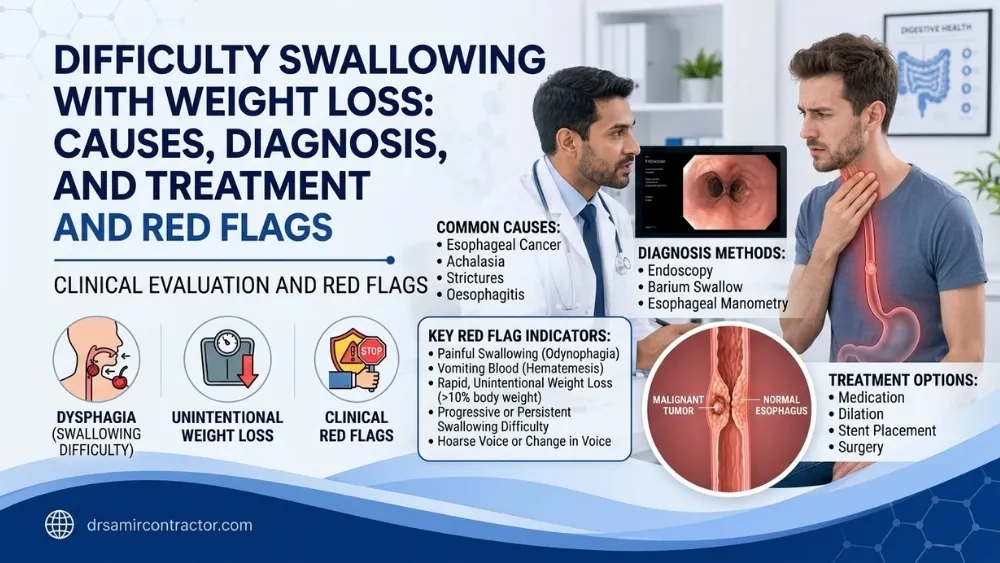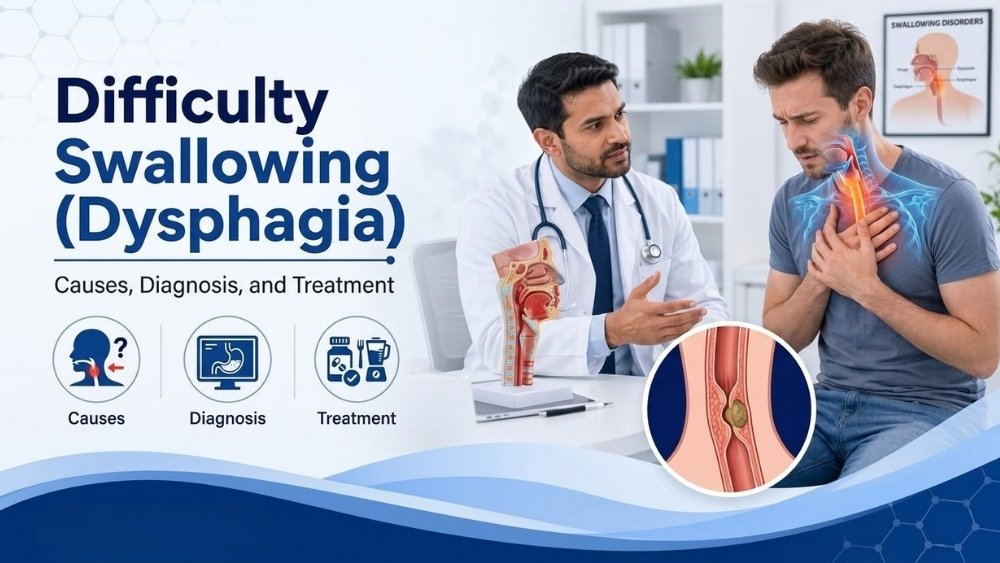
Difficulty swallowing - called dysphagia - is the sensation that food or liquid is not passing normally from the mouth through the food pipe to the stomach. It is never a normal symptom. While most causes are benign and treatable, difficulty swallowing always requires medical evaluation to identify the underlying cause - and to exclude serious conditions including esophageal cancer.
✦ Quick Answers
Swallowing is something most people never think about - until it stops working normally. Difficulty swallowing is a symptom that patients often delay reporting, assuming it will resolve on its own or attributing it to a cold or anxiety. This delay is dangerous because dysphagia - particularly when progressive - can be the first sign of a serious and treatable condition that demands early diagnosis.
The good news is that the majority of dysphagia cases in India are caused by non-cancerous conditions - esophageal stricture from long-standing GERD, achalasia (a motility disorder), or esophagitis. These are highly treatable. The key is not to wait. Endoscopy quickly identifies the cause and allows treatment to be started without unnecessary delay.
What Is Difficulty Swallowing (Dysphagia)?
Dysphagia means that swallowing is abnormal. Food or liquid does not pass smoothly from the mouth through the pharynx (throat) and esophagus (food pipe) into the stomach. The sensation varies - some patients feel food sticking at the throat level, others feel it lodging behind the breastbone, and some feel that swallowing requires effort or causes discomfort.
Two clinically important types
Oropharyngeal Dysphagia
- Difficulty initiating swallowing
- Food or liquid enters the airway (aspiration)
- Coughing or choking when swallowing
- Nasal regurgitation of liquids
- Usually caused by neurological conditions - stroke, Parkinson's, motor neuron disease
- Also oral, throat, or pharyngeal structural problems
- Requires speech and swallowing therapy assessment
Esophageal Dysphagia
- Swallowing initiates normally but food sticks in the chest or throat afterward
- Sensation of food lodging behind the breastbone
- May affect solids first, then liquids (structural cause)
- May affect solids and liquids from the start (motility cause)
- Caused by: GERD stricture, achalasia, cancer, esophagitis, external compression
- This is the type covered by this page - GI evaluation and endoscopy are the starting point
The progression pattern matters clinically
Pattern of progression - what it suggests:
Symptoms That Accompany Difficulty Swallowing
Dysphagia rarely occurs in isolation. The accompanying symptoms guide the diagnosis significantly.
Symptoms frequently seen with esophageal dysphagia
- Sensation of food sticking - behind the breastbone or at the lower throat level
- Need to wash food down with large amounts of liquid
- Regurgitation - food or liquid coming back up, sometimes hours after eating
- Coughing or choking during or after swallowing
- Heartburn or acid reflux - suggests GERD as the underlying cause
- Painful swallowing (odynophagia) - see related page
- Change in eating habits - avoiding certain foods, eating more slowly, cutting food into smaller pieces
- Weight loss from reduced food intake
- Voice changes or hoarseness
- Recurrent chest infections from aspiration of food or liquid
What Causes Difficulty Swallowing?
Common Benign Causes (Treatable)
- GERD-related esophageal stricture - years of untreated acid reflux scar the food pipe, narrowing it. One of the most common causes of dysphagia in India given the high prevalence of GERD
- Achalasia - motility disorder where the lower food pipe sphincter fails to relax; food accumulates above, causing regurgitation and dysphagia to both solids and liquids
- Eosinophilic esophagitis - allergic inflammation of the food pipe; often in younger patients with food allergies or asthma
- Esophageal ring (Schatzki ring) - a thin tissue ring at the lower food pipe causing intermittent solid food dysphagia
- Esophagitis from GERD - active inflammation without stricture; improves with PPI therapy
- Esophageal web - thin tissue membrane, more common in women with iron deficiency anaemia
- Diffuse esophageal spasm - abnormal muscle contractions causing dysphagia and chest pain
- Post-radiotherapy stricture - in patients who have received radiation to the neck or chest
Serious Causes (Need Urgent Evaluation)
- Esophageal cancer - progressive dysphagia, weight loss, new onset in older patients; must be excluded by endoscopy
- Gastric cancer involving the esophagogastric junction
- Extrinsic compression - enlarged lymph nodes, mediastinal mass, or aortic aneurysm pressing on the food pipe
- Pharyngeal cancer - dysphagia with throat pain, neck mass, or hoarseness
- Severe complicated GERD - Barrett's esophagus with high-grade dysplasia
When Should You Worry? Red Flags
Difficulty swallowing is itself a red-flag symptom - it should never be normalised or ignored. The following features make it more urgent.
Seek prompt medical evaluation - do not delay - if difficulty swallowing is:
- Progressive - getting worse over days or weeks, now affecting foods that were previously fine
- Associated with unintended weight loss
- Present in a person above 45 years of age with no prior history of reflux
- Associated with pain on swallowing (odynophagia)
- Accompanied by vomiting blood or black stool
- Associated with a lump in the neck
- Associated with hoarseness of voice that is new and persistent
- Causing regurgitation of old, undigested food - especially hours after eating
- Preventing adequate fluid intake - risk of dehydration and aspiration
- Accompanied by unexplained anaemia or extreme fatigue
Any new dysphagia - even without the above features - should be evaluated. The earlier an endoscopy is performed, the faster the cause is identified and treatment started.
Who Is at Higher Risk?
- People with long-standing, untreated GERD - years of acid exposure can scar the food pipe, causing a peptic stricture that narrows the lumen and causes dysphagia
- People above 45-50 with new-onset dysphagia - esophageal and gastric cancer risk increases with age; new dysphagia in this group must be investigated
- Smokers and heavy alcohol users - both are significant risk factors for squamous cell carcinoma of the esophagus
- Patients with Barrett's esophagus - established precancerous change from long-term GERD; requires surveillance endoscopy
- Younger patients with food allergies or asthma - eosinophilic esophagitis is increasingly recognised in this group
- Women with iron deficiency anaemia - esophageal web (Plummer-Vinson syndrome) is a recognised but uncommon cause of dysphagia in iron-deficient women
- Patients post-radiotherapy to neck or chest - radiation stricture is a known long-term complication
- Post-bariatric surgery patients - anastomotic stricture after gastric bypass is a recognised cause of dysphagia in the postoperative period
How Doctors Evaluate Difficulty Swallowing
A careful, structured history is the starting point. Unlike many other GI symptoms where treatment trials are reasonable before investigation, dysphagia requires investigation before treatment is started - the treatment depends entirely on the cause.
Your doctor will ask:
- Where does the food seem to stick - throat, chest, or lower chest?
- Does it affect solid food only, or liquids as well?
- Has it been getting progressively worse, or is it intermittent?
- How long has it been present?
- Is there pain on swallowing?
- Has there been any weight loss?
- Is there a history of GERD, heartburn, or previous endoscopy?
- Is there any history of smoking, alcohol, or head and neck cancer?
- Are there any neurological symptoms - weakness, difficulty speaking, or history of stroke?
Physical examination will assess the throat, neck (for a mass), and nutritional status. The history and examination together determine which investigations are needed and how urgently.
Tests That May Be Needed
Upper GI Endoscopy (essential - usually the first test)
A flexible camera directly examines the food pipe, stomach, and upper intestine. It identifies strictures, inflammation, rings, webs, achalasia features, and tumours. Biopsies can be taken from suspicious areas. Endoscopic dilation of a stricture can be performed in the same procedure. This is the single most important investigation for esophageal dysphagia.
Barium swallow X-ray
The patient swallows a contrast liquid while X-ray images are taken. Provides a functional picture of swallowing - the shape, contour, and movement of the food pipe. Particularly useful for diagnosing achalasia (characteristic bird-beak narrowing), large diverticula, and pharyngeal causes. Sometimes performed before endoscopy to guide it.
Esophageal manometry
Measures the pressure and muscle activity inside the food pipe. Essential for diagnosing achalasia and differentiating it from other motility disorders. Performed before surgery for achalasia and as a pre-operative assessment before fundoplication for GERD.
CT scan of chest and abdomen
When esophageal cancer is found or suspected - CT scan is needed for staging and to assess whether surgery is feasible. Also ordered when external compression on the food pipe is suspected.
24-hour pH monitoring
If GERD is suspected as the cause and endoscopy is normal or inconclusive - pH monitoring confirms whether acid exposure is contributing to the dysphagia.
Treatment Options
Treatment is entirely determined by the cause. This is the most important principle with dysphagia - never treat the symptom without knowing the diagnosis.
Cause-Specific Treatment Pathways
Eating Safely with Dysphagia - Practical Guidance
- While awaiting evaluation: Eat slowly, take small bites, chew thoroughly. Avoid dry, hard food - roti, hard bread, raw vegetables, large meat pieces
- Safer options: Soft khichdi, dal, curd rice, banana, soft cooked vegetables, mashed potato (batata), smooth porridge, smooth soups
- Sit upright while eating - never eat lying down or reclined
- Wash food down if needed with small sips of water between bites - but report this adaptive behaviour to your doctor as it is a clinical sign
- Do not modify your diet as a long-term solution - dietary restriction manages the symptom but allows the underlying cause to progress. Evaluation is urgent.
When Is Surgery Needed?
Many dysphagia cases are managed endoscopically or with medication. Surgery is needed in specific situations:
- Achalasia not responding to endoscopic dilation - laparoscopic Heller myotomy provides durable relief of dysphagia in achalasia
- GERD with complicated stricture not responding to dilation and PPI therapy - laparoscopic fundoplication with esophagoplasty in selected cases
- Esophageal cancer suitable for curative surgery - esophagectomy (removal of part or all of the esophagus) performed by specialist upper GI surgeons in a multidisciplinary setting
- Pharyngeal or esophageal diverticulum - large symptomatic diverticula causing food trapping and aspiration require surgical repair
- Significant hiatal hernia with dysphagia - laparoscopic hiatal hernia repair and fundoplication
What Happens If Difficulty Swallowing Is Ignored?
Dysphagia is one of the symptoms where delay in evaluation carries the most serious consequences:
- Progressive weight loss and malnutrition - reduced food intake from worsening dysphagia leads to significant weight loss, weakness, and nutritional deficiency
- Aspiration pneumonia - food or liquid entering the airway causes recurrent chest infections, which can be life-threatening in elderly or debilitated patients
- Worsening stricture - an untreated GERD-related stricture continues to scar and narrow over time, becoming harder to dilate
- Missed early esophageal cancer - if dysphagia is from a tumour and evaluation is delayed by months, the cancer may progress from a resectable to an inoperable stage. Early-stage esophageal cancer can be cured surgically; advanced-stage cannot
- Worsening achalasia - untreated achalasia leads to a massively dilated, tortuous food pipe (megaesophagus) that is much harder to treat effectively
- Dehydration - when swallowing is so impaired that adequate fluids cannot be taken orally
There is no benign reason to delay evaluation of dysphagia. The earlier the endoscopy, the earlier the diagnosis, and the better the outcomes - for every cause including cancer.
Recovery and What Patients Can Expect
day
wk
Op
term
Difficulty Swallowing in India - What Is Relevant for You
Why dysphagia is an important symptom in the Indian context
- Esophageal cancer is among the more common GI cancers in India - and its most prominent early symptom is progressive difficulty swallowing. Delayed presentation remains a major reason for poor outcomes in India. Most patients present at an advanced stage because early dysphagia was ignored or attributed to stress
- GERD prevalence is high in India, and many patients have had untreated acid reflux for years before developing a peptic stricture. This is a preventable cause of dysphagia
- Achalasia is more common in India than many clinicians recognise - it is frequently misdiagnosed as GERD for months because the initial symptom of regurgitation is similar
- Tobacco chewing (tobacco-pan, gutkha) - extremely prevalent in Gujarat and across India - is a significant risk factor for oropharyngeal and esophageal cancer. Dysphagia in a tobacco user must not be dismissed
- Iron deficiency anaemia - highly prevalent in Indian women - is associated with esophageal webs (Plummer-Vinson syndrome) as a cause of dysphagia in young women. This is worth considering when young women with known anaemia present with solid food dysphagia
? When and Where to Seek Care in Vadodara
Any new difficulty swallowing - even if mild - should be evaluated without delay. Dr Samir Contractor at Sterling Hospital, Vadodara provides upper GI endoscopy, esophageal manometry, and both endoscopic and surgical management for all causes of dysphagia.
An endoscopy performed promptly provides a diagnosis in the same visit. For a treatable benign condition, this is reassuring. For a cancer detected early, it may be life-saving.
Desi Patient Questions (Gujarati / Hinglish)
Majority cases ma cancer nathi hota - stricture, achalasia, ya GERD common benign causes chhe. Pan cancer exclude karva endoscopy zaruri chhe - especially jyaré progressive hoy ya weight loss hoy. Delay na karo - ek endoscopy answer aapé chhe quickly.
Ha - tobacco chewing esophageal ane oropharyngeal cancer no significant risk factor chhe. Jyaré tame tobacco user cho ane dysphagia aavyu - please turant doctor ne malsho. Aa symptoms ignore karvana nahi. Early detection thi outcomes dramatically better chhe.
Chest ma food sticking esophageal dysphagia chhe - lower food pipe ni problem. Most commonly GERD stricture ya achalasia. Serious nahi pan serious causes exclude karvani zarur chhe. Endoscopy karo - doctor same session ma diagnosis ane treatment (dilation) banne kari shake chhe.
Ha - most strictures ma endoscopy ane dilation ek j session ma thay chhe. Tame sedation ma so chho, doctor scope naakhe, stricture juo, ane dilate kare. Tame uthine better swallowing feel karo chho most cases ma. Repeat sessions jaruri hoi shake chhe jyaré stricture pachi aavé.
Ha - years of untreated GERD food pipe ane scar banaavé chhe which narrows - peptic stricture. Jyaré tame solid food dysphagia notice karo to endoscopy karo. Dilation thi quick improvement milé chhe. PPI medicine re-scarring prevent kare chhe. GERD time par treat karo to stricture prevent thay chhe.