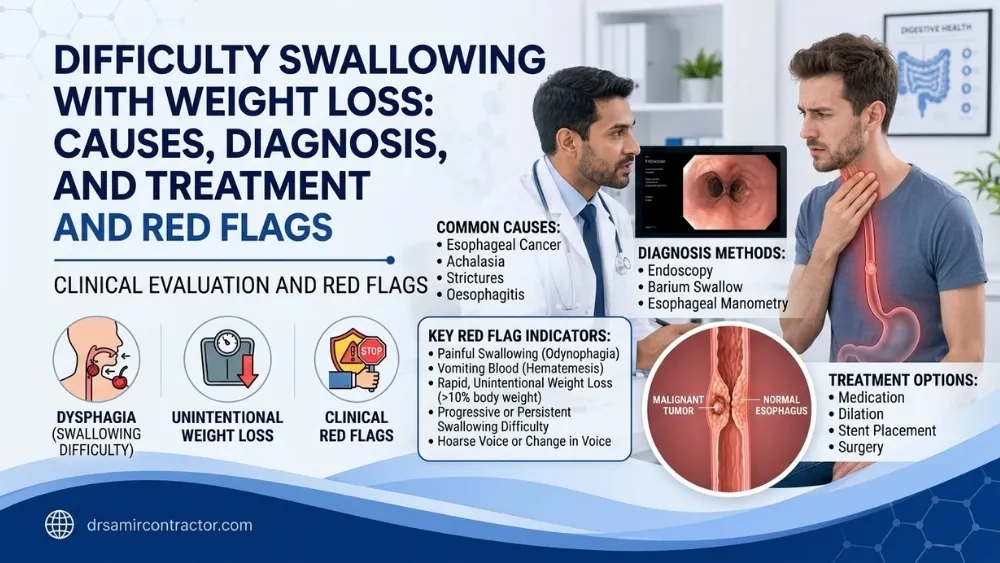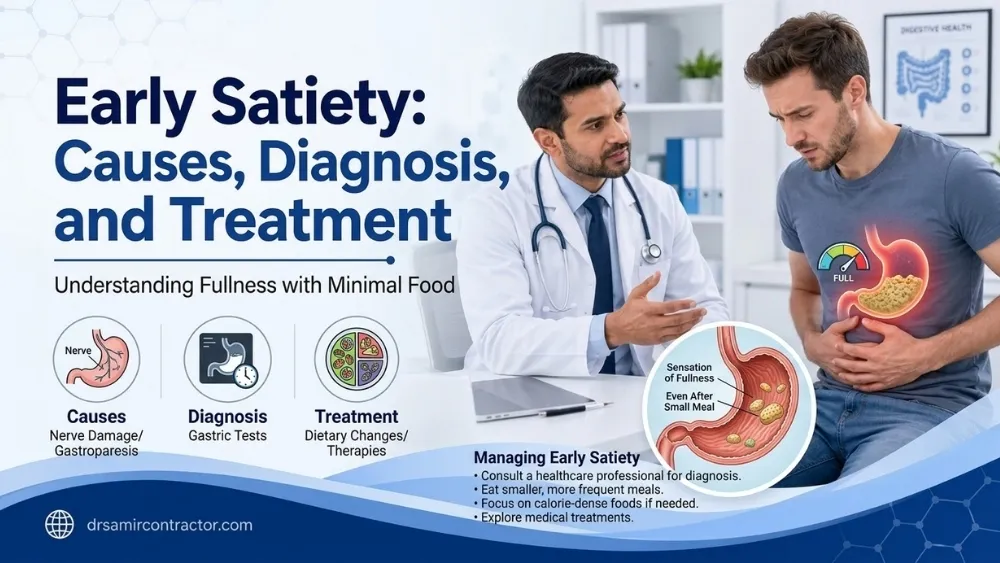
Dysphagia - difficulty swallowing - is a symptom that always requires medical evaluation. It ranges from intermittent food sticking from a Schatzki ring to progressive obstruction from esophageal cancer. Most causes are benign and highly treatable. But the pattern of dysphagia determines urgency: progressive difficulty swallowing with weight loss demands urgent endoscopy.
✦ Quick Answers
This is the disease-level reference page for dysphagia - covering all causes, their distinguishing features, investigations, and treatment in one comprehensive guide. It is designed for patients who have received a diagnosis of dysphagia or who have been referred for investigation of swallowing difficulty and want to understand what this means and what to expect.
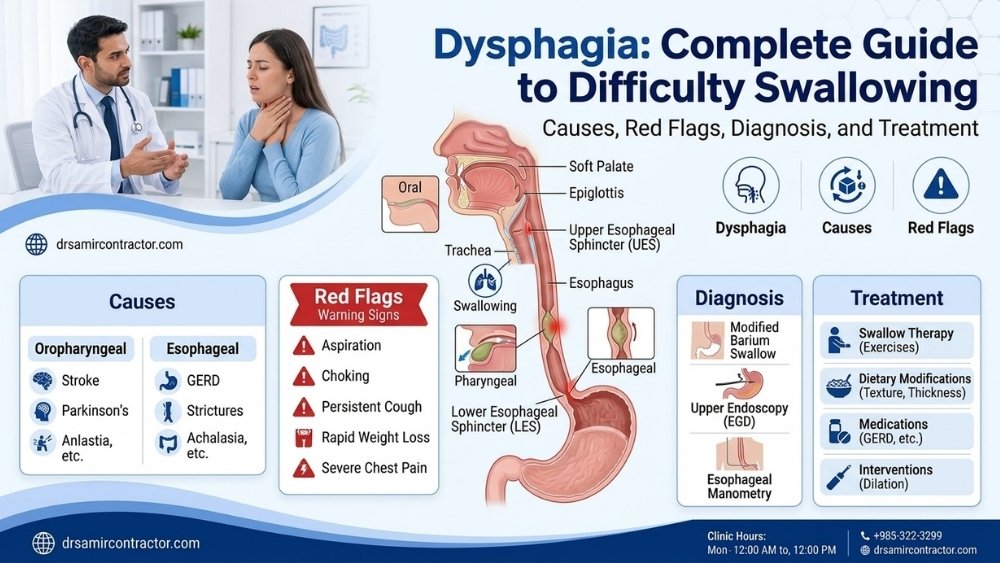
Classification of Dysphagia
Oropharyngeal dysphagia
Difficulty initiating swallowing - food fails to transfer from mouth to food pipe properly. Often causes nasal regurgitation, coughing on swallowing, and aspiration. Causes are primarily neurological (stroke, Parkinson's, motor neuron disease, multiple sclerosis) or structural (pharyngeal tumour, Zenker's diverticulum). Managed by speech and swallowing therapy and specific treatment of the underlying cause.
Esophageal dysphagia
Swallowing initiates normally but food sticks in the chest or throat afterward. This is the focus of this page - GI evaluation and endoscopy are the primary approach. Divided into structural (mechanical blockage) and motility (abnormal muscle function) causes.
Causes of Esophageal Dysphagia - Complete Reference Table
| Cause | Pattern of Dysphagia | Key Features | Urgency |
|---|---|---|---|
| GERD-related peptic stricture | Progressive, solids first then liquids | History of long-standing GERD; lower chest sticking; smooth narrowing on endoscopy; responds to dilation + PPI | Scheduled |
| Achalasia | Both solids and liquids from the start; not progressive in same way | Regurgitation of undigested food (no sour taste); nocturnal cough; weight loss over time; bird-beak on barium swallow; requires manometry | Scheduled |
| Schatzki ring | Intermittent, not progressive; solids only | Episodic complete food impaction (steakhouse syndrome); thin ring at GE junction on endoscopy/barium; responds well to single dilation | Scheduled |
| Eosinophilic esophagitis | Intermittent; food impaction episodes | Younger patients; food allergies/asthma history; rings, furrows on endoscopy; high eosinophil count on biopsy; needs steroids + dietary elimination | Scheduled |
| Esophageal cancer | Progressive - solids → liquids; worsening over weeks | Weight loss; age >45; tobacco/alcohol history; irregular mass on endoscopy; requires biopsy and staging CT | Urgent |
| Esophageal web | Solid food sticking at throat level | More common in women with iron deficiency anaemia; upper food pipe; responds to endoscopic rupture/dilation | Scheduled |
| Zenker's diverticulum | Throat-level sticking; regurgitation of old food | Undigested food returning hours later; halitosis; gurgling in throat; upper food pipe pouch on barium swallow; surgical or endoscopic myotomy | Scheduled |
| Diffuse esophageal spasm | Intermittent; solids and liquids; associated chest pain | Corkscrew appearance on barium swallow; non-peristaltic contractions on manometry; responds to smooth muscle relaxants | Scheduled |
| Post-bariatric stricture | Progressive after sleeve/bypass surgery | Develops weeks to months post-operatively; responds to endoscopic balloon dilation | Prompt |
| Extrinsic compression | Progressive; may have respiratory symptoms | Enlarged mediastinal lymph nodes; vascular or mediastinal mass; CT scan identifies the cause | Urgent |
Red Flags in Dysphagia - Urgent Evaluation Required
Urgent endoscopy needed - do not delay - when dysphagia is:
- Progressive - worsening week by week, more foods now causing sticking
- Associated with unintended weight loss
- Present in a person above 45 with no prior esophageal history
- Accompanied by pain on swallowing (odynophagia)
- Associated with hoarseness, neck lump, or anaemia
- History of significant tobacco or alcohol use
- Causing complete food impaction episodes
- Regurgitation of old undigested food without sour taste - achalasia pattern needs evaluation
- Occurring after bariatric surgery and not settling
- Associated with blood in vomit
Investigations for Dysphagia - What, When, and Why
Upper GI Endoscopy - always first
Direct visualisation of the food pipe from top to bottom. Identifies strictures (smooth = benign; irregular = malignant), rings, inflammatory patterns of EoE, achalasia features, and tumours. Biopsies taken from all suspicious areas. Dilation can be performed at the same session for benign strictures and rings. The single most informative first investigation for esophageal dysphagia.
Esophageal manometry
Measures the pressure and movement of the food pipe muscles. Essential for diagnosing achalasia (absent peristalsis + incomplete LES relaxation) and other motility disorders (diffuse esophageal spasm, hypercontractile esophagus). Performed when endoscopy is normal or when achalasia features are seen on barium swallow. Mandatory before anti-reflux surgery to ensure normal peristalsis.
Barium swallow
A contrast X-ray study. Shows the structural shape and movement of the food pipe. Identifies: Schatzki ring (thin filling defect), achalasia (bird-beak narrowing), stricture extent, Zenker's diverticulum (pouch filling with contrast), and cervical webs. Gives functional information that endoscopy cannot - particularly useful for planning dilation or surgery.
CT scan of chest and abdomen
For staging when esophageal cancer is confirmed or suspected. Identifies local tumour extent, lymph node involvement, and distant metastases. Guides whether curative surgery is feasible.
24-hour pH monitoring
Confirms GERD when stricture is being managed - important to document acid exposure before planning surgical anti-reflux procedure.
Treatment by Cause
GERD-related peptic stricture
Endoscopic balloon or bougie dilation - immediate symptom improvement. PPI therapy (twice daily) to prevent re-stricturing. Repeat dilation at intervals if needed. Laparoscopic fundoplication for underlying GERD with hiatal hernia - reduces stricture recurrence rate by controlling the acid driving the scarring.
Achalasia
Pneumatic balloon dilation - effective in most patients; may require repeat sessions. Laparoscopic Heller myotomy + partial fundoplication - surgical division of the lower esophageal sphincter; durable long-term results. POEM (per-oral endoscopic myotomy) - newer endoscopic technique available at specialist centres. Choice based on patient age, fitness, centre expertise, and patient preference.
Schatzki ring / esophageal web
Endoscopic dilation or disruption - usually requires only 1-2 sessions. Highly effective with immediate symptom relief. PPI therapy if GERD is associated.
Eosinophilic esophagitis
Dietary elimination (identify and remove trigger allergens), swallowed topical steroids (budesonide or fluticasone), PPI therapy. Endoscopic dilation for stricturing. Regular endoscopic follow-up with biopsy to monitor response. Long-term management needed - condition tends to relapse without ongoing dietary or medical management.
Esophageal cancer
Early-stage: esophagectomy with curative intent; may be combined with neoadjuvant chemotherapy and radiotherapy. Endoscopic resection (EMR or ESD) for early superficial tumours. Advanced stage: palliative esophageal stenting restores swallowing; combined chemo-radiotherapy for disease control. Multidisciplinary team management is essential.
What Happens If Dysphagia Is Left Uninvestigated?
- Progressive nutritional compromise - reduced food intake leads to weight loss, malnutrition, and weakness
- Worsening stricture - peptic strictures tighten without PPI therapy; achalasia esophagus dilates and loses function over time
- Aspiration pneumonia - retained food or liquid aspirated into lungs at night
- Food bolus impaction - becomes more frequent as narrowing progresses; each episode carries a small perforation risk
- Missed esophageal cancer - the most consequential outcome; advanced-stage cancer has profoundly worse outcomes than early-stage. Every month of delay in investigation is a month of potential tumour growth
Frequently Asked Questions
Dysphagia in India
India-specific context
- Esophageal cancer - both squamous cell and adenocarcinoma - is among India's more common GI cancers and frequently diagnosed at a late stage because progressive dysphagia is attributed to "throat problem" or "old age" for months before investigation
- GERD-related peptic stricture is the most common benign cause of food sticking in India - driven by years of inadequately managed GERD in a population with high dietary and lifestyle risk factors
- Achalasia is under-recognised in India - frequently misdiagnosed as GERD for months before manometry establishes the correct diagnosis and appropriate treatment is started
- Tobacco chewing (gutkha, pan masala) - widely prevalent in Gujarat - is a significant risk factor for oropharyngeal and esophageal cancer. Any tobacco user with new dysphagia must be investigated urgently
- Eosinophilic esophagitis is increasingly recognised in Indian urban centres, particularly in young adults with recurrent food impaction and allergic background
Seek Care in Vadodara
New dysphagia - especially progressive or with weight loss - consult Dr Samir Contractor at Sterling Hospital, Vadodara for urgent upper GI endoscopy, esophageal manometry, and complete investigation.
Desi Patient Questions
Khanu stick thavanu = dysphagia = endoscopy zaruri chhe. Progressive hoy (vadhare vadhu foods stuck thay) ya weight loss hoy to urgent javo. Benign cause ma same visit ma dilation possible chhe - fast relief. Serious cause ma early detection best outcome aapé chhe. Delay nathi karvanu.
Roti avoid karvathi symptom manage thay chhe - cause nathi treat thatu. Roti sticking = likely stricture ya ring. Endoscopy karo - dilation thi same day roti again normally khai sakay cho. Food restriction is adaptation, not treatment. Please get evaluated.
Tobacco chewing esophageal cancer no significant risk factor chhe. Dysphagia + tobacco = urgent endoscopy immediately. Majority cases benign cause nilshe - pun cancer exclude karvun mandatory chhe. Ek endoscopy = definitive answer within same week.