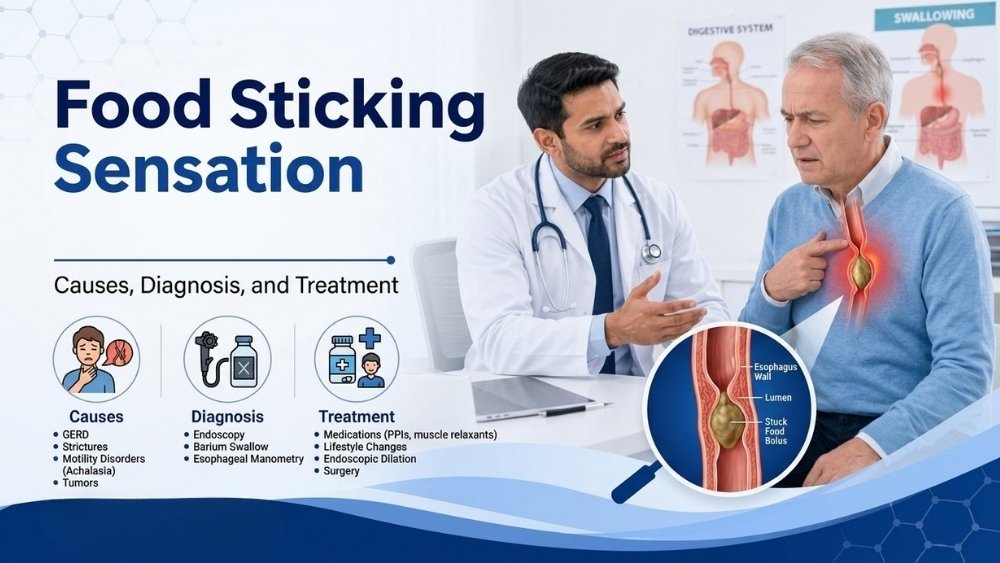
The sensation of food sticking in the throat or chest when swallowing is a form of esophageal dysphagia - a sign that the food pipe is narrowed, inflamed, or not functioning normally. Most causes are benign and highly treatable. But progressive food sticking, particularly with weight loss, always needs endoscopic evaluation without delay.
✦ Quick Answers
Patients describe it in many ways - food getting stuck in the chest, needing to drink large amounts of water to wash food down, or a sense of food sitting behind the breastbone for several minutes before it moves. Some change their diet around it for months - avoiding bread, meat, and dry foods - before ever consulting a doctor.
This adaptation is understandable, but it is dangerous. When food sticking is progressive - when more and more foods cause it - it signals an underlying process that is narrowing or obstructing the food pipe. Identifying and treating this early leads to better outcomes. Waiting until only liquids can pass means the condition has already advanced significantly.
What Is the Food Sticking Sensation?
The food sticking sensation is a form of esophageal dysphagia - a symptom in which food does not pass smoothly through the food pipe (esophagus) into the stomach. The food pipe is a muscular tube that normally propels food downward through coordinated muscle contractions (peristalsis). When this tube is narrowed, inflamed, or its muscles are not working properly, food slows down or lodges, creating the sticking sensation.
The sticking is usually felt in one of three anatomical zones - and the location gives a strong clue to the cause.
Throat Level
- Felt high - at or just below the Adam's apple
- May cause coughing on swallowing
- Suggests: oropharyngeal cause, upper esophageal web, Zenker's diverticulum
- Neurological causes more common at this level
Mid-Chest
- Behind the breastbone - middle portion
- Suggests: mid-esophageal pathology
- Eosinophilic esophagitis common here
- Extrinsic compression from enlarged lymph nodes
Lower Chest / Epigastric
- Behind lower breastbone or upper abdomen
- Most common location for food sticking
- Suggests: GERD stricture, Schatzki ring, achalasia, cancer at GE junction
- Endoscopy is essential here
How the Food Sticking Sensation Presents
What patients typically describe
- Food seems to pause or lodge in the chest or throat after swallowing - then eventually passes with effort or after drinking liquid
- Need to drink large amounts of water during meals to help food go down
- Avoiding certain foods - especially dry bread, roti, meat, raw vegetables - because they stick more reliably
- Regurgitation of unswallowed or partially swallowed food
- A sense of pressure or fullness behind the breastbone that builds during a meal and eases between meals
- Discomfort or mild pain at the point where food sticks
- Eating more slowly than before, cutting food into smaller pieces
Important pattern questions that guide diagnosis
- Solids only, intermittent: Suggests esophageal ring (Schatzki ring) or mild stricture - food sticks inconsistently, often larger pieces of dry food
- Solids first, now liquids too: Suggests progressive structural narrowing - stricture or cancer. Needs urgent evaluation
- Solids and liquids from the start: Suggests motility disorder - achalasia or esophageal spasm. Not a mechanical blockage
- Occurs with specific foods (e.g., bread, meat): Classic for Schatzki ring or mild eosinophilic esophagitis
What Causes Food Sticking?
Common Benign and Treatable Causes
- GERD-related peptic stricture - the most common cause in Indian patients with long-standing GERD. Years of acid damage scar and narrow the lower food pipe. Progressive dysphagia for solids. Diagnosed by endoscopy, treated by dilation and PPI therapy
- Schatzki ring - a thin tissue ring at the esophagogastric junction (lower food pipe). Causes intermittent food sticking, classically for dry or large food like bread or meat. Diagnosed by endoscopy or barium swallow, treated by dilation
- Achalasia - motility disorder; food accumulates above the lower sphincter which fails to relax. Both solids and liquids affected from early on. Regurgitation of undigested food is common. Diagnosed by manometry, treated endoscopically or surgically
- Eosinophilic esophagitis (EoE) - allergic inflammation causing mucosal rings, furrows, and narrowing. Intermittent food sticking and food impaction, especially in young patients with food allergies. Diagnosed by endoscopy with biopsy
- Esophageal web - thin membrane, usually in the upper food pipe. More common in iron-deficient women. Treated by endoscopic rupture or dilation
- Post-radiotherapy stricture - after neck or chest radiation therapy for other cancers. Often progressive and may require repeated dilation
- Zenker's diverticulum - a pouch at the junction of throat and food pipe that traps food. Causes regurgitation of old food and sticking at throat level. Treated surgically or endoscopically
Serious Causes to Exclude
- Esophageal cancer - progressive dysphagia beginning with solids and advancing to liquids, associated with weight loss. Most important cause to exclude urgently. Needs endoscopy and biopsy
- Gastric cancer at the esophagogastric junction - similar presentation to lower esophageal cancer
- Extrinsic mediastinal mass - enlarged lymph nodes or other chest masses pressing on the food pipe from outside
- Complicated Barrett's esophagus - high-grade dysplasia or early intramucosal cancer causing sticking symptoms
When Should You Worry? Red Flags
Seek urgent evaluation if food sticking is associated with:
- Progressive worsening - foods that once passed easily now cause sticking
- Advancing to liquids - previously only solids stuck, now liquids cause difficulty too
- Unintended weight loss - even gradual, over weeks to months
- Complete food impaction - food is completely stuck, unable to swallow even saliva (go to hospital immediately)
- Associated pain on swallowing (odynophagia)
- New symptom in a person above 45 - especially with no prior history of GERD
- Associated with vomiting of old, undigested food
- Accompanied by hoarseness, neck lump, or unexplained anaemia
- Tobacco or heavy alcohol use history
Food bolus impaction - what to do
When food becomes completely lodged in the food pipe and cannot be swallowed even with water - this is a food bolus impaction. It is a GI emergency. Do not try to forcefully wash it down with large amounts of water (this can cause aspiration). Do not try to induce vomiting. Go to a hospital emergency department immediately. An endoscopist can remove the food safely under sedation - it is a straightforward procedure in experienced hands.
Who Is at Higher Risk?
- People with long-standing, untreated GERD - years of inadequately controlled acid reflux is the most common precursor to peptic stricture formation causing food sticking in India
- Those above 45-50 with new food sticking - esophageal cancer risk increases with age and new-onset dysphagia in this group must not be attributed to benign causes without endoscopy
- Smokers and heavy alcohol users - significant risk factors for squamous cell esophageal cancer, which presents as progressive food sticking
- Tobacco chewers (gutkha, pan masala users) - associated with oropharyngeal and esophageal cancer risk in India
- Younger patients with food allergies or asthma - eosinophilic esophagitis is increasingly recognised; intermittent food impaction is a classic presentation
- Women with iron deficiency anaemia - esophageal webs causing food sticking at throat level
- Post-bariatric surgery patients - anastomotic stricture after gastric bypass is a recognised cause of food sticking in the weeks to months after surgery
- People who have had previous esophageal surgery or radiation - post-procedural stricture is a known complication
How Doctors Evaluate Food Sticking
Unlike many GI symptoms where a treatment trial before investigation is reasonable, food sticking always needs investigation - the treatment depends entirely on the cause and treating the wrong condition leads to prolonged symptoms.
Your doctor will ask:
- Where does food seem to stick - throat, mid-chest, or lower chest?
- Does it affect all solid food, or only specific types (dry bread, meat, large pieces)?
- Is it intermittent or occurring with most meals?
- Has it been getting worse - are more foods now causing sticking?
- Do liquids also cause the sensation, or only solids?
- Is there any weight loss, pain, or regurgitation of old food?
- Is there a history of GERD, heartburn, or reflux?
- What is the tobacco, alcohol, and medication history?
- Has there been any previous endoscopy or esophageal procedure?
Physical examination assesses nutritional status, lymph nodes in the neck, and any abdominal abnormality. The answers guide the urgency of investigation - progressive sticking with weight loss is investigated urgently; intermittent sticking for solids only, in a young person with known GERD, is investigated promptly but not as an emergency.
Tests That May Be Needed
Upper GI Endoscopy (always the primary investigation)
The most important test for food sticking. A camera directly examines the food pipe lining - identifies strictures, rings, inflammatory changes of eosinophilic esophagitis, achalasia features, and tumours. Biopsies are taken from any suspicious area. Endoscopic dilation of a stricture or ring can often be performed at the same procedure - meaning diagnosis and treatment in one visit.
Barium swallow X-ray
A contrast study that shows the shape, contour, and filling of the food pipe. Particularly useful for identifying Schatzki ring (a thin filling defect), achalasia (bird-beak narrowing at lower sphincter), Zenker's diverticulum, and the extent of a stricture. Sometimes performed before endoscopy to guide it - especially when the location or nature of the narrowing is uncertain.
Esophageal manometry
Measures the pressure and movement of the food pipe muscles. Essential for diagnosing achalasia and other motility disorders that cause food sticking without a visible structural abnormality on endoscopy. Also performed as a pre-surgical assessment before anti-reflux surgery.
CT scan of chest and abdomen
For staging when esophageal cancer is confirmed, or when extrinsic compression is suspected. Provides information about whether the tumour has spread to nearby structures and lymph nodes.
Blood tests
Full blood count (anaemia - a red-flag with dysphagia), liver function, and nutritional markers (albumin, pre-albumin) when significant weight loss has occurred.
Treatment Options
Treatment is cause-specific - the approach for each condition is different and often very effective.
Cause-Specific Treatment Pathways
- ? GERD-Related Peptic Stricture: Endoscopic balloon dilation at the time of endoscopy - immediate improvement in most patients. High-dose PPI therapy to prevent re-stricturing. Repeat dilation at intervals if the stricture recurs. Surgical fundoplication in refractory cases to address the root cause of acid reflux.
- ? Schatzki Ring: Endoscopic dilation - highly effective with immediate symptom relief. Most patients require only one or two dilation sessions. PPI therapy if GERD is associated. Recurrence is possible but manageable with repeat dilation.
- ? Achalasia: Pneumatic (balloon) dilation - effective in many patients; may require repeat sessions. Laparoscopic Heller myotomy - surgical division of the lower sphincter; durable long-term results. POEM (per-oral endoscopic myotomy) - newer endoscopic technique available at specialist centres. A partial fundoplication is added at the time of surgery to prevent reflux.
- ? Eosinophilic Esophagitis: Dietary elimination of trigger allergens, swallowed topical steroids (budesonide, fluticasone), PPI therapy. Endoscopic dilation if stricturing is present. Allergy evaluation to identify and avoid trigger foods long-term. Specialist gastroenterology or allergy involvement.
- ? Esophageal Cancer: Multidisciplinary team management - surgery, chemotherapy, radiotherapy depending on stage. Curative esophagectomy for early-stage disease. Palliative esophageal stenting restores swallowing ability in patients not suitable for curative treatment. Early detection dramatically changes outcomes.
- ⚪ Food Bolus Impaction (Emergency): Urgent endoscopic removal under sedation. Safe and effective in experienced hands. The underlying cause (ring, stricture, eosinophilic esophagitis) is then identified and treated to prevent recurrence.
Eating Safely While Awaiting or Undergoing Treatment
- While awaiting endoscopy: Eat slowly, take small bites, chew thoroughly. Avoid dry, hard foods that are known to stick
- Safer choices: Soft khichdi, dal, curd rice, banana, mashed batata (potato), smooth soups, soft cooked vegetables. Roti softened with dal or sabzi passes more easily than dry roti
- After dilation: Soft diet for 24-48 hours, then gradually return to normal eating. Avoid hard, dry food for 3-5 days. PPI medication as prescribed
- Important: Do not adapt your long-term diet around food sticking as a permanent solution. Dietary restriction manages the symptom but allows the underlying condition - stricture, ring, or cancer - to progress undetected and untreated
When Is Surgery Needed?
- Achalasia not responding adequately to endoscopic dilation - laparoscopic Heller myotomy provides durable, long-term relief for the majority of achalasia patients
- GERD-related stricture with severe underlying reflux - laparoscopic fundoplication addresses the root cause, reducing stricture recurrence rate after dilation
- Zenker's diverticulum - surgical or endoscopic myotomy of the cricopharyngeal muscle; excellent results
- Esophageal cancer - esophagectomy for suitable early-stage patients as part of curative management with multidisciplinary team
- Complex post-radiotherapy stricture - endoscopic dilation is first-line; surgery rarely needed but may be required for refractory cases
What Happens If Food Sticking Is Ignored?
- Progressive narrowing - an untreated peptic stricture continues to scar; achalasia worsens as the esophagus dilates and loses effective peristalsis. Both become harder to treat effectively as they progress
- Nutritional deterioration - progressive dietary restriction leads to protein-calorie malnutrition, weight loss, vitamin deficiencies, and weakness
- Recurrent food bolus impaction - patients who have had one impaction episode are at high risk of recurrence. Each episode is distressing and carries a small risk of esophageal perforation
- Aspiration - retained food above a stricture or in an achalasic esophagus is aspirated into the lungs at night, causing aspiration pneumonia
- Delayed cancer diagnosis - if the underlying cause is esophageal cancer and evaluation is deferred, the tumour advances to an inoperable stage. The window for curative treatment closes. This is the most serious consequence of ignoring progressive food sticking
There is no safe reason to wait. Endoscopy provides an answer quickly, is safe, and in many cases allows treatment in the same visit.
Recovery and What Patients Can Expect
day
wk
Op
term
Food Sticking Sensation in India - What Is Relevant for You
Why food sticking is often diagnosed late in India
- Long-standing GERD - extremely common in India - leads to peptic stricture over years. Many patients adapt their diet around the symptom for months before seeking evaluation, by which time the stricture has progressed
- The patient habit of "managing with water" - drinking large amounts during meals to wash food down - is a culturally embedded adaptive behaviour that delays diagnosis
- Tobacco and gutkha chewing, highly prevalent in Gujarat and across India, is a major risk factor for esophageal cancer presenting as food sticking. Any tobacco user with this symptom must be evaluated without delay
- Eosinophilic esophagitis is under-diagnosed in India - younger patients with recurrent food impaction during meals are rarely evaluated for this condition, which requires biopsy at endoscopy for diagnosis
- Roti - the daily staple - is one of the most commonly reported trigger foods for food sticking. Patients who notice roti sticking that did not previously cause problems should seek evaluation rather than switching to softer food and assuming it is a dental or chewing problem
When and Where to Seek Care in Vadodara
If you have food sticking when eating - especially if it is recurring, progressive, or causing you to avoid certain foods - consult Dr Samir Contractor at Sterling Hospital, Vadodara. Upper GI endoscopy identifies the cause and dilation can often be performed in the same appointment.
There is no benefit to waiting. Early endoscopy for progressive food sticking detects treatable conditions at a stage when outcomes are excellent - and excludes cancer at a stage when curative treatment is possible.
Desi Patient Questions (Gujarati / Hinglish)
Roti sticking ane paani pee ne wash down karvanu - aa esophageal dysphagia nu classic sign chhe. Most common cause GERD stricture ya Schatzki ring chhe - banne treatable. Endoscopy karo - same visit ma dilation possible chhe. Long time wait na karo, stricture time sathe worse thay chhe.
Food regurgitating back after sticking - particularly if undigested hours later - achalasia no strong indicator chhe. Ee condition endoscopy ane manometry thi diagnose thay chhe ane effectively treat thay chhe. Doctor ne malsho - test results banne na avya vina treatment decide nahi thatu.
Ha - urgent chhe. Tobacco users ma food sticking esophageal cancer na early sign hoi shake chhe. Please endoscopy immediately karo - delay kharabo thay. Early stage cancer treatable chhe; late stage nahi. Tobacco band karo ane doctor ne turant malsho.
Ha - majority strictures ane rings ma endoscopy ane dilation same session ma thay chhe. Tame sedation ma so cho, scope naakhe, stricture dilate kare. Tame uthine same day better swallowing feel karo. Repeat visits jaruri hoi shake chhe but ek j procedure ma diagnosis ane treatment banne milé chhe.
Ghabrao nahi - majority food sticking benign causes thi hoy chhe. Pan shu chhe te janna mate endoscopy karvanu important chhe. Jyaré benign nikle to - reassurance milshe ane dilation thi same day improvement milshe. Jyaré early cancer nikle - treatment effective chhe. Waiting ane worrying thi koi faida nathi - action lo, endoscopy karo.