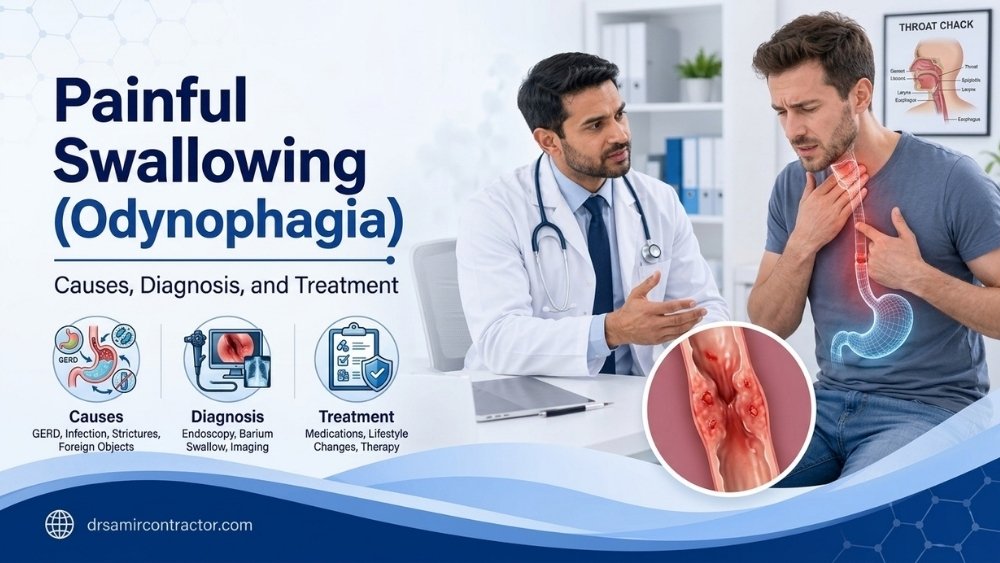
Painful swallowing - called odynophagia - is pain felt in the throat or chest during the act of swallowing food or liquid. It is different from difficulty swallowing, though both can occur together. It is caused by inflammation, infection, or damage to the lining of the food pipe or throat, and always needs evaluation when persistent or severe.
Quick Answers
Pain with swallowing is a symptom that is distinct from difficulty swallowing - though both can occur at the same time. When food or liquid passes through an inflamed, infected, or damaged segment of the throat or food pipe, it produces pain. This is odynophagia.
Understanding the cause matters because treatment is specific to it. Pain from severe GERD is managed differently from pain caused by an esophageal fungal infection - and both are managed very differently from pain caused by a tumour. An endoscopy is usually the most direct route to the answer.
What Is Painful Swallowing (Odynophagia)?
Odynophagia (pronounced oh-din-oh-FAY-jee-ah) means pain during the act of swallowing. The pain is triggered by the physical movement of food or liquid through the throat or esophagus. It is felt as a sharp, burning, or squeezing sensation - located at the throat, behind the breastbone, or in the chest - that occurs at the moment of swallowing and may linger briefly afterward.
Odynophagia vs. dysphagia - an important distinction
Odynophagia (Pain)
- Pain occurs during swallowing
- Swallowing itself may be mechanically normal
- Pain on contact of food/liquid with an inflamed area
- Caused by: infection, severe inflammation, pill injury, tumour
- Common in: immunocompromised patients, severe GERD
- Endoscopy shows: inflamed, ulcerated, or infected mucosa
Dysphagia (Difficulty)
- Food or liquid does not pass smoothly
- Sensation of sticking, resistance, or obstruction
- Swallowing is mechanically impaired
- Caused by: stricture, achalasia, motility disorder, cancer
- May not cause pain at all (e.g., stricture, achalasia)
- Endoscopy shows: narrowing, mass, or motility findings
Both can occur together - pain during swallowing that also sticks - which suggests inflammation or ulceration at a site of existing narrowing or structural change.
How Painful Swallowing Presents
The nature and location of the pain, and the symptoms that accompany it, help point toward the cause.
Description of the pain itself
- Sharp, stabbing, or burning pain triggered by each swallow
- Felt in the throat, mid-chest, or behind the lower breastbone
- May last a few seconds after swallowing before easing
- Often forces patients to slow down eating, eat only soft food, or avoid eating altogether
- May be present for liquids alone, or for all food types
Associated symptoms that guide the cause
- Heartburn and acid reflux - suggests severe GERD-related esophagitis
- White coating in the mouth or throat - suggests oral or esophageal candidiasis (fungal infection)
- Fever - suggests an infectious esophagitis
- Weight loss and progressive difficulty swallowing - raises concern for malignancy
- Recent medication use (NSAIDs, tetracycline, bisphosphonates, iron) - suggests pill-induced esophagitis
- Known diabetes, steroid use, or low immunity - increases risk of esophageal candidiasis
- History of chemotherapy or radiotherapy to the chest or neck - mucositis and radiation esophagitis are recognised causes
Painful swallowing in a diabetic patient - especially one with oral thrush (white patches in the mouth) - strongly suggests esophageal candidiasis. This is a specific, treatable condition that responds well to antifungal therapy. It should not be managed with antacids alone.
What Causes Painful Swallowing?
Common Treatable Causes
- Severe GERD-related esophagitis - acid burns the food pipe lining; causes painful swallowing alongside heartburn and reflux
- Esophageal candidiasis (fungal infection) - caused by Candida; common in diabetics, patients on steroids or antibiotics, and immunocompromised individuals. White plaques visible on endoscopy
- Pill-induced esophagitis - tablets lodging in the food pipe and dissolving there, causing a chemical burn. Common culprits: NSAIDs, tetracycline, doxycycline, bisphosphonates (for osteoporosis), iron tablets, aspirin, potassium chloride
- Eosinophilic esophagitis - allergic inflammation of the food pipe, causes painful swallowing alongside dysphagia; more common in younger patients with food allergies
- Infectious esophagitis (herpes simplex, CMV) - seen in immunocompromised patients; presents with severe pain, fever, and difficulty swallowing
- Post-endoscopic procedure soreness - temporary discomfort after instrumentation of the food pipe
- Tonsillitis / pharyngitis - throat infection causes pain on swallowing that is usually high up and associated with sore throat
Causes Requiring Prompt Evaluation
- Esophageal ulcers - from severe GERD, infections, or medications; visible on endoscopy and requiring targeted treatment
- Esophageal cancer - painful swallowing with progressive dysphagia and weight loss; needs urgent endoscopy and biopsy
- Radiation esophagitis - following radiotherapy to the chest or neck; can be severe and may require IV fluids or nutritional support
- Chemotherapy-induced mucositis - diffuse painful inflammation of the entire GI tract mucosa; managed with specialist input
- Caustic ingestion - accidental or intentional ingestion of acid or alkali; causes severe esophageal burns requiring urgent evaluation and specialised management
When Should You Worry? Red Flags
Seek prompt medical evaluation if painful swallowing:
- Is severe enough to prevent eating or drinking
- Occurs in a diabetic, someone on long-term steroids, or any immunocompromised patient - infection must be excluded
- Is accompanied by fever - suggests infectious esophagitis
- Is rapidly worsening over days
- Is associated with difficulty swallowing and weight loss - raises concern for malignancy
- Occurs after possible caustic ingestion - this is an emergency
- Is associated with vomiting blood or black stool - suggests esophageal ulcer or bleeding
- Has been present for more than 2-3 weeks without improvement
Painful swallowing in immunocompromised patients - including those with poorly controlled diabetes, patients on long-term steroids, or patients receiving chemotherapy - should always prompt early endoscopy. Esophageal infections in this group can progress rapidly.
Who Is at Higher Risk?
- Diabetic patients - poorly controlled diabetes impairs immune function, making esophageal candidiasis very common. One of the most important and frequently missed causes of painful swallowing in India
- Patients on long-term steroids - for asthma (including inhaled steroids), autoimmune conditions, or transplant immunosuppression. Steroid use promotes candida overgrowth in the food pipe
- People on antibiotics - long courses of antibiotics disrupt normal flora and allow candida to overgrow in the food pipe
- Patients with severe GERD - inadequately treated reflux causes grade C or D esophagitis, which is painful on swallowing
- Those taking NSAIDs, bisphosphonates, iron, or doxycycline - pill-induced esophagitis occurs when tablets are taken without enough water, or swallowed lying down
- Patients undergoing chemotherapy or radiotherapy - mucositis and radiation esophagitis cause significant odynophagia
- People with HIV or other immune deficiency - multiple esophageal infections (candida, herpes, CMV) are more common in this group
- Elderly patients - often take multiple medications, have reduced saliva, and are more prone to pill injury and infections
How Doctors Evaluate & Tests Needed
The history guides the initial assessment very effectively. Your doctor will ask:
- Where exactly is the pain - throat, chest, or behind the breastbone?
- Does it occur with every swallow, or only with solids or specific foods?
- Is there heartburn, reflux, or a history of GERD?
- Are there white patches in the mouth or throat?
- What medications are you currently taking - and how do you take them?
- Is there a history of diabetes, steroid use, or chemotherapy?
- Is there fever, weight loss, or difficulty swallowing alongside the pain?
- Has there been any possible ingestion of a caustic substance?
Examination will include inspection of the mouth and throat for white patches (candida), neck lymph nodes, and the overall nutritional status. The history often points strongly toward a specific cause before investigations are started.
Not every patient needs every test. Investigations depend on your age, symptom pattern, examination findings, and whether red flags are present.
Upper GI Endoscopy (most important)
Directly visualises the food pipe mucosa. Identifies the specific cause: grade of esophagitis, white plaques of candida, herpetic or CMV ulcers, eosinophilic esophagitis (vertical furrows, white exudates), pill-induced ulcers, or tumours. Biopsies and brushings can be taken during the same procedure - for culture, histology, and viral studies. Endoscopy is the investigation of choice for most patients with significant or persistent painful swallowing.
Blood tests
Blood glucose (diabetes screening), full blood count (immune function, anaemia), and specific viral studies when relevant. In immunocompromised patients, CMV and herpes PCR may be sent.
Barium swallow
Occasionally used when endoscopy is not immediately available or when a structural cause needs to be assessed. Not as sensitive as endoscopy for mucosal detail and does not allow biopsy.
Throat swab or oral swab
If oral candidiasis is visible and esophageal involvement is suspected, systemic antifungal treatment is started - a swab helps confirm the organism and guide treatment if standard therapy does not work.
Treatment Options
Treatment is cause-specific. This is why getting the right diagnosis by endoscopy is the essential first step. Starting treatment before knowing the cause risks inadequate management and delays resolution.
Cause-Specific Treatment Pathways
Eating with Painful Swallowing - Indian Guidance
- Choose soft, cool, non-acidic foods: Cold curd, cold curd rice, cold coconut water, banana, smooth khichdi, soft boiled potato (batata nu shak without spice), soft steamed vegetables
- Avoid: Very hot food and drinks - heat aggravates inflamed mucosa. Spicy, acidic, and oily food. Carbonated drinks. Raw onion and garlic. Citrus (nimbu, santara) during active pain
- Swallowing technique: Small bites, chew thoroughly, wash down with small sips of cool water between bites
- If drinking is painful: Sip cool fluids slowly - dehydration is a real risk if painful swallowing prevents adequate fluid intake. Seek medical care if fluid intake is inadequate for 24+ hours
- Tablets: Always take tablets upright, with a full glass of water. Remain sitting or standing for 30 minutes afterward. This simple habit prevents pill-induced esophagitis entirely in most cases.
When Is Surgery Needed?
Painful swallowing from the causes listed above is almost never treated with surgery directly. Surgery may become relevant in specific situations:
- Esophageal cancer causing odynophagia - surgical resection (esophagectomy) in suitable early-stage patients as part of curative treatment
- Caustic esophageal injury - severe chemical burns may require surgical reconstruction of the esophagus in the acute or late phase depending on the extent of damage
- Severe GERD with complicated esophagitis unresponsive to maximum medical therapy - laparoscopic fundoplication to address the root cause
- Stricture from healed esophageal ulceration - endoscopic dilation is first-line; surgery rarely needed
The vast majority of painful swallowing is managed with medication, dietary modification, and endoscopic procedures - surgery is the exception rather than the rule.
What Happens If Painful Swallowing Is Left Untreated?
- Untreated esophageal candidiasis - can spread beyond the esophagus in immunocompromised patients; causes systemic fungal infection which is serious and difficult to treat
- Severe esophagitis from GERD - progresses to ulceration, bleeding, stricture, and Barrett's esophagus if acid continues to damage the lining without treatment
- Pill-induced ulcers - can deepen and bleed; rarely perforate the esophagus in severe cases
- Inadequate nutrition and dehydration - painful swallowing that prevents eating and drinking leads to significant weight loss, weakness, and electrolyte imbalance - particularly dangerous in elderly patients and those with underlying illness
- Missed cancer - delayed endoscopy for painful swallowing with red-flag features risks diagnosing cancer at a more advanced stage
Recovery and What Patients Can Expect
days
wk
wk
wk
Frequently Asked Questions
Painful Swallowing in India - What Is Relevant for You
India-specific factors that make this symptom particularly important
- India has one of the highest prevalences of type 2 diabetes in the world - esophageal candidiasis is a common and frequently missed cause of painful swallowing in Indian diabetic patients. It is often managed with antacids for weeks before the correct diagnosis is made
- Inhaled corticosteroids are widely used for asthma across India - many patients are not counselled to rinse their mouth after use, leading to oral and esophageal candidiasis
- NSAIDs (ibuprofen, diclofenac, aspirin) are purchased without prescription across India and widely taken for pain without food or water - a common cause of pill-induced esophagitis and painful swallowing
- Bisphosphonates for osteoporosis are increasingly prescribed in India - improper technique (taking without water or without staying upright) causes esophageal ulceration
- GERD is highly prevalent in India, and inadequately treated reflux causing erosive esophagitis is a significant cause of odynophagia - particularly in urban patients with dietary and lifestyle risk factors
When and Where to Seek Care in Vadodara
If you are a diabetic patient with painful swallowing, or if your painful swallowing is persistent, worsening, or preventing adequate food and fluid intake - consult Dr Samir Contractor at Sterling Hospital, Vadodara. Upper GI endoscopy identifies the cause clearly and allows targeted treatment to be started immediately.
Treating candida esophagitis with antacids, or severe esophagitis with antifungals, leads to prolonged suffering and risk of complications. The right treatment starts with the right diagnosis.
Desi Patient Questions (Gujarati / Hinglish)
Ha - diabetics ma esophageal candidiasis khub common chhe. Aa fungal infection chhe jo antacid thi nathi sudhartu. Doctor endoscopy karshe, diagnosis confirm karshe, ane fluconazole antifungal thi treatment 3-5 din ma improvement aapé. Sugar control pan zaruri chhe recurrence avoid karva mate.
Ha - inhaled steroids thi gala ane food pipe ma candida thay shake chhe jyaré mouth rinse nathi kartu after each use. Ek simple solution: inhaler lidha pachhi tarat paani thi gargles karo ane mooa saf karo. Aa ek habit thi majority cases prevent thay chhe.
Ha - NSAIDs khali petey ya thoda paani sathe levathi esophagus ma ulcer bani shake chhe - pill-induced esophagitis. Always: tablet sathe pooru glass paani pio, upright raho 30 minutes, ane jyaré sako tyaré food sathe lo. Doctor ne pain killer about batavo jyaré swallowing problem discuss karo.
Mouth ma safed coating + painful swallowing = candida esophagitis most likely. Aa treatable chhe. Doctor ne immediately malsho - endoscopy ya empirical fluconazole treatment start thay chhe. Jyaré diabetes hoy ya steroids levo cho to particularly important chhe to get evaluated.
Bisphosphonates (osteoporosis tablets) esophagus ma chemical burn banavi shake chhe jyaré incorrect levay. Stop karjo ane doctor ne call karo. Future ma: khali pet, ek pooru glass paani sathe, upright 30 minutes raho, breakfast pehla levo. Correct technique thi aa completely preventable chhe.
Painful Swallowing Not Improving? Get the Right Diagnosis in Vadodara
Treating candida with antacids, or GERD with antifungals, prolongs suffering. Dr Samir Contractor provides upper GI endoscopy and targeted treatment for all causes of painful swallowing at Sterling Hospital, Vadodara.