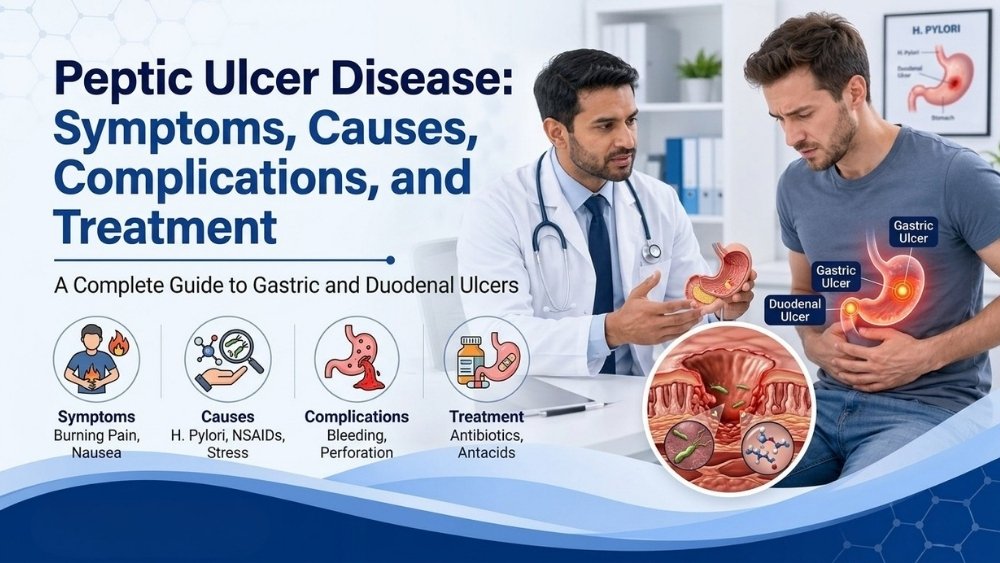
Peptic ulcer disease refers to open sores that form in the stomach lining (gastric ulcer) or the first part of the small intestine (duodenal ulcer). H. pylori infection and NSAID overuse are the two dominant causes in India. Most ulcers heal with medication. Complications - bleeding, perforation, obstruction - require urgent surgical intervention.
Quick Answers
A peptic ulcer is a break in the mucosal lining of the stomach or duodenum that penetrates through the protective layer into the underlying tissue. The ulcer forms when the balance between damaging factors (acid, pepsin, H. pylori, NSAIDs) and protective factors (mucus, bicarbonate, mucosal blood flow) is disrupted.
In India, peptic ulcer disease is extremely common - particularly duodenal ulcers driven by H. pylori and NSAID-related gastric ulcers from widespread over-the-counter analgesic use. The good news: when properly treated, most ulcers heal completely and permanently.
Gastric vs. Duodenal Ulcer - The Difference
Gastric Ulcer (Stomach)
- Located in the stomach lining
- More common above age 50
- Pain often worsens with eating
- More strongly associated with NSAIDs and alcohol
- Repeat endoscopy needed to confirm healing - cancer must be excluded
- Healing takes 8-12 weeks with PPI therapy
- Higher association with gastric cancer - all gastric ulcers must be biopsied
Duodenal Ulcer (Duodenum)
- Located in the first part of the small intestine
- More common in younger patients
- Pain often improves with eating (food buffers acid), returns 2-3 hours later
- More strongly associated with H. pylori infection
- Not a cancer risk - repeat endoscopy not mandatory if H. pylori eradicated
- Healing takes 4-8 weeks with PPI therapy
Symptoms of Peptic Ulcer Disease
- Gnawing, burning, or aching upper central abdominal pain - the classic ulcer pain
- Duodenal ulcer: pain 2-3 hours after meals or at night; briefly relieved by eating or antacids
- Gastric ulcer: pain during or immediately after eating; may worsen with food
- Nausea and vomiting in some patients
- Loss of appetite - particularly with gastric ulcers
- Dark or black tarry stool (melaena) - from upper GI bleeding
- Vomiting blood or coffee-ground material - from significant bleeding
- Sudden severe abdominal pain with rigid abdomen - perforation (emergency)
- Progressive vomiting after meals with weight loss - gastric outlet obstruction
Many peptic ulcers - particularly in patients taking NSAIDs and in the elderly - are "silent" and present only when a complication (bleeding, perforation) develops without warning. This is why NSAID users with known risk factors should be co-prescribed PPIs as a protective measure.
Causes of Peptic Ulcer Disease
- H. pylori infection - responsible for 70-80% of duodenal ulcers and 60-70% of gastric ulcers globally. India's high H. pylori prevalence (40-60%) makes this the most important cause locally. H. pylori disrupts the mucosal defence layer and promotes acid secretion.
- NSAIDs and aspirin - inhibit cyclooxygenase (COX) enzymes, reducing prostaglandin synthesis. Prostaglandins are crucial for mucosal protection (mucus and bicarbonate secretion). NSAID-induced ulcers are often silent until they bleed.
- Stress ulcers - in critically ill patients (ICU, major surgery, burns, head injury). Managed with prophylactic PPIs.
- Alcohol and smoking - impair mucosal defence; smoking specifically delays ulcer healing and increases recurrence
- Zollinger-Ellison syndrome - a rare gastrin-secreting tumour (gastrinoma) that causes massive acid hypersecretion and multiple, recurrent, refractory peptic ulcers. Suspected when ulcers recur despite adequate treatment and H. pylori is negative.
Complications - Red Flags and Emergencies
Perforation
- Sudden, severe abdominal pain - "like a knife"
- Abdomen becomes rigid and board-like
- Rapid deterioration, collapse
- Surgical emergency - immediate repair needed
- Laparoscopic or open surgery
Bleeding
- Black, tarry stool (melaena)
- Vomiting blood or coffee grounds
- Dizziness, weakness from blood loss
- Endoscopic haemostasis first-line
- Surgery if endoscopy fails
Gastric Outlet Obstruction
- From chronic scarring at pylorus
- Persistent vomiting of food after meals
- Weight loss, dehydration
- Endoscopic balloon dilation or surgery
Seek emergency care if peptic ulcer patient has:
- Sudden severe abdominal pain with a rigid abdomen - perforation
- Black, tarry stool or vomiting blood - significant bleeding
- Persistent vomiting of food with progressive weight loss - obstruction
- Collapse, dizziness, or very pale appearance with abdominal pain - acute blood loss
Diagnosis
Upper GI Endoscopy - definitive
Directly visualises the ulcer - size, location, depth, base (clean base vs. active bleeding vs. visible vessel). Biopsies from all gastric ulcers to exclude malignancy and test for H. pylori. Repeat endoscopy at 8 weeks for gastric ulcers to confirm healing and exclude cancer. Treatment (haemostasis, epinephrine injection, clip application) can be performed at the same session for bleeding ulcers.
H. pylori testing
Urea breath test, stool antigen, or endoscopic biopsy. Essential in all peptic ulcer patients.
CT scan of abdomen
For suspected perforation - free air under the diaphragm confirms perforation on CT. Also for staging if malignancy is identified on endoscopic biopsy.
Fasting serum gastrin
When Zollinger-Ellison syndrome is suspected - multiple recurrent ulcers, ulcers in unusual locations, failed standard therapy in H. pylori-negative patients.
Treatment
Uncomplicated peptic ulcer
- H. pylori eradication if positive - 14-day course. This is the single most important treatment. Eradication heals the ulcer and prevents recurrence in the vast majority of H. pylori-positive patients.
- PPI therapy - 4-8 weeks. Gastric ulcers: 8-12 weeks. Duodenal ulcers: 4-6 weeks. PPI taken 30-60 minutes before breakfast.
- Stop NSAIDs - mandatory where clinically possible. Switch to paracetamol. If NSAIDs must be continued, co-prescribe PPI indefinitely.
- Stop alcohol and smoking - both impair ulcer healing and promote recurrence.
- Confirm H. pylori eradication - urea breath test 4-6 weeks after completing eradication therapy.
- Confirm gastric ulcer healing - repeat endoscopy at 8 weeks to confirm healing and exclude malignancy.
Complicated peptic ulcer - surgical and endoscopic management
- Bleeding ulcer - endoscopic haemostasis (adrenaline injection, clipping, thermocoagulation) - controls bleeding in 80-90% of patients. Repeat endoscopy if rebleeding. Surgery for failed endoscopic haemostasis.
- Perforated ulcer - laparoscopic or open Graham patch repair (closure of perforation with omental patch). IV antibiotics, IV fluids started immediately. Highly time-sensitive - outcomes depend on speed of surgical intervention.
- Gastric outlet obstruction - endoscopic balloon dilation for pyloric stenosis from ulcer scarring. Surgical pyloroplasty or gastrojejunostomy when dilation fails or obstruction is fixed.
Dietary Guidance During Peptic Ulcer Treatment
- Eat regularly: Small, frequent meals. An empty stomach allows acid to act directly on the ulcer - regular eating buffers acid continuously
- Best choices: Plain khichdi, soft dal, curd, banana, soft roti with light sabzi, boiled potato, coconut water
- Strictly avoid: NSAIDs taken without food; alcohol; very spicy food; excess tea and coffee on empty stomach; smoking
- Note: The old "bland diet" advice is no longer mandatory - avoid foods that personally trigger pain, but a specific restrictive diet is not necessary for ulcer healing in most patients. Medication and H. pylori eradication do the healing.
What Happens If Peptic Ulcers Are Left Untreated?
- Continued pain and quality of life impairment
- Progression to complications - bleeding (can be life-threatening), perforation (surgical emergency), obstruction
- Gastric cancer risk - all gastric ulcers carry a small malignancy risk; H. pylori gastritis with ulcers carries a long-term cancer risk that eradication reduces
- NSAID-induced ulcers, if NSAIDs are continued without PPI co-prescription, progress to dangerous bleeding - often without warning symptoms
Frequently Asked Questions
Peptic Ulcer Disease in India
India-specific context
- H. pylori-driven duodenal ulcer disease is extremely prevalent in India - and many patients are managed for years with antacids without testing or treating H. pylori, allowing recurrence
- NSAID-related gastric ulcers are increasing in India with the widespread over-the-counter availability and use of ibuprofen and diclofenac without food or PPI co-therapy
- Perforated peptic ulcer remains one of the most common emergency surgical conditions managed by upper GI surgeons in India - often in young patients who had no prior symptoms
- Belief that "milk helps ulcers" is culturally entrenched - patients often delay proper treatment hoping milk consumption will resolve their symptoms
Seek Care in Vadodara
For peptic ulcer diagnosis, H. pylori testing, endoscopic treatment of bleeding ulcers, or emergency perforated ulcer surgery - Sterling Hospital, Vadodara under Dr Samir Contractor's care.
Desi Patient Questions
Perforated ulcer = surgical emergency. Immediate laparoscopic ya open repair zaruri chhe - delay = peritonitis ane danger. Same day surgery. Post-surgery H. pylori eradication ane PPI therapy recurrence prevent kare chhe. Speed matters - jaldi hospital javo.
Na - doodh temporarily neutralize kare chhe pan pachhi vadhare acid produce kare chhe. Old concept chhe - proven nathi. Real treatment: H. pylori eradication (14 days), PPI therapy, NSAIDs band. Doctor sathe discuss karo - milk na pivo instead of treatment.
Na - khaalo tarry stool (melaena) upper GI bleeding chhe. Hospital javo immediately - endoscopy thi bleeding stop kari shakay chhe most cases ma. Blood loss severe hoi shake chhe jyaré wait karo. Aa emergency chhe.
Peptic Ulcer Symptoms? Get Properly Evaluated and Treated in Vadodara
Endoscopy, H. pylori testing, and emergency surgical management - all at Sterling Hospital, Vadodara under Dr Samir Contractor.