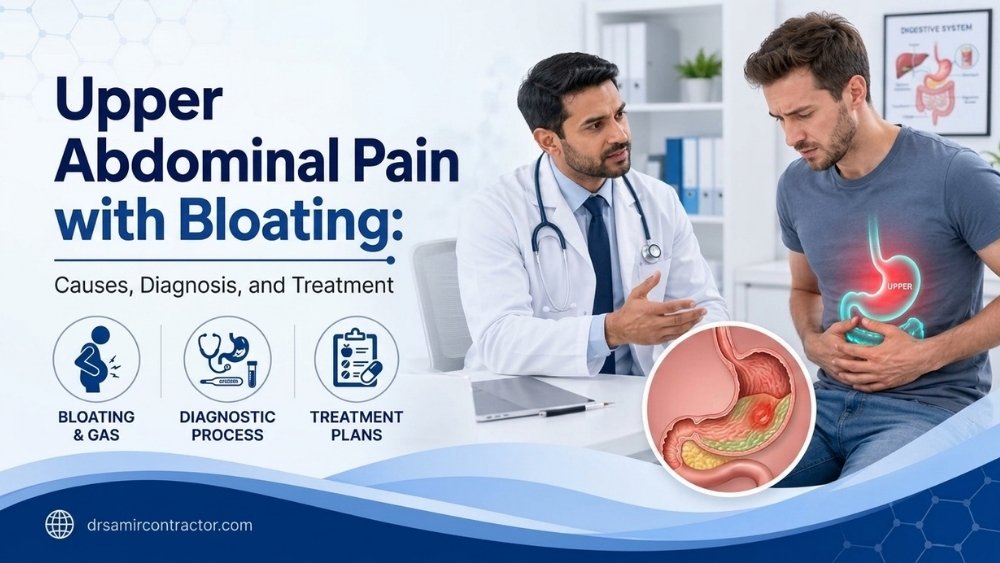
Upper abdominal pain combined with bloating - feeling tight, full, or gassy in the upper abdomen - is one of the most common symptom clusters seen in GI practice in India. The combination points toward the stomach, gallbladder, or functional GI tract. Most causes are manageable with dietary change and medication, but certain patterns need urgent investigation.
Quick Answers
Upper abdominal pain and bloating together are extremely common in India - and the cause is almost always in the stomach, gallbladder, or functional GI system. The pattern of pain (location, timing relative to meals, character) combined with the bloating helps narrow the cause significantly before any investigation.
The key diagnostic question with this cluster is: does the pain occur in the centre (suggesting stomach or pancreas), or in the right upper quadrant (suggesting gallbladder)? And does it worsen specifically after fatty food (gallbladder) or is it more general (functional, gastritis)?
What the Combination Means - Four Common Diagnostic Scenarios
Functional Dyspepsia
- Central upper pain + bloating after meals
- No specific food trigger
- Stress commonly worsens it
- Endoscopy usually normal
- H. pylori may or may not be present
- Manages with diet, prokinetics, PPI
Gallstones / Biliary Dyspepsia
- Right upper pain + bloating after fatty meal
- 30-60 min delay after eating
- May radiate to right shoulder
- Ultrasound shows stones
- Laparoscopic cholecystectomy is curative
H. pylori Gastritis
- Upper central pain + bloating
- Nausea after meals
- Partially responds to antacids
- Never fully resolves until H. pylori treated
- Breath test confirms diagnosis
- 14-day eradication resolves most cases
GERD / Esophagitis
- Upper central / lower chest pain + bloating
- Burning quality - heartburn overlap
- Worse after oily meals and lying down
- PPIs help significantly
- Endoscopy shows esophagitis or hiatal hernia
Typical Symptoms of This Cluster
- Aching, cramping, or pressure-like pain in the upper abdomen - centre or right side
- Sense of abdominal tightness or swelling after eating
- Excessive belching - attempts to relieve the distension
- Nausea after meals, especially heavy or oily food
- Relief of pain with belching or passing gas in some patients
- Symptoms clearly triggered or worsened by specific foods - oily food (gallbladder), spicy food (gastritis), large meals (functional)
- Heaviness in the upper abdomen that persists for 1-3 hours after eating
Right upper abdominal pain that specifically worsens 30-60 minutes after a fatty meal - and may radiate to the right shoulder - is the classic gallstone (biliary colic) pattern. This should be investigated with an ultrasound regardless of other symptoms.
Common Causes
- Functional dyspepsia - impaired gastric accommodation and motility; post-meal pain with bloating, no structural abnormality on endoscopy
- Gallstones - right upper pain with bloating after fatty meals; biliary colic pattern; diagnosed by ultrasound
- H. pylori gastritis - burning upper central pain, bloating, nausea; responds partially to antacids but fully only with eradication
- GERD - lower chest and upper abdominal pain with bloating and heartburn
- Peptic ulcer - gnawing upper central pain, may improve briefly then worsen with food (gastric ulcer) or improve with food (duodenal ulcer)
- Chronic dyspepsia with gastric outlet impairment - pain and bloating lasting hours, sometimes with nausea and early satiety
- Gas and functional bloating - dietary (rajma, chole, cabbage, carbonated drinks) without underlying disease
- Acute pancreatitis (severe) - severe central upper pain radiating to back with bloating and vomiting - needs urgent evaluation
Red Flags
Seek urgent evaluation if pain with bloating is associated with:
- Fever - suggests infection (cholecystitis, cholangitis, pancreatitis)
- Jaundice (yellow eyes/skin) - suggests bile duct obstruction
- Severe, constant pain radiating to the back - pancreatitis
- Vomiting blood or black stool
- Unintended weight loss
- Rigid or board-like abdomen - surgical emergency
- New onset in a person above 45
Tests That May Be Needed
Not every patient needs every test. Investigations depend on age, symptom pattern, and red-flag features.
H. pylori testing
Urea breath test or stool antigen. Performed early in India given 40-60% prevalence. Eradication is highly effective and resolves symptoms in positive patients.
Ultrasound abdomen
The most useful imaging for this cluster - identifies gallstones, cholecystitis, pancreatic abnormality, and liver pathology quickly and safely.
Upper GI Endoscopy
When symptoms persist beyond 4-8 weeks of treatment, when red flags are present, or when peptic ulcer or gastric cancer needs to be excluded.
Blood tests
Full blood count, liver function, amylase (pancreatitis), and blood glucose. Performed alongside ultrasound when the cause is unclear from history alone.
Treatment
- Functional dyspepsia: Dietary changes (smaller meals, reduce oily food), PPI therapy, prokinetics, H. pylori eradication if positive
- Gallstones: Low-fat diet for symptom control; laparoscopic cholecystectomy for definitive treatment - prevents recurrent biliary colic and complications
- H. pylori gastritis: 14-day eradication course; most patients achieve complete symptom resolution
- GERD: PPI therapy (correctly timed), lifestyle modification, alginate antacid
- Peptic ulcer: H. pylori eradication if positive; PPI therapy for 4-8 weeks; stop NSAIDs
- Simple gas and bloating: Dietary modification - reduce rajma, chole, cabbage, carbonated drinks; simethicone for immediate relief
Indian Dietary Guidance for Upper Pain with Bloating
- Gallstones pattern: Avoid oily and fried food - bhajia, samosa, puri, ghee-heavy curries directly trigger biliary colic
- Gastritis / dyspepsia pattern: Smaller meals, avoid chai on empty stomach, reduce spicy preparation methods, choose soft khichdi and dal over heavy thali
- Gas and bloating: Reduce rajma, chole, whole urad dal, cabbage, cauliflower; avoid carbonated drinks; jeera water and saunf water help settle functional gas
- After meals: A short 10-minute walk helps gastric motility and reduces bloating. Avoid lying down for 1-2 hours after eating.
What If Ignored?
- Gallstones left untreated progress to cholecystitis, bile duct obstruction, and pancreatitis - all requiring more urgent and complex management than elective cholecystectomy
- H. pylori gastritis untreated progresses to peptic ulcer and carries a long-term gastric cancer risk
- Functional dyspepsia chronically reduces quality of life, eating habits, and nutritional status
- Missed early gastric cancer - persistent upper pain and bloating in a patient above 45 without endoscopy risks late diagnosis
Frequently Asked Questions
This Cluster in India
India-specific factors
- Gallstones are extremely common in Indian women - right upper pain with bloating after oily Gujarati cooking is the most common presentation in Dr Samir's outpatient practice
- H. pylori prevalence of 40-60% makes gastritis-related upper pain and bloating very common - and very treatable once tested and eradicated
- Gas-forming Indian foods - rajma, chole, whole urad dal, cabbage - directly cause this symptom cluster in patients with functional GI hypersensitivity
Seek Care in Vadodara
Recurring upper abdominal pain with bloating - particularly after meals - should be evaluated with ultrasound and H. pylori testing at minimum. Dr Samir Contractor provides complete upper GI evaluation at Sterling Hospital, Vadodara.
Desi Patient Questions
Fatty food pachhi right upper pain + bloating = gallbladder pattern likely. Ultrasound karo - gallstones 30 minute ma confirm thay. Low-fat diet for now, ane jyaré confirmed hoy to laparoscopic surgery best option chhe recurrence prevent karva.
Rajma-chole fermentable carbs chhe - gas production normal chhe. Pan excessive hoy to: soak karjo, cooking water discard, well-cook karo. Doctor consultation jyaré consistently pain hoy - H. pylori test ane ultrasound rule out karva joiye underlying cause.
Ha - turant javo. Fever + jaundice + upper pain = bile duct obstruction or cholangitis - serious condition. Hospital evaluation, blood tests, ultrasound, ane possibly ERCP. Delay dangerous chhe.
Upper Abdominal Pain with Bloating? Identify the Cause in Vadodara
Ultrasound, H. pylori testing, and endoscopy - all available at Sterling Hospital, Vadodara under Dr Samir Contractor's care.