Acid reflux symptoms that keep returning despite antacids and PPI tablets are not a sign that the medicines are too weak. They are a sign that the underlying cause has not been properly identified or addressed. This page explains the four main reasons why reflux treatment fails - and what proper evaluation and treatment actually looks like.
Quick Answers
"I have tried every acidity medicine and nothing works long-term." This is one of the most common presentations in upper GI practice. Patients have self-medicated with antacids for months or years, then moved to PPIs, tried different brands, added H2 blockers at night - and still experience regular heartburn, regurgitation, and post-meal discomfort. The instinct is to look for a stronger medicine. The correct instinct is to ask: why is the treatment not working?
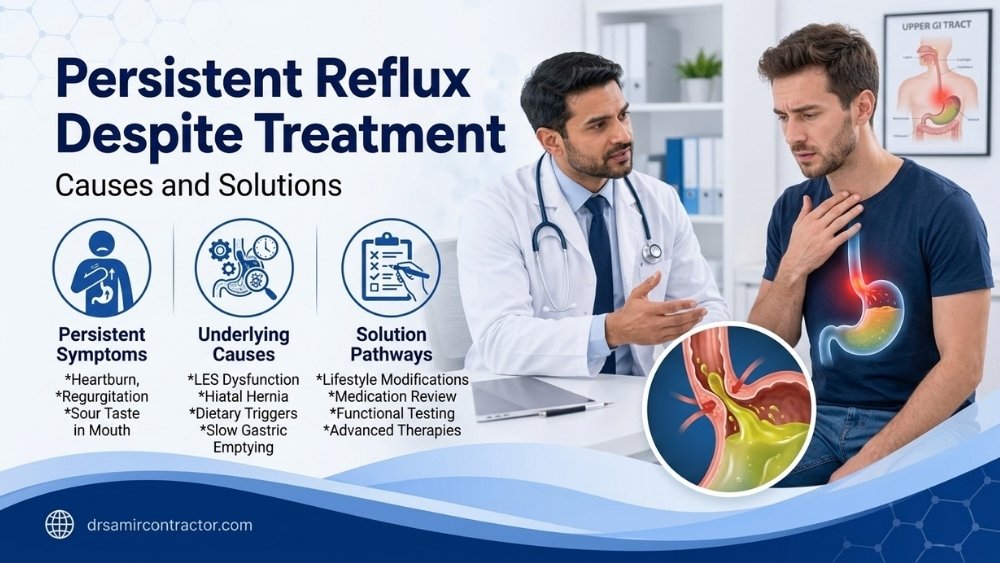
Persistent reflux despite treatment is a clinical pattern that indicates either the treatment has been inadequate, the diagnosis is incorrect, or a structural cause has not been identified. This page walks through each reason systematically.
Four Reasons Reflux Treatment Fails
Medicine Taken Incorrectly
- PPI taken after food instead of 30-60 min before breakfast
- Once-daily dose when twice-daily is needed
- Short 1-2 week courses instead of 4-8 weeks
- Antacid alone instead of PPI for established GERD
- Dose too low for symptom severity
Wrong Diagnosis
- Bile reflux - alkaline, PPIs have no effect
- Non-acid reflux - reflux without high acid
- Functional dyspepsia - not acid-driven
- Eosinophilic esophagitis - allergic, needs steroids
- Achalasia - motility disorder, not reflux
- Cardiac or musculoskeletal chest pain
Structural Cause Not Addressed
- Hiatal hernia displacing the anti-reflux valve
- Severely incompetent LES not responsive to medication
- Barrett's esophagus requiring surveillance
- Grade C-D esophagitis needing higher-dose treatment
Lifestyle Triggers Continuing
- Late-night large meals unchanged
- Central obesity - not addressed
- Smoking - directly weakens LES
- NSAIDs continuing to cause damage
- Oily, spicy food and chai on empty stomach
In most patients with persistent reflux despite treatment, at least two of these four categories apply simultaneously. Addressing the medicine timing alone - without identifying a structural cause or changing lifestyle - provides only partial improvement.
What Patients With This Cluster Experience
- Heartburn and chest burning returning within days of stopping medication
- Regurgitation persisting even while on PPIs
- Night-time waking with burning or liquid in the mouth despite antacids at bedtime
- Medication giving partial relief that is never complete
- Symptoms requiring ever-increasing medication to manage
- Cough, hoarseness, or throat symptoms that do not respond to reflux medication
Red Flags Within This Cluster
Escalate evaluation urgently if persistent reflux also has:
- Difficulty swallowing - structural complication (stricture) developing
- Weight loss - inadequate food intake or serious underlying cause
- Blood in vomit or black stool - bleeding ulcer or esophageal damage
- 5+ years of symptoms without a single endoscopy - Barrett's esophagus must be excluded
- New onset above 45 - cancer must be excluded before managing as reflux
The Systematic Evaluation Approach
When Surgery Provides a Lasting Solution
Laparoscopic fundoplication is the right treatment for a specific, well-defined group of GERD patients:
- Confirmed esophagitis or hiatal hernia on endoscopy
- Pathological acid exposure confirmed on 24-hour pH monitoring
- Adequate esophageal motility confirmed on manometry (ensures the surgery will work)
- Symptoms not adequately controlled on optimised PPI therapy
- Patient prefers definitive surgical solution over lifetime medication
For this correctly selected patient, laparoscopic fundoplication provides long-term symptom control - with most patients stopping or significantly reducing PPIs within 3 months of surgery. The operation takes 1-2 hours, hospital stay is 1-2 days, and most patients return to normal activity within a week.
Surgery should never be performed based on symptoms alone - objective documentation of GERD is mandatory. This protects patients from surgery that will not help them.
Frequently Asked Questions
This Cluster in India
Why persistent reflux despite treatment is so common in India
- PPI taken after food is the most common and most easily correctable reason for treatment failure in Indian patients - a simple timing correction produces dramatic improvement
- H. pylori untreated in 40-60% of the population means many patients taking PPIs have an additional untreated infection driving their symptoms
- Hiatal hernia - a common structural cause - is frequently missed in India because patients are never referred for endoscopy
- NSAIDs (ibuprofen, diclofenac) taken alongside PPIs continue to damage the stomach lining, preventing effective treatment
Seek Care in Vadodara
If reflux has persisted despite 8+ weeks of medication - consult Dr Samir Contractor at Sterling Hospital, Vadodara. Endoscopy, H. pylori testing, pH monitoring, and surgical evaluation are available together to identify what standard treatment is missing.
Desi Patient Questions
First: confirm karo ke tablet 30-60 min before breakfast levay chhe, food pachhi nahi. Second: H. pylori test karo. Third: endoscopy karo - hiatal hernia detect thaay to surgery meaningful option chhe. Symptoms alone thi surgery decide nathi thatu - proper workup first.
Bile reflux na liye PPIs work nathi kartta - bile alkaline chhe. Ursodeoxycholic acid, alginates, ane prokinetics bile reflux mate specific treatment chhe. Gastroenterologist ne malsho - endoscopy confirm karshe ane correct treatment guide karshe.
Reflux That Won't Stop Despite Tablets? Get a Proper Evaluation in Vadodara
Persistent reflux means the cause has not been found. Dr Samir Contractor provides endoscopy, H. pylori testing, pH monitoring, and surgical consultation - all at Sterling Hospital, Vadodara.