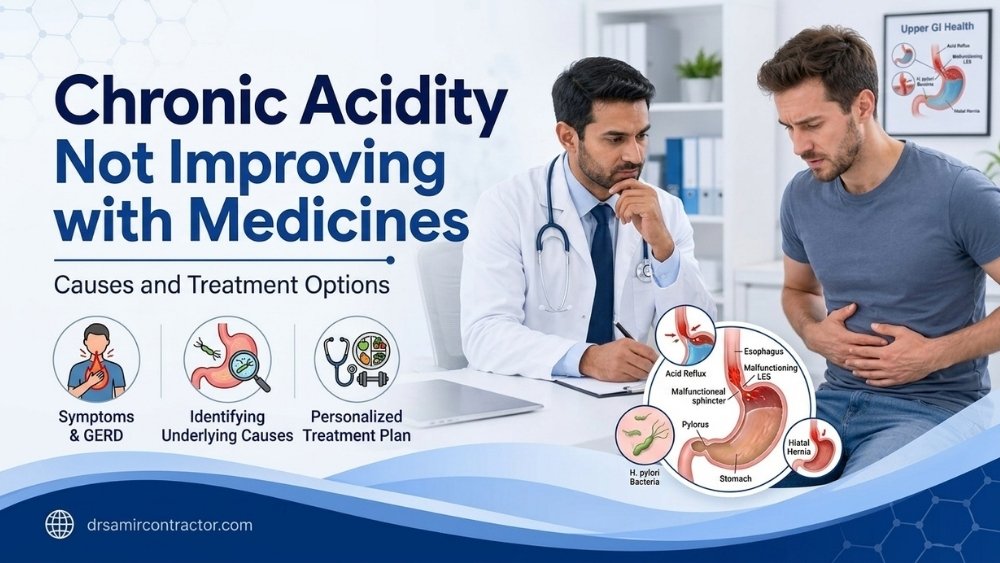
If you have been taking acidity medicines - antacids, omeprazole, pantoprazole, or ranitidine - for weeks or months with little lasting relief, the problem is not that the medicines are too weak. The problem is that the cause of your symptoms has not been properly identified. Persistent acidity despite medication always deserves a proper evaluation - not a stronger tablet.
✦ Quick Answers
"I have been taking acid tablets for years and nothing works." This is one of the most common statements heard in a GI outpatient clinic in India. Patients try antacids, then graduate to omeprazole or pantoprazole, add ranitidine at night, try multiple brands, take double doses - and still feel burning, bloating, and discomfort after every meal.
The issue is almost never that the medicines are not strong enough. The issue is that the diagnosis is incomplete. Persistent acidity despite medication is the body's way of signalling that something has not been correctly identified or addressed. This page explains the most common reasons why acidity tablets fail - and what a proper evaluation actually involves.
Why Acidity Medicines Often Fail
There are four main categories of reasons why "acidity" does not improve with medicines. Identifying which applies to you is the starting point of proper management.
Wrong Diagnosis
- The symptom is not actually from acid
- Functional dyspepsia - not acid-driven
- Bile reflux - alkaline, not acid
- Eosinophilic esophagitis - allergic
- Non-acid GERD - reflux without high acid
- Cardiac or musculoskeletal chest pain
Incorrect Medicine Use
- PPIs taken after meals instead of 30-60 mins before
- Taken on empty stomach only once when twice-daily needed
- Antacid used as the only treatment for GERD
- Treatment course not completed (4-8 weeks minimum)
- Switched brands without completing the course
Untreated Underlying Cause
- H. pylori infection never tested or treated
- Hiatal hernia not identified
- Peptic ulcer not diagnosed
- Barrett's esophagus or esophagitis - needs endoscopy
- NSAID or other medication continuing to cause damage
Lifestyle Triggers Continuing
- Late-night meals unchanged
- Oily and spicy food not reduced
- Tea on empty stomach still daily
- Overweight - not addressed
- Stress not managed
- Smoking or alcohol continuing
What Patients With Persistent Acidity Experience
The typical chronic pattern
- Burning in the chest or upper abdomen - present most days despite medicines
- Sour taste in the mouth - particularly in the morning
- Belching, bloating, and heaviness after meals
- Temporary relief with antacids that lasts only 1-2 hours
- Symptoms returning quickly after stopping or missing a dose
- Nighttime burning that disturbs sleep
- Chronic dry cough or throat clearing not explained by respiratory cause
- Hoarse voice in the mornings
Clues that suggest the diagnosis is not simple GERD
- Pain or burning that does not change with PPIs at all - suggests functional dyspepsia, bile reflux, or a non-acid cause
- Improvement with eating, worsening on empty stomach - suggests peptic ulcer (duodenal) rather than GERD
- Predominantly upper abdominal pain without chest burning - suggests dyspepsia or ulcer rather than esophageal GERD
- Food sticking or pain on swallowing - suggests eosinophilic esophagitis or stricture
- Symptoms clearly worse with specific foods not typically acid-triggering - may indicate eosinophilic esophagitis or bile reflux
Common Causes of Persistent Acidity Despite Medicines
✓ Treatable Causes Often Missed
- H. pylori infection not tested or treated - H. pylori gastritis causes burning, bloating, and upper GI discomfort that does not fully respond to PPIs. Eradication often resolves symptoms permanently. One of the most common missed diagnoses in India
- Functional dyspepsia - upper GI symptoms from gastric hypersensitivity and impaired motility; not acid-driven. PPIs help partially but do not fully address the underlying mechanism. Prokinetics, low-dose neuromodulators, and dietary change are key
- Bile reflux - bile from the small intestine refluxing into the stomach and esophagus; alkaline, not acidic. PPIs have no effect on bile - the burning and bitterness does not respond to acid medicines. Diagnosed by endoscopy or bile acid testing
- Eosinophilic esophagitis - allergic inflammation of the food pipe causing heartburn-like symptoms and food sticking. Partially responds to PPIs but requires dietary elimination and swallowed steroids for adequate control
- Non-acid or weakly-acidic reflux - reflux events that occur despite PPIs reducing acid; these weakly acidic episodes still cause symptoms. Diagnosed by impedance-pH monitoring. May respond to dietary and positional measures more than medication changes
- Incorrect PPI timing - PPIs must be taken 30-60 minutes before the first meal of the day to be effective. Taking them after food, at bedtime only, or intermittently significantly reduces efficacy
- Hiatal hernia not identified - structural cause of GERD that does not fully resolve with medication alone. Needs surgical correction in symptomatic cases
Causes That Need Evaluation to Exclude
- Barrett's esophagus - precancerous change requiring surveillance endoscopy; may present as refractory heartburn
- Esophageal cancer - "acidity" in a patient above 45 that does not respond to treatment may be the first symptom of esophageal or gastric cancer. Endoscopy is essential to exclude this
- Cardiac cause - chest pain from a cardiac source that is being managed as acidity. An ECG and cardiac review must be performed before assuming all chest discomfort is GI
- Peptic ulcer disease - may partially respond to PPIs but not fully resolve without H. pylori eradication or NSAID cessation. Endoscopy confirms diagnosis and allows biopsies
When Should You Worry? Red Flags
Seek urgent evaluation if persistent acidity is associated with:
- Difficulty swallowing or food sticking in the throat or chest
- Unintended weight loss - even gradual
- Vomiting blood or material that looks like coffee grounds
- Black, tarry, or bloody stool
- New-onset symptoms in a person above 45 who has never had acidity before
- Symptoms that have progressively worsened despite treatment
- Persistent vomiting associated with the acidity
- Chest pain with sweating or breathlessness (rule out cardiac cause first)
- Chronic symptoms lasting more than 5 years without a single endoscopy
The most dangerous pattern is: long-standing "acidity" in a patient above 45 who has never had an endoscopy. This is not a safe situation. An endoscopy identifies Barrett's esophagus, gastric cancer, or serious esophageal pathology - all of which can develop silently under the cover of chronic reflux symptoms.
Who Is Most Likely to Have Persistent Acidity?
- Overweight individuals - central obesity directly increases GERD pressure. Medication reduces symptoms but cannot overcome the mechanical problem of abdominal fat
- Those with a large hiatal hernia - structural GERD never fully responds to medication alone; surgical correction is needed in many cases
- H. pylori-positive patients who have never been tested or treated - perhaps the most common scenario in India - suffering from H. pylori gastritis for years while taking antacids
- People taking NSAIDs or aspirin regularly - these medications damage the stomach lining and reduce the effectiveness of acid suppression. Symptoms continue as long as the offending drug continues
- Smokers - nicotine directly relaxes the lower esophageal sphincter, perpetuating reflux regardless of medication
- Those with functional dyspepsia - this condition is not acid-driven; PPIs help partly but prokinetics, neuromodulators, and dietary change are the more relevant treatments
- Patients taking PPIs incorrectly - a very common but easily correctable problem; PPIs taken after food or irregularly are significantly less effective
A Systematic Approach to Evaluating Persistent Acidity
When a patient presents with acidity that has not responded to medicines, a proper evaluation follows a systematic checklist - rather than simply prescribing a different or stronger tablet.
Tests That May Be Needed
Not every patient needs every test. Investigations depend on your age, symptom pattern, examination findings, and whether red flags are present.
H. pylori testing (essential in India)
Urea breath test, stool antigen, or endoscopic biopsy. H. pylori testing should be performed in virtually every patient with persistent dyspepsia or reflux in India before long-term PPI use is continued. Eradication therapy - a 14-day combination course - resolves symptoms in a high proportion of positive patients without the need for ongoing medication.
Upper GI Endoscopy
The single most important investigation when acidity has not improved after 4-8 weeks of properly taken medication. Directly examines the food pipe and stomach. Identifies esophagitis, hiatal hernia, Barrett's esophagus, bile reflux (greenish bilious pool in stomach), eosinophilic esophagitis features, peptic ulcers, and malignancy. Allows biopsies for H. pylori, histology, and eosinophil counts.
24-hour pH impedance monitoring
When endoscopy is normal but symptoms persist on adequate PPI therapy, pH impedance monitoring determines whether reflux - acidic or non-acidic - is occurring and whether it correlates temporally with symptoms. This is the diagnostic test of choice for refractory GERD when endoscopy has not explained the symptoms.
Esophageal manometry
Measures esophageal muscle pressure and coordination. Important before surgical anti-reflux procedures to confirm the diagnosis of GERD and to rule out an esophageal motility disorder that would contra-indicate fundoplication.
Blood tests and ECG
Full blood count (anaemia), kidney and liver function, and fasting glucose. An ECG and cardiac evaluation must be included when chest discomfort is a prominent symptom - to exclude a cardiac cause before long-term GI management is pursued.
What Actually Works: Treatment Pathways
The goal is to identify the specific cause of treatment failure and address it precisely - not to escalate medication indefinitely.
Structured Treatment After Proper Evaluation
- 1️⃣ Correct PPI Use - Immediately: Take the PPI 30-60 minutes before breakfast (and before dinner if twice-daily dosing is needed). This alone significantly improves response rates in patients taking PPIs incorrectly. Review dose adequacy with your doctor.
- 2️⃣ H. pylori Eradication if Positive: 14-day triple or quadruple therapy (antibiotics + PPI). Confirm eradication by breath test 4-6 weeks after completing. This resolves symptoms permanently in many patients and is the most evidence-based step for H. pylori-positive dyspepsia and ulcer disease in India.
- 3️⃣ Add Prokinetics for Motility Component: If post-meal fullness, bloating, and nausea accompany the burning - prokinetics (domperidone, itopride) improve gastric emptying and accommodation, addressing the functional dyspepsia component that PPIs alone cannot treat.
- 4️⃣ Treat Bile Reflux Specifically: Bile reflux does not respond to PPIs. Ursodeoxycholic acid, prokinetics, and alginates are used. In severe cases, surgical correction (partial gastrectomy with Roux-en-Y reconstruction) redirects bile away from the stomach.
- 5️⃣ Surgical Anti-Reflux Procedure for Confirmed GERD with Hiatal Hernia: When endoscopy confirms esophagitis or hiatal hernia, manometry confirms poor sphincter function, and pH study confirms pathological acid reflux - laparoscopic fundoplication provides durable, long-term relief. Surgery is appropriate for patients who require indefinite high-dose PPI therapy, cannot tolerate medication, or have significant structural GERD.
Lifestyle Changes That Make Medication Work Better
- PPI timing: Always 30-60 minutes before breakfast. This is the most important technique change for patients whose PPIs are "not working"
- Stop eating 2-3 hours before sleep: Moving dinner earlier dramatically reduces nighttime symptoms, especially in patients who eat at 9-10 PM and sleep at 11 PM - a common Gujarati pattern
- Weight loss: Even 5 kg weight loss significantly reduces reflux pressure and improves medication effectiveness in overweight patients
- Stop or reduce: Chai on empty stomach, very oily or spicy food, alcohol, smoking. These directly reduce lower esophageal sphincter pressure
- Elevate head of bed: A wedge pillow or raising the bed head by 15-20 cm reduces nighttime acid exposure. Adding extra pillows under the head alone does not work - the entire upper body needs elevation
- Review all medicines with your doctor: NSAIDs, certain blood pressure drugs, and some antidepressants worsen reflux. A medication review is part of managing refractory GERD
When Is Surgery the Right Choice?
Surgery for GERD is not the treatment of last resort - it is a well-evidenced, effective treatment for a specific group of patients who meet clear criteria.
Surgical candidates for laparoscopic GERD surgery:
- Confirmed GERD on endoscopy and/or pH monitoring - not just assumed from symptoms
- Significant hiatal hernia contributing to reflux
- Inadequate symptom control despite properly taken, adequate-dose PPI therapy
- Patient preference to avoid lifelong medication, with confirmed GERD diagnosis
- PPI intolerance or side effects that prevent continued use
- Obese patients with GERD who are also candidates for bariatric surgery (sleeve gastrectomy worsens GERD - gastric bypass or sleeve plus fundoplication are alternatives)
Pre-surgical workup always includes:
- Upper GI endoscopy - confirms diagnosis and rules out other pathology
- 24-hour pH monitoring or pH impedance - confirms acid exposure
- Esophageal manometry - confirms adequate esophageal motility before surgery
Surgery should never be performed based on symptoms alone, without objective proof of GERD through investigation.
What Happens If Persistent Acidity Is Left Uninvestigated?
- Progressive esophageal damage - untreated acid exposure causes escalating esophagitis, ulceration, stricture, and ultimately Barrett's esophagus
- H. pylori-related complications - untreated H. pylori progresses to peptic ulcer, bleeding, and carries a lifelong increased risk of gastric cancer
- Barrett's esophagus undetected - the most important complication of long-standing GERD. Without surveillance endoscopy, dysplasia and early esophageal cancer develop silently
- Missed serious diagnosis - persistent "acidity" above age 45 without endoscopy risks missing esophageal or gastric cancer at an early, treatable stage
- Indefinite PPI use with no endpoint - long-term PPI use without an underlying diagnosis carries a small but real risk of magnesium deficiency, B12 deficiency, and C. difficile infection. It is not a risk-free indefinite strategy
- Reduced quality of life - years of inadequately managed symptoms affect sleep, eating enjoyment, social life, and productivity
What Happens When the Right Treatment Is Given
Days
wk
wk
Op
Chronic Acidity in India - Why It Is So Often Undertreated
The Indian chronic acidity problem in context
- India has one of the highest per-capita antacid consumption rates in the world - yet also one of the highest rates of inadequately managed GERD. The two facts are connected: antacids manage symptoms short-term, discouraging proper evaluation
- H. pylori infection affects 40-60% of the Indian population - yet the majority of Indian patients with chronic dyspepsia have never been tested. This single missed diagnosis is responsible for years of unnecessary antacid use in millions of patients
- Chai on empty stomach, late-night heavy meals, oily Gujarati food preparations, and lack of post-meal activity are culturally entrenched habits that directly undermine even correct medication use
- NSAIDs - ibuprofen and diclofenac - are purchased and taken without prescription routinely across India. Their role in perpetuating gastritis and preventing GERD treatment response is significantly under-recognised
- The pattern of seeing multiple general practitioners and taking different brands of antacids without ever seeing a gastroenterologist or getting an endoscopy is extremely common in Vadodara and across Gujarat - often for years or decades before proper evaluation occurs
- Barrett's esophagus surveillance is essentially non-existent in India outside of academic centres. The consequence is that esophageal cancers developing from untreated chronic GERD are frequently diagnosed at advanced stages
? When and Where to Seek Care in Vadodara
If you have been taking acidity medicines for more than 8 weeks without adequate relief - or if you have been on antacids for years without a single endoscopy - consult Dr Samir Contractor at Sterling Hospital, Vadodara. H. pylori testing, upper GI endoscopy, pH monitoring, and surgical consultation are all available under one roof.
The goal is a diagnosis - not a prescription. One proper evaluation changes the management plan and prevents years of further inadequate treatment.
Frequently Asked Questions
Desi Patient Questions (Gujarati / Hinglish)
Varsho thi medicine levata hova pachi pan problem rehvanu - most likely karan: H. pylori test nahi thayo, medicine khava pachhi levay chhe (pehla levi joiye), ya lifestyle triggers (late dinner, oily food, chai khali pet) continue thay chhe. Endoscopy ane H. pylori test - aa banne first steps chhe proper diagnosis mate.
PPI (omeprazole, pantoprazole) hamesha 30-60 minute pehla breakfast. Khava pachhi levathi significantly less effective thay chhe. Ee ek change thi j bahu patients ne dramatic improvement milshe je years thi "medicine nathi kaam karti" kehta hata. Tonight thi j change karo.
H. pylori ek bacterium chhe jo stomach ma infection kare chhe - India ma 40-60% people affected chhe. Breath test (urea breath test), stool test, ya endoscopy thi diagnose thay. Treatment: 14-day antibiotic + PPI course. Test karo - jyaré positive hoy to eradication therapy thi many patients permanently better thay chhe without lifelong medicines.
Jyaré hiatal hernia confirmed hoy, endoscopy ma GERD confirm hoy, ane medicine adequate response nahi aapé - surgery effective ane long-term option chhe. Surgery pehla endoscopy, pH study, ane manometry zaruri chhe. Well-selected patients ma surgery result excellent chhe - most patients stop ya significantly reduce kare chhe medicines.
Chronic dry cough - especially raat ke subeh - reflux thi thay shake chhe (laryngopharyngeal reflux). Cough syrup kaam nahi kare - reflux treat karo. PPI correct timing sathe, late dinner avoid karo, ane pillow uchu rakho. Doctor ne malsho - sometimes twice-daily PPI ane strict diet both zaruri hoy chhe LPR manage karva.