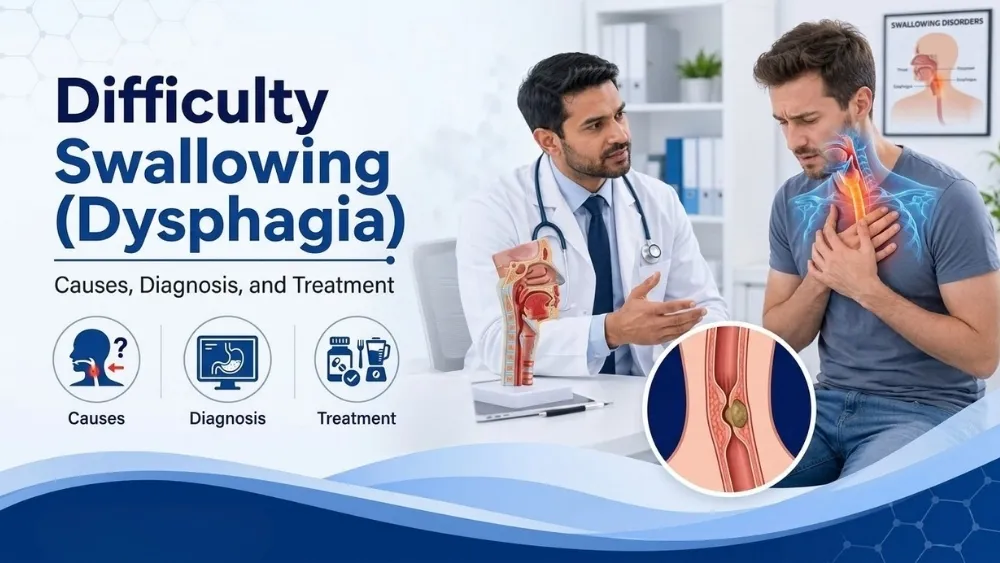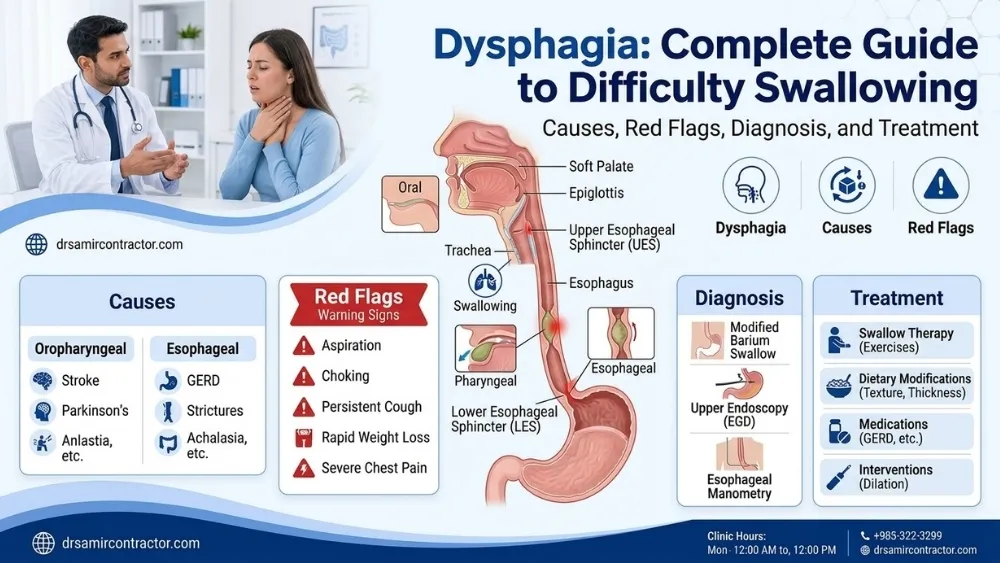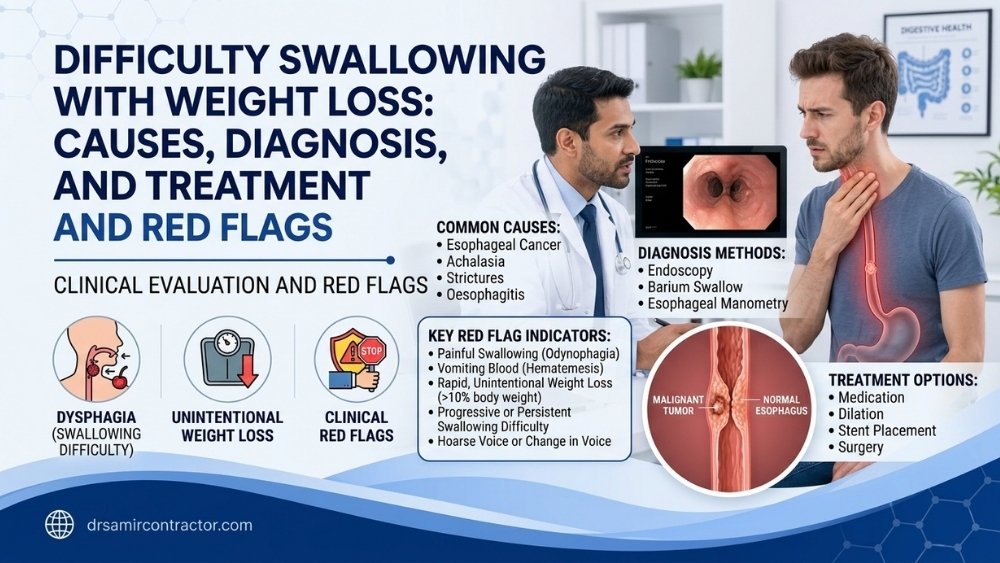
Difficulty swallowing (dysphagia) combined with unintended weight loss is one of the most serious symptom combinations in upper GI medicine. It requires urgent endoscopy - not a wait-and-see approach. The majority of cases have benign, treatable causes. But esophageal and gastric cancer must be excluded without delay, because early detection is the most important factor in outcome.
✦ Quick Answers
Important: This Symptom Combination Needs Urgent Evaluation
Progressive difficulty swallowing combined with weight loss is a medical red flag. This page does not encourage waiting - it encourages immediate action. If you or someone you know has both symptoms, book an urgent appointment for endoscopy today.
Difficulty swallowing alone - particularly if intermittent, in a younger patient, and associated with known reflux - can often be evaluated on a scheduled basis. But when it is accompanied by weight loss, the clinical picture changes significantly. Weight loss means the patient has been unable to eat adequately for a sustained period - which indicates that the dysphagia has been progressive and meaningful, not occasional.
This combination narrows the diagnostic possibilities and raises the probability of a structural cause. The earlier endoscopy is performed, the sooner a diagnosis is made - and the better the outcomes for every cause in this list, including cancer.
Why These Two Symptoms Together Change the Clinical Picture
Dysphagia alone can have many causes, most benign. Weight loss alone is non-specific. Together, they indicate a process that is:
- Mechanically significant - the obstruction or narrowing is severe enough to reduce food intake
- Progressive - it has been worsening long enough to affect body weight
- Not functional - functional conditions rarely cause measurable weight loss
Serious Causes - Must Exclude Urgently
- Esophageal cancer - progressive dysphagia starting with solids then liquids; weight loss from reduced intake; most important diagnosis to exclude
- Gastric cancer at GE junction - affects the esophagogastric junction, causing similar progressive dysphagia pattern
- Pharyngeal / oropharyngeal cancer - high dysphagia, neck mass, hoarseness
- Extrinsic mediastinal mass - enlarged lymph nodes compressing the food pipe
Treatable Causes Also Causing This Pattern
- GERD-related esophageal stricture - progressive dysphagia for solids from scar tissue narrowing; weight loss when advanced
- Achalasia - severe, long-standing cases with significant weight loss from inability to eat
- Post-radiotherapy stricture - progressive scarring after neck or chest radiotherapy
- Eosinophilic esophagitis with stricture - especially in younger patients
- Zenker's diverticulum (severe) - food trapping causing aspiration and weight loss
What Patients With This Cluster Experience
- Solid food sticks in the chest or throat from the start - progressing to softer foods over weeks
- Needing large amounts of water to wash food down - worsening over time
- Moving to softer and softer food as weeks pass - eventually only liquids pass
- Measurable weight loss over weeks - clothing becoming loose, people noticing the change
- Fatigue and weakness from inadequate nutrition
- Sometimes - pain on swallowing accompanying the sticking
- Regurgitation of food that never reached the stomach (achalasia) or sour acid regurgitation (GERD stricture)
This Is a Red-Flag Cluster
Urgent endoscopy is needed - do not delay - when:
- Dysphagia is progressive - worsening over days or weeks
- Weight loss accompanies difficulty swallowing - any amount
- The patient is above 45 years of age
- There is also pain on swallowing
- Associated hoarseness, neck lump, or anaemia
- Tobacco use (smoking or chewing) - major esophageal cancer risk factor
- Alcohol use combined with tobacco - multiplicative cancer risk
- Regurgitation of blood-tinged material
Tests - Urgency and Sequence
Upper GI Endoscopy - immediate priority
The first and most important investigation. In patients with this symptom cluster, it should be performed as soon as possible - ideally within days of presentation. The food pipe, stomach, and duodenum are examined directly. Any mass, stricture, or mucosal abnormality is biopsied. Results are available within days. An endoscopy that shows a benign stricture provides immediate treatment (dilation) and relief. One that shows a tumour initiates the staging workup without further delay.
CT scan of chest and abdomen
Performed immediately after endoscopy confirms cancer, for staging. Determines whether the tumour has spread to local lymph nodes, adjacent structures, or distant organs - essential for treatment planning.
PET-CT or endoscopic ultrasound (EUS)
Additional staging tools used in cancer cases to assess local invasion depth (EUS) and distant spread (PET-CT). Available at specialist centres.
Esophageal manometry
Performed when the endoscopy is normal or when achalasia is suspected as the cause of the weight-loss pattern.
Nutritional assessment
Albumin, pre-albumin, full blood count, and weight charting. Nutritional status directly affects treatment candidacy and surgical risk - assessed alongside investigations.
Treatment - Depends Entirely on the Cause
- Benign stricture (GERD-related): Endoscopic dilation - immediate relief. PPI therapy. Repeat dilation as needed. Fundoplication in refractory cases.
- Achalasia: Pneumatic dilation or laparoscopic Heller myotomy. Nutritional rehabilitation alongside treatment.
- Esophageal cancer (early stage): Esophagectomy with curative intent. May be combined with neoadjuvant chemotherapy/radiotherapy. Specialist multidisciplinary team management.
- Esophageal cancer (advanced or inoperable): Palliative esophageal stenting - restores swallowing ability quickly. Chemotherapy, radiotherapy, or combined modality for palliation and disease control.
- Nutritional support during treatment: For all patients with significant weight loss - oral nutritional supplements, nasogastric feeding, or PEG tube feeding may be needed during the investigation and treatment period.
The Cost of Delay
This is the symptom cluster where delay is most consequential. Esophageal cancer progresses from stage I to stage IV in months, not years. The difference between operable and inoperable disease - between curative and palliative treatment - can be a matter of weeks of delay. Every patient presenting with this combination should have an endoscopy performed on an urgent basis, not deferred because "it is probably acidity."
When the cause turns out to be benign - and most often it is - the patient gets relief from dilation on the same visit and reassurance immediately. When it is cancer, early detection is the most impactful intervention available.
Frequently Asked Questions
This Cluster in India
India-specific context
- Esophageal cancer - both squamous cell and adenocarcinoma - is among the more common GI cancers in India. It is frequently diagnosed late because the early dysphagia is mismanaged as acidity
- Tobacco chewing (gutkha, pan masala) is prevalent in Gujarat and is a direct risk factor for esophageal and oropharyngeal cancer - any tobacco user with this cluster must be investigated urgently
- Long-standing GERD untreated in India regularly progresses to stricture and sometimes Barrett's esophagus - benign but structurally significant causes of this cluster
- Patients commonly wait 3-6 months before seeking care for this combination, attributing progressive swallowing difficulty to "throat problem" or "old age" - by which time the stage has often advanced
Seek Urgent Care in Vadodara - Do Not Wait
If you or a family member has both difficulty swallowing and weight loss - book an urgent consultation with Dr Samir Contractor at Sterling Hospital, Vadodara. Upper GI endoscopy is available promptly and provides a definitive answer on the same visit.
Desi Patient Questions
Aa combination urgent endoscopy mate indicator chhe. Majority cases ma benign cause milshe - stricture ya achalasia. Pan cancer exclude karvun mandatory chhe. Doctor pase same week javo - delay dangerous chhe. Early diagnosis banne benign ane cancer both ma best outcomes aapé chhe.
Ha - tobacco users ne esophageal cancer nu higher risk hoy chhe. Banne symptoms sathe (dysphagia + weight loss) urgent endoscopy karo. Doctor ne clearly kaho: "khanu nathi utartu ane vajan ghatu thaay chhe" - aa combination urgent slot mate qualify kare chhe.
Endoscopy direct visualization aapé chhe - stricture, cancer, ya normal - same session ma. Jyaré stricture hoy to dilation pan same visit ma possible chhe. Jyaré biopsy levay to report 2-3 days ma aavé. Endoscopy most informative ane fastest route to answer chhe.